Zawiercie 2026-04-17
The City of Zawiercie
The city of Zawiercie is called the “Gateway to the Jura.” Numerous hiking trails to the central part of the Kraków-Częstochowa Upland begin here. It is a very green and diverse area, situated on the border of industrial regions and very attractive natural areas. Zawiercie is a peaceful city to live in, free from the hustle and bustle, and cheaper to live in than other cities in Poland.
Moreover, the Warta River has its source in the village of Kromołów, which is part of the town of Zawiercie. These are karst springs, typical of limestone terrain. The Warta River flows from a small spring area. The area is developed and marked as the headwaters of the Warta River. The Warta River is one of the most important and longest rivers in Poland, flowing into the Oder River. The river is 808 km long. The Czarna Przemsza River also has its source here, in the Bzów district. The rivers initially flow through a single valley, and then, separated by the Jurassic Cuesta, become tributaries of the Oder and Vistula, respectively. The town therefore lies in the basins of two major Polish rivers.
The town of Zawiercie is located in the Silesian Voivodeship, in the Kraków-Częstochowa Upland. The town belongs to Zawiercie County. The Old Market Square is located in the western part of the town. It is bounded by the railway line, national road no. 78, and Zachodnia, Cerefisko, and Podmiejska streets. Zawiercie is historically and geographically included in the broader Dąbrowa Basin and is often referred to as its northern border. The long period of these areas’ subordination to the Moscow Partition influenced the development of this part of the Polish-Lithuanian Commonwealth. Zawiercie’s current population is approximately 46,106 (as of 2023). The town’s area is 85.29 km². The town’s elevation is 300-400 m. Vehicle license plates are SZA.
Zawiercie is home to heavy industry plants: an ironworks and a cast iron foundry, and until recently, textile and glass factories. A glassworks producing crystal glass operated here. Near Zawiercie, there are deposits of zinc, lead, and silver ores, as well as certain amounts of uranium, which are not mined. Iron ore and lignite were also once mined.
The town received city rights on July 1, 1915. From 1975 to 1998, Zawiercie administratively belonged to the Katowice Voivodeship, and during the Second Polish Republic, it was part of the Kielce Voivodeship. Zawiercie lies in the former Kraków Land, part of the historical Lesser Poland region.
The settlement existed as early as the 15th century. It was mentioned in a Latin document, which noted that two forges were already operating there. In 1437, another document mentioned the settlement as Zawiercze. The etymology of the name Zawiercie comes from the prepositional phrase “za Wartą,” meaning a settlement located beyond the Warta River. The name “Warta” itself comes from the noun “wart,” meaning the swift current of the river. Interestingly, Zawiercie eventually absorbed into its borders and administration settlements that had been established earlier, as early as the 12th/13th century. Zawiercie arose through a process of urbanization, the expansion and merger of other towns into a single urban entity. The area was home to inns, craft workshops, forges, and bloomeries. Lignite and metal ores—zinc, lead, and iron—were mined. Sawmills were founded for these purposes. Trade routes existed. The area was a melting pot, where some communities emerged while others withered. Migrations were frequent. In individual settlements, the first administrators were village heads, who collected taxes on behalf of the owner. The oldest settlement was Kromołów, near the source of the Warta River, first mentioned in 1193. Due to the relatively large population in the 19th century, clothmaking and weaving developed. A significant element in the development of this area was the Roman Catholic religion, which was introduced from Kraków.
In 1795, after the Third Partition of Poland, the area of present-day Zawiercie became part of the Germanic province of New Silesia. Due to the Napoleonic Wars, following the victorious Greater Poland Uprising (1806), the town became part of the Duchy of Warsaw from 1807 to 1815. In 1815, after the Congress of Vienna, Zawiercie became part of the Kingdom of Poland, which was within the borders of the Muscovite state.
The development of Zawiercie was influenced by the Warsaw-Vienna Railway running through the town and an extensive network of paved roads. On December 1, 1847, the first train passed through Zawiercie. Initially, the line was single-track. Double-track rail service from Koluszki to Ząbkowice began in 1881. A second-class station and railway station were opened in 1890. In April 1914, the current railway station was opened.
Around 1870, the first factory was founded in the town: the Reich and Company Glass Factory. At the same time, a cotton mill was expanded into a large factory by Germanic Berlin Jews. In 1875, an artificial wool factory was founded. It is characteristic that many plants and factories were located near the Warsaw-Vienna Railway, and railway sidings were built for factories located far from the railway lines. By the end of the 19th century, approximately 15 mines, steelworks, factories, and industrial plants had been established. In 1878, construction of the first workers’ housing estate began. Schools, chapels, and churches were built. In 1894, the first workers’ strike took place at a textile factory, ending with the dismissal of several hundred workers.
During the Great War, unemployment rose in Zawiercie. The population suffered from food shortages, which forced them to flee to the Austrian Partition, where food was much cheaper. After 1918, Zawiercie found itself within the borders of the reborn Polish-Lithuanian Commonwealth and found itself in the Kielce Voivodeship. The economic situation of the residents was dire. Many businesses went bankrupt, and Zawiercie was called a city of the unemployed. Three-quarters of the population relied on social assistance. This was the main reason for the development of communist ideas. In 1928, in the local elections, 25% of the population voted for the communists. On April 18, 1930, “Bloody Friday” occurred. The unemployed were awaiting payment of benefits. The unemployed went to the city hall, and after their benefits were refused, the unemployed captured the city hall. The police were deployed, and street fighting broke out, involving 3,500 people. Three people died and dozens were injured. Only in 1936 did the situation begin to improve. New factories opened and old ones employed new workers.
On September 1, 1939, the Germans began World War II, along with their Muscovite brethren. Zawiercie was incorporated into the German province of Silesia, Opole district. A Polish resistance movement operated in Zawiercie. On January 20, 1945, the Soviets entered the city with the 125th Infantry Division of the 21st Army of the 1st Ukrainian Front.
The period after World War II was a period of development for the city. In April and May 1945, the “Poręba” and “Ferrum” factories resumed production, and in June 1945, the Glassworks opened, followed by the “Zawiercie” glassworks in February 1945. However, the city’s food supply was very poor. Workers were not paid their wages on time. The period from 1945 to 1947 was a time of protests and strikes. The situation improved only in 1948, when those interested were given plots of land to lease for vegetable gardens. Reconstruction of the city after the war’s devastation continued until 1960. Many residential buildings were renovated and new housing estates were built. In 1948, Zawiercie became an urban district. In the 1960s, four bridges were built across the Warta River. The city boasted nine primary schools, ten vocational schools, two general secondary schools, a swimming pool, three hospitals, and a dozen health clinics. New workplaces were established.
In 1989, Poland underwent a political transformation. In reality, former communists became businessmen, and society was once again robbed. After the closure of many factories, a significant percentage of workers lost their jobs. As a result, the government in Poland remains in power with post-communist, Volksdeutsche, and Freemasons. In the 1990s, the difficult problems of finding work and housing became more acute. Municipal and industrial construction ceased. Since 1999, the city has been the capital of the Zawiercie district. Only in the 21st century did it become a valuable historical monument in Zawiercie is the Basilica of Saints Peter and Paul, dating from 1896. The former bathhouse in the historic TAZ workers’ housing estate is also a historical monument. The TAZ workers’ housing estate dates back to the turn of the 20th century. The Church of the Holy Trinity and Saint Florian. The Church of Saint Nicholas. The railway station. Primary School No. 2 named after Stanisław Szymański.
Railway in Zawiercie.
Address: ul. Grunwaldzka 2, 42-400 Zawiercie. Geographic coordinates: 50.480N 19.423E. Elevation: 330 m.
The Warsaw-Vienna Railway influenced the city’s development. On December 1, 1847, a train passed through Zawiercie for the first time. However, the station was not built until 1890. As early as 1870, the first sidings to industrial plants were built. The Germans called the stations Warthenau. Initially, the line was single-track. Double-track rail service from Koluszki to Ząbkowice began in 1881. The station and second-class railway station were opened in 1890. In April 1914, the current railway station was opened.
Railway lines: LK No. 1 Warsaw Central Railway – Częstochowa – Katowice. Railway line No. 4 Grodzisk Mazowiecki – Zawiercie, Central Railway Line. Railway line No. 160 Zawiercie – Dąbrowa Górnicza Ząbkowice. Railway line No. 182 Tarnowskie Góry – Katowice Pyrzowice Airport – Zawiercie. Railway line No. 186 Zawiercie – Dąbrowa Górnicza Ząbkowice.
There are three railway stations in the town of Zawiercie: Zawiercie serves local and long-distance trains, including international trains to Budapest, Bratislava, Prague, and Vienna. Zawiercie Borowe Pole serves only local trains on the Częstochowa – Gliwice route. Zawiercie Kądzielów is on railway line No. 182.
According to the Polish State Railways (PKP) classification, Zawiercie station is classified as a regional station. All trains operated by PKP IC stop at the station: Express InterCity Premium, Express InterCity, Intercity, TLK, and all trains operated by Koleje Śląskie. In 2017, the station served 1,350,500 passengers. In 2024, the station served 1,790,000 passengers.
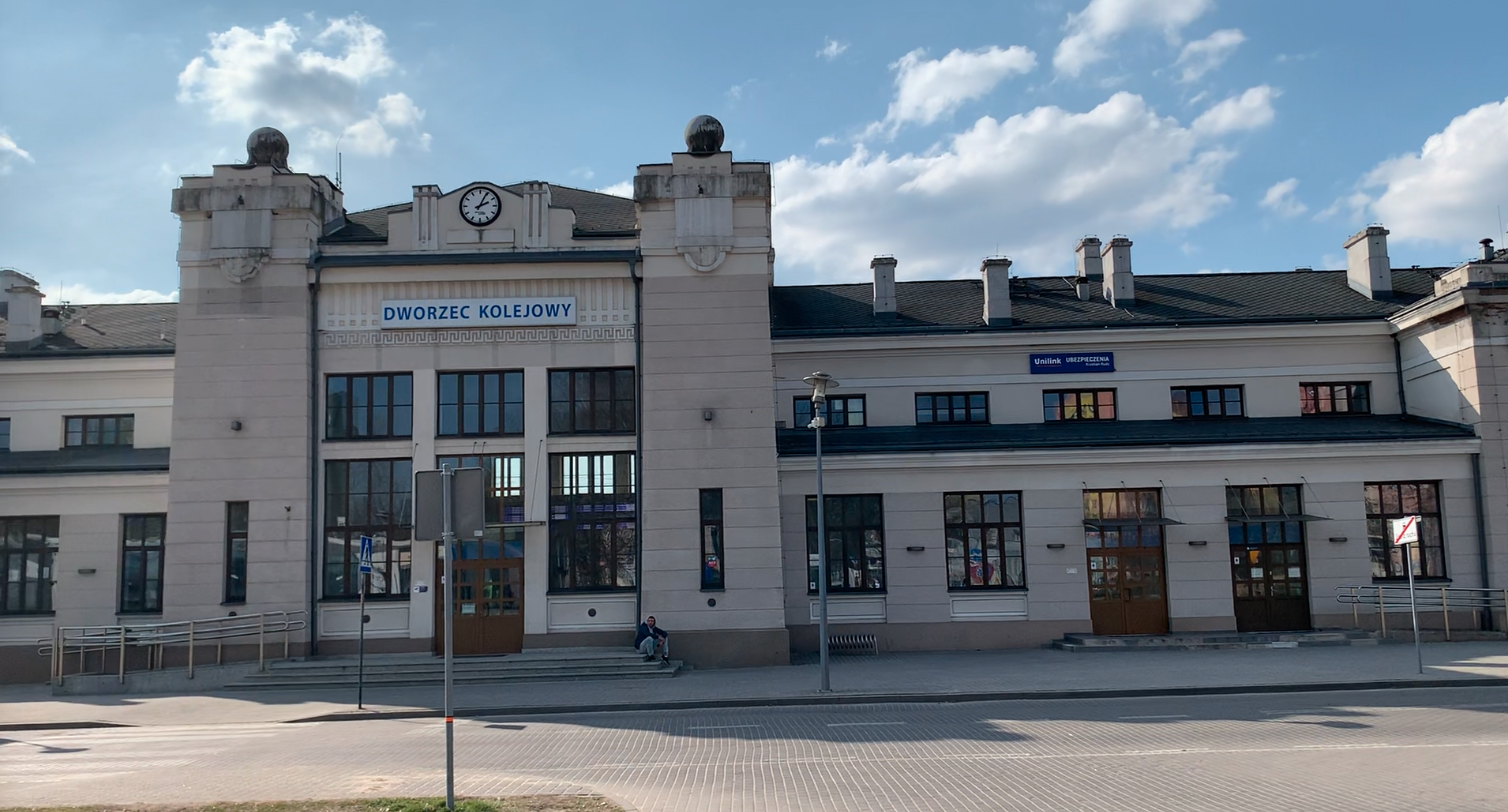
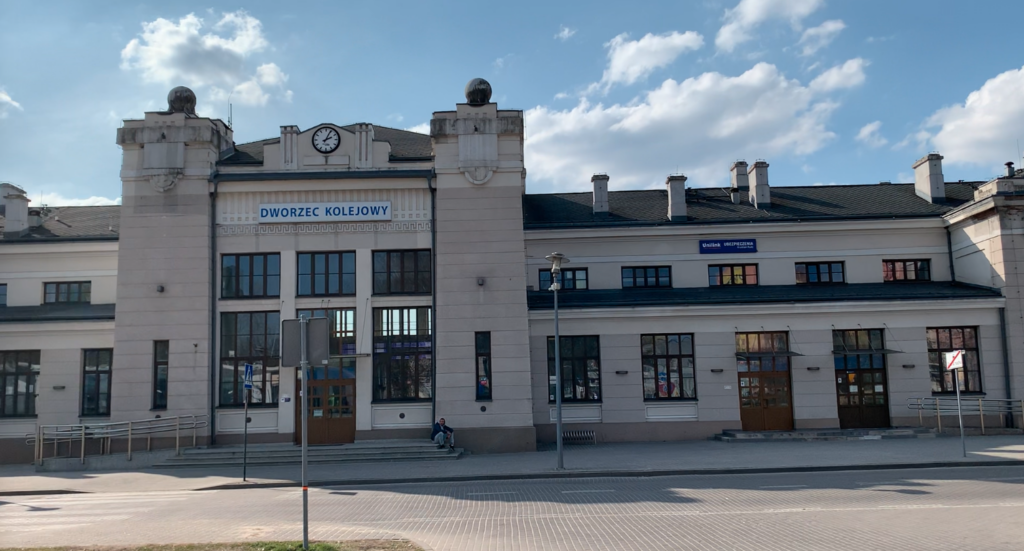
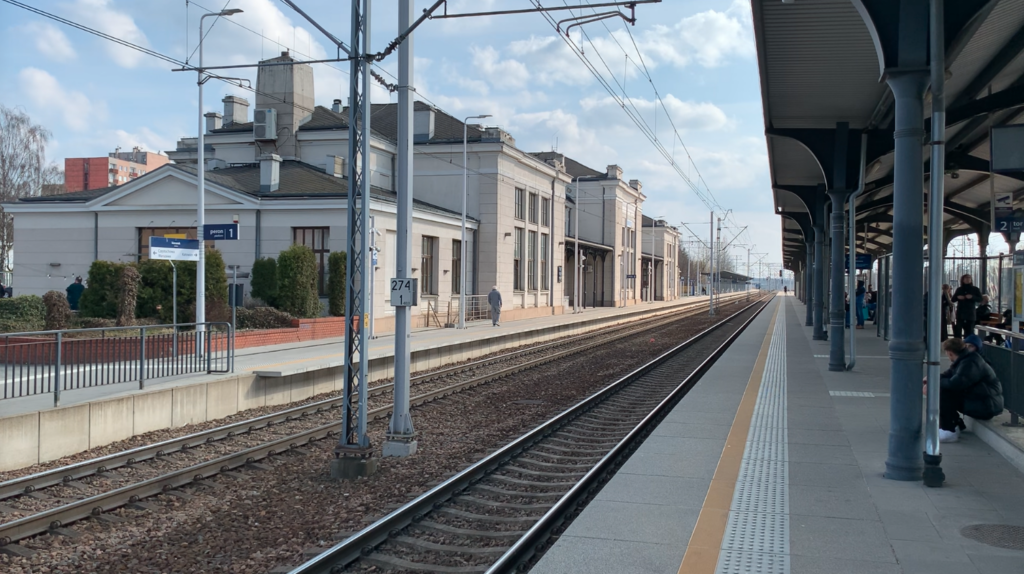
The station. The first station building was built in 1872. It was wooden and quickly proved too small. In 1890, a new station building was constructed, this time in brick. Between 1910 and 1913, to celebrate the 300th anniversary of the Romanov dynasty (the Moscow mafia), a decision was made to build a new station. The building opened in the spring of 1914. It was designed by engineer Czesław Domaniewski, chief architect of the Warsaw-Vienna and Warsaw-Kalisz Railways. Since 1933, the station premises have housed, among other things, the “Baj-Baju” theater and a community center for children and youth. The building proved to be structurally sound enough to withstand even the explosion of ammunition wagons on June 2, 1945. The building was rebuilt in the 1970s and 1980s. The building has been renovated and modernized several times. The last renovation was carried out in 2012.
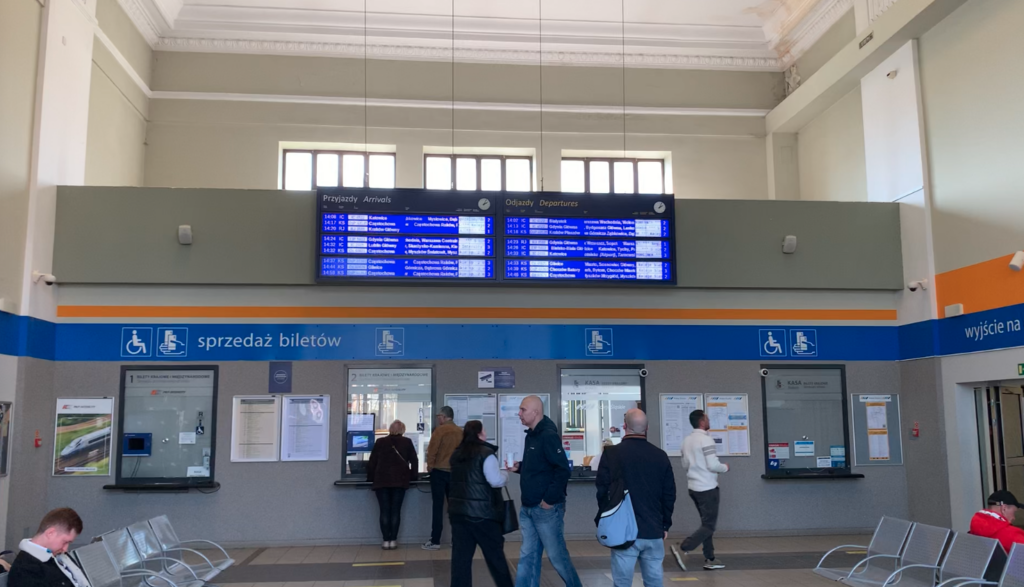
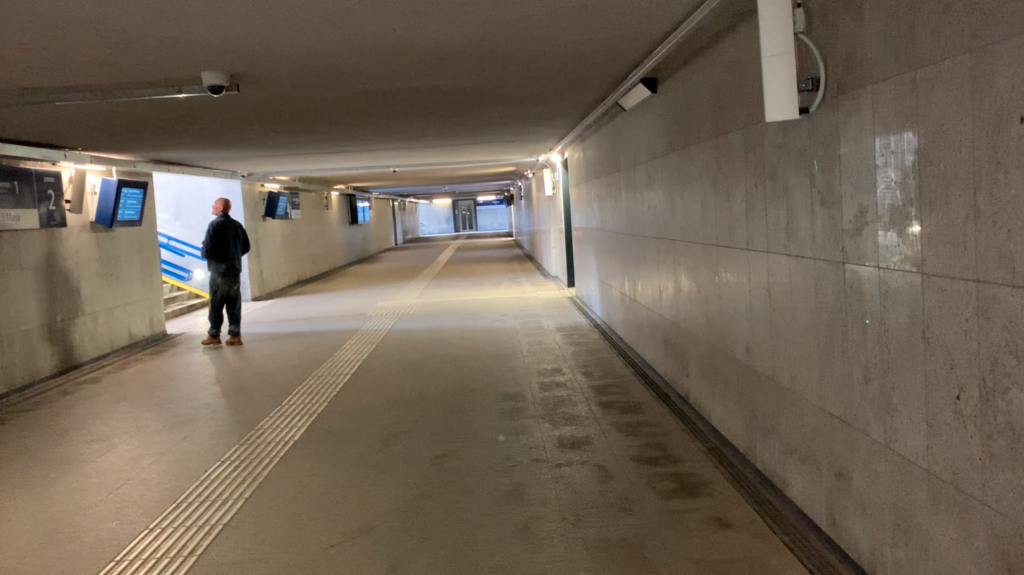
The railway station building at Zawiercie station is an example of classic railway architecture from the turn of the 19th and 20th centuries, later modernized but retaining its historic character. The structure resembles a palace. The station has an elongated, rectangular shape, set parallel to the tracks. It is a brick building, plastered, and usually painted in light colors. The style is typical of the Warsaw-Vienna railway. The roof is gabled, relatively high, and covered with a material imitating roof tiles. Architectural details include a symmetrical facade composition. The central projection is prominently projecting, with corner towers and numerous ornaments. At the top are the words “Railway Station” and a large clock with a white face. The main entrance features a wide approach with three steps. The building features large rectangular windows, which are decorated with simple ornamentation around them, without much ostentation. The interior features a main hall (waiting room), ticket offices, and access to the platforms via a tunnel or ground level. The interior has been adapted to modern standards, and access for people with disabilities has been improved. Despite this, the historic layout and overall appearance of the structure have been preserved. The building is approximately 90 meters long, 15 meters wide, and 11 meters high. In front of the building is the station square, bus stops, and parking.
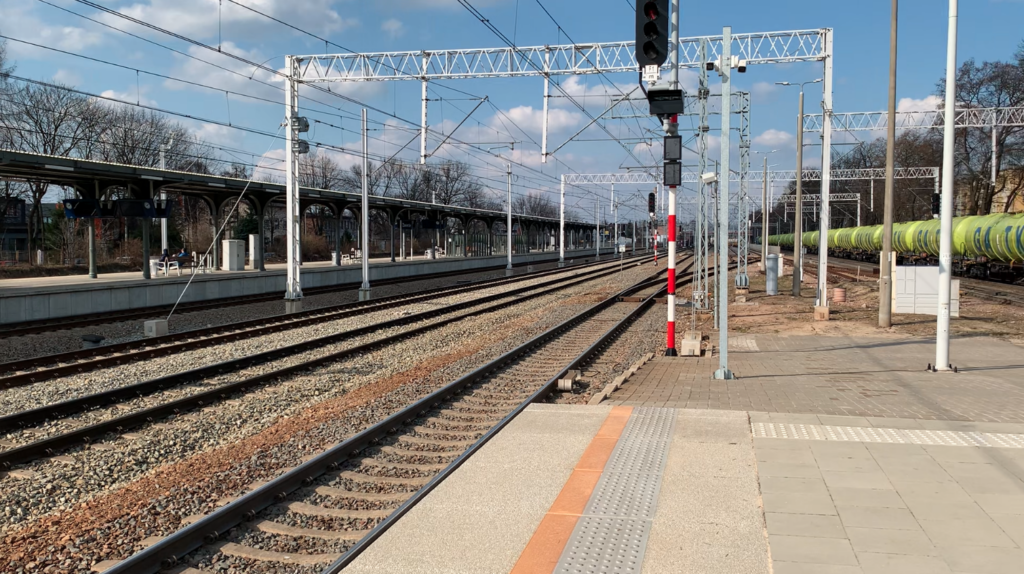
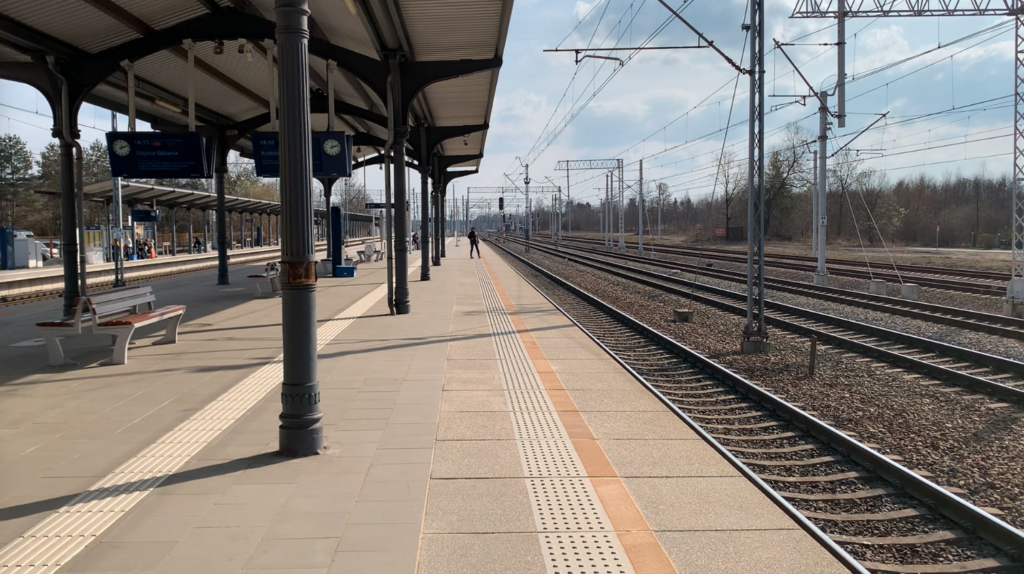
The typical platforms were built in 1911, at the same time as the passenger tunnel. At the same time, a viaduct was built under the tracks to connect the streets. Currently (2026), the station has three platforms. Platform 1 is located on the station side. The platform is 300 m long and has a 137 m long canopy. Platform 2 is an island platform and is 262 m long, with a historic canopy measuring 166 m long. Platform 3 is also an island platform and has a 180 m long canopy. All platforms have burgundy precast edge slabs. The rest of the surface is made of concrete blocks.
In 2009, the reconstruction of the station’s switch heads was completed. This allowed trains to pass through the station at speeds of up to 100 km/h, instead of the previous limit of 40 km/h. In 2012, the platforms were rebuilt. In October 2020, railway line No. 182 Tarnowskie Góry – Zawiercie was renovated. The renovation was due to the launch of passenger services to the airport. At Zawiercie station, Platform 4 was removed for this purpose and a new, island-type Platform 3 was built. Trains running on the Katowice – Zawiercie – Airport route change their front lines at Zawiercie station.
On April 16, 2026, 170 passenger trains departed from Zawiercie station. You could go to the following stations: Białystok, Bielsko-Biała Główna, Bohumin, Bydgoszcz Główna, Chorzów Batory, Częstochowa, Dąbrowa Górnicza, Gdynia Główna, Gliwice, Katowice, Kielce Główny, Kraków Główny, Kraków Płaszów, Lublin Główny, Łazy, Olsztyn Główny, Płock, Poznań Główny, Prague hl.n., Prague-Zahradní Město, Przemyśl Główny, Racibórz, Sławno, Szczecin Główny, Świnoujście, Tarnowskie Góry, Warsaw East, Zakopane, Zebrzydowice, Żywiec.
Written by Karol Placha Hetman