Sandomierz 2026-07-02
City of Sandomierz
Sandomierz is a city in Poland, in the Świętokrzyskie Voivodeship, in Sandomierz County. The city has both city and commune rights. The city area is 28.69 square kilometers. In 2022, the city’s population was 21,586. Vehicle license plates are TSA.
The city lies on the Vistula River, with its historical center located on the left bank, on loess hills. On the right bank of the Vistula, there was a village called Nadbrzezie, which is now the industrial part of Sandomierz. Sandomierz is located in the Vistula Lowland and stretches from the Sandomierz Upland to the Tarnobrzeg Plain. Sandomierz’s seven hills are rather arbitrary, a term used for tourist attractions. In reality, the terrain is more complex. Geologists describe Sandomierz as a complex of loess plateaus and isolated ridges, dissected by numerous ravines. The number “seven” is therefore primarily historical and symbolic, similar to the Eternal City of Rome.
Sandomierz received its charter in 1286, granted by Leszek the Black. The original document is located in the Diocesan Museum. There is also information that the charter was granted before 1227, but it was never implemented. Historically, Sandomierz is located in Lesser Poland and was the main city of the former Sandomierz Land, later the Sandomierz Voivodeship. Sandomierz was and remains a royal city. The city began to expand in the area where the Jan Długosz House is now located. In 1286, the city received the right to hold a warehouse. A tax office and a land court operated in the city. The city found itself on a trade route from Ruthenia to the west, with a crossing point across the Vistula River. Therefore, Sandomierz quickly gained importance. Sandomierz was considered, along with Kraków and Wrocław, a major center of culture and trade in the Kingdom of Poland. In 1241, the city was destroyed by the Tatars. A new charter was granted in 1286 by Duke Leszek the Black. Sandomierz had the right to hold warehouses, fairs, and tolls and ferry crossings. Both land and municipal courts operated, but the most important matters were decided by the prince. From the 15th century, Sandomierz, like Kazimierz nad Wisłą, was connected to the grain and timber trade via the Vistula River. Polish kings and princes frequently resided in Sandomierz. Congresses of the Polish nobility also took place here, and in this respect, Sandomierz surpassed Piotrków and Sieradz. The cities of Sandomierz and Pińczów became centers of reform movements, which caused uproar among the public. In 1570, a congress of various reform movements was held, and the so-called Sandomierz Concord was signed. This was an agreement against the Counter-Reformation. Fortunately, the Counter-Reformation gained the support of the majority of the population and the nobility, following the events in Western Europe. The Swedish Deluge led to the city’s slow decline. In 1613, the Jesuit College was opened in Sandomierz.
During the partition period, Sandomierz became a border town between the Kingdom of Poland, completely dependent on the Muscovites, and Galicia, completely dependent on the Austrian Empire. Sandomierz lost its administrative, educational, and economic importance. Stagnation ensued. The Great War left significant devastation. After Poland regained independence in 1935, the city was designated the capital of the Central Industrial Region (COP). The city’s population reached 100,000. Development was halted by the German invasion of Poland in 1939. In 1942, the Germans established a Jewish ghetto in Sandomierz, as in almost every Polish city incorporated into the General Government. By September 1942, the ghetto held approximately 5,200 people. In October 1942, the ghetto was liquidated, and the Jews were murdered either locally or at the Bełżec concentration camp. Soviet troops entered Sandomierz on August 18, 1944. Sandomierz suffered no war damage. The Muscovites had a public security office and a Kielce national council there. In 1990, Sandomierz was at the forefront of cities removing communist elements from public life, particularly Muscovite monuments, which were moved to the cemetery.
The city houses the Diocesan Museum in the Jan Długosz House and the District Museum in Sandomierz Castle. Roman Catholicism is the dominant religion among Sandomierz’s residents. Sandomierz is the seat of the Diocese of Sandomierz. There are seven churches and six parishes. The most impressive is the Cathedral Basilica of the Nativity of the Blessed Virgin Mary, which dates back to the 14th century.
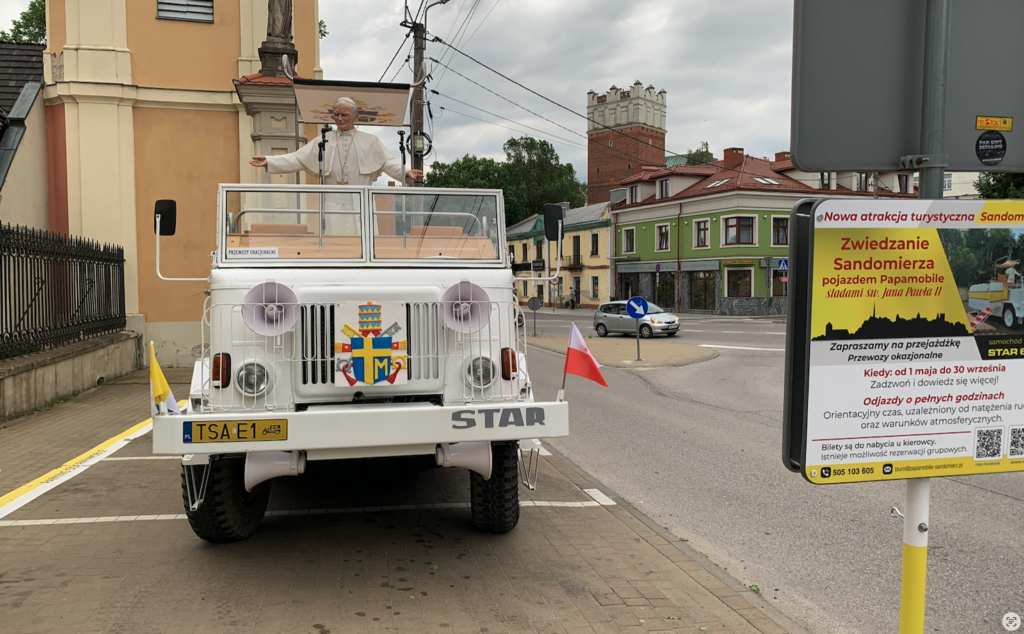
In 2026, a new tourist attraction was added. It is the STAR 660, the Popemobile, which transported Pope John Paul II during his pilgrimage to Poland in 1979. The car was rebuilt from the original vehicle and features a figure of Pope John Paul II. The car rides take place around Sandomierz, along the so-called Papal Trail.
Tourist attractions include a 450-meter-long underground tourist route. It was one of the first of its kind in Poland. The cellars along which the route leads are located 4-12 meters below the level of the city streets. Another attraction in Sandomierz is jewelry made from striped flint, a stone quarried in the Sandomierz area. Sandomierz is undoubtedly home to a wealth of historic buildings, including the Opatowska Gate, the Town Hall, and many others. 93 buildings are listed in the register of historical monuments. Guidebooks list over 120 architectural monuments.
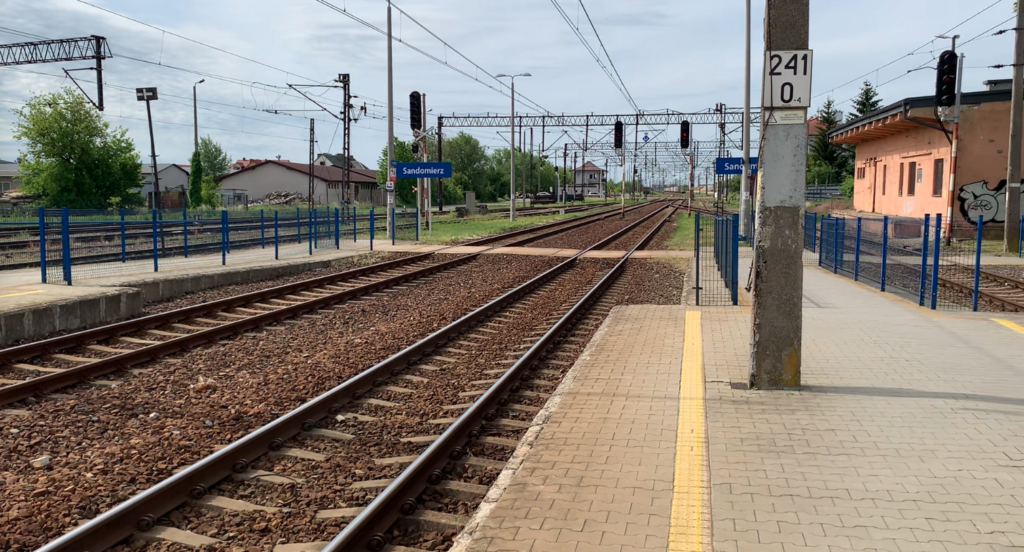
Sandomierz Railway Station.
Address: 35 Lwowska Street, 27-600 Sandomierz. Geographic coordinates: 50.660 N 21.765 E. Elevation: 145 m. The station opened on January 25, 1887, or October 30, 1887.
Sandomierz is a railway junction. Within the wider region, tracks from Skarżysko Kamienna, Stalowa Wola, Rozwadów, Tarnobrzeg, Kielce, Lublin, Zamość, Przeworsk, and Dębica stations converge here. However, this region of Poland is disorganized in terms of railways. Poland inherited the network from the partitioning powers and several investments made during the Second Polish Republic. Furthermore, Sandomierz railway station is located on the right bank of the Vistula River, in the Zarzekowice district, formerly the village of Nadbrzezie. Nadbrzezie was the original name of the railway station. The distance from the railway station to the market square in Sandomierz is as much as 3,500 m.
The railway station in Sandomierz has a history spanning over 139 years. It opened on January 25, 1887, with the opening of the railway line from Dębica to Nadbrzezie, which belonged to the Charles Ludwik Galician Railway. The station’s initial name was Nadbrzezie. It was located in this area because there were no possibilities or financial resources to extend the tracks to Sandomierz itself. Initially, the station was a terminus. In 1924, the station’s name was changed to Sandomierz when Nadbrzezie was incorporated into the city. After Poland regained independence, the station became important for connections to Kraków, Tarnów, Dębica, Rzeszów, and Lviv. The railway handled passenger traffic, transported agricultural produce, and transported timber and construction materials. The Polish Army also used the station as the Nowa Dęba military training ground was being developed. In August 1939, mobilization transports of Sandomierz garrison units were conducted from here. During World War II, the Germans used the railway line through Sandomierz extensively. Military and supply transports passed through Sandomierz, transporting Polish people to concentration camps near Auschwitz. In October 1942, the Germans transported approximately 4,500 Jews (Polish citizens) by train from Sandomierz to the execution site in Bełżec. In August 1944, the station was important for the Muscovites during the fighting for the Sandomierz bridgehead. The neighboring Tarnobrzeg station was also important, where wooden bridges were built across the Vistula River: a pedestrian bridge, a bridge for heavy military equipment, and a narrow-gauge railway. The railway bridge in Sandomierz operated until August 1944, when retreating Germans destroyed the crossing. Rail traffic resumed in 1948. After World War II, Sandomierz station served numerous passenger, express, and freight trains. Industrial sidings played a significant role, particularly to the glassworks, now Pilkington.
Electrification. Regarding the railway station in Sandomierz, on Line No. 25, two stages of electrification can be distinguished: The Skarżysko Kamienna – Sandomierz section was electrified in 1987. The Sandomierz – Tarnobrzeg – Chmielów section was electrified earlier, in 1980. This means that Sandomierz station was connected to the overhead lines in 1980, when the electrification of the section from Sandomierz through Tarnobrzeg to Chmielów was completed.
After the socio-economic changes in 1989, there was a significant decline in rail transport. In 2002, the last ticket office was closed. In October 2004, the station’s waiting room was closed, and on December 11, 2006, regular passenger traffic was suspended, leaving only freight traffic. In May and June 2010, a major flood inundated Sandomierz station and the surrounding railway lines. The tracks and equipment were damaged. However, repairs began later that year. On December 11, 2011, passenger trains returned to Sandomierz. These included TLK trains to Warsaw and Przemyśl. In the following years, regional services were expanded and the railway infrastructure was modernized.
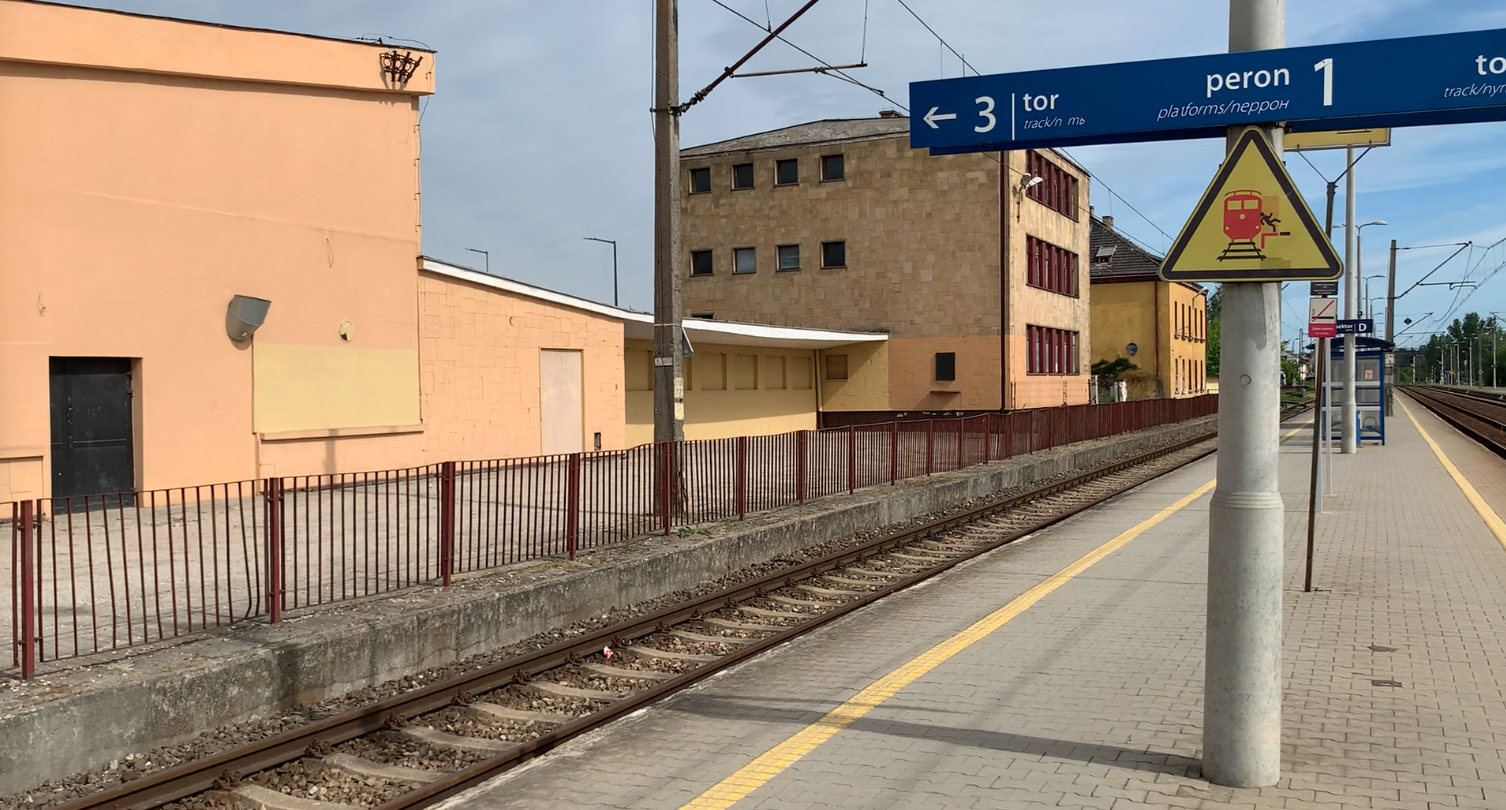
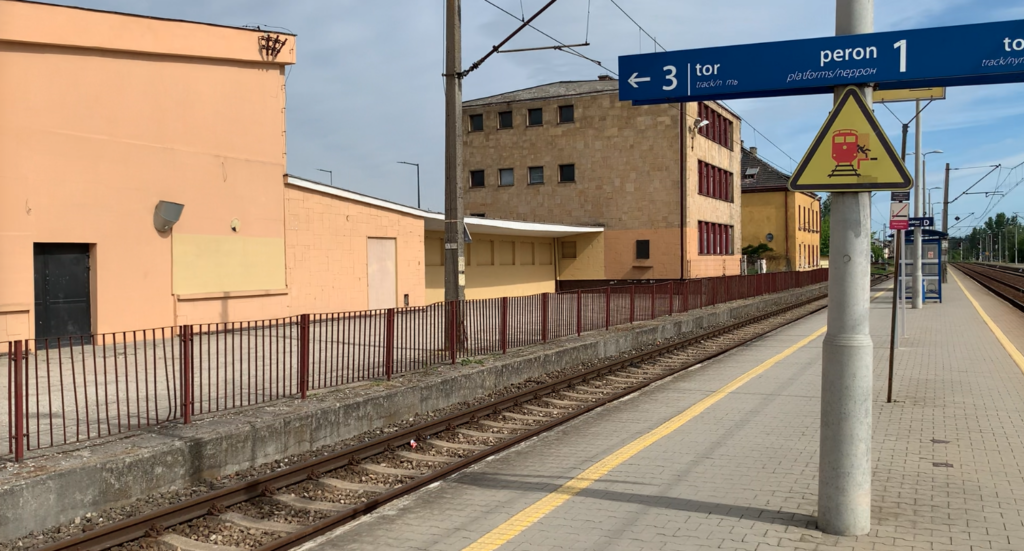
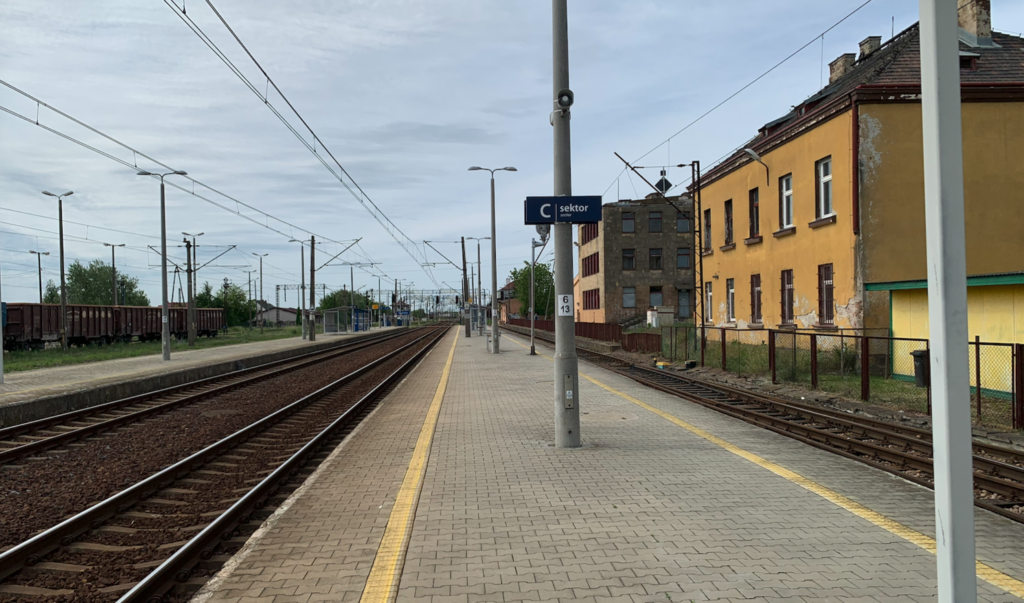
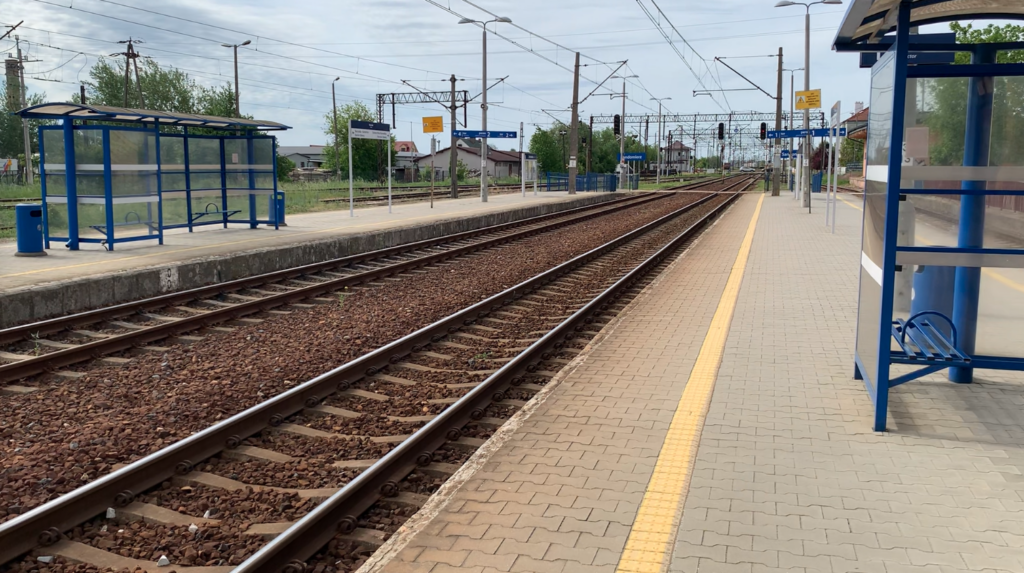
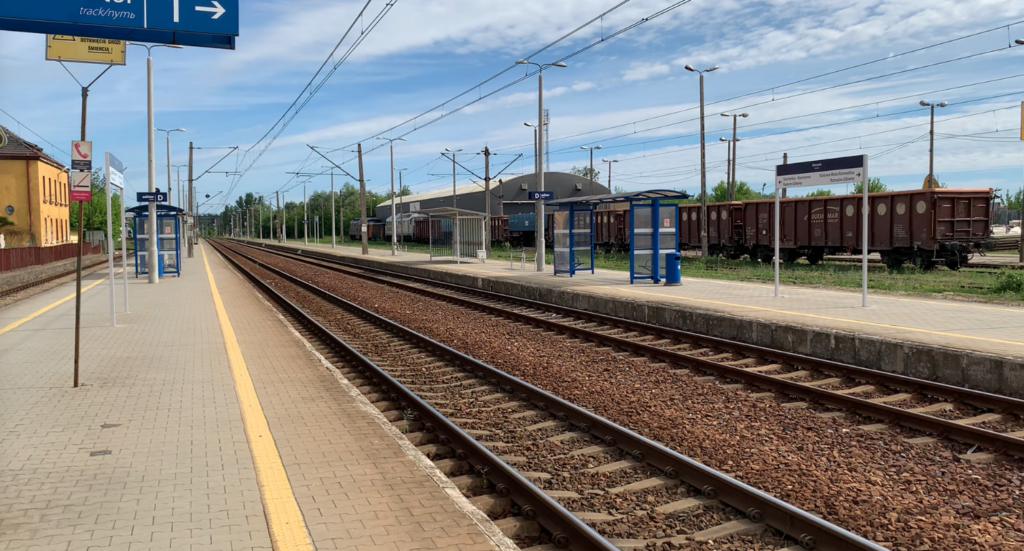
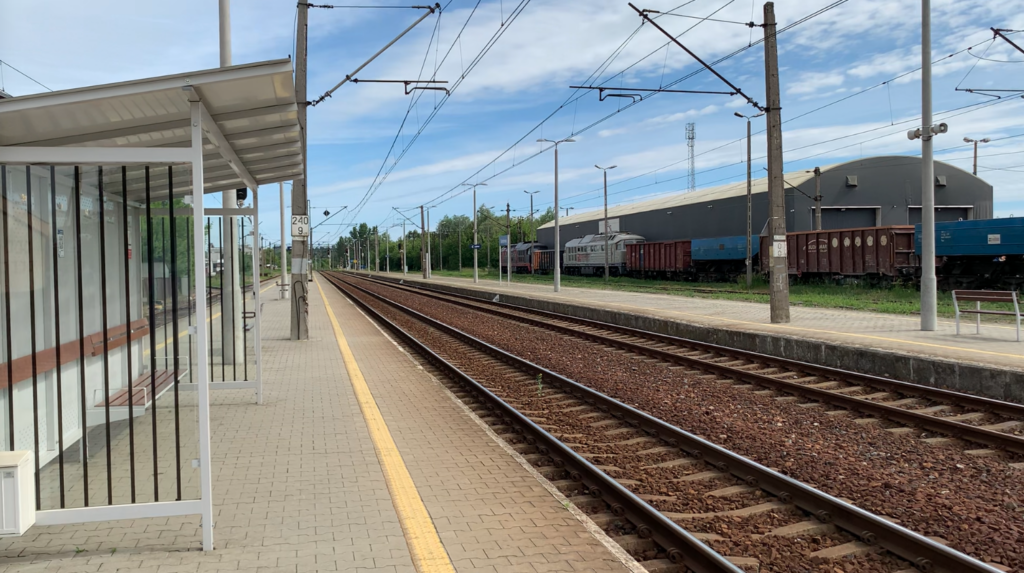
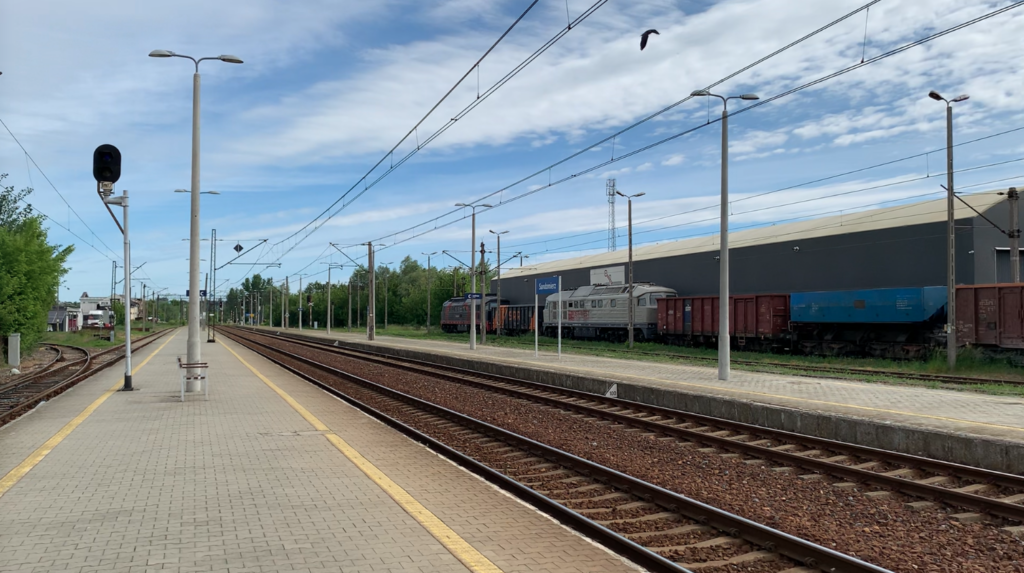
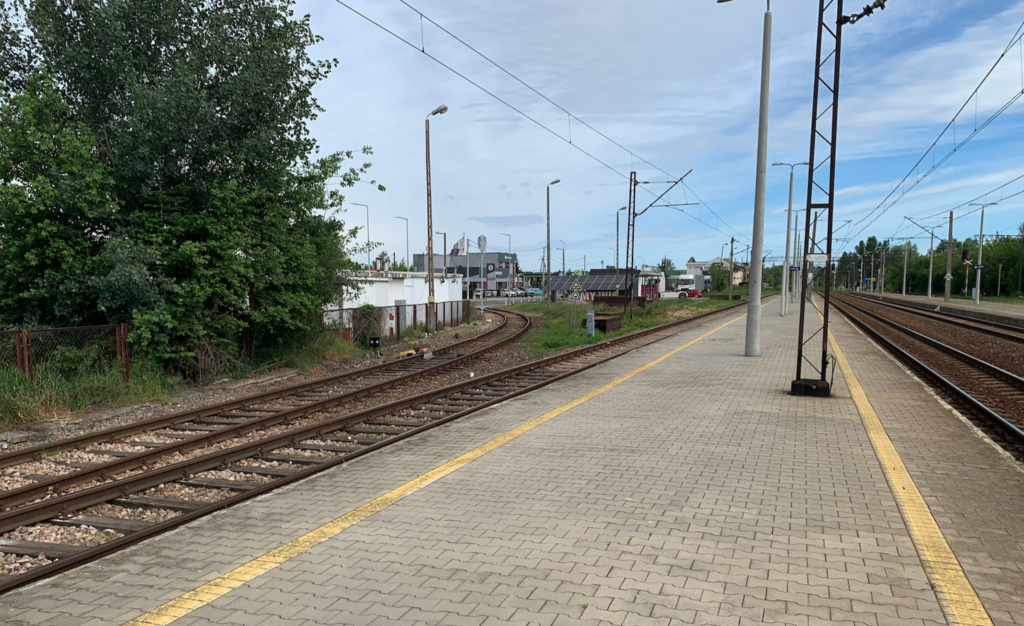
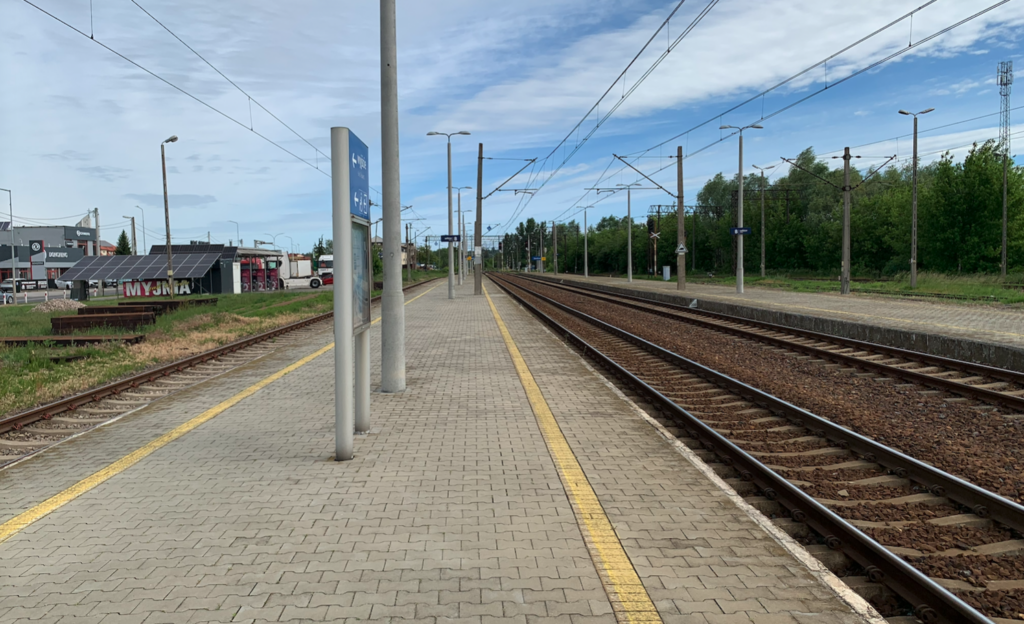
Sandomierz railway station is located on Line No. 25 and is the starting point for Line No. 78 to Grębów. Railway sidings are also in operation. The station has a passenger section and an expanded freight section. The station features two island platforms and four platform edges. Around 2010, the platforms were renovated, resurfaced with concrete paving stones. Yellow warning lines with buttons were installed. The platform edges remain low, concrete, and painted white. New lighting, benches, trash cans, and two bus shelters were installed on each platform. There are two types of shelters. Access to the platforms is at track level, from the south.
On December 11, 2011, passenger trains were restored through Sandomierz. A TLK train was operating on the Przemyśl Główny – Warszawa Wschodnia route. In December 2012, direct trains were launched on the Przemyśl Główny – Gdynia Główna route. From August to November 2013, modernization work was carried out at Sandomierz station and the Sobów – Sandomierz – Zalesie Gorzyckie railway line, consisting of replacing the tracks, overhead lines, platforms, and railway traffic control equipment. In 2016, trains connecting the city with Warszawa Zachodnia and Przemyśl ran through Sandomierz.
Currently, passenger traffic at the station does not exceed 100 passengers per day. On Wednesday, July 1, 2026, 13 passenger trains departed from the station. Connections were available to the following stations: Kielce Główne, Przemyśl Główny, Rzeszów Główny, Skarżysko Kamienna, Stalowa Wola Południe, and Warszawa Wschodnia. InterCity San Warszawa Wschodnia – Przemyśl Główny trains and InterCity Witos Warszawa Wschodnia – Przemyśl Główny trains arrived through Sandomierz station. Some trains were operated by coaches on the Sandomierz – Rzeszów Główny section. At the time, PKP PLK was conducting track work on the Sandomierz – Tarnobrzeg, Tarnobrzeg – Nowa Dęba, Nowa Dęba – Kolbuszowa, and Kolbuszowa – Rzeszów Główny sections.
In 2023, a new locomotive shed was built in the eastern part of the station. It houses two crossing tracks. This area also housed a water tower, which was demolished around 2023. A commemorative plaque at the station reads: “In tribute to the murdered and fallen railway workers of Sandomierz station in the fight against Nazi fascism in the years 1939-1945. Year 1970, Society and railway workers of Sandomierz.”
The railway station building.
The first station building was built in 1887 and closely resembled the apartment block that still stands at the station today. The difference was that the block had five axes, while the station had six axes.
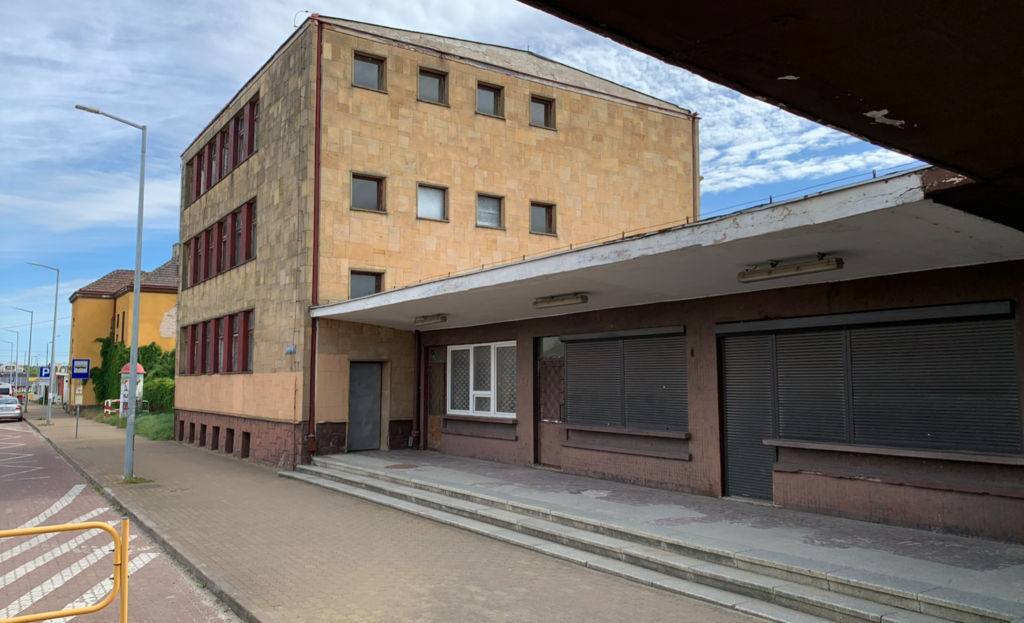
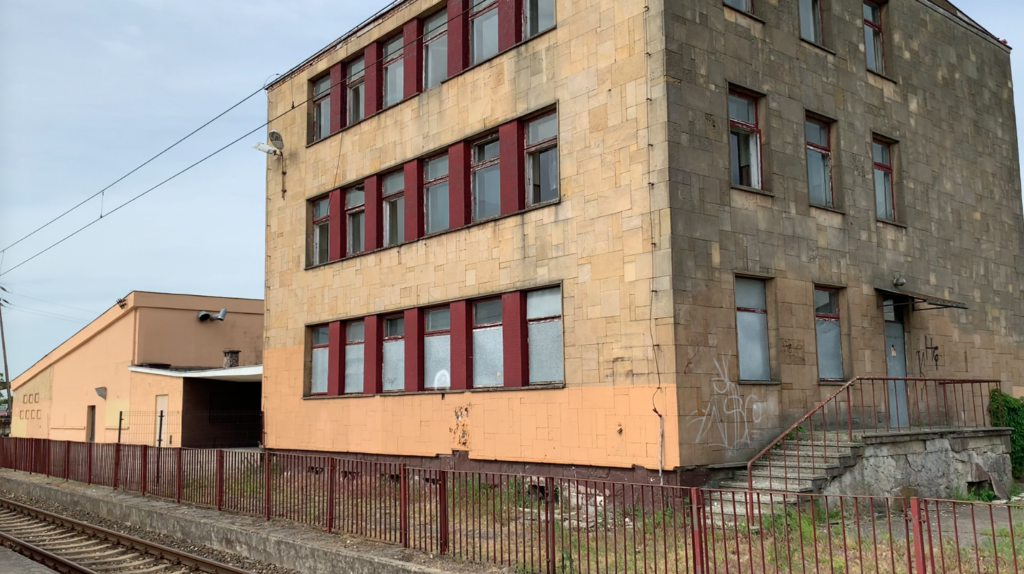
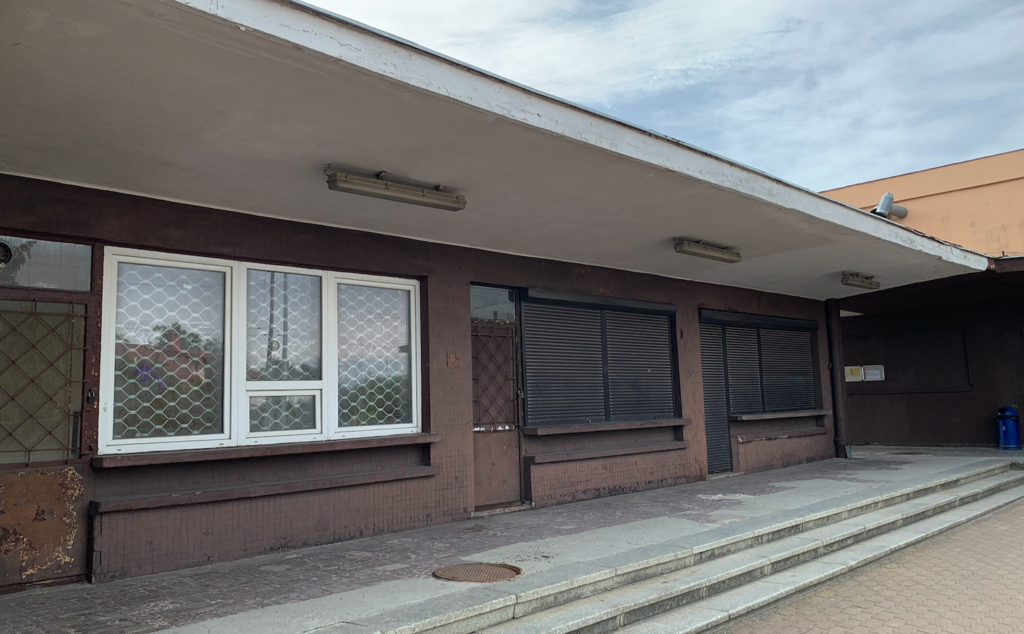
After World War II, a station complex was constructed, unassuming but very practical. The building consists of three elements. On the north side is a three-story office building. In the center is a shopping pavilion with three individual shops. On the south side is the station hall with a waiting room and ticket offices. The building’s facade is made of sandstone, which was painted years later. The building once housed three ticket offices. One of the ticket offices was converted into a railway information point. There was a buffet, a RUCH kiosk, and a flower shop. At one time, the commercial spaces were offered for sale or lease. The station underwent its last minor renovation (painting) in 2005. Broken windows were replaced with sheet metal. Currently (2026), the building is closed to passengers. National Road No. 77 runs in front of the station, and there is a small station square.
Railway bridge in Sandomierz.
Initially, it was a temporary wooden bridge supported by piles driven into the riverbed. Construction of the permanent bridge began in September 1925 and was opened to traffic on February 8, 1928. The bridge was designed by engineer Andrzej Pszenicki, and the supports were designed by engineer Stanisław Kabaczyński. The railway bridge is 476.3 meters long and 5.8 meters wide. It is an 8-span structure. The six main spans are parabolic truss-type, with the carriageway located at the bottom. The bridge is designed for a single track. Plans were underway to build a second bridge for the second track. In 1944, the bridge was destroyed by retreating German troops. In 1945, the supports were rebuilt, and in 1948, the damaged steel structure elements were rebuilt.
Railway Line No. 25 Łódź Kaliska – Dębica.
The Łódź Kaliska – Dębica Railway Line No. 25 is 323.528 km long. It runs through three voivodeships: Łódź, Świętokrzyskie, and Podkarpackie. Its direction is approximately northwest to southeast. The line is electrified with 3 kV DC on the following sections: Łódź Kaliska – Tomaszów Mazowiecki and Skarżysko-Kamienna – Chmielów near Tarnobrzeg. Electrification of the Tomaszów Mazowiecki – Opoczno section is planned. Train speeds are up to 120 km/h. The line is single-track and double-track.
Railway Line No. 78 Sandomierz – Grębów.
Railway Line No. 78 Sandomierz – Grębów is 9.397 km long. The maximum train speed is 60 km/h. The line was built in 1931. It was electrified on May 31, 1989. This line allowed trains to run directly from Sandomierz to Stalowa Wola, bypassing the Sobów station.
Looking at railway maps, it’s hard not to notice that a connection was planned: the Metan railway station, on the left bank of the Vistula, with the Zbydniów station, on the right bank of the Vistula. This would have been a main line: Skarżysko Kamienna – Stalowa Wola – Przemyśl – Lviv. This short railway connection, only 10.3 km long, never materialized. After World War II, these plans were no longer realistic. In 1953, the development of the sulfur industry began near Tarnobrzeg. A network of sulfur railway lines was built: Machów, Jeziórko, and Olendry. Active railway sidings branch off from Sandomierz station, connecting the river port, the Pilkington Polska glassworks, and the Dossche feed factory.
Freight trains are typically hauled by ET22 electric locomotives. These trains operate on the Stalowa Wola, Skarżysko Kamienna, Tomaszów Mazowiecki, and Lublin routes. Shunting work at the station and on the sidings is primarily performed by SM42 diesel locomotives.
Written by Karol Placha Hetman