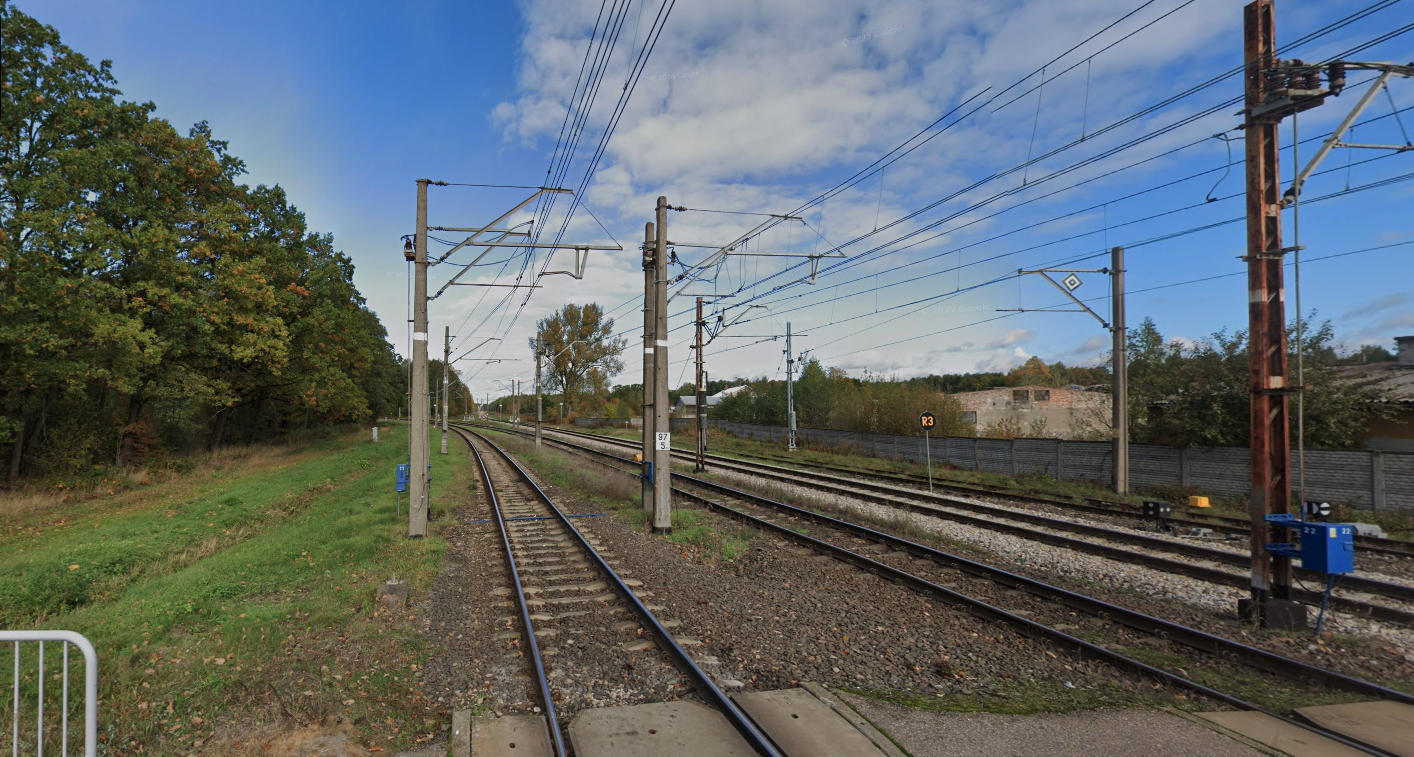
Pilawa. 2026-01-09
Pilawa Railway Station.
Geographic coordinates: 51.954N 21.533E. Elevation 148 m. Address of the Pilawa railway station: Dworcowa Street, 08-100 Pilawa.
City of Pilawa.
Pilawa is a city in Poland, in the Masovian Voivodeship, Garwolin County, Pilawa Commune. The city has an area of 6.7 km². The city’s population was 4,518 as of 2023. The postal code is 08-440. License plates are WG. Pilawa received its town charter on January 1, 1984, during the communist era. From 1975 to 1998, the town administratively belonged to the Siedlce Voivodeship. Pilawa is 53 km from Warsaw.
The town is connected to the railway. It houses the “Polifarb” S.A. Paint and Varnish Factory, a Foil Packaging Factory, a printing plant, a sawmill, and a timber yard. National Road No. 805 runs through the town, and National Road No. 17 Warsaw-Hrebenne is 2 km away.
Some believe the settlement was called Piła, but the settlers who arrived here, clearing the surrounding forests, were unable to pronounce the name correctly. However, the name Pilawa derives from the Potocki family’s coat of arms. The name Pilawa appears in medieval records in 1385. According to prehistoric finds, settlement in this area dates back to the Bronze Age, 1700-650 BC. A cemetery was found here. Pilawa likely served as a watchtower to monitor forest exploitation, particularly logging. In 1870, the village had 34 farms. After the January Uprising, repression of the Polish population and brutal Russification intensified. During this time, Germanic settlers sold their farms and emigrated westward, to the Germanic Partition.
The Pilawa Railway.
The Pilawa Railway has existed since 1877. The railway station building and the water tower are historic landmarks. Construction of the Vistula Railway began in 1865. In 1877, the railway was launched. A large station, station building, warehouse, four loading ramps, and storage yards were constructed. A water tower and a locomotive shed were built shortly afterward. Three brick residential buildings were constructed for railway workers’ families. Pilawa quickly became an important station on the Warsaw-Piława-Dęblin (Ivanogród)-Lublin line. The importance of Pilawa station increased during the interwar period, when a line to Mińsk Mazowiecki was built. After World War II, another line was built. Railway line No. 12 Skierniewice-Łuków was launched: the Skierniewice-Piława section on October 3, 1954. The Pilawa–Łuków section on May 23, 1954.
The railway changed the face of Pilawa. Many residents became railway workers or provided services for the railway, transporting goods from the station to customers. Additionally, the surrounding forests provided a source of timber, and in 1910, a large sawmill was built, and the railway provided a means of transporting timber, primarily to Warsaw.
In 1913, another serious fire broke out in the town. Many residential and commercial buildings, as well as the station building, burned down. When the Great War broke out, the Muscovites deported many railway workers’ families deep into the Muscovite state. Some of these families returned to Poland in 1920. In 1915, the German army entered the town. Logging and plundering of timber began on an unprecedented scale. The Germans built another sawmill. While the Great War was raging, in 1917, the communist revolution took place in many European cities. Strikes followed, including those of railway workers in Pilawa. In November 1918, a Polish Military Organization (POW) unit and railway workers disarmed the German soldiers and sent them west. They were not spared from looting and taking away machinery and equipment westward. After 150 years of captivity, a seven-grade primary school, known as the Public School, was opened. A Volunteer Fire Department was established. In 1923, a chemical factory was founded. The plant gave rise to the Paint and Varnish Factory.
The station building was built in 1877. During both the Great War and World War II, the building was destroyed and rebuilt. The station was constructed of half-timbered construction, meaning a wooden structure with brick infill. The building is single-story with a multi-faceted roof.
The most recent renovation was completed in May 2024. The façade was renovated, filling in the gaps in the wooden structure. The bricks were replastered and painted white. The roof covering, window and door joinery were replaced. The roof was clad with titanium-zinc sheet metal. The electrical, water, and sewage systems were replaced. LED lighting was installed. Solar and photovoltaic panels (30 panels) were installed on the roof. A new passenger information system was installed, utilizing electronic displays, display cabinets, and a new audio system. The building received an intelligent computerized system for managing electricity and water resources. It was equipped with a fire protection system and security monitoring. A new clock and new signs were installed on the building: “railway station” with the name of the town of PILAWA. The building was illuminated. The waiting room design harks back to the 19th century. The brown paneling was restored. A waiting room for families with small children was provided. There is a modern restroom and two ticket offices. The remaining space on the ground floor is occupied by railway company offices and a small rental unit. Architectural barriers were removed and facilities for disabled people were introduced. The station’s surrounding area was renovated, with greenery and small-scale architecture. A new parking lot for passenger cars and a bicycle shelter were built. The investments were financed from state funds with minimal support from EU funds. The reconstruction of Pilawa station cost PLN 11.5 million. The design documentation was prepared by AMT. The construction contractor was Anna-Bud.
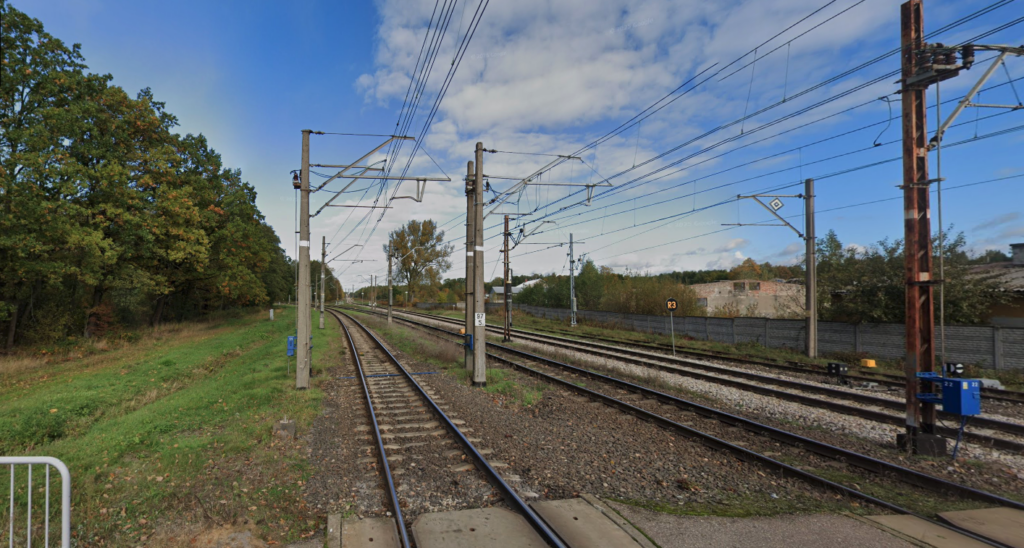
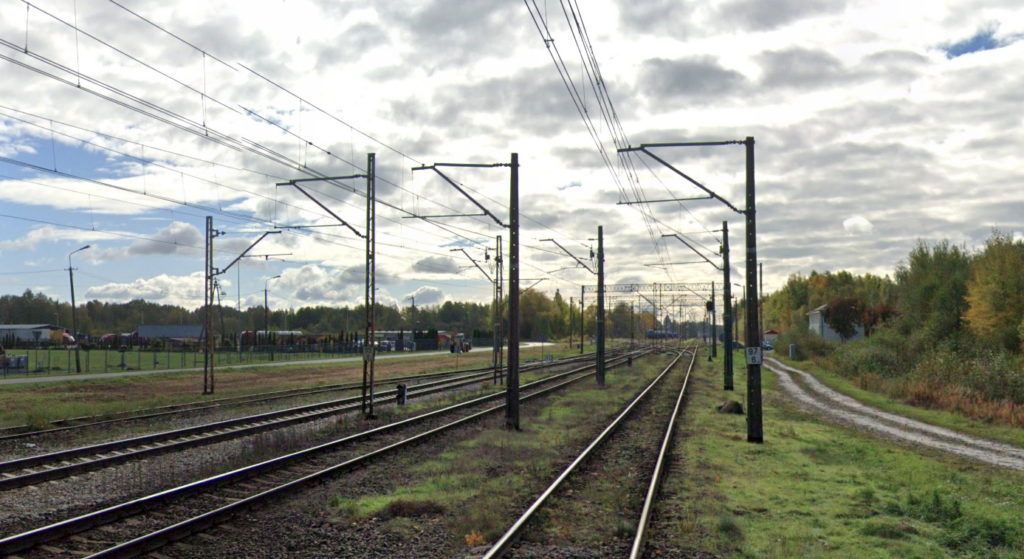
The station had two island platforms and four platform edges. There was a level crossing. Between 2017 and 2019, the station underwent renovations. The tracks, switches, and overhead lines were replaced, and new platforms were built. A passenger tunnel was constructed with ramps for wheelchairs, strollers, bicycles, and pedestrians. The platforms are equipped with shelters, benches, lighting, and audio information. The platform surfaces feature prefabricated edge slabs, linear drains, yellow warning lines, guide paths, and warning buttons.
The station houses the “PI” Local Control Center. The “PLA” and “PLB” signal boxes are currently closed. The station level is large. The disused water tower is located approximately 300 meters northwest of the station building and is in good condition. Relays are installed on the tower. The brick locomotive shed is unused.
According to the Polish State Railways (PKP) classification, the station is classified as a local station. Over the past 10 years, the station has served over 2,000 passengers annually, except during the Chinese coronavirus pandemic, when passenger numbers dropped to 1,500. In 2024, the station served 2,300 passengers. On January 9, 2026, 81 passenger trains departed from the station. The stations served the following stations: Bydgoszcz Główna, Chełm, Dęblin, Frankfurt/Oder, Gorzów Wielkopolski, Grodzisk Mazowiecki, Hrubieszów Miasto, Jagodin, Kołobrzeg, Lublin Główny, Piła Główna, Poznań Główny, Rava Ruskaia I, Rzeszów Główny, Sobolew, Sochaczew, Szczecin Główny, Świnoujście, Warszawa Zachodnia, Zielona Góra Główna, and Żyrardów.
Railway lines
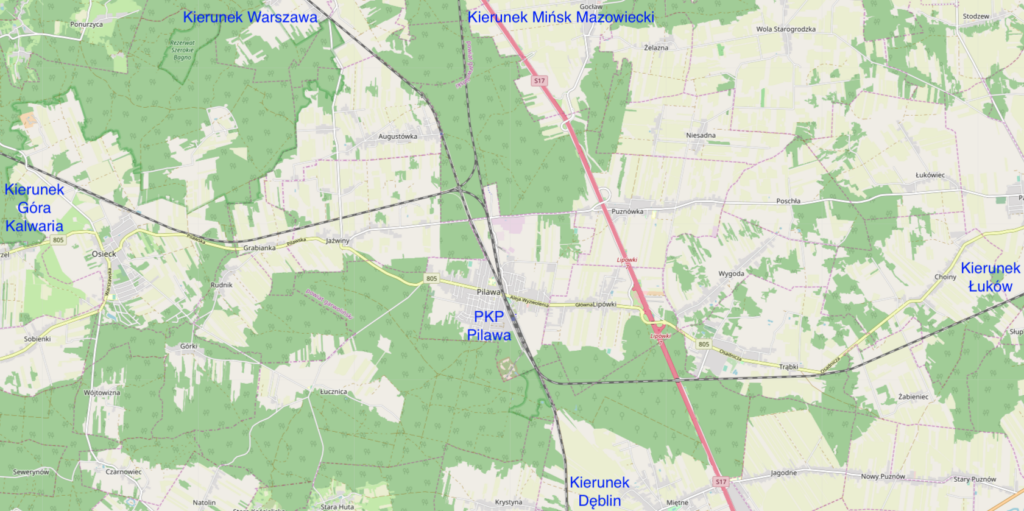
Railway Line No. 7 Warsaw East – Dorohusk (Vistula Railway, Vistula Iron Road) is a 267.471 km long railway line connecting Warsaw and Dorohusk. The line runs from the northwest to the southeast. It is double-track almost its entire length, except for the section from Wólka Okopska to the border with Ukraine. The line is electrified.
Railway line No. 12 Skierniewice – Łuków, Warsaw Freight Bypass – electrified, fully double-track. The line is 161.567 km long. The line runs latitudinally. Popularly known as the “S-Ł” or “Esełka” line, it traverses the Łódź Voivodeship, the Masovian Voivodeship, and the Lublin Voivodeship. The line belongs to the AGTC combined transport network, serving as a transport corridor for line C-E 20. Currently, it is used exclusively for freight traffic, as the southern bypass of the Warsaw Railway Junction.
Railway line No. 13 Krusze – Pilawa is electrified, single-track, and 56.604 km long. The line runs meridionally. On the Krusze – Mińsk Mazowiecki section, the line serves freight traffic only. From the branch posts, at the Mińsk Mazowiecki station (Stojadła and R101) and the Grzebowilk station to Pilawa, PKP Intercity express and international trains run on it, which allows them to bypass the crowded LK No. 7 on the Warszawa Wschodnia – Pilawa section.
Written by Karol Placha Hetman