Oświęcim 2023-10-23
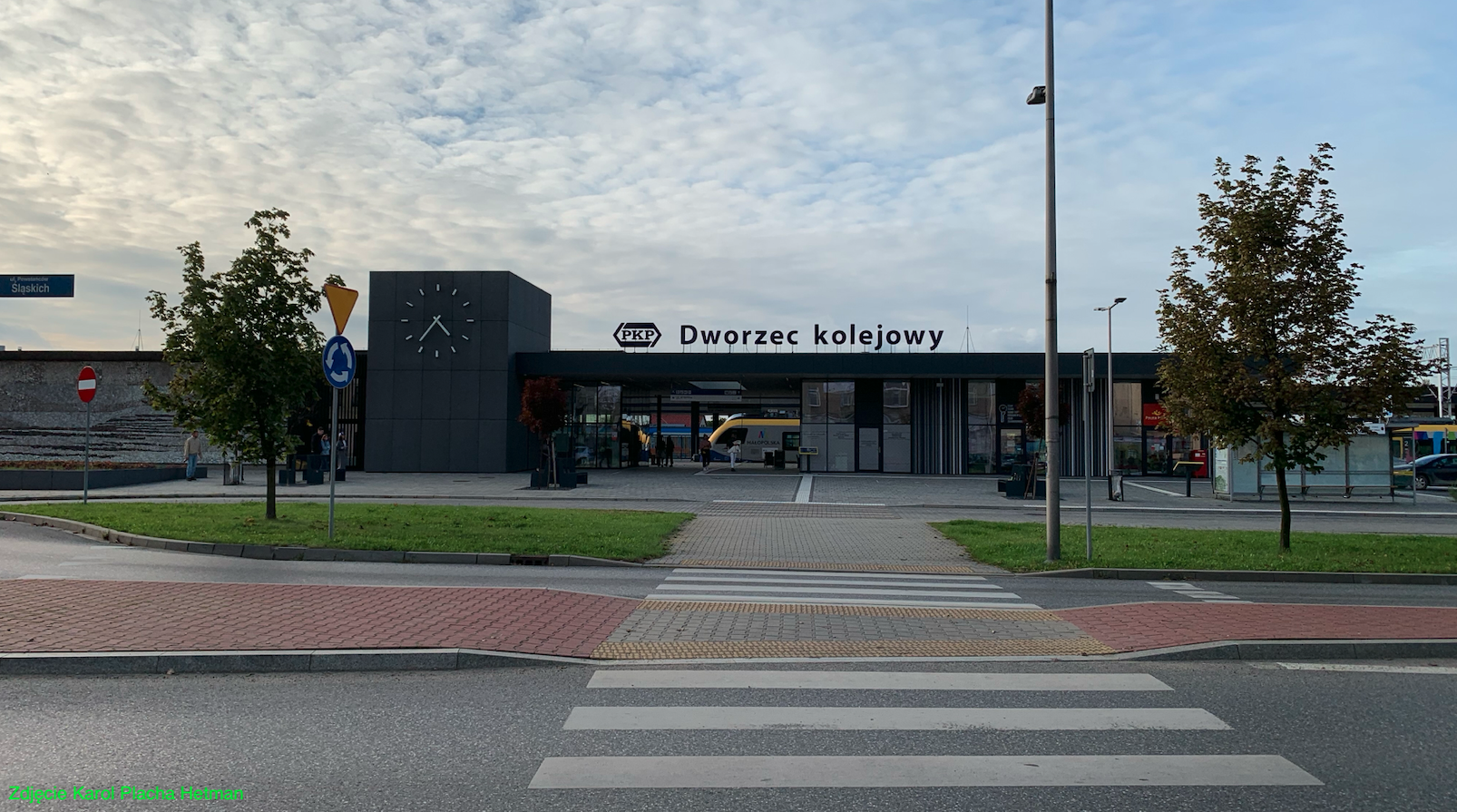
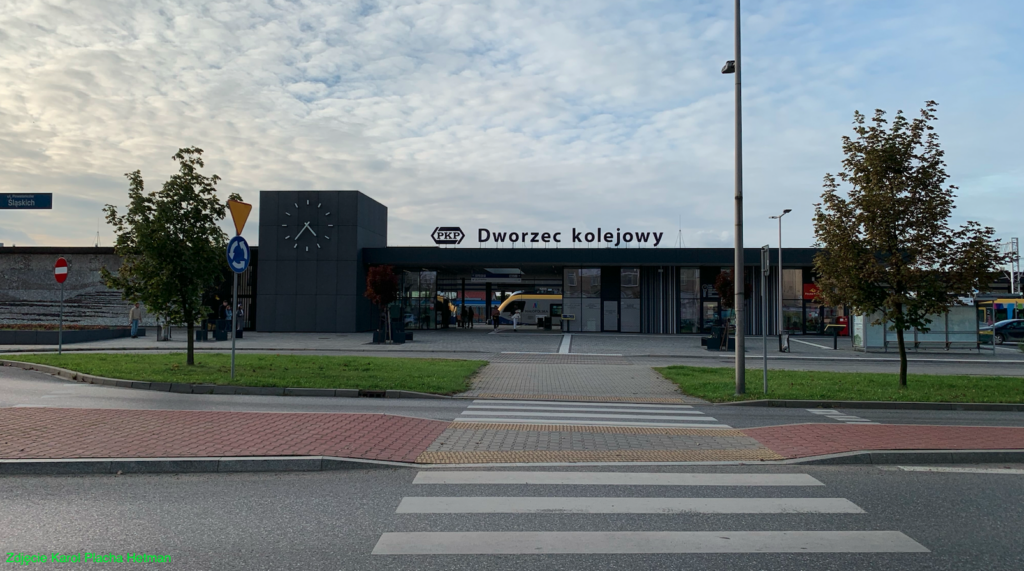
Oświęcim railway station.
Geographic coordinates: 50.041N 19.201E. Elevation 232 m. Address: Oświęcim – Powstańców Śląskich Street 22, 32-600 Oświęcim.
The town of Oświęcim.
The settlement was founded in the 12th century. Town privileges were granted in 1272 and confirmed in 1291. From 1315 to 1564, the city was the capital of the Duchy of Oświęcim-Zator. From 1564, Oświęcim was a royal city of the Crown of the Kingdom of Poland. Historically, the city belongs to the Kraków Land. During the Partitions of Poland, it was part of the Austro-Hungarian partition. After Poland regained independence in 1918, the city belonged to the Kraków Voivodeship. During the German occupation (1939-1945), the city was incorporated directly into the Raj and became part of the Upper Silesian Province.
In Oświęcim, the Germans established the largest concentration camp for Polish citizens. It consisted of the Auschwitz-Birkenau concentration camp and extermination center. The complex included the Auschwitz I main camp in Oświęcim, Auschwitz II-Birkenau in Brzezinka, and Auschwitz III-Monowitz in Monowitz, with a system of numerous sub-camps. In the 1960s, schools taught young people that 5 million people were murdered in the Germanic camp. In the 1990s, it was reported that only 1.5 million people perished. Currently, the figure is around 1 million. If this continues, the Freemasons will claim that no one died there. Moreover, the Germans claim it was a Polish concentration camp. That is why history lessons in schools are so important. Only 200,000 people survived until liberation.
This wasn’t the end of the barbaric behavior of the Germans in Oświęcim. During the war, they expanded a chemical factory belonging to the IG Farben concern, where they produced Zyklon B, which was used to murder and gas people. Doctors who conducted pseudo-medical experiments on concentration camp prisoners collaborated with the concern. Officially, IG Farben was liquidated in 2012, but its “know-how” was acquired by other Germanic companies.
The city of Oświęcim belongs to the Lesser Poland Voivodeship, in Oświęcim County. Geographically, Oświęcim lies on the Soła River, which flows into the Vistula River outside the city. The Oświęcim Basin (Kotlina Oświęcimska) was named after the city. The basin contains numerous reservoirs, both natural and artificial. There are the Macocha and Młynówka streams, several ponds, and Lake Kruki. The basin lies between the Carpathian Foothills and the Silesian Upland. Currently (2021), Oświęcim has a population of 37,231. The city has an area of 30 square kilometers.
Oświęcim Railway Station.
The Oświęcim railway station was opened in 1856, when Lesser Poland was under Austro-Hungarian rule. This was when rail service on the Dziedzice-Trzebinia route was launched.
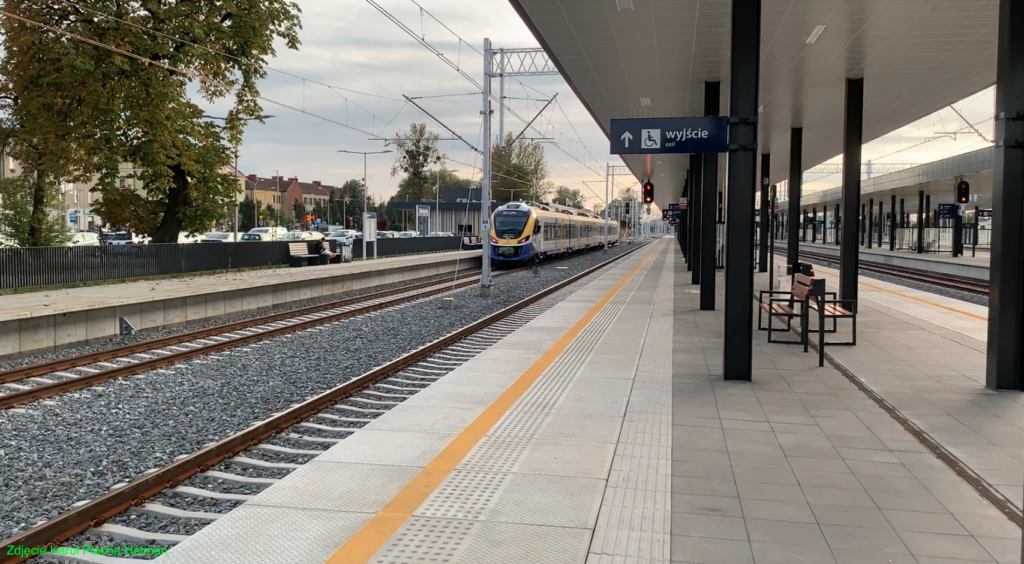
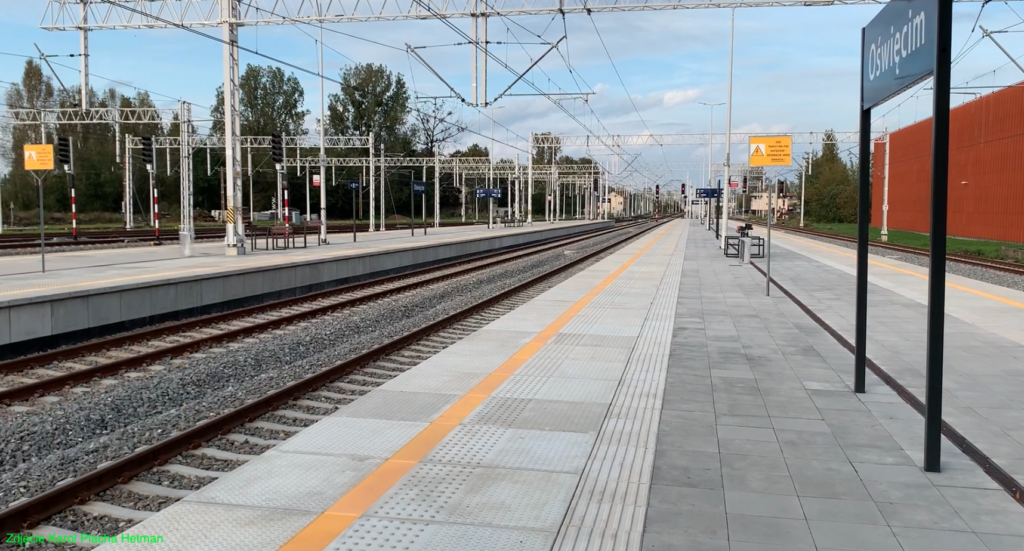
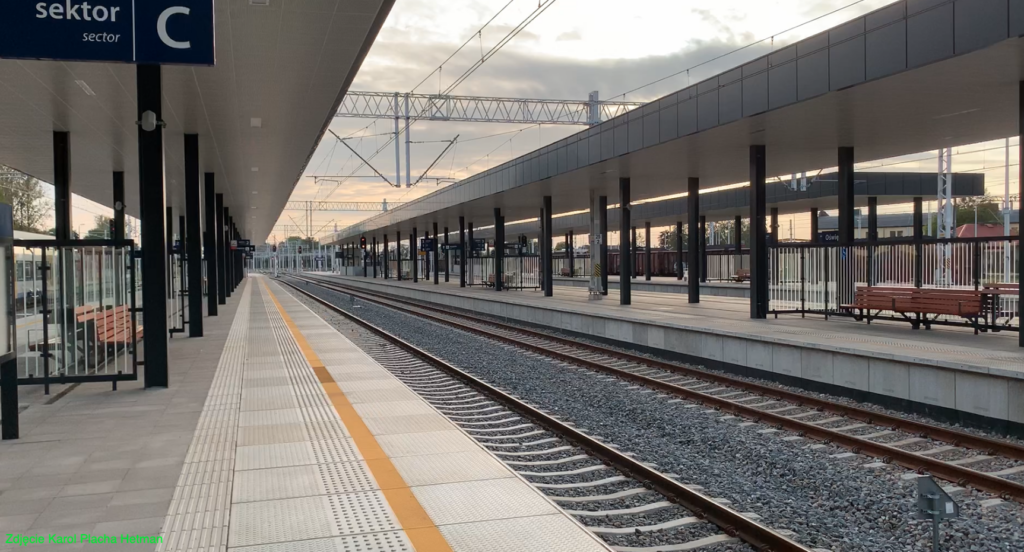
The station was completely rebuilt between 2020 and 2023. The modernization of Oświęcim station was part of PKP Polskie Linie Kolejowe S.A.’s investment on the Trzebinia-Oświęcim-Czechowice Dziedzice route. The renovations aim to provide more accessible, comfortable rail services and shorter journeys between Lesser Poland and Silesia. The modernized route will enable more efficient use of the railway’s potential for domestic and international transport. PLN 800 million has been allocated for the entire investment and other railway line modernization projects. The works were completed in the fourth quarter of 2023.
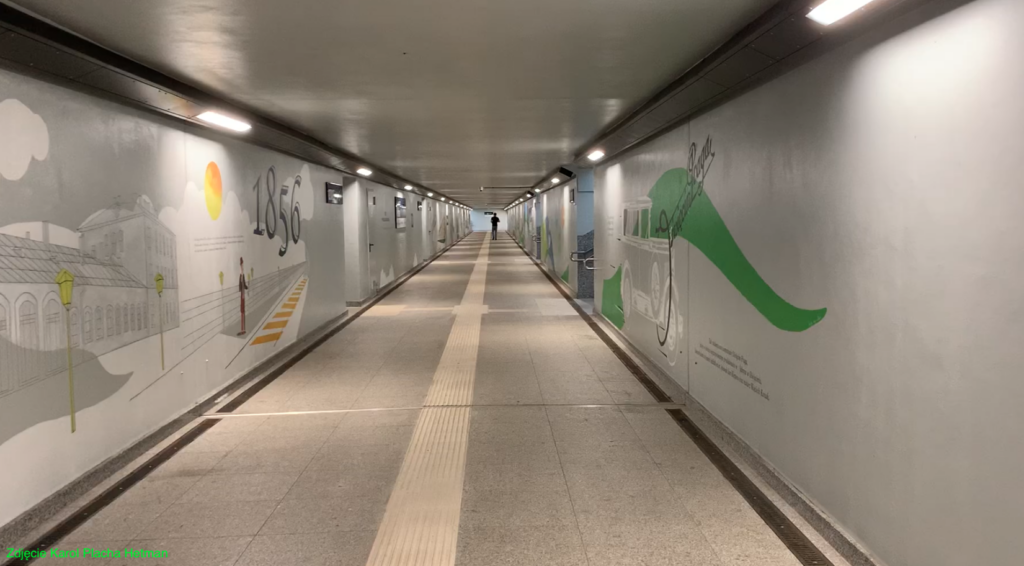
The track system and overhead lines were rebuilt, and new platforms were constructed. The footbridge over the tracks was removed and replaced with a tunnel under the tracks and platforms. Elevators were built for passengers in wheelchairs, with large luggage, or with bicycles. The tunnel is 135 meters long. As part of the investment, a new signal box was built, housing new devices for rail traffic control and safety.
Oświęcim Station.
Around 1856, the first station opened. It was a single-story building covered with a low gable roof. In 1880, two wings were added to this building, each with a three-story structure. They were covered with a low hipped roof. These wings housed service offices and apartments. The central section housed the ticket and baggage office, a waiting room, and a restaurant.
After World War II, a new railway station was built. This was the second railway station building in Oświęcim, built in 1964-1965, according to the design of Karol Fojcik, known for designing the Chorzów Miasto, Zabrze, and Lubliniec stations, among others. In Oświęcim, it was a large modernist building. A large, glazed, two-story hall was located in the central part. The hall contained ticket offices, benches for travelers, restrooms, a RUCH kiosk, and ticket machines. The interior featured an impressive mosaic by Kazimierz Gąsiorowski. The two outer wings were three-story buildings. The buildings were constructed in the Swedish style, meaning the interior of the building was a kind of quadrangular well designed to allow daylight into the building.
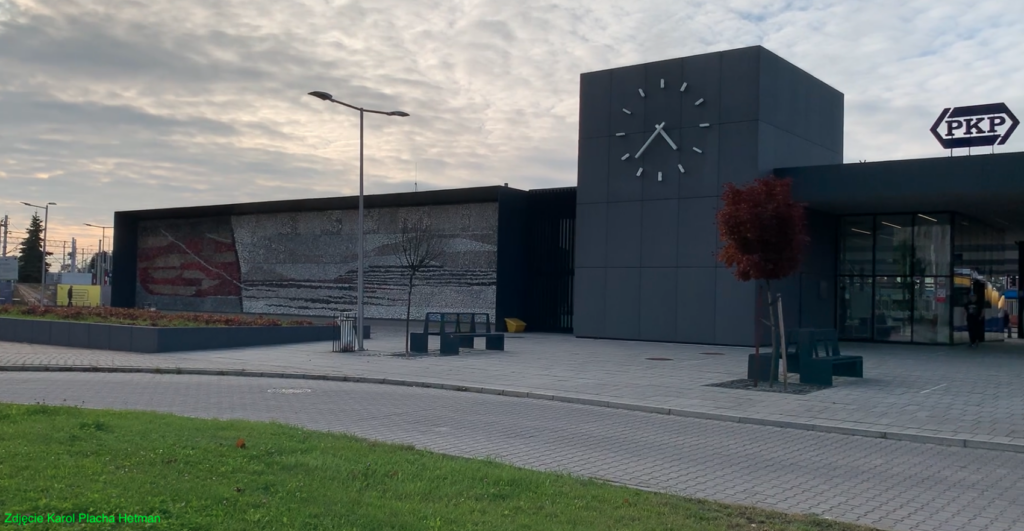
Between 2018 and 2020, a third new railway station was built. It officially opened on June 15, 2023. The building is small and divided into two sections. The first section houses the station security staff and passenger rooms. The glass-walled waiting room features benches, a Małopolska ticket machine, a room for parents with small children, a drinks vending machine, luggage lockers, and spacious restrooms. Restrooms are free and open to the public. On September 10, 2023, Koleje Małopolskie opened its own ticket office. The section designated for commercial premises includes a watchmaker’s shop, a Polish Post office, and a small restaurant. The new station in Oświęcim has been adapted to accommodate disabled guests. The station is monitored and equipped with electronic management systems. The mosaic by Kazimierz Gąsiorowski was moved to the external façade of the new station, facing the station square. During the construction of the new station, a temporary station was opened for passenger services, made of shipping containers. It housed a ticket office, waiting room, and restrooms. There was even a watchmaker’s shop.
After the recent renovation, bicycle racks were installed at the station. A bus stop and taxi rank are located in the station square. For drivers, three parking lots are available in the immediate vicinity of the station: one larger, one smaller, and the third a large Park & Ride lot built on the site of the former “Glob” hotel.
Platforms
In Oświęcim, after World War II, four low-rise platforms were built. Platform 4 was the farthest from the station. This platform was intended for planned passenger trains bound for the Wola coal mine, the KWK Czeczott mine. Ultimately, no trains departed from this platform and served as an additional platform, for example, for special and retro trains.
The platforms were surfaced with paving slabs. Warning and edge markings were painted white on the platforms. Platform 1 was a single-edge platform, 175 m long. Platforms 2 and 3 were 240 m long and 6 m wide. Platform 4 was 200 m long and 6 m wide. The platforms featured several shelters, which only protected passengers from rain and snow. The platforms were equipped with benches, garbage cans, street lighting, and an audio system. Access to the platforms was provided by a footbridge over the tracks. Passengers in wheelchairs, with strollers, and with large luggage used the level crossing. The footbridge over the tracks was built around 1965. It not only provided access to the platforms but also connected the eastern and western parts of the city. The footbridge was dismantled in 2019 and replaced with a temporary walkway at track level during the station and terminal renovations.
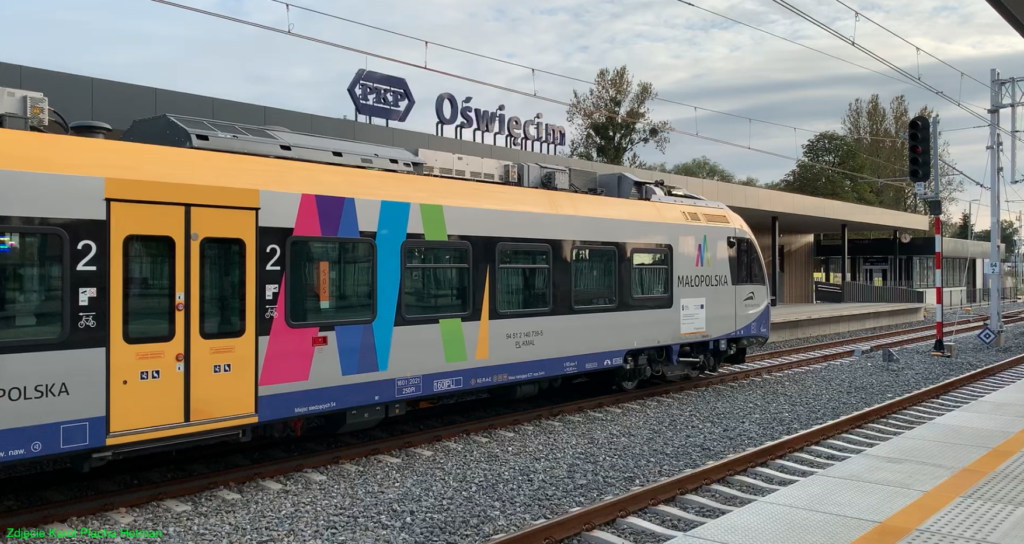
As a result of the station renovations, the platforms were completely rebuilt between 2020 and 2023. The new platforms are high-rise. Platform 1 is an island platform, 200 m long, and has a single edge. Platforms 2 and 3 are island platforms, each 300 m long, and have a roof approximately 120 m long. Platform 4 is also an island platform, 200 m long, and has a roof approximately 70 m long. The platforms are approximately 8 m wide. The platform surface is made of precast slabs at the edges, 1 m wide. The slabs have anti-slip flooring, yellow warning lines, buttons, and guide paths. The rest of the platform surface is made of paving slabs. There is also a drainage system in the form of a linear drain. The platforms are equipped with benches, information boards, a sound system, lighting, and trash cans. Additionally, the benches are covered with transparent screens to protect travelers from the wind. The platforms are connected by a tunnel for travelers and residents, as the tunnel also connects the eastern and western parts of the city. The tunnel is 135 meters long.
Trains.
The real development of railways in the Oświęcim area occurred after Poland regained independence in 1918. This was associated with industrial development and the influx of people from the poorer parts of former Galicia. Some people headed to Mysłowice, where there was a registration point for people wishing to emigrate to the USA. Emigration routes led by rail to Germanic seaports and by ship to Canada and the USA.
After World War II, another wave of Polish population migration occurred. This time, repatriates expelled from former eastern Poland to the so-called Recovered Territories. All under Moscow’s control and with the West remaining silent. The repatriation point was organized in Dziedzice.
The 1950s were a time of Poland’s peaceful development, albeit under communist dictatorship. The Polish population began to take organized vacations to the seaside, the mountains, and the Masurian Lake District. State-owned factories organized vacations for their employees. A large portion of the trains were supplementary trains, rented by the companies. There were also carriages reserved for these passengers on scheduled trains. In the 1970s, passengers could travel from Oświęcim to Kraków, Katowice, Wisła, Zwardoń, Cieszyn, and Chałupki. The peak of passenger transport was in the 1980s. From the 1990s onward, the Polish State Railways (PKP) faced increasingly poorer funding. Rail connections were discontinued, passenger stops were closed, and even stations were closed. Only in 2012 did the railway slowly begin to be modernized.
For the 2024 summer season, InterCity plans to launch long-distance trains via Oświęcim on the Kraków-Oświęcim-Vienna and Katowice-Oświęcim-Vienna routes. SKM Małopolska also plans to launch trains on the Kraków-Skawina-Oświęcim route. In December 2023, these trains terminated in Przeciszów.
Oświęcim rail enthusiasts point out that train stops in Kruki, near the hospital, and near the large Błonie housing estate would be useful, which would facilitate access to trains and encourage rail travel. Such a stop has been built in Zator, near the Energylandia amusement park.
In October 2023, 25 passenger trains departed from Oświęcim station, providing connections to Katowice, Kraków Główny, and Racibórz. In 2022, the station served approximately 1,500 passengers daily.
Railway line No. 93 Trzebinia – Zebrzydowice.
Railway line No. 93 Trzebinia – Zebrzydowice is 81.408 km long, runs east-west, is a double-track line, fully electrified. The line was built in stages. On December 17, 1855, the Bohumin – Zebrzydowice – Dziedzice section was opened, and on March 1, 1856, the Dziedzice – Oświęcim section was opened. By the end of 1856, the Oświęcim – Libiąż – Trzebinia section was in operation. From the very beginning, the rails had a gauge of 1435 mm. The first owner was the Imperial-Royal Privileged Northern Railway of Emperor Ferdinand. On January 1, 1906, the route was nationalized by the Kaiserlich-Königliche Staatsbahnen (kkStB), the Imperial-Royal State Railways. In 1918, the route was divided between Poland and the Czech Republic. In Poland, the Polish State Railways (PKP) became the owner.
Railway line No. 93 is a line of national importance. Its design allows passenger trains to reach speeds of up to 120 km/h on the Trzebinia-Dziedzice section and up to 160 km/h on the Dziedzice-Polish border section.
The line was electrified in three stages. Electrification: on April 29, 1964, the Dziedzice-Polish border section; on December 4, 1971, the Oświęcim-Dziedzice section; and on April 30, 1973, the Trzebinia-Oświęcim section.
Since 2001, as a result of cuts to PKP (Polish State Railways) implemented by the Masonic governments, the number of rail connections has been systematically reduced, and the tracks have not been properly repaired. As a result, travel speeds have decreased and travel times have increased. Railways were becoming uncompetitive with road transport.
It wasn’t until 2015 that a feasibility study for the revitalization of the railway lines began. In 2017, the first major renovation work began. Libiąż station is a prime example. On December 25, 2015, due to the poor technical condition of the rails and switches, the speed was limited to 30 km/h. A tender for the station renovation was then announced, which was won by Skanska. As a result of the work, 9 km of track was replaced, the overhead lines were rebuilt, and the platforms were modernized. The railway siding to the Janina coal mine was renovated. As a result of the work, passenger train speeds increased to 100 km/h and freight train speeds to 70 km/h.
On October 2, 2017, a contract was signed for the renovation of Line No. 93 on the Trzebinia-Oświęcim section. In February 2018, the contractor, PNiUIK Kraków, entered the construction site. On August 27, 2018, PKP PLK signed a contract with PORR for the design-build modernization of Line No. 93 on the Oświęcim-Dziedzice section. The project included the design and reconstruction of the double-track Line No. 93 from 0.700 km to 44.950 km, excluding Libiąż station, which was modernized as part of a separate project. The stations rebuilt included Chrzanów, Chełmek, and Oświęcim, along with engineering structures and crossings, level crossings, roads (with associated infrastructure), ground reinforcement and protection, platforms and access roads, overhead lines, non-traction power systems, and rail traffic control equipment. The contract included the renovation of 63 km of track, 106 switches, 13 level crossings, 45 engineering structures, and 23 structures eliminating architectural barriers for people with disabilities. The work was completed in 2022. The total project value was PLN 1,005,799,936.58. The project also included railway lines: No. 94 on the Dwory–Oświęcim section, No. 138 on the Oświęcim–Nowy Bieruń section, No. 699 on the Oświęcim OWC–Oświęcim OWC1 section, and No. 882 on the Oświęcim–KWK Czeczott section. A new track was constructed on the Dziedzice–Brzeszcze KWK section. Geological surveys revealed that soil reinforcement was necessary in many areas. Many infrastructure elements had to be dismantled and rebuilt.
Since 2020, passenger trains have been resumed on the Kraków Główny – Trzebinia – Oświęcim route, with 9 pairs per day. PolRegio operates the route. The Dziedzice – Zebrzydowice section has been operated by Koleje Śląskie since 2014.
A Dynamic Passenger Information System was introduced in 2022 on line no. 93, at the following 11 stations: Chrzanów Śródmieście, Chrzanów, Chełmek, Libiąż, Gorzów Chrzanowski, Oświęcim, Brzeszcze, Brzeszcze Jawiszowice, Jawiszowice Jaźnik, Kaniów, and Dankowice. The system provides up-to-date information on passenger train traffic. In the event of a power outage, a UPS system will maintain operation for another 15 minutes. Audio passenger information systems are operational in signal boxes at individual stations and at the Dziedzice Local Control Centre.
Railway line no. 94 Kraków Płaszów – Oświęcim.
Railway line No. 94 Kraków Płaszów – Oświęcim is an east-west line. The line is 64.502 km long, double-track, and electrified at 3 kV DC. The line was commissioned in 1884. Electrification was completed in two stages: on October 30, 1970, on the Kraków Płaszów – Spytkowice section, and on September 9, 1971, on the Spytkowice – Oświęcim section. The route is of national importance, primarily for freight traffic between Silesia and Kraków. Since 2000, passenger traffic on the line has been declining, especially on the Skawina – Oświęcim section. The Kraków Płaszów – Skawina section was important because it continued on Line No. 97 towards Zakopane. The last passenger train to run the entire route, Line No. 94, in 2014, was an international Interregio train from Krakow to Ostrava in the Czech Republic: Krakow – Skawina – Oświęcim – Czechowice Dziedzice – Zebrzydowice – Ostrava. In 2015, train services on the Krakow – Skawina – Oświęcim route were reinstated. However, after a year, due to the poor condition of the tracks and the long travel time, they were suspended again. At the end of 2022, after repairs, passenger service was restored. In 2017, a long-distance InterCity train ran on the following routes: Warsaw – Krakow – Skawina – Oświęcim – Dziedzice – Vienna. There was also a train on the Przemyśl – Krakow – Trzebinia – Oświęcim – Prague route. Services were suspended due to the renovation of Line No. 93 from Trzebinia to Czechowice Dziedzice and the renovation of the Dziedzice junction. Renovations are expected to be completed by the end of 2023.
Railway No. 138 Oświęcim – Katowice.
Railway No. 138 Oświęcim – Katowice is 32.761 km long, double-track, and electrified. The line runs from south to north. It traverses the Małopolska and Silesian Voivodeships. The maximum speed is 110 km/h.
Railway No. 882 Oświęcim – KWK Czeczott.
Railway No. 882 Oświęcim – KWK Czeczott is a 9.551 km long freight line. The line enabled the Czeczott Coal Mine to operate freight trains running directly through Oświęcim station towards Trzebinia, Skawina, and Mysłowice. The Czeczott Mine also has a second line towards the town of Bieruń. The Piast and Ziemowit coal mines are also nearby. Maximum speed is 40 km/h (freight trains).
Written by Karol Placha Hetman