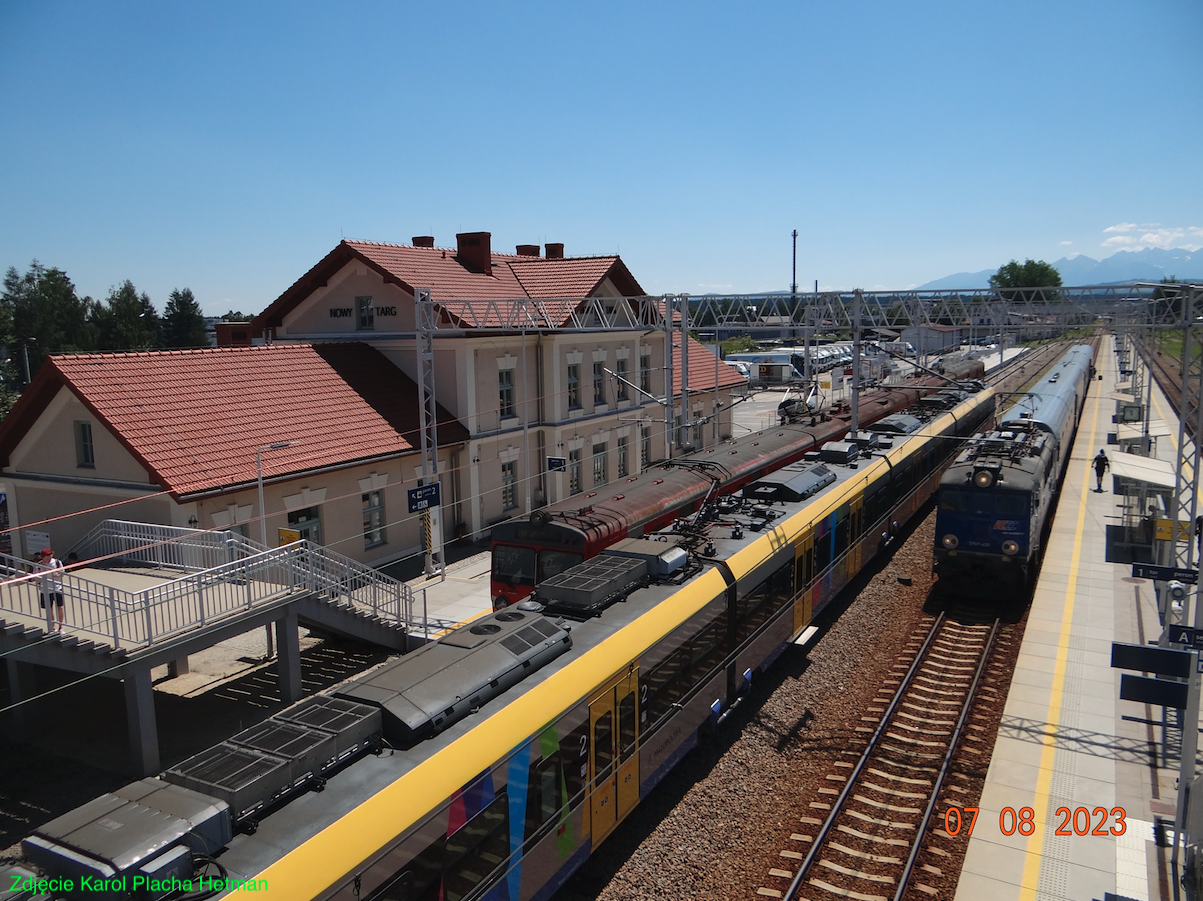
Nowy Targ 2023-07-21
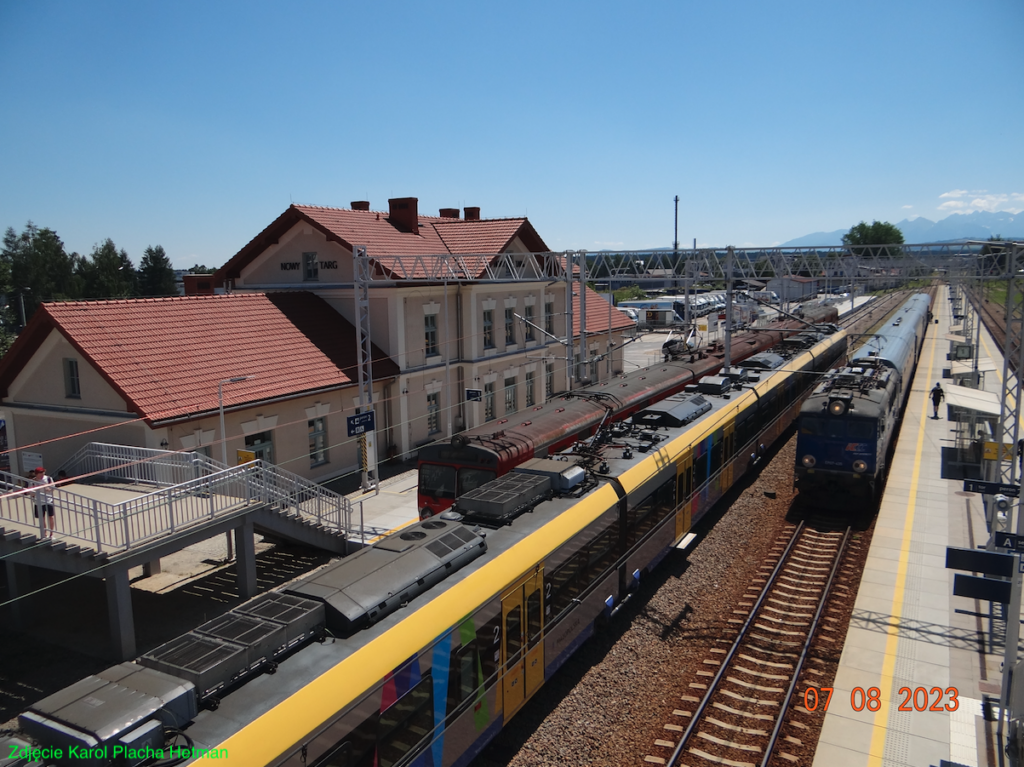
Nowy Targ Railway Station.
Address: Kolejowa Street 164, 34-400 Nowy Targ. Coordinates: 49.473N 20.015E. Elevation: 601 m.
History of Nowy Targ.
The beginnings of settlement in Podhale date back to the 13th century. Cistercians arrived from Jędrzejów and founded a monastery in Ludźmierz. They were granted the right to establish new settlements in Podhale. These settlements stood on the trade route from Silesia to Hungary. At that time, Nowy Targ, then called Novum Forum, was built. It was established under Western European law. A parish existed here as early as 1326. Casimir the Great took over Podhale from the Cistercians, thus making it a royal parish. It was then decided to relocate the settlement to better land, and Casimir the Great granted the town a second charter (June 22, 1346). Thus, a new town was established, with a market square and a parish church dedicated to St. Catherine. Nowy Targ received numerous royal privileges, which fostered its development. Trade and crafts flourished. With royal permission, each year, on November 25th, on St. Catherine’s Day, a new town was established. A huge fair was held on St. Catherine’s Day. This fair lasted eight days. In 1487, King Casimir IV Jagiellon authorized a second annual fair on July 25, on St. James’s Day, which also lasted eight days. Weekly fairs were then permitted on Thursdays, which continue to this day. In 1521, King Sigismund the Old allowed city councilors to collect tolls from Podhale roads in exchange for paving and maintaining them in proper condition. Merchants traveling through Podhale were not allowed to bypass the city. By the 16th century, guilds already existed in Nowy Targ, organized into the Guild of Various Crafts. However, the furriers were the most numerous, and later formed their own guild. King John II Casimir authorized a third major fair per year, on the first Sunday after Easter. In the 15th century, the city had approximately 500 inhabitants, and in the 16th century, approximately 800. In 1601, the city was ravaged by its first great fire. The fire burned down almost the entire city, including the church, hospital, town hall, and manor house. Taxes paid by the city constituted a significant portion of the royal budget. While the townspeople and craftsmen of Nowy Targ fared well, the peasants fared much worse. The starosts continually introduced new levies and labor charges. Dissatisfied residents of Podhale filed complaints and won their cases in court, yet their financial situation continued to deteriorate. Rebellions and even attacks on the castle in Czorsztyn occurred, but these were brutally suppressed. Despite this, the people of Podhale participated in an uprising against the Swedes, who in 1656 sacked the city and murdered most of its inhabitants.
In 1772, the First Partition of the Polish-Lithuanian Commonwealth took place, and the city came under Austrian rule. From the late 17th century, the city began a slow decline. Among the causes were fires in 1673, 1696, 1710, 1719, and 1784. Added to this were epidemics and persecution by the occupiers. Under Austrian administration, Podhale was incorporated into Galicia. The starosty’s property was confiscated and privatized. Although the Austrian authorities retained Nowy Targ’s privileges, the city was forced to pay high tributes to the occupiers and provide recruits. After the last great fire (1784), the city was rebuilt on a new street grid, excluding former buildings and plot layouts. The market square was significantly enlarged. By 1840, the city had 2,000 residents. After the Spring of Nations, serfdom was abolished in Podhale. Later, Galicia gained autonomy, and Nowy Targ became the seat of a district and a court. By the end of the 19th century, Nowy Targ had a school, mills, sawmills, a brewery, a power plant, and numerous craft workshops. A fire department, then known as the Fire Brigade, had been in operation since 1881. The brick town hall was built in 1884 and remains in this state to this day. In 1899, the Chabówka-Zakopane railway line was opened. Education and the Sokół Gymnastic Society flourished. Before the Great War, Nowy Targ had a population of 9,000.
During the Great War, the inhabitants of Podhale fought on the Austrian side, due to the roots of most of the recruits. At the end of 1914, the Muscovites were defeated at Limanowa, and then at Gorlice (May 1915), and they retreated eastward. On the night of October 31/November 1, 1918, Nowy Targ was taken over by the Polish Army. Civilian residents and high school students participated in the fighting.
During the Second Polish Republic, the city developed steadily. New important buildings were built: a brickyard, another sawmill, and, in 1930, an airport.
Following the German army’s aggression, Nowy Targ was occupied by the new occupiers on September 1, 1939, at approximately 4:30 PM, without a fight, entering from Slovakia. During the occupation, the entire Podhale region became one large point of resistance. It was the Podhale population that provided couriers, liaisons, and guides between the occupied Republic of Poland (the Underground State) and the government-in-exile in London. The Germans began a Germanization campaign in Podhale, attempting to prove that the highlanders were descended from the Goths, just like the German race. However, a small percentage of the Podhale population collaborated. By 1941, a large network of resistance fighters was already operating in Nowy Targ. Underground publications were published, even in German. However, in 1942, the network was shattered. Many people lost their lives during quick executions or were sent to extermination camps (“monuments to German civilization”). Some members of the network escaped, including Józef Kuraś “Ogień.” On January 29, 1945, the city was occupied by the Russians, who were shown the way by the “Ogień” unit. The Germans were so surprised that they fled in panic, without a fight.
In this new reality, the communists took power. Józef Kuraś “Ogień” (Fire) was to head the UB (Poviat Public Security Office). He was supposed to report to the Kraków UB office, but turned around and returned “to the forest.” Communist symbols were erected in Nowy Targ: a Lenin museum and a monument to Russian soldiers (which was blown up twice). It wasn’t until 1951 that the church, whose construction began during the Second Polish Republic, was completed. In 1955, the Nowy Targ Leather Industry Plant “Podhale” was opened, which employed 10,000 workers in its heyday. New housing estates were built. In 1979, St. John Paul II the Great celebrated Mass at the airport. In 1979, construction began on a new hospital, which was completed in 2008.
Nowy Targ railway station.
The railway line from Chabówka via Nowy Targ to Zakopane opened on October 25, 1899. On July 1, 1904, the station in Nowy Targ became a junction station, as the railway line to Sucha Góra was opened. The station was called Neumarkt and Dunajec. A steam locomotive shed and a water tower were built in Nowy Targ, and two water cranes were erected next to the tracks.
A major reconstruction of the station in Nowy Targ took place in 1975. An island platform and a footbridge over the tracks were constructed. This was connected with the electrification of the Chabówka-Zakopane railway line, which was officially opened on December 3, 1975.
A significant event in the history of Nowy Targ was the discontinuation of passenger services to Nowy Targ Fabryczny station in 1987. In 1919, the railway line to Podczerwone station was closed. The tracks were removed. A bicycle path was built along the railway tracks from Nowy Targ to Trsteno in Slovakia.
Railway line no. 99.
Railway line No. 99 Chabówka – Zakopane is one of the most famous railway lines in Poland. It is part of the Kraków – Zakopane route. The line is single-track and was electrified in 1975 with a 3 kV DC overhead contact line. The line is 43.785 km long. Passenger trains, connecting Zakopane with the rest of Poland, run on the line. The line was opened in 1899. The line is technically demanding and, in the steam locomotive era, was primarily operated by tank locomotives, such as the TKt1, OKz32 (very good), and TKt48 (very good). However, there were also Ty-2/Ty-42 and derivative locomotives on the route. Since electrification, the line has been primarily operated by EU07 and derivative electric locomotives. Speeds on the line range from 60 to 90 km/h. Despite the difficult terrain, the line was built at a relatively low cost. This was due to the route being laid along river valleys. This was typical design throughout the Carpathians. Therefore, trains cannot reach high speeds here. Counter-curves were often used to ensure the safety of the trains. On the other hand, residents of all major towns in Podhale can benefit from the railway. A disadvantage of running the tracks along the slopes near rivers was initially landslides, which temporarily rendered the route impassable. Running the line along rivers caused the track gradient to reach 28‰ in some places. However, this poses no problems for experienced engineers.
No tunnels or long viaducts were built on the route. Although a tunnel near the Sieniawa Pass was initially planned, the line would have bypassed the town of Raba Wyżna. It is currently unknown whether the protests by residents of Raba Wyżna were for or against the construction of the railway line. As in many other places in the world, the construction of the railway line sparked protests from residents of some towns, which ceased once the benefits were realized.
In the early 1970s, the route was electrified in stages. The first stage, Chabówka – Nowy Targ, opened on November 18, 1975. The second stage, Nowy Targ – Zakopane, opened on December 3, 1975. On that date, the entire Kraków – Zakopane route was already electrified.
From 2017 to 2023, a major renovation of the entire Kraków Główny – Zakopane route was carried out. The renovation included the track systems, passenger stops, and railway stations. The entire electric traction system was replaced. All stations were adapted to accommodate wheelchair users and passengers with bicycles. New passenger stops were built, such as in Chabówka. Railway traffic control devices were modernized, and automatic control at level crossings was introduced.
Currently (2023), work is underway at Zakopane station. New, longer platforms and a new track system will be constructed. A connecting line is planned between railway line No. 99 and line No. 98, which will allow the trains to bypass the Chabówka station and, above all, avoid the need to change train heads. This is the last point on the Kraków-Zakopane route where locomotives must detour around the depot.
Former railway line No. 118.
The Nowy Targ–Sucha Góra railway line was a decommissioned railway line that operated from 1904 to 1991. The line was 21.532 km long and ran along Voivodeship Road No. 957 to Czarny Dunajec, and then along the Czarny Dunajec River. In 1918, the line was incorporated into the Polish State Railways (PKP). After World War II, the border section was dismantled. Polish trains reached the Podczerwone station. Passenger service continued on the line until 1987, but freight service was suspended in 1989. In 1991, the line was physically closed. The Suchá Hora station was located in Slovakia. The line was a local service, connecting Nowy Targ and Podczerwone. Currently, a bicycle path follows the railway line. The path is paved and three meters wide. The 20.6 km long trail runs through Ludźmierz, Rogoźnik, Stare Bystre, Czarny Dunajec, and Podczerwone to the state border and continues for 14.4 km on the Slovak side to Trstena. The route is suitable for recreational cycling and rollerblading. There is a railway station in Trstena and a further Transversal Railway route. In 2015, the historic railway bridge over the Czarny Dunajec River in Czarny Dunajec was renovated. It is currently a pedestrian and bicycle bridge.
Nowy Targ Station currently.
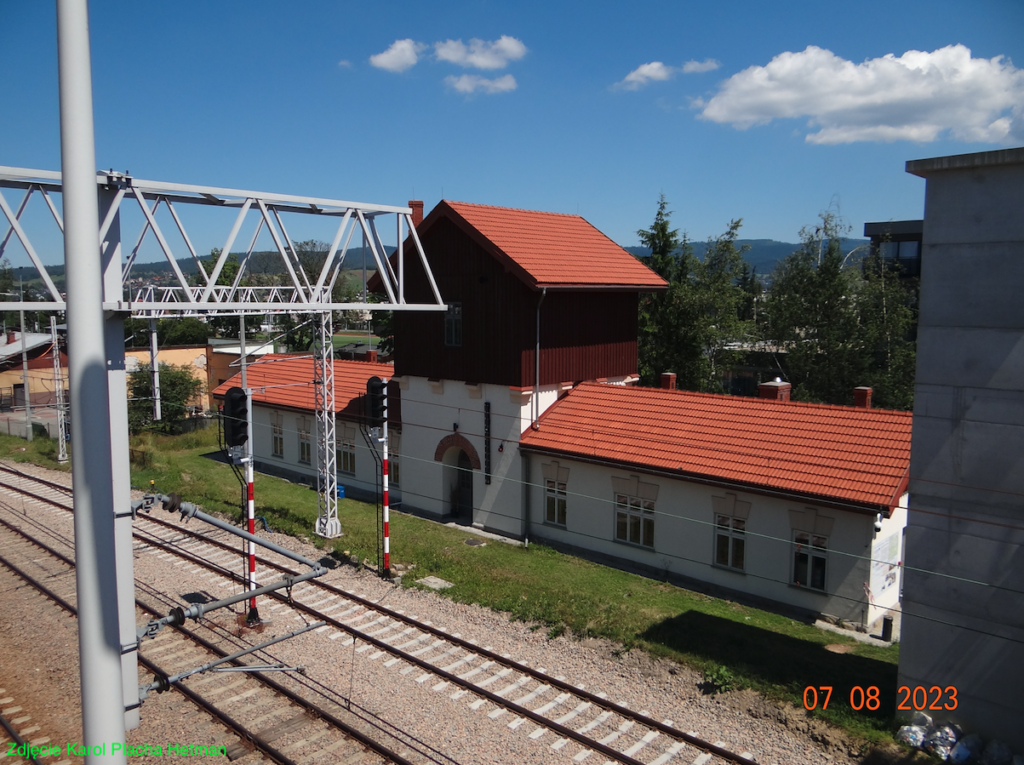
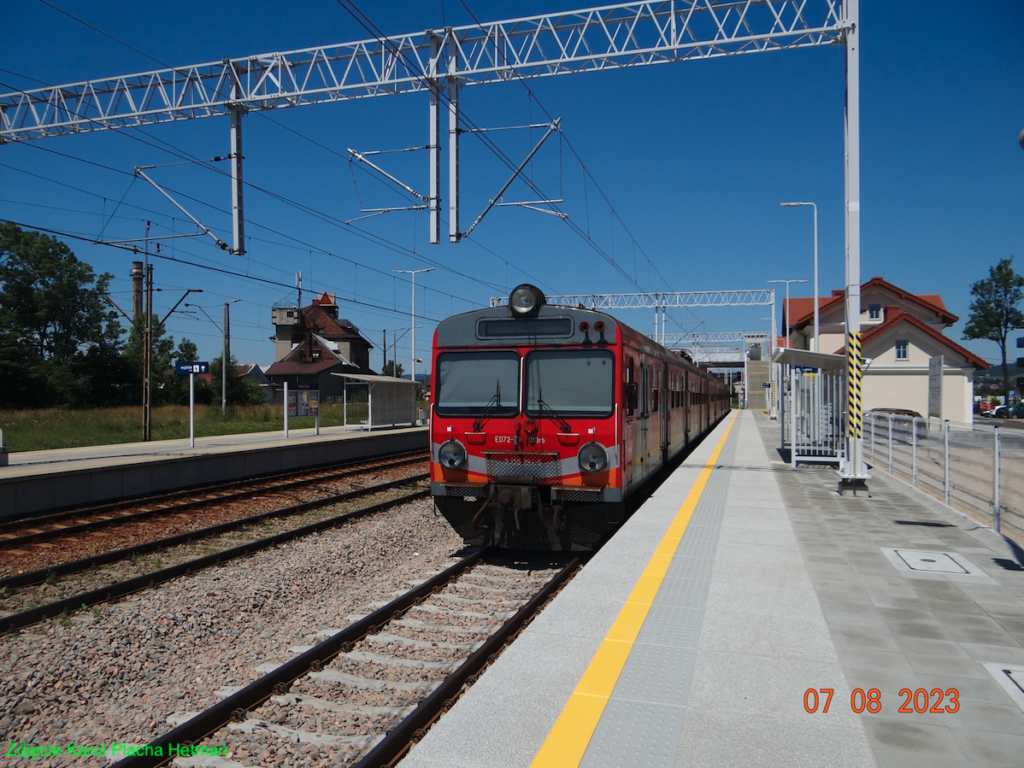
The station is located at Kolejowa Street No. 66. The last renovation of the station took place between 2019 and 2021. The track layout was rebuilt to simplify the southern station head. A historic building with a water tower is nearby. As part of the station modernization, a P+R parking lot was constructed.
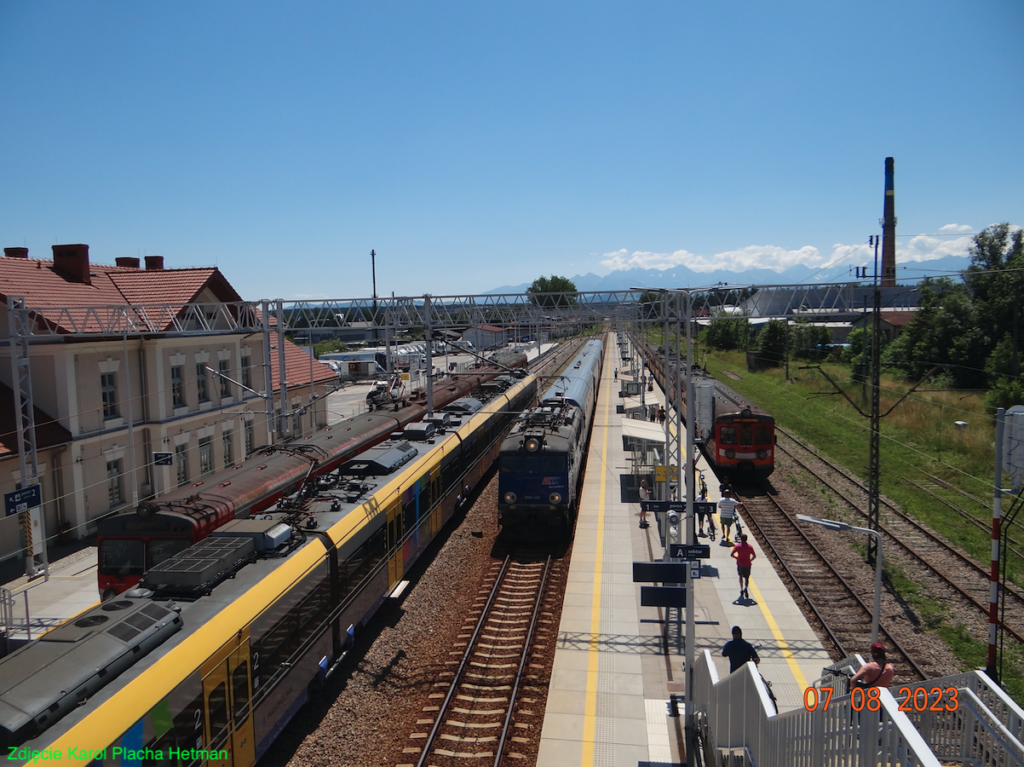
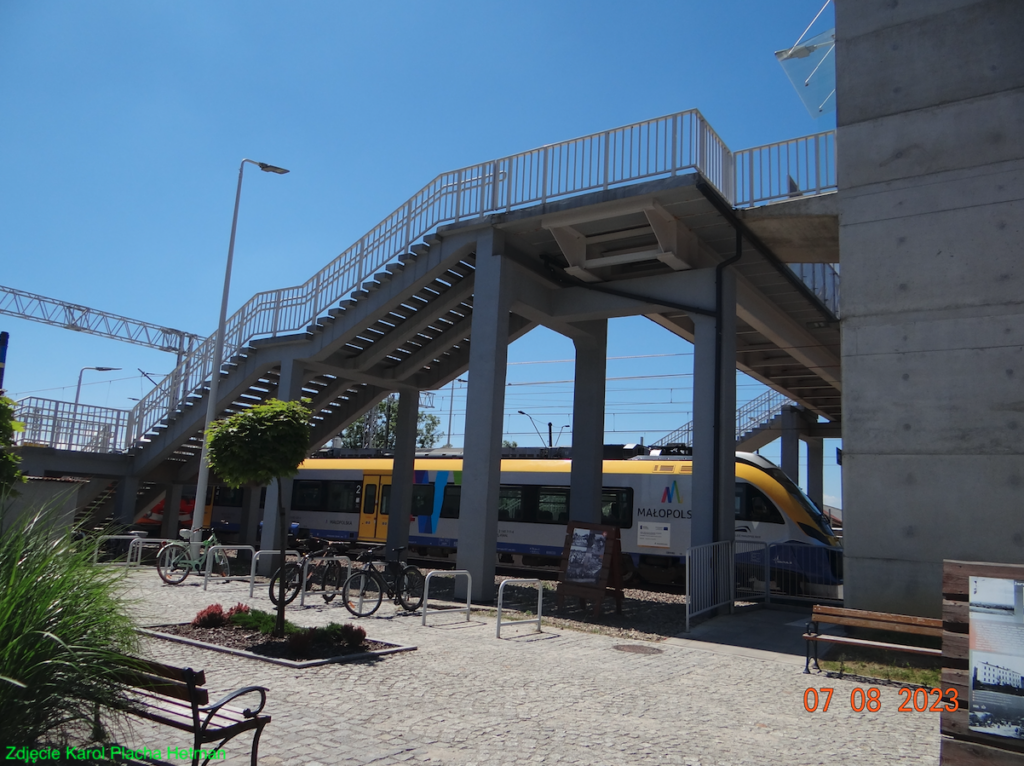
The station has five main tracks, two platforms, and three platform edges. Platform 1, 245 m long, is a single-track platform with track No. 4 and is located next to the station building. Platform 2, 320 m long, is an island platform with tracks No. 1 and 3. Access to the platforms is via a footbridge over the tracks. In 2021, the footbridge was renovated and equipped with elevators for wheelchair users, passengers with large suitcases, and bicycles. On the Chabówka side, there is a local railway station (SKP) station, which also operates the rail-road crossing along Ludźmierska Street (DW No. 957). The station has traffic lights. Radio communication channel R4.
Since 2018, the station and the building with the water tower have been owned by the city of Nowy Targ. In 2020, both the station and the historic water tower were restored to their former glory. The station is equipped with a ticket machine. There is no ticket office. Inside, there is a waiting room, restrooms, and a train information desk. Most of the building is occupied by railway services. The local branch of the Polish Tourist and Sightseeing Society is also located in the station building. The water tower is open to visitors on Mondays, Wednesdays, and Fridays from 10:00 a.m. to 1:00 p.m. Admission is free.
In 2022, Nowy Targ station served 150-200 passengers per day, and on holidays and Sundays, up to 300 passengers per day. In July 2023, 41 passenger trains departed from Nowy Targ station per day. They served destinations such as Bydgoszcz Główna, Gdynia Główna, Katowice, Kraków Główny, Rabka-Zdrój, Szczecin Główny, Warszawa Wschodnia, and Zakopane. The most frequent destinations were Zakopane.
Written by Karol Placha Hetman