Kraśnik 2026-11-19
Kraśnik
Kraśnik is a town in Poland, located in the Lublin Voivodeship, and serves as the seat of Kraśnik County. It is situated 49 km southwest of Lublin. Between 1975 and 1998, the town was administratively part of the Lublin Voivodeship. Historically, Kraśnik belonged first to the Kraków region, then to the Sandomierz region, and finally to the Lublin region. The town originated as a noble settlement, with successive owners hailing from distinguished Polish families. As of 2024, Kraśnik had a population of 30,842 and covers an area of 25.28 km². The town lies on the Lublin Upland, stretching along both banks of the Wyżnica River within the Urzędów Hills (Wzniesienia Urzędowskie). The Western Roztocze region begins in the vicinity of the town. The city consists of two main parts: Kraśnik (also known as Kraśnik Stary or Kraśnik Lubelski) in the southeast, and Kraśnik Fabryczny (the Factory District) in the northwest. The two areas are 6 km apart and are connected by Urzędowska Street, as well as a former railway line. Until 1975, Kraśnik Fabryczny was an independent town.
Kraśnik Fabryczny originated around a factory—the Rolling Bearing Factory (Fabryka Łożysk Tocznych). The enterprise was established in 1938 as Ammunition Factory No. 2, a project developed as part of the Central Industrial District (Centralny Okręg Przemysłowy). The site chosen for construction was a forested area between the town of Kraśnik and the village of Urzędów, spanning 676 hectares. Simultaneously, a residential settlement designed for 6,000 inhabitants—named Dąbrowa Bór—was built. By the outbreak of World War II, 39 residential buildings and 6 public-use facilities had been constructed, including a school, a hospital, and a community center with a cinema, though not all of these structures were fully completed. The factory’s production profile focused on artillery ammunition—ranging from 37 mm to 155 mm in caliber—and fuzes. The engineering staff was recruited from armaments plants in Radom, Skarżysko-Kamienna, and Warsaw, while the manual labor force consisted of local youth.
With the onset of the German aggression against the Republic of Poland, production was halted and construction work ceased. On September 2, 1939, the Germans bombed and damaged the railway track and several factory buildings. The Poles organized a number of evacuation transports, some of which were directed toward Krzemieniec. The German occupation of Dąbrowa Bór began on September 15, 1939. Although the occupiers brought in their own specialists and administrative staff, they did not resume full-scale production. They removed the most valuable machinery and transported it to the Reich. The remaining equipment was gathered in a single hall, which was converted into a repair workshop for military vehicles, alongside a small-scale production line for spare parts for Heinkel aircraft. In the other halls, the Germans established warehouses for grain and long-shelf-life food supplies, as well as goods stolen from the inhabitants of the Lublin region. Furthermore, a portion of the factory grounds was designated as a concentration camp—a subcamp of the Majdanek concentration camp—where 8,000 people perished. Dąbrowa Bór was liberated on July 27, 1944.
On September 15, 1948, the Polish rolling-element bearing industry was born. Today, few remember that the production of bearings was of vital importance to the industrial sector. By decision of the central state authorities—as part of a major national industrialization drive—the Kraśnik Metal Products Factory (Kraśnicka Fabryka Wyrobów Metalowych) was established on the site of the former COP (Central Industrial District) factory; it became the first bearing manufacturing plant in the history of Polish industry. At the same time, a town was being built to provide housing for the incoming workers and their families. In 1953, the town was named Kraśnik Fabryczny. On May 1, 1949, the production of the first batch of 1,000 ball bearings—type 6204—was completed.
Chronology of events: 1954 – Kraśnik Fabryczny was granted town status. 1956 – the plant was named after Marian Buczek. 1963 – production of large-scale bearings began. 1967 – a modern Large-Scale Bearings Department was launched. 1969 – a new forging division was opened, featuring an automatic press from the Swiss company Hatebur.
The factory met the growing needs of Polish industry and even secured international contracts. On January 8, 1958, the Kraśnik Metal Products Factory—a state-owned enterprise located in Kraśnik, near Lublin—registered the word-and-device trademark “FŁT 1” for products including rolling bearings and their components. On October 8, 1967, a modern department for large-scale bearings (W-18) was ceremoniously opened. On November 27, 1972, the complex was renamed the “Predom-FŁT” Rolling Bearing Industry Complex. On November 5, 1975, the complex was dissolved, and the factory once again became an independent entity. Engineers from the factory established a collaboration with their counterparts in Osaka, Japan, and subsequently applied the knowledge gained there. On August 2, 1982, the Ball Production Facility (Z-6) was officially opened, with the Japanese Ambassador to Poland and Busuke Mori, president of the company NSK-AKS (Amatsuji Steel Ball Mfg), in attendance. In 1986, the plant secured a license from the Federal Republic of Germany for the production of needle bearings, leading to the launch of the needle bearing production department, P-1.
At the peak of its development, the factory employed thousands of people; in 1979, it had a workforce of approximately 7,600. By the end of the 1970s, the production capacity stood at approximately 30 million bearings per year. Bearings were manufactured for the automotive industry, industrial machinery, agriculture, and other economic sectors. The factory served not only as a workplace but also as an important hub for social—and even political—life. The Communists were, and remain, incapable of governing. In June 1976, strikes took place at the factory. Another strike broke out in July 1980. On December 14, 1981—following the imposition of martial law by the Communists—a major strike began, which was suppressed on December 18, 1981, by ZOMO (riot police) and the military.
On January 2, 1995, the state-owned factory was transformed into a joint-stock company. Around 2010, FŁT-Kraśnik S.A. employed approximately 2,700 people and produced 8,500 bearings annually—a volume comparable to that of the 1980s. Its products were exported to many countries worldwide. On December 8, 2005, the FŁT combined heat and power plant was sold to the company Praterm. In 2013, FŁT was acquired by ZXY Luxembourg Investment S.a.r.l., based in Luxembourg. The company is part of the Chinese conglomerate Tri-Ring Group Corporation. On January 1, 2015, a new brand identity and the designation “PBF” (Polish Bearing Factory) were introduced for the bearings produced, replacing the previous “KFŁT” and “FŁT-1” markings. The plant’s primary product range consists of rolling bearings and their components. Additionally, the Kraśnik facility manufactures grinding spindles, bearing repair kits, various tooling and equipment, as well as machinery, devices, and machine tool sub-assemblies—complete with design and engineering documentation. According to a 2024 ESG report, the factory employed 1,067 people and offered approximately 1,500 types of bearings.
Kraśnik also hosts investment sites within the Kraśnik Subzone of the Tarnobrzeg Special Economic Zone. Other factories in Kraśnik include Tsubaki-Hoover Polska Sp. z o.o., which manufactures metal products. Gumet – production of rubber-to-metal and rubber seals. Nabor – production of rubber and rubber-to-metal products. AJG – Printing Works. And others.
History of the town of Kraśnik.
The town is situated on an ancient trade route leading from Silesia to Volodymyr and Kyiv. In the 13th century, the area of Kraśnik became part of the castellany of Zawichost. In 1377, the town’s charter was confirmed, and its municipal rights were simultaneously expanded. Toward the end of the 14th century, a wooden parish church dedicated to Saint Paul was founded. The town was owned by the Goraj family, followed by the Tęczyński, Olelkowicz-Słucki, Radziwiłł, and Zamoyski families. In 1604, Jan Zamoyski incorporated the town into the Zamość Estate (Ordynacja Zamojska), where it remained until 1866. The town was struck several times by fires and plagues. The earthen ramparts surrounding the town were later replaced by defensive walls, and a fortified castle was also established. The town was destroyed by the Swedes. In 1863, as a consequence of its residents’ participation in the January Uprising, Kraśnik lost its municipal rights. During the First World War, heavy fighting took place near Kraśnik between Russian and Austrian forces. To improve supply lines to the front, the Russians constructed a railway line between Lublin and Rozwadów, which opened on December 31, 1914.
Following the restoration of Poland’s independence, Kraśnik regained its municipal status. Between 1937 and 1938, as part of the development of the Central Industrial District (COP), an ammunition factory was built in the town. From 1922, the 24th Uhlan Regiment was stationed in the town; during the September Campaign of 1939, it took part in combat as part of the 10th Cavalry Brigade. The uhlans from Kraśnik went on to fight on the fronts of Western Europe, serving, among other units, in General Maczek’s armored brigade. On October 9, 1942, a People’s Guard (Gwardia Ludowa) unit, commanded by Grzegorz Korczyński, raided the detention facility in Kraśnik and liberated several dozen prisoners. A skirmish ensued during the operation, resulting in the deaths of two gendarmes and one partisan. On the night of December 31, 1942, to January 1, 1943, as part of Operation “Wieniec II,” a railway culvert near Kraśnik was blown up. The unit from the Grey Ranks (Szare Szeregi) was led by Tadeusz Zawadzki—codenamed “Zośka”—a figure featured in Aleksander Kamiński’s book *Stones for the Rampart* (*Kamienie na szaniec*). On March 10, 1945, Father Stanisław Zieliński—rector of the Church of the Holy Spirit and chaplain to the National Armed Forces (Narodowe Siły Zbrojne)—was murdered in Kraśnik by “unknown perpetrators.”
Kraśnik serves as a significant road hub in the Lublin Voivodeship. It is situated on the S19 “Via Carpatia” expressway—an international transport corridor connecting Northern and Southern Europe. In Poland, the core of this route is the S19 expressway, which runs from the Lithuanian border at Budzisko, through Białystok, Lublin, Kraśnik, Rzeszów, and Dukla, to the Slovakian border at Barwinek. Once completed, the Polish section will span approximately 700 km. National Road 74 (DK 74) is a major route in eastern and central Poland, linking the areas of Sulejów and Piotrków Trybunalski with Kielce, Opatów, Kraśnik, Janów Lubelski, Zamość, and the border crossing at Zosin. Provincial Road 833 (DW 833) is a regional road in the Lublin Voivodeship that connects Kraśnik with Urzędów and Chodel. Spanning 29 km, it serves as a vital link between Kraśnik, the western part of the Kraśnik County, and the Opole County.
Kraśnik is home to 8 primary schools, two music schools, 7 kindergartens, and 6 secondary-level schools. There are three museums: the Regional Museum, the Museum of the 24th Uhlan Regiment, and the St. Florian Museum. Four publications are issued in the town: “Głos Gazeta Powiatowa,” “Kurier Lubelski,” “Dziennik Wschodni,” and “Kraśnik 24.pl.” Additionally, there are 14 sports clubs and 6 parishes.
Kraśnik Railway Station.
Kraśnik Railway Station. Address: Kolejowa 1, 23-200 Kraśnik. Geographic coordinates: 50.929°N, 22.282°E. Elevation: 246 m. The Kraśnik station is located at the 44.108 km mark of railway line No. 68 (Lublin Główny – Przeworsk).
The unusual alignment of the railway line stems primarily from its historical routing, rather than from any subsequent upgrades to the track. Railway line No. 68 makes a wide arc in the vicinity of Kraśnik, largely due to historical factors and modifications made to its original path. This was neither an accidental detour nor a quirk of the initial design process. The Lublin–Rozwadów line was constructed by the Russians during the First World War; work began in September 1914, and the first military train reached Rozwadów on December 31, 1914. Approximately 105 kilometers of track were laid in less than four months. It was a strategic project, intended to connect the railway network in the Kingdom of Poland with that of Galicia. The original route was provisional and built in great haste. The section between Niedrzwica and Kraśnik is particularly noteworthy. According to historical research by Rafał Borowiec, published in the *Rocznik Lubelski* (Lublin Yearbook), there were plans to adjust the alignment of a roughly 12-kilometer stretch. This matter was the subject of long-standing negotiations: the Zamoyski Estate (*Ordynacja Zamojska*) opposed shifting the route closer to Wilkołaz, as doing so would have moved the railway further away from the sugar refinery in Zakrzówek. This is a crucial detail: the path of the tracks was determined not only by the terrain but also by economic interests and the concerns of landowners. It is worth remembering that when the railway was first built, Kraśnik looked very different than it does today. Present-day Kraśnik Fabryczny developed much later, centered around an ammunition and rolling-bearing factory. The railway was primarily intended to connect Lublin with Rozwadów, rather than to pass through the heart of the town. Due to the reconstruction of various sections, the length of the Lublin–Rozwadów line was reduced from approximately 105 km to 99.3 km compared to its historical route. There is no single document that definitively attributes the wide curve near Kraśnik to one specific geographical obstacle. A crucial detail is that the Lublin–Kraśnik–Rozwadów section was established as early as 1915; it was therefore planned under technical and transport conditions vastly different from those of modern railways. It is possible that military considerations played a role in the planning process. Following the Third Partition of Poland in 1795, Kraśnik fell under Austrian rule as part of West Galicia (New Galicia)—a fact corroborated by the town’s historical records. The border with the Russian-occupied territory lay relatively nearby, in the vicinity of the Bystrzyca River, just 20 km from Kraśnik. A railway line that does not follow a straight path but frequently changes direction is more vulnerable to sabotage targeting military rail transports. In general, the route was laid out along a watershed—the boundary between river drainage basins—to avoid costly earthworks, which allowed for faster track construction. However, this resulted in sharp curves and steep gradients, which in turn limited the speed at which trains could travel.
The Kraśnik station opened in 1914, during the First World War. On December 31, 1914, the first military train traveled along the line. In 1926, construction crews for the Polish State Railways (PKP) realigned a section of the route to a more advantageous path. This included relocating the Leśniczówka and Wilkołaz stations, which replaced the former stations of Sobieszczany and Borkowizna. However, not all of the original curves in the tracks were straightened.
Railway line No. 68 (D29-68)—running from Lublin Główny through Kraśnik, Stalowa Wola Rozwadów, and Stalowa Wola Południe to Przeworsk—passes through Kraśnik. The railway station is located on Kolejowa Street in the “Old District” (Dzielnica Stara).
In 1937, a railway line was constructed from the Kraśnik station to the Ammunition Factory (later the Rolling Bearing Factory, in what became known as Kraśnik Fabryczny). This line was dismantled in 2012. In addition to this, there are unused sidings leading to a military unit and a sawmill; these remained in operation until the 1990s.
The first station building in Kraśnik was a wooden structure. Following Poland’s regaining of independence, a new, two-story brick station building was constructed. Several identical station buildings were erected across Poland, including one in Tarnobrzeg. The building housed ticket and baggage counters, a waiting room, a restaurant, and offices for railway staff, while the upper floor contained living quarters for railway employees. Due to the systematic dismantling of railway operations between 1995 and 2005—carried out by a succession of Masonic-communist governments—both passenger and freight traffic steadily declined. Initially, the station’s operating hours were curtailed, and the ticket office hours were reduced; eventually, the station was closed and fell into a state of progressive disrepair. Its demolition began in 2020.
The station building was a two-story, seven-bay masonry structure with a plastered exterior, topped by a high, hip-style roof covered in brown-painted sheet metal. The attic space was unused. A single-story annex was attached to the main building. The facade was sand-colored, while the plinth was light brown. The windows were rectangular, with those on the ground floor being taller.
Platforms. Initially, the station lacked conventional platforms. It was only during the era of independent Poland that two single-sided earthen platforms were constructed. Hewn stones were laid along the trackside to form the platform edge. A wooden shelter, which stood on the platform, was demolished in 1975.
In 1971, a monument was erected in the square in front of the station building to honor railway workers who were killed or murdered by the Germans between 1939 and 1945. The monument remains in place today (as of 2026) and is well-maintained. It is situated within a large, green public space planted with mature trees; this area now occupies nearly the entire former station forecourt.
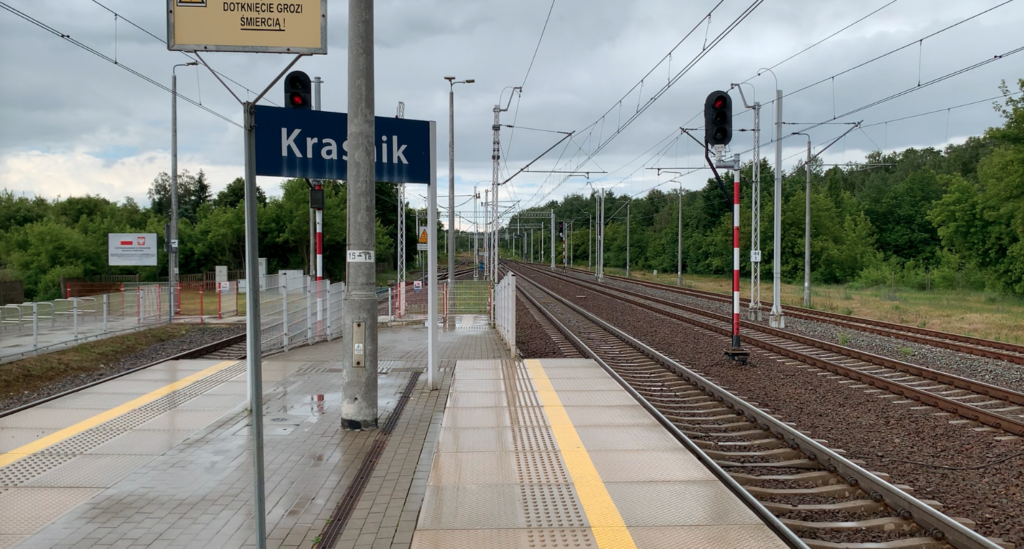
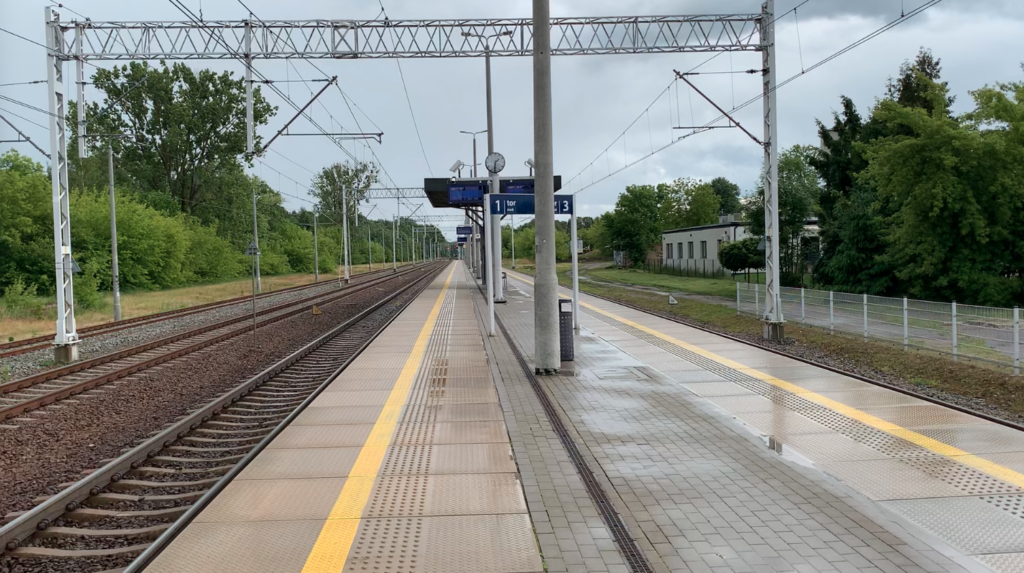
The station has undergone a comprehensive modernization. The track layout was altered, with new tracks and turnouts installed. Railway traffic control systems were upgraded, and control operations for the station were transferred to the Szastarka Local Control Center (LCS). Four through-tracks now run through the station—one main track and three additional tracks. A new, elevated platform, measuring 250 meters in length and approximately 6.50 meters in width, was constructed between track No. 1 and track No. 3. Access to the platform is provided at track level from its northwestern end. Several side tracks have been retained, including sidings serving a nearby scrap yard, a warehouse, and a former military unit, while the siding that once led to a sawmill has been converted into a stabling track. Redundant and disused side tracks were removed. The new track No. 3 was built on the site of the former track No. 5.
The railway line to the Kraśnik Fabryczny station was completely dismantled, partly due to the construction of the S19 expressway. The line was 6 kilometers long. Railway traffic on this line was suspended in 2011, and the tracks were dismantled in 2013. The line ran parallel to Provincial Road (DW) No. 833—specifically, the street known as Lubelskiego Lipca 1980. Within the factory grounds, the former rail alignment has become overgrown with self-seeded vegetation, though the streetlights remain.
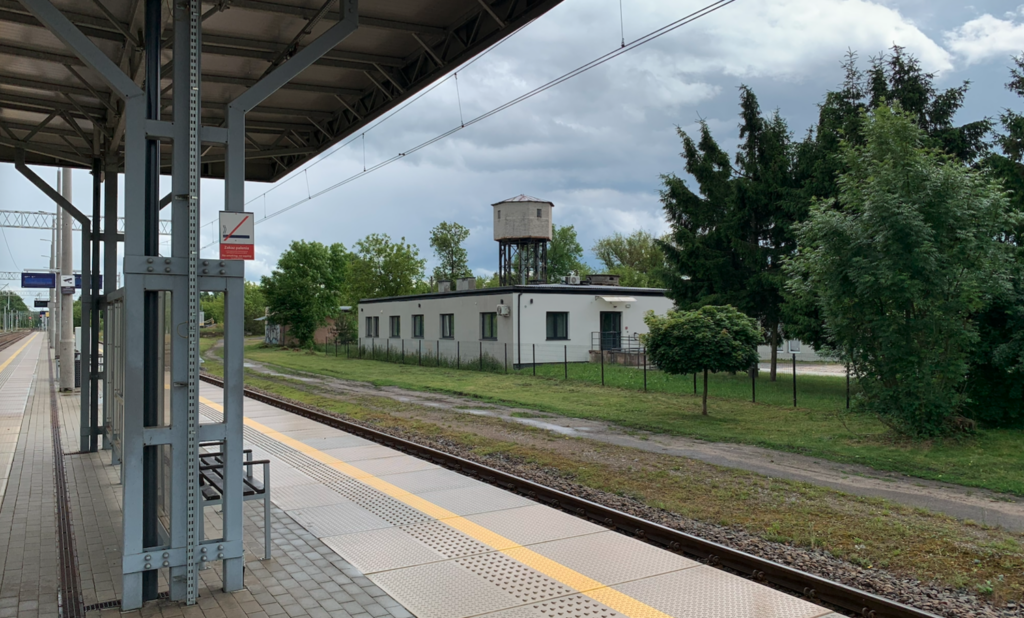
The platform at Kraśnik station is 250 meters long and approximately 6.50 meters wide. The edge paving slabs are beige and feature an anti-slip surface, a yellow warning line, and tactile paving studs. The remainder of the platform is paved with concrete blocks, and a linear drainage system is in place for rainwater. The platform is equipped with lighting, a public address system, CCTV, a small canopy, benches, waste bins, clocks, and various information boards and display cases. The canopy, however, is problematic; it is positioned too high and offers no protection against the wind.
Both of the old railway signal boxes—the “K” control signal box (facing the direction of Lublin) and the “K1” subordinate signal box (facing the direction of Szastarka)—have been decommissioned and demolished. These signal boxes utilized centralized mechanical interlocking systems integrated with light signals, representing a relatively modern standard for their time.
During the renovation of the Kraśnik station and the concurrent upgrade of railway line No. 68, the Kraśnik station served as a terminus. Initially, it functioned as such for trains arriving from and departing to Stalowa Wola and Rzeszów (March–September 2018), and subsequently for trains arriving from Lublin (September 2018 – March 2019). Passengers continued their journeys via replacement bus services.
Under the administration of the United Right (Zjednoczona Prawica), a significant electrification project was carried out on railway line No. 68 and at the Kraśnik station. The investment took place between March 2018 and March 2019. This electrification led to a substantial increase in train traffic along this route.
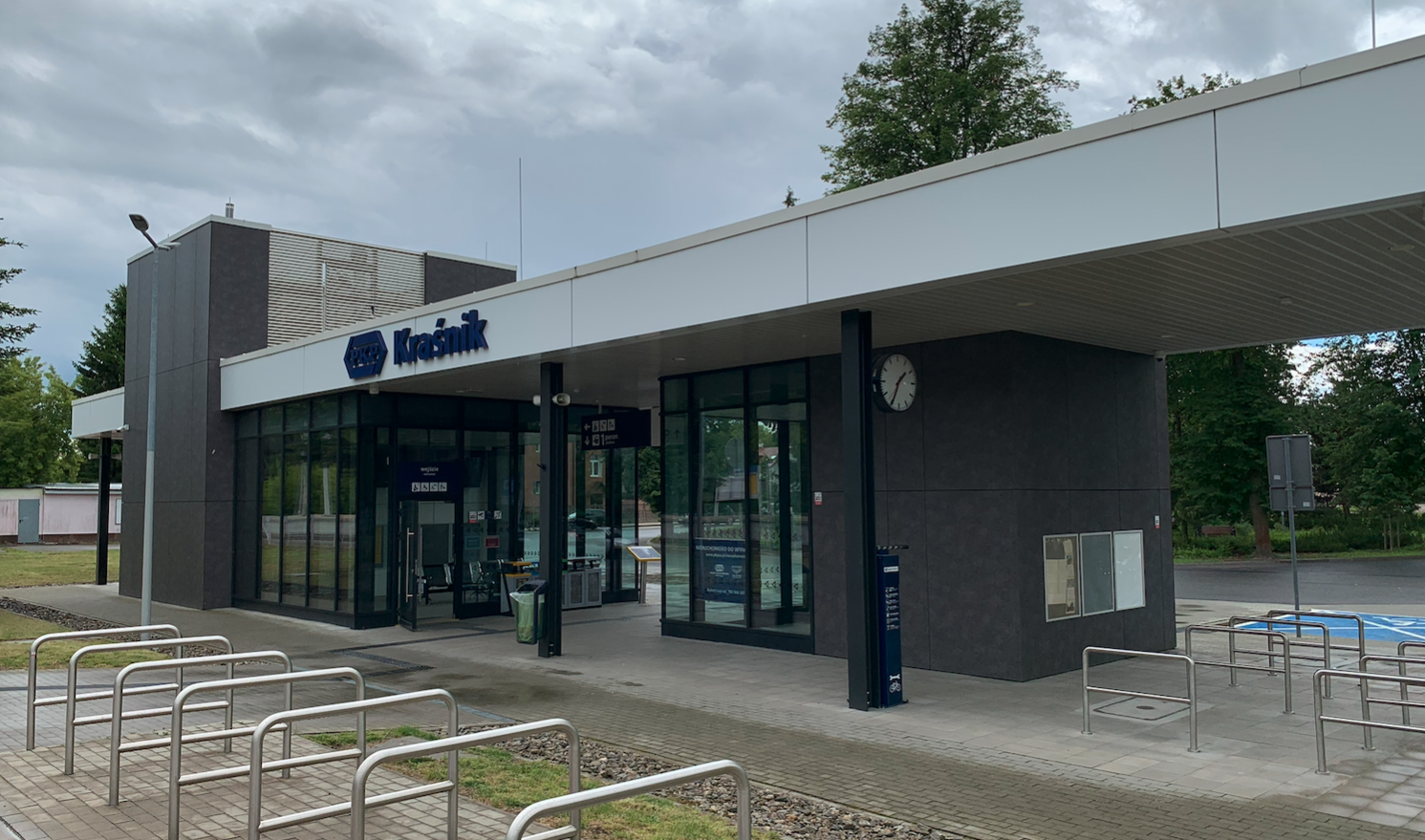
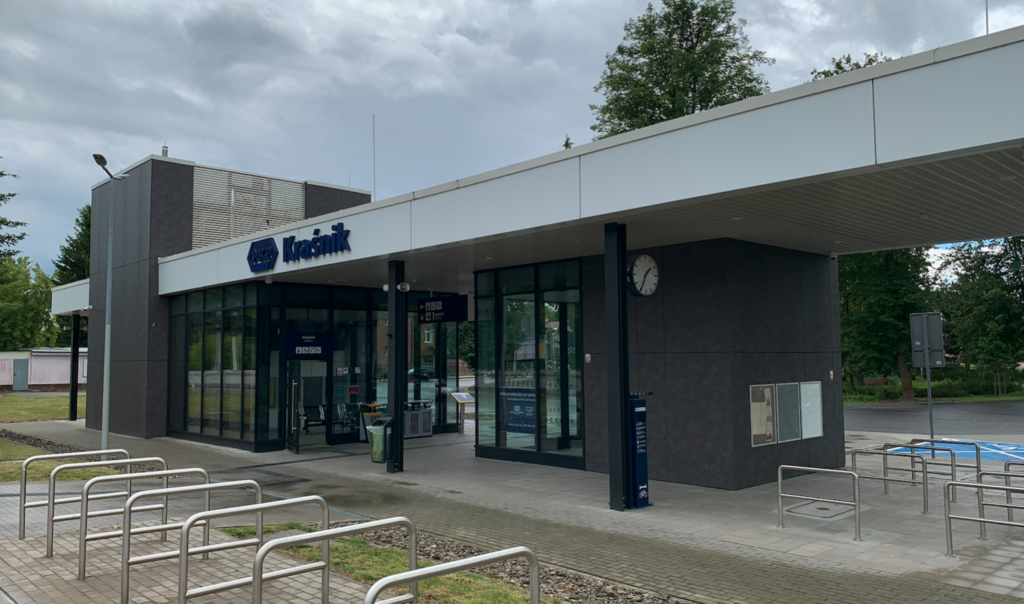
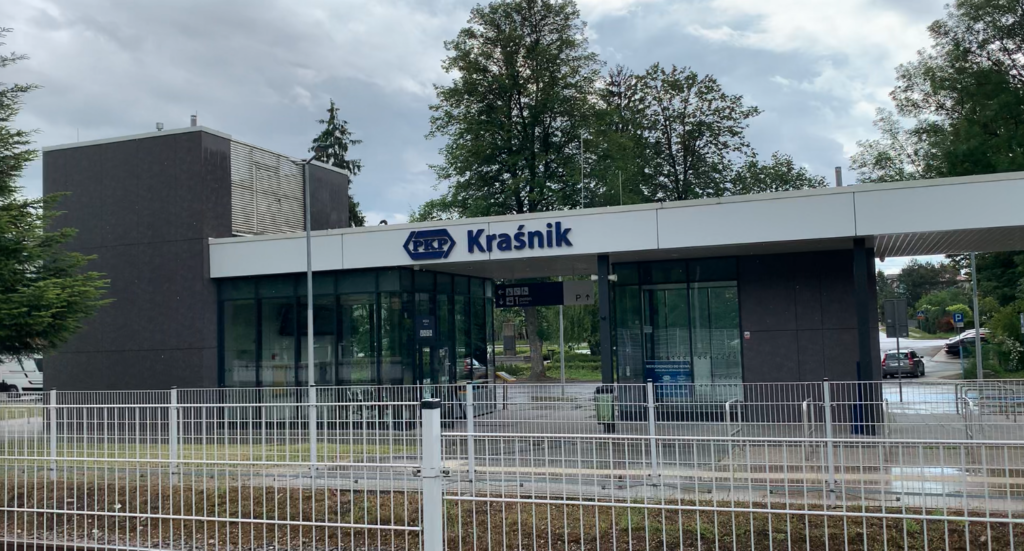
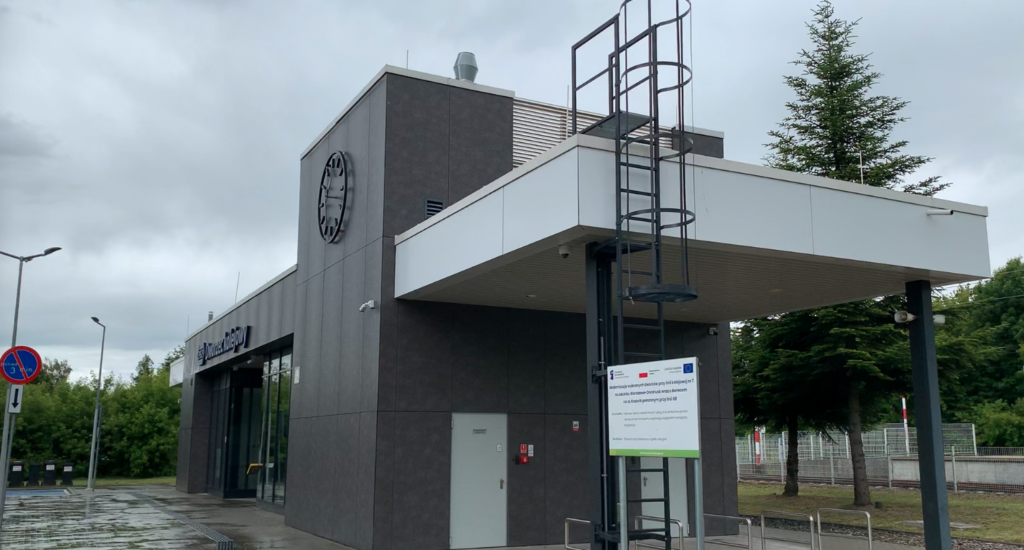
The new station building in Kraśnik was constructed based on a standardized, modular design. A station in Sadurki was also commissioned around the same time; the two differ in their exterior facade finishes. In August 2020, to facilitate the construction of the new facility in Kraśnik, temporary modular units (containers) were installed to house a ticket office, a waiting area, and restrooms. A major challenge in Kraśnik was the lack of maps detailing underground utility infrastructure; the process of surveying and documenting these installations took several months. By April 2021, favorable weather conditions allowed work to proceed according to schedule, with the building’s structural framework already completed. The new station opened on November 7, 2022. The building includes a waiting area, restrooms, utility and technical rooms, and space for passenger services—such as a ticket counter and a ticket vending machine. It features electronic train arrival and departure boards, an ATM, and a vending machine for drinks and snacks. The facility is accessible to people with disabilities. A bicycle parking area and a bike repair station are located under a canopy.
The building was constructed as an “Innovative System Station” (Innowacyjny Dworzec Systemowy – IDS). It is a single-story structure that includes a waiting area, restrooms, electronic arrival and departure boards, a ticket machine, accessibility features for people with disabilities, and a clock tower. The project cost approximately 5 million PLN.
The station in Kraśnik is part of the “Innovative System Station” (IDS) initiative—a proprietary project developed by PKP S.A. (Polish State Railways). A total of 40 such stations were planned across Poland as part of the Station Investment Program for the 2016–2023 period. However, this does not mean that all 40 projects have been completed.
It is worth noting that there are three variants of the “Innovative System Station” (IDS) design: IDS-A—a smaller version with a semi-open waiting area; IDS-B—a larger version featuring an enclosed waiting area and service spaces; and “custom” (individual) IDS designs, tailored to specific stations. I do not have a confirmed, up-to-date total for all IDS projects completed as of November 2026. The current administration, which is systematically destroying Poland, poses a problem. According to materials from PKP S.A. (Polish State Railways) and lists of station investments, Innovative System Stations (IDS) have been constructed at the locations listed below. It is necessary to distinguish between the standardized IDS-A and IDS-B buildings and the custom (individual) designs. List of stations with IDS-type facilities: IDS-A (smaller buildings) – Biadoliny Szlacheckie, Żelistrzewo, Gorzkowice, Wilkoszewice, Barchów, and Przetycz. IDS-B (larger buildings) – Chałupy, Biskupice Wielkopolskie, Pobiedziska Letnisko, Janikowo, Rogów, Chrzęsne, Dobczyn, Ząbki, Czarna Tarnowska, Sterkowiec, Kanie, Kraśnik, Sadurki, and Świdnik Miasto. Stations with custom (individual) IDS designs include: Nasielsk, Mława, Ciechanów, Strzelce Krajeńskie Wschodnie, Pomiechówek, Oświęcim, Sędziszów Małopolski, Bielsko Podlaskie, Nidzica, Czeremcha, and Nowy Tomyśl.
Between the Lublin Główny and Stalowa Wola Rozwadów stations, this is one of only two stops served by long-distance trains. The other station is Zaklikowa. In 2017, the Kraśnik station handled up to 200 passengers per day. Passenger traffic grew steadily, reaching 500 passengers per day by 2024. There was a slight decline during the pandemic (2020–2021). The Kraśnik station is served by the following InterCity trains: No. 3538 “Bystrzyca” (Bydgoszcz Główna – Rzeszów Główny), No. 23108 “Smok Wawelski” (Kraków Główny – Lublin Główny), No. 3836 “Noteć” (Piła Główna – Rzeszów Główny), No. 1338 “Wisłok” (Rzeszów Główny – Warszawa Zachodnia), and No. 8334 “Zamoyski” (Rzeszów Główny – Szczecin Główny)—totaling 5 pairs of InterCity trains. The remaining services are operated by the carrier PolRegio, using electric multiple units (EMUs). As of November 18, 2026, 30 passenger trains depart from the Kraśnik station daily. Destinations include Bydgoszcz Główna, Kraków Główny, Lublin Główny, Piła Główna, Rzeszów Główny, Stalowa Wola Południe, Stalowa Wola Rozwadów, Szastarka, Szczecin Główny, and Warszawa Zachodnia.
Adjacent to the railway station is a bus loop with a stop named “Dworzec PKP” (Railway Station). It is served by the local public transport operator (MPK Kraśnik) as well as private bus carriers. At the station, there is a water tower supported by an openwork steel structure. The tower remains in use, supplying water to nearby households. Adjacent to this tower, remnants of an older water tower have also been preserved.
Written by Karol Placha Hetman