Jarocin 2026-04-04
Jarocin is a city in west-central Poland, in the Greater Poland Voivodeship. The city is the seat of Jarocin County and the Jarocin Commune. In 2021, the city’s population was 26,410, and in 2025, 26,253. The city has an area of 22 square kilometers. Vehicle license plates are PJA. The city is located in the Greater Poland Lowlands, in a predominantly flat area favorable for agriculture. Jarocin is located in the Southern Greater Poland Lowland, on the Kalisz Upland. Small streams flow nearby, which belong to the Warta River basin. The distances from Jarocin to Ostrów Wielkopolski are as follows: 47 km, Kalisz 50 km, Leszno 69 km, Poznań 70 km, Wrocław 110 km, and Warsaw 262 km.
The town was granted its charter around 1283. It has a long history dating back to the Middle Ages and a preserved urban layout with a market square. Jarocin’s development accelerated in the 19th century thanks to the construction of the railway and the development of crafts and trade. The town served as a local administrative, educational, and service center for the surrounding towns. Today, Jarocin combines a peaceful, regional character with well-developed infrastructure and convenient transportation.
The patron saint of Jarocin is Saint Martin. This fact was confirmed by the Jarocin City Council on March 1, 1996, and by Stanisław Napierała, Bishop of Kalisz, on January 12, 1997. On November 11, 2005, a stained glass window depicting St. Martin was unveiled in the hall of Jarocin City Hall. The Day of the City’s Patron Saint is celebrated on November 11 and the following weekend. A tradition inherent in the Day of the City’s Patron Saint celebrations is the ride of St. Martin on horseback through Jarocin’s Market Square.
History
Nomadic peoples arrived in this area as early as 4500 BC. People of the Lusatian culture began to settle here, followed by those of the Przeworsk culture and the influence of the Roman Empire. The settlement was established in the 13th century. The first uncertain written mention dates back to 1257. The date is certain, as it appears in a document of Przemysł II, 1283. The name Jarocin comes from the personal name Jarocin with the suffix -in. By the end of the 13th century, the town had the right to hold eight fairs a year. Jarocin was a noble town, composed of several parts, each owned by a different family. The town was plagued by fires and plagues, but it always recovered. The town fell into ruin during the Swedish invasion and subsequent wars. By the end of the 18th century, Jarocin belonged to the Radoliński family.
Until the Second Partition of Poland (1793), Jarocin was located in the Kalisz Voivodeship, and from 1793 onward, Jarocin was part of the Prussian Partition. Because Jarocin was occupied by Germans for a long time (Prussian Partition), Germanization continued. The Germans changed the name of Jarocin to Kesselberg, and then to Jarotschin.
In 1871, the town’s population reached 2,210. Three-quarters of the residents were Poles and Catholics. The town had 204 residential buildings. By the beginning of the 19th century, the town had a police station, a conscript office, the office of the Prussian district commissioner, a Catholic church, an elementary school, a post office with a telegraph, and a postal station for stagecoach services. The residents were primarily farmers. There were also millers and other craftsmen. There were two distilleries and a brewery. In the second half of the 19th century, the town hosted four fairs annually. In 1887, Jarocin became the seat of the newly established district.
In the second half of the 19th century, two railway lines ran through Jarocin. The first was the Poznań-Kluczbórz railway, and the second was the Oleśnica-Gniezno railway. The town gained rail connections with other towns in Greater Poland, which influenced its economic development. By the end of the 19th century, the town’s population reached 6,250.
In 1914, the Germans began the Great War, which they ultimately lost. Moreover, they lost much territory to the reborn Polish-Lithuanian Commonwealth. On December 27, 1918, the Greater Poland Uprising broke out. The insurgents captured the city’s strategic points: the post office and the railway station, preventing any possible transport of Germanic troops. Jarocin was finally taken over by the Polish Army on January 1, 1919.
On September 1, 1939, the Germans began World War II. The Germans transformed Greater Poland into a new state, the Warthegau. As part of the colonization campaign, the Polish population was expelled to the General Government, and the German population was brought in. In January 1945, Jarocin was occupied by the Soviets. The 33rd Army of the 1st Belorussian Front entered the city. Fifty-six Muscovites died in the fighting for the city, far too few. And another Moscow occupation began.
Before 1975 and since 1999, Jarocin was the seat of the Jarocin County. During the period 1975–1998, Jarocin administratively belonged to the Kalisz Voivodeship. After World War II, Jarocin experienced economic development. In 1977, a new factory of the Jarocin Furniture Factory was built. In 1978, the new Wojska Polskiego Street was opened, improving transit through the city. In 1982, a factory was founded; the Jarocin Machine Tool Factory “Ponar-Jafo.” In 2017, the Jarocin Furniture Factory was closed. On January 1, 2018, the area of Jarocin increased by 44.33 hectares through the incorporation of some of the outer areas into the existing city limits.
The town of Jarocin boasts several valuable historical monuments: St. Martin’s Church from 1610. The town hall, built between 1799 and 1804, now houses the local government and the Regional Museum. The palace and park complex: the Radoliński Palace, a neo-Gothic structure (1836–1850). The treasury in the palace park is a remnant of a medieval castle, rebuilt before 1894, and now houses the Regional Museum. The ruins of the Gothic Church of the Holy Spirit from 1516, in ruins since 1856. The Polonia Hotel, built in the 19th century as a representative structure, has housed the PKO BP bank since 2007. A granary from the early 19th century. The post office building from the early 20th century. The municipal water tower from 1903. The Cooperative Bank building from around 1870. The town hall building from 1892.
National roads running through the city include: No. 11 Kołobrzeg – Piła – Poznań – Jarocin – Ostrów Wielkopolski – Lubliniec – Bytom. No. S11 (2017) City Bypass: Wolica Pusta – Jarocin – Witaszyczki. No. 12 Łęknica – Leszno – Jarocin – Kalisz – Radom – Dorohusk. No. 15 Ostróda – Toruń – Gniezno – Jarocin – Trzebnica. Regional Road No. 443 Jarocin – Gizałki – Rychwał – Tuliszków. Between 2018 and 2023, 39,067 meters of roads and 8,900 meters of bicycle paths were built in Jarocin.
The economy in Jarocin is recovering very slowly. The governments of post-communists, Freemasons, and Volksdeutsche (Volksdeutsche) are striving to eliminate the Polish-Lithuanian Commonwealth and completely subordinate it to Germans. Currently, Jarocin belongs to the Wałbrzych Special Economic Zone. The city has approximately 50 hectares of available investment land. Municipal companies have been established to handle water and sewage management, municipal waste management, and municipal construction. Most industrial plants are located in the western part of the city, enclosed by Aleja Niepodległości and Powstańców Wielkopolskich streets. The most important companies in Jarocin include: RBB Stal, which operates a steel service center and a comprehensive steel processing facility. P11 Group, a manufacturer of indoor and outdoor advertising. Hydro Marko, a company specializing in the comprehensive implementation of investments in the construction of water, sewage, and industrial facilities. Drobud, a road works company. Biernacki, a meat processing plant. Etos, a feed product manufacturer. GOPOL Sp. z o.o., a manufacturer of professional tools for mechanical wood processing. Farmio Poultry Plants Sp. Martin Bauer Polska Sp. z o.o. – a producer of herbs and teas. Construction of new apartments is underway to prevent the emigration of residents. Since 2018, the city has been revitalizing the city’s green spaces, parks, and squares.
16th Jarocin Airport Repair Battalion, named after Brigadier General Stanisław Taczek. Currently, it is an independent logistics unit of the Air Force, as Military Unit 3918. The unit’s history dates back to April 1945, when the 1st Independent Engineering-Airport Battalion was formed in Dęblin. In August 1946, the unit was relocated to Łódź. Subsequent deployments included Oksywie, Elbląg, Grudziądz, and in 1957, finally to Jarocin.
Railway History in Jarocin.
Address: PKP Jarocin – ul. Dworcowa 2, 63-200 Jarocin. Geographic coordinates: 51.968 N, 17.494 E. Elevation: 125 m.
Railway history in Jarocin began in 1875, when the Oleśnica-Gniezno railway line was opened. This was relatively late compared to other regions of the present-day Polish-Lithuanian Commonwealth. The line was built as part of the Lower Silesian Railway. On June 30, 1875, the Oleśnica-Jarocin-Gniezno (OGnE) section was opened. On October 1, 1875, a line was opened as part of the Poznań-Kluczbork Railway Company; Poznań-Jarocin-Kluczbork. Jarocin thus became a junction station. Further railway lines were built; Jarocin – Gostyń – Leszno, as well as Mieszków – Śrem – Czempiń.
The history of the Jarocin junction began on October 7, 1872, with the issuance of a concession to the Poznań-Kluczbork Railway Company, headquartered in Poznań, for the construction of the Kluczbork-Poznań Railway. Designs had been in development since 1867. Almost simultaneously, a plan for another railway line was developed, also running through the Jarocin region. It was to connect the Oleśnica-Gniezno stations in a north-south direction. Plans for this line were developed in 1870-1871. This route was of strategic importance, as it ran along the border with the Moscow Partition, but it was also intended to contribute to economic development. The construction of the railway was financed by the Oleśnica-Gniezno Railway Company, based in Oleśnica. On June 17, 1872, King William I of Prussia issued a concession deed for the construction and operation of the Oleśnica-Gniezno line. On April 16, 1871, the construction of the Oleśnica-Gniezno line began at the F. Plessner and Sp. Spółka Komandytowa Railway Construction Company. The line was to be completed within three years. However, a lack of liquid financing delayed its completion. The situation was alleviated by contributions paid by defeated France.
There was no doubt that the two railway lines would have to intersect. The towns considered were Pleszew, Koźmin, or Jarocin. Ultimately, in March 1873, the Germans decided that Jarocin would be the railway junction. On June 30, 1875, trains began running between Oleśnica and Gniezno, and from December 10, 1875, between Poznań and Kluczbork.
The Jarocin railway station was located on land belonging to the Bogusław estate, which belonged to Count Władysław Radoliński, the owner of Jarocin. Trains first ran through the city from Oleśnica to Gniezno, and then from Poznań to Kluczbork. Each line was operated by a different operator. Therefore, passengers traveling on the Kluczbork – Jarocin – Gniezno route had to transfer in Jarocin.
Initially, three pairs of trains operated on the Poznań – Kluczbork route: two passenger trains and one freight train. In reality, the passenger trains contained freight wagons. There were four classes of passenger cars. The passenger train stop at the Jarocin station lasted eight minutes. The train covered the Jarocin – Poznań route in 1 hour and 55 minutes, covering a distance of 70 km. Initially, two pairs of trains operated on the Oleśnica – Gniezno route. The journey from Jarocin to Gniezno took 1 hour and 50 minutes, covering a distance of 69 km.
The development of the railway contributed to economic recovery. The railway facilitated the transport of goods, primarily agricultural produce, and increased the city’s importance in the region. Railway infrastructure was established: a station, sidings, warehouses, a storage yard, and technical support facilities.
In 1888, the Jarocin-Leszno railway line was opened, followed in 1906 by the Jarocin-Śrem railway line. From October 1, 1888, connections were established from Jarocin to Leszno, and from October 1, 1906, to Śrem. Both lines were built with state funds. In 1906, construction began on a second track on the Jarocin-Gniezno section.
But this was after the nationalization of the Prussian railways. The process of nationalizing railways in the Germanic state did not take place in a single year, but in stages. The most important period was 1879-1884. During this period, the Prussian state purchased most of the private railway lines. This was advantageous for passengers, as they purchased tickets from the departure station to the destination. In 1879, a law nationalizing the previously private railway lines was passed. Thus, in 1884, the state authorities purchased the Poznań-Kluczbórz railway, and in 1886, the Oleśnica-Gniezno railway. Following the nationalization of the railways, administrative reorganization took place, establishing offices for traffic, tariffs, rolling stock, routes, and workshops. Individual offices sent reports to the management, and based on these reports, orders were issued and projects were financed. Subsequent railway lines were built with state funds.
As the railway junction expanded, residential buildings also grew for the growing social group of railway workers. Their service buildings were built on Moniuszki, Sienkiewicza, and Nowa Streets. In other parts of the city, for example, on Chrobrego Street and adjacent areas, single-family housing began to be built. During the interwar period, houses for railway workers were also built along the railway tracks near the cemetery.
In 1888-1889, a locomotive shed with workshops for repairing steam locomotives and wagons was built. At the end of the 19th century, a railway power plant was built, which powered the entire railway junction, especially the railway station building. The station lacked gas lighting. The station in Jarocin was the first in the Duchy of Poznań to have electric lighting. In 1903, a railway waterworks system with its own water intake, powered by a steam engine, was launched. A sewer system was built a few years later. At the initiative of Polish physician Dr. Józef Niklewski, a railway health clinic was opened. The station was modernized. Wooden structures were replaced with larger brick ones.
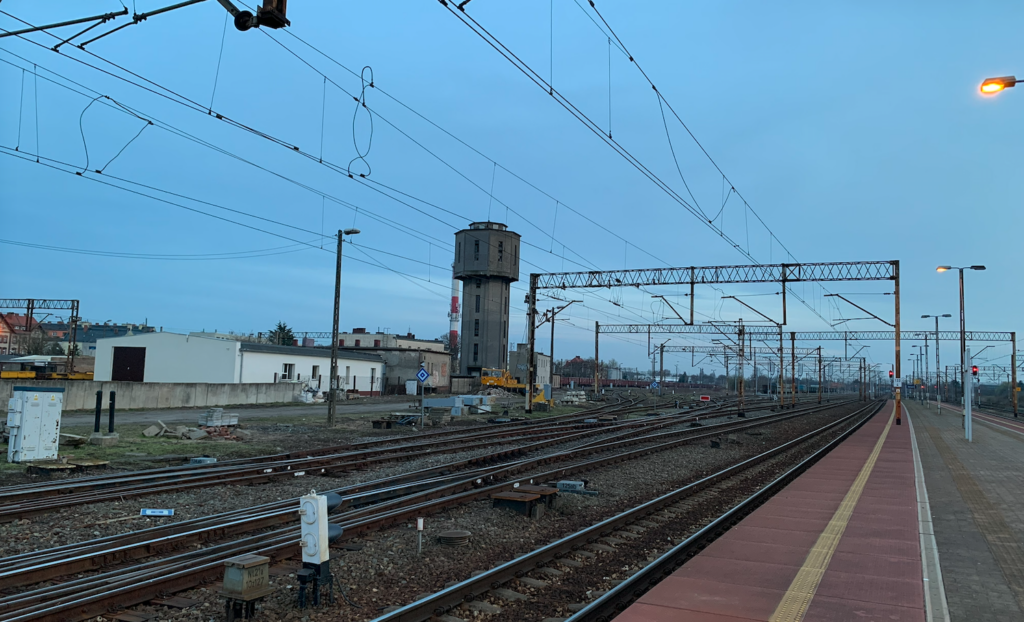
In 2010, on the station level, on the eastern side, there was one platform and one platform edge. On the western side, there were two platforms and three platform edges. A brick water tower stood in the northern part of the station. The tower was as tall as the station building. Around 1910, two passenger tunnels were built: one for the eastern side, the other for the western side. Around 1915, a second, circular water tower was built in the southern part of the station.
At the beginning of the 20th century, Jarocin station played an important role, handling both passenger and freight traffic. Railway service required specialized workers, a large family of railway workers. They constituted a very important and numerous community in the town. In 1932, 215 railway workers were employed at the Jarocin railway station. There were administrative workers, officers, cashiers, mechanics (engine drivers), signalmen, auditors, crossing guards, locomotive workers, and freight workers. Including their families, there were approximately 2,000 people, and the entire Jarocin town had a population of 8,000.
Additional buildings were constructed at the railway station, intended for control, passenger and freight transport, and engineering structures with all the railway infrastructure. There was a water tower with a pumping station, coal entanglements, and steam locomotive maintenance areas. The station’s most important facility was the locomotive shed, more commonly referred to in Greater Poland as a “locomotive shed” (“parozożowa”), and in other regions of Poland as a “szopa” (“shed”). In France, it was called a “depo” (“depot”). This facility was not used as a garage for storing locomotives, but for their maintenance and repairs.
On the night of November 8-9, 1918, a revolution broke out in the barracks in Jarocin, and the first Polish Soldiers’ Council in the German Partition was established. Polish soldiers occupied the barracks, post office, prison, and railway station. On November 29, 1918, a branch of the Polish Railwaymen’s Association in Poznań began operating in Jarocin. Many more Polish associations and organizations associated with the Polish State Railways (PKP) were later established. On December 27, 1918, the Jarocin railway junction had 40 locomotives and 600 passenger and freight cars. The entire railway infrastructure was operational. A significant stockpile of hard coal had been accumulated. The Germans were sent west. On October 25, 1919, Chief of State Józef Piłsudski stayed at the Jarocin station, traveling to Poznań for the ceremony of assuming civil and military authority in the liberated areas of Greater Poland. At the station, the Chief was greeted by Polish regional authorities. Photographs of this event have survived.
In 1920, the new PKP company reorganized its operations to meet the needs of the Polish economy. The main task of the Jarocin station became the formation of long-distance passenger trains. The locomotives and passenger cars were added to the inventory of the Jarocin Locomotive Depot. There was a rescue train in stock, which was sent to the following routes: Jarocin – Środa, Jarocin – Września, Jarocin – Pleszew, Jarocin – Krotoszyn, Jarocin – Piaski, Piaski – Koźmin, Mieszków – Czempiń.
The large community of railway workers fueled the development of cultural life. In 1920, a railway choir called “Lutnia” was established. Over time, an amateur theater group was formed, which presented musical productions and operettas. Social evenings and dances were organized. In 1925, a railway orchestra was established.
In 1934, railway workers founded an aid association called “Rodzina Kolejowa” (Railway Family). The association’s mission was to help those in distress. They helped widows and orphans, organized medical examinations and assistance for the sick, provided meals for children, and organized children’s clubs. The association established the first Scout troop in Jarocin, named after the pilot Captain Franciszek Żwirko. Children grew in number and were divided into Scout and Cub Scout troops. Bicycle trips and sports competitions were organized.
In 1937, by order of the Minister of Railways, two lines running through Jarocin were classified as connections of primary importance to the country. Jarocin had one of seven first-class stations and one of eight locomotive sheds. On June 17, 1938, a special train carrying the relics of St. Andrew Bobola passed through Jarocin.
In 1938, a trapdoor was installed in the locomotive shed for the repair of steam locomotives. A car wash was built near the shed for cleaning and washing passenger cars.
In the second half of the 1930s, Jarocin had more than a dozen social organizations, including railway workers and their families. The most numerous were the Society of Polish Railwaymen, the Trade Union of Railway Engineers, the Trade Union of Railway Employees, the Trade Union of Conductor’s Teams, the Union of Railway Switchmen, and the paramilitary organization Railway Military Training. In 1939, Jarocin had approximately 2,100 railway workers and their families, out of a population of approximately 8,200. On April 1, 1939, the Jarocin locomotive depot housed 47 steam locomotives and approximately 700 passenger and freight cars.
This was a time of growing Germanic imperialism. In Greater Poland, the Germanic minority was becoming increasingly arrogant and arrogant. In October 1938, a demonstration called “Railwaymen of the Army” took place. Employees of the Jarocin State Railways raised 6,500,000 złoty to purchase a machine gun for the 68th Polish Infantry Regiment stationed in the town. The ceremonial dedication and handover of the weapon took place in the Jarocin market square.
Unfortunately, on September 1, 1939, the Germans, along with their Muscovite brethren, invaded the Polish-Lithuanian Commonwealth and began World War II. The railway infrastructure in Jarocin was partially destroyed. The armored train “Poznańczyk” was assigned to the Jarocin station, and fought on the Krotoszyn-Września line. After dispatching evacuation transports, on September 3, 1939, at 2:00 PM, the Poles blew up four railway viaducts and key track switches and connections. The evacuation proceeded along the route towards Gniezno. The steam locomotive leading up the transport had a plow attached to it for breaking railway sleepers. The multi-span railway bridge, the largest in the Poznań District Railway Protection Corps (DOKP), over the Warta River, near Dębno, was destroyed. On September 6, 1939, the town of Jarocin was taken over by the Germans. German terror began.
For about three months, the Germans repaired the damage caused by the 1939 Defensive War. They employed prisoners of war and forced laborers. During the occupation, the Germans modified the locomotive irrigation system. They built a 16-kilometer-long water pipeline from the Warta River to the railway station. A pumping station was built near the railway bridge in Orzechów. The water filled the station’s water tower.
Retreating from Jarocin, the Germans destroyed the station’s water tower and the water reservoir in the locomotive shed. On January 24, 1945, the Soviets entered Jarocin, and a new occupation began: the communist one. As early as January 25, 1945, former Polish railway workers returned to work. Rail connections between Jarocin and Poznań were quickly established. Initially, trains ran through Śrem and terminated at the Luboń station. From February 25, 1945, trains to Poznań ran along the Kluczbork-Poznań route.
In 1948, the Railwayman Cultural Center was opened, built on the site of the former shooting range of the Railway Military Training Center. The opening of new production plants in the city led to the construction of additional sidings. Railway soldiers were stationed near the steam locomotive turning triangle, supporting the railwaymen in work related to the track surface and engineering structures.
At the beginning of the 1960s, a new reinforced concrete water tower was erected at the station, similar to those in Olsztyn, Gniezno, and Piła. The turntable at the locomotive shed was renovated. At that time, the Ol49 steam locomotives, popularly known as “Oelki,” and the TKt48, also known as “Tekatki,” reigned supreme at Jarocin.
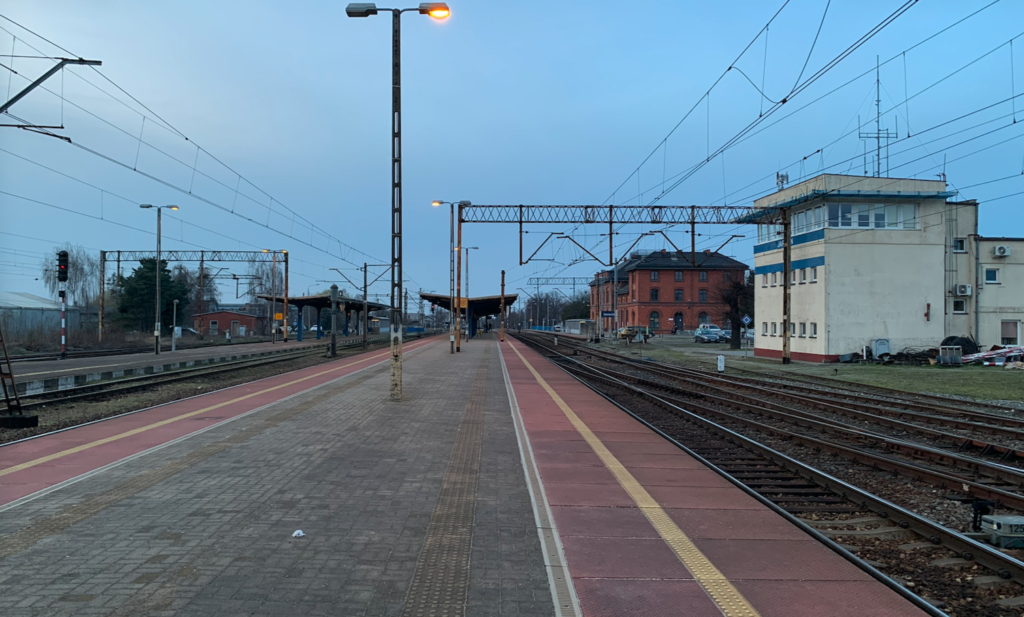
On December 31, 1974, the electrified section of the Poznań-Ostrów Wielkopolski line was opened, followed by the Gniezno-Jarocin section on November 25, 1976, and the Jarocin-Krotoszyn section on November 28, 1987. At the same time, the entire station was electrified. A specialized mainline train was introduced to the station. A project to build a large, modern locomotive shed in the Ługi housing estate, on Odrzańska Street, was developed, but ultimately never implemented. In September 1979, the company’s vocational school opened at the station. At the beginning of the 1980s, the locomotive shed was modernized. The building was raised and a new roof was installed. Equipment and machinery for servicing and repairing rolling stock were replaced. Between 1975 and 1980, a new master signal box was built. The signal box has operator stations on the eastern and western sides. It was equipped with electrical relay devices. Previously, mechanical devices had been used. By the mid-1980s, the old pro-German signal boxes had been decommissioned. Two signal boxes remained as rear-end control stations. In 1976, two reinforced concrete viaducts were built over the tracks at the level crossings along Powstańców Wielkopolskich Street. In the 1980s, the railway viaduct over Poznańska Street on the line to Gniezno was renovated. In addition to the renovation of the old brick viaduct, two pedestrian and bicycle tunnels were built on both sides of the roadway.
In 1983, diesel locomotives were assigned to the railway junction. A fuel station was built to service them. Initially, the locomotives were ST43 and SM42.
In the 1990s, when Polish society hoped for normalcy, disappointment quickly set in. Former communists became businessmen and enriched themselves with state assets. State-owned companies received no state aid. A rampant privatization ensued. People whom Poles trusted turned out to be traitors, Volksdeutsche, post-communists, and Freemasons. The 1990s saw a multi-year railway crisis, which had a tragic impact on many connections. Railway lines and even entire stations were closed. The crisis affected all planned investments at the Jarocin junction. Organizational changes at the Polish State Railways (PKP) failed to stem the crisis. On March 27, 1995, the passenger rail service from Jarocin to Czempiń was closed. Attempts were made to replace this connection with bus service. Other rail services were severely limited.
In April 1992, the locomotive depot ceased operation of its steam locomotives. In 1996, the water tower was decommissioned. Most of the water cranes were removed. The marshalling yards for forming freight trains were removed. In 1996, the police station was closed, marking the beginning of the dismantling of Polish state structures. The station was located near the footbridge over the tracks. Around 2000, the railway health service was closed. From 2001 to 2008, Jarocin housed the headquarters of the PKP CARGO Freight Transport Company in Jarocin, and the facility was closed.
On June 18, 1995, a French TGV high-speed train, operating in Poland for advertising purposes, stopped at Jarocin station.
The new century saw the continued discontinuation of passenger services. On March 31, 2004, the Jarocin-Leszno service was suspended due to low passenger interest in the service. The truth was different. The carrier did not have a sufficient number of railcars because the line is not electrified. On December 9, 2012, passenger trains to Gniezno were discontinued.
In 2005, the locomotive shed ceased operations, and on November 18, 2007, it was officially closed. On December 21, 2010, PKP CARGO vacated the Jarocin locomotive shed, which was transferred to the administration of the Wielkopolska Railway Society. On March 24, 2007, the Wielkopolska Railway Society was established, headquartered in Jarocin, with the goal of cultivating railway traditions in the Jarocin region and saving the Jarocin locomotive shed from decline by establishing a museum there. On March 7, 2012, the Minister of Culture and National Heritage approved the regulations of the Jarocin Locomotive Shed Museum, granting it museum status. Currently, the Jarocin Locomotive Shed Museum operates periodically within the Jarocin station grounds. The former locomotive shed periodically hosts an exhibition showcasing the history of railways. The locomotive shed hosts railway festivals, usually once a year.
In July 2012, renovations began on the viaducts over the tracks along Powstańców Wielkopolskich Street and lasted until August 2013. In December 2012, the footbridge over the tracks was dismantled, and on June 21, 2013, a new, shorter footbridge was opened, covering only the eastern tracks. During the last renovation, carried out in 2014, Platform 4 was closed. The passenger tunnel was shortened. The signal boxes on the platforms were removed. The telephone exchange in the administration building was removed. In 2016, the former Post Office No. 2 building, which housed the Railway Police station until the mid-1990s, was demolished. In 2019, the former signal box at Platform 2, which housed the Railway Security Guard station, was demolished. A repair shop for SKPL Cargo is located within the Jarocin station. The concourse is located in the southern part of the station.
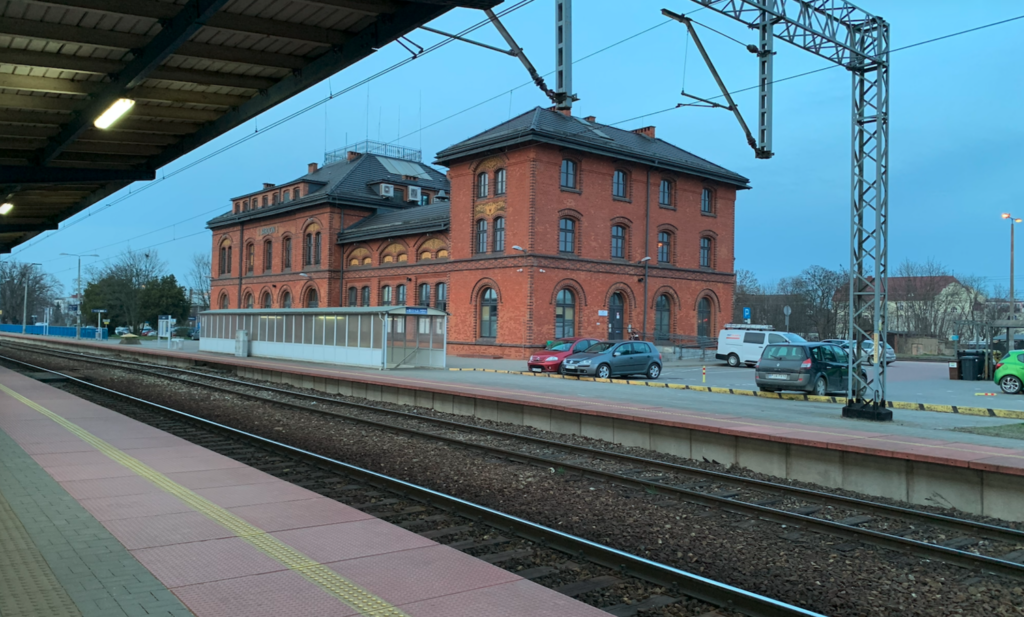
Currently, the station has four platforms and six platform edges. The platforms are numbered 1, 2, 3a, and 3b. Platforms 1 and 2 are island platforms. Platform 1, which has a new track, serves the most trains. Platforms 3a and 3b also have new tracks. Platform 1 is 350 m long, Platform 2 is 300 m long, Platform 3a is 150 m long, and Platform 3b is 200 m long. The shelter on Platform 1 is 115 m long, and that on Platform 2 is 54 m long. The shelters are made of riveted steel and are historical structures.
Railway lines. Railway line No. 272 Kluczbork – Poznań Główny. Jarocin station is located at km 133.57. Railway line No. 281 Oleśnica – Chojnice. Jarocin station is located at km 94.60. Railway line No. 360 Jarocin – Kąkolewo. The line is 58.638 km long. The line was established on October 1, 1888. In 2018, traffic on the line was suspended.
On April 1, 2026, 89 passenger trains departed from Jarocin station. It was possible to travel to the station; Chełm, Frankfurt/Oder, Gniezno, Gorzów Wielkopolski, Kalisz, Kłodawa, Konin, Kraków Główny, Krotoszyn, Krzyż, Lublin Główny, Łęka Opatowska, Łódź Fabryczna, Łódź Kaliska, Odolanów, Ostrów Wielkopolski, Poznań Główny, Szczecin Główny, Świnoujście, Warsaw Wschodnia, Zakopane. There is InterCity train No. 82170 Usedom Chełm – Frankfurt (Oder). This train is mainly used by Germans and Muscovites. There are also other InterCity trains; No. 7324 “Wybicki” Krakow Main Line – Poznań Main Line, No. 7320 “Cegielski” Krakow Main Line – Poznań Main Line, No. 73104 “Kozica” Poznan Main Line – Krakow Main Line, No. 73102 “Pułaski” Krakow Main Line – Poznań Main Line, No. 73100 “Spodek” Krakow Main Line – Poznań Main Line, No. 8220 “Koziołek” Lublin Main Line – Szczecin Main Line, No. 8120 “Włókniarz” Łódź Fabryczna – Szczecin Main Line, No. 38106 “Osterwa” Szczecin Main Line – Zakopane. The remaining connections are operated by Koleje Wielkopolskie (Greater Poland Railways).
The station building.
Initially, the station was occupied by small buildings and barracks. The first station building in Jarocin was built in 1975.
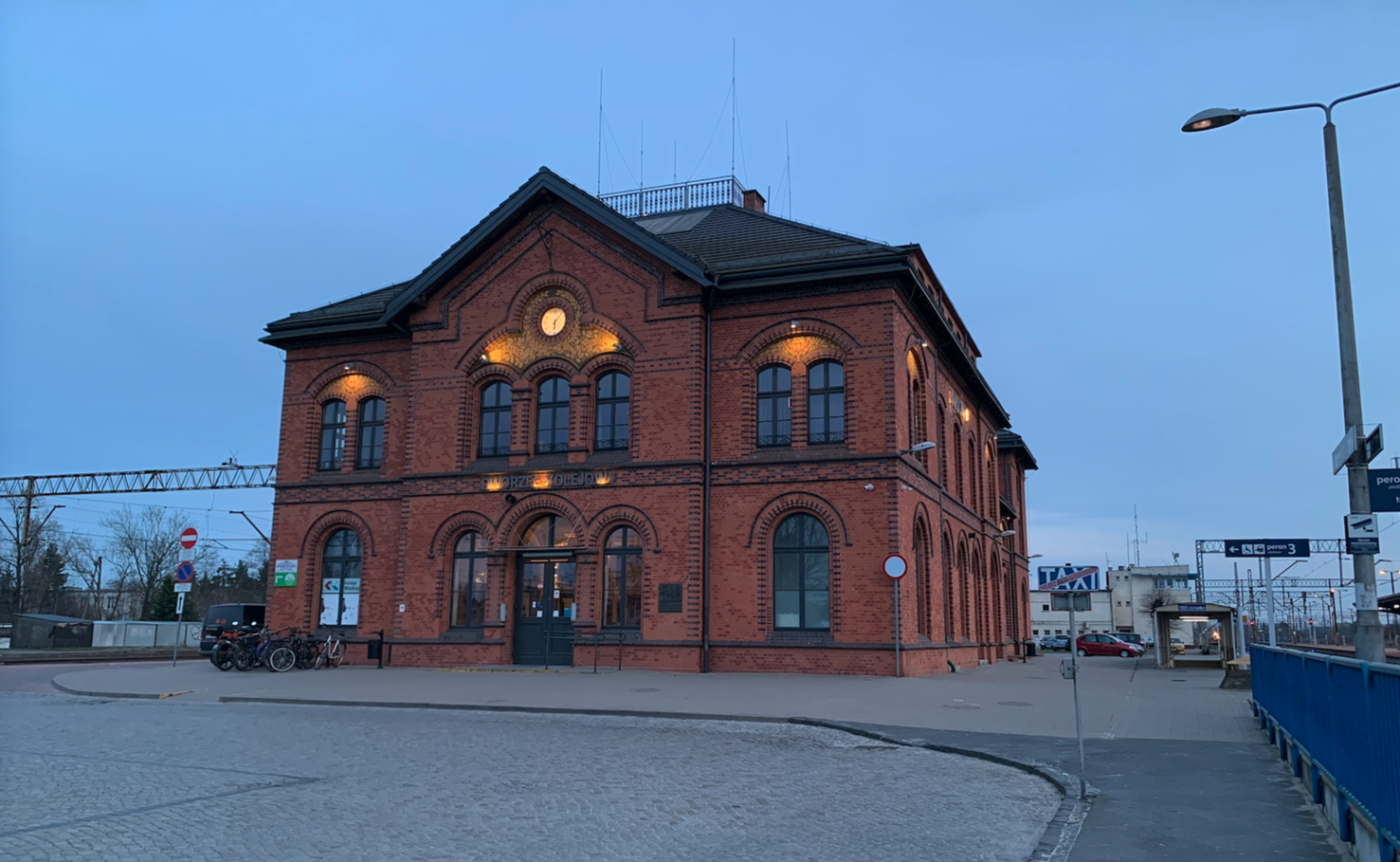
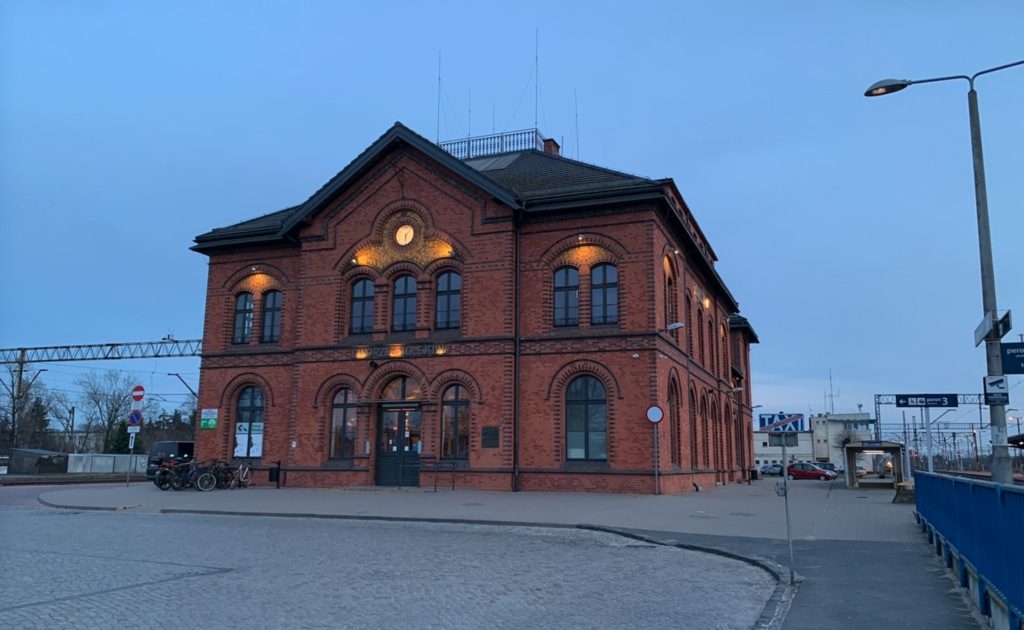
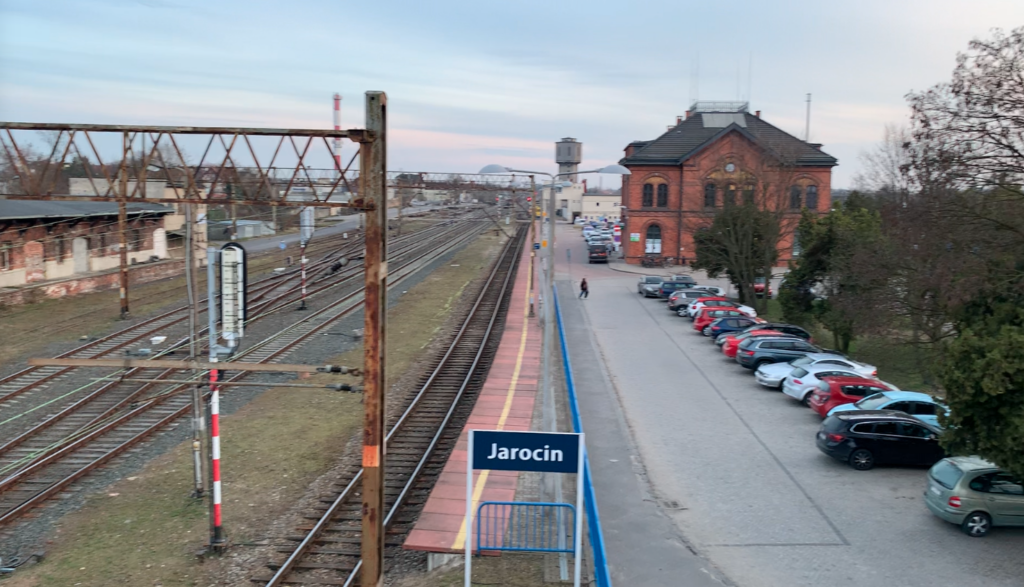
The current station building was constructed between 1880 and 1883 and has only minor changes to its original appearance. A recent renovation of the building showed the year 1883 written in Roman numerals on its western façade; “AD. MDCCCLXXXIII.” However, finishing work lasted until 1886. The building was constructed as an island station, between the tracks of two railway companies. The station building is 40 meters long and 20 meters wide. The station building was the first in the southeastern Greater Poland region to be equipped with electricity. There was no gas lighting system. An elegant restaurant was located in the southern part of the building. The restaurant continued to operate during the occupation and the communist era, until the late 1980s.
From the station square, the representative facade of the island station stands. The facade is seven-bay, two-story, with a projection. There is a single, stately entrance. At the top, in the center of the painting, is a large clock with a white face. The building is three-part. The front section has a high roof, which houses a usable attic with windows facing east and west. A viewing terrace with a decorative balustrade and lightning protection masts is located on the roof. Photovoltaic panels and air conditioning units are located on the roof. The central section is lowered, practically single-story. The southern section is three-story and also covered with a high hipped roof. The entire station is covered with black tiles. After dark, the station square is illuminated. The station square was paved, and a large square, which still exists today, was created in the center.
Between 1979 and 1983, the station underwent a general renovation. The wooden ceilings were replaced with concrete beams. The ticket offices and the layout of the service areas were rebuilt. The wooden windows and doors were replaced. New murals were painted according to a new design. The youth club on Platform 1 was removed. New restrooms were built. In 1987-1988, the station’s catering area was renovated.
On January 23, 2014, after a thorough renovation, the station reopened, along with Platforms 1, 3, 3a, and the underpasses to Platforms 1 and 2. Platform 2 remained unchanged. During the renovation, the former restroom building was removed. The station’s façade was renovated, regaining its natural red color of Greater Poland brick. Black brick ornamentation became visible. The painted ornaments above the double and triple windows were restored.
Written by Karol Placha Hetman