Dębica 2026-05-05
Austria-Hungary.
The railway became one of the factors that united the culturally and economically diverse country of Austria-Hungary. According to the Imperial-Royal authorities, the railway, which was to be punctual, efficient, and reliable in transport, was to be a testament to the strength of the Habsburg monarchy. Railways were an important element of technical and economic development, even in the empire’s remotest regions. However, this empire was a colossus with feet of clay. Corruption was rampant, official positions were traded, the rich became increasingly wealthy, and the poor fell into extreme poverty. The state simultaneously attempted to modernize and struggled with serious crises. However, reforms were only partially implemented. The Habsburgs managed to maintain a large state throughout the turbulent 19th century. However, the Habsburgs failed to keep pace with political and national changes. The state was bureaucratic. National conflicts continued, including the revolution of 1848. In 1867, the Austro-Hungarian Empire was established, granting greater autonomy to the Hungarians. The empire was multinational: Poles, Czechs, Hungarians, Croats, and others. National issues were not properly resolved. Ultimately, the Habsburgs lost the rivalry with the Prussians. The Habsburgs’ positives included their adherence to the Roman Catholic faith. They actively supported the Counter-Reformation, which combated Protestantism and other sects. Religion was an important part of the government, and the emperor was seen as the defender of Christianity, especially against the Ottoman Empire. But only for a time.
The Austrian government quickly became interested in railway construction. By 1848, a network of state-owned railways had been established, extending from Vienna, Buda, and Pest. The first railway in Lesser Poland was the Kraków-Upper Silesian Railway (Krakau-Oberschlesische Eisenbahn), built by Germans. In 1847, this railway connected Mysłowice-Szczakowa-Kraków. At Mysłowice, it connected with the Prussian Upper Silesian Railway, and at Granica (now Maczki) station, with the Warsaw-Vienna Railway. After the Spring of Nations (1848), when the balance of power in Europe remained unchanged, the young Emperor Franz Joseph I decided to expand the railway network in Galicia. He was guided by military and economic objectives.
In 1851, a set of regulations was issued that normalized rail traffic. After the Crimean War (1853–1856), during which Austria remained on the sidelines, it was decided to focus on developing the railways in Galicia towards the Muscovite state. Relations between Austria and the Muscovite empire deteriorated. However, it quickly became clear that the state could not afford such large investments. Privatization became necessary. The Jewish Rothschild family (red shield), with Jakob Rothschild as its main shareholder, took over the railway. This family originated from Germanic origins. To conceal the fact, the “Staatsbahn” (Staatsisenbahn) part of the name was retained.
In 1850, preparations began for this privatization and subsequent investments. By 1853, the Bochnia–Dębica section had been built. The Kraków–Bochnia connection was not yet in place. Specifically, there were embankments and cuttings, but no tracks. In 1856, the single-track Kraków-Dębica line opened for service. Engineer Kajetan Kob designed the line. He also designed all the bridge crossings. The first train from Kraków to Dębica arrived on October 5, 1856. The line was 110.517 km long. The official opening of the line took place on February 20, 1856.
Between 1858 and 1861, the Dębica-Przemyśl-Lviv section was built. In 1861, the line became the property of the Galizische Carl-Ludwig-Bahn (CLB Charles Ludwig Railway) Company. The agreement was signed on April 7, 1857. The company took over the entire railway infrastructure: tracks, stations, locomotive sheds, and rolling stock. Archduke Charles Ludwig was the brother of Emperor Franz Joseph. The company operated the Kraków-Lviv line from 1858 to 1892. On January 1, 1892, the line was nationalized again. However, in 1884, a state railway was re-established: the kkStB (Kaiserlich-Königlich Staatsbahnen). In Austria-Hungary, there were two systems: the kkStB, the Austrian section, and the MÁV, the Hungarian section. The kkStB was the Imperial-Royal State Railways of Austria. By the Great World War, the kkStB had taken over most of the railway lines and rolling stock.
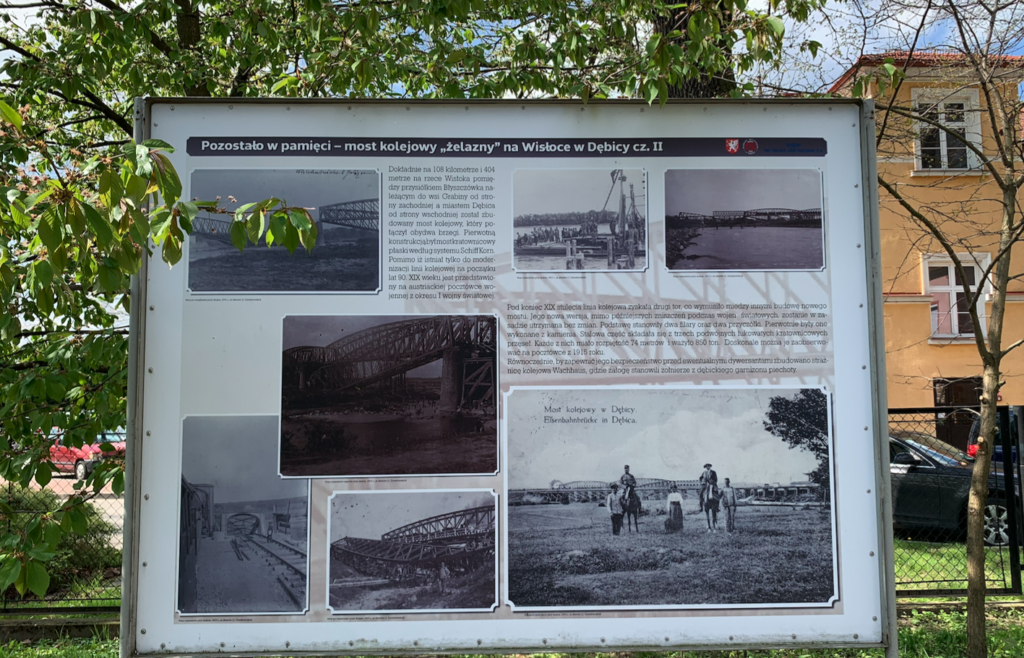
Iron railway bridge over the Wisłoka River in Dębica.
The iron railway bridge over the Wisłoka River in Dębica was built on the 108.404 km long Kraków-Dębica-Lviv railway line. The bridge crossed the Wisłoka River. It was located in the hamlet of Błyszczówka, within the village of Grabiny, on the western side of the river, and in the town of Dębica, on the eastern side of the river.
The original construction was a flat truss bridge of the SchiffKorn system. A flat truss bridge of the SchiffKorn system is a historical type of bridge structure used in the 19th century, primarily in railways in Prussia and Austria. The name comes from the engineer’s surname: SchiffKorn. A flat truss bridge is a bridge constructed with a truss system of bars, where all the elements lie in one plane, on both sides of the track. The arrangement of bars formed repeating triangles or rectangles. There was no upper structure. Initially, such bridges were built of iron, and later of steel. Advantages: relatively simple construction, easy to prefabricate, and capable of supporting heavy loads. Disadvantages: limited span, heavy dead weight, and outdated structure. This bridge existed until 1890.
The construction of a second track necessitated the construction of a second bridge. Subsequent wartime damage did not affect the construction of the new bridge, which was rebuilt using the same structure. The foundation consists of two piers and two abutments, originally constructed of stone. Each span was double, with three spans: truss-shaped and arched. Each span was 74 meters long and weighed 850 tons. A military guardhouse (Wachhaus) was built next to the bridge, staffed by soldiers from the Dębica infantry garrison.
During the interwar period, the bridge was regularly maintained and was in very good condition, as it was an important transport link within the Central Industrial Region. When the Germans and their Muscovite brothers invaded Poland, the bridge fell into German hands undamaged. It was heavily guarded throughout the occupation. When the Soviets entered Dębica in August 1944, the Germans blew up the bridge to slow the Soviet advance. After the January 1945 offensive, Soviet sappers temporarily repaired the bridge using four wooden pillars. In 1946, a construction company from Kraków renovated the bridge. The two western spans were completely renovated. In 1950, reinforced concrete pillars were erected in place of the wooden and stone pillars. During the renovations, welded steel beams were connected to the remaining structure using riveting. The upper arch was composed of six sections. Between the upper arches, the structure was openwork. Each span consisted of eight cross-braces, five posts, and four suspension beams. During the reconstruction, suspended walkways were installed to facilitate structural maintenance. In 1963, a catenary for electric trains was installed.
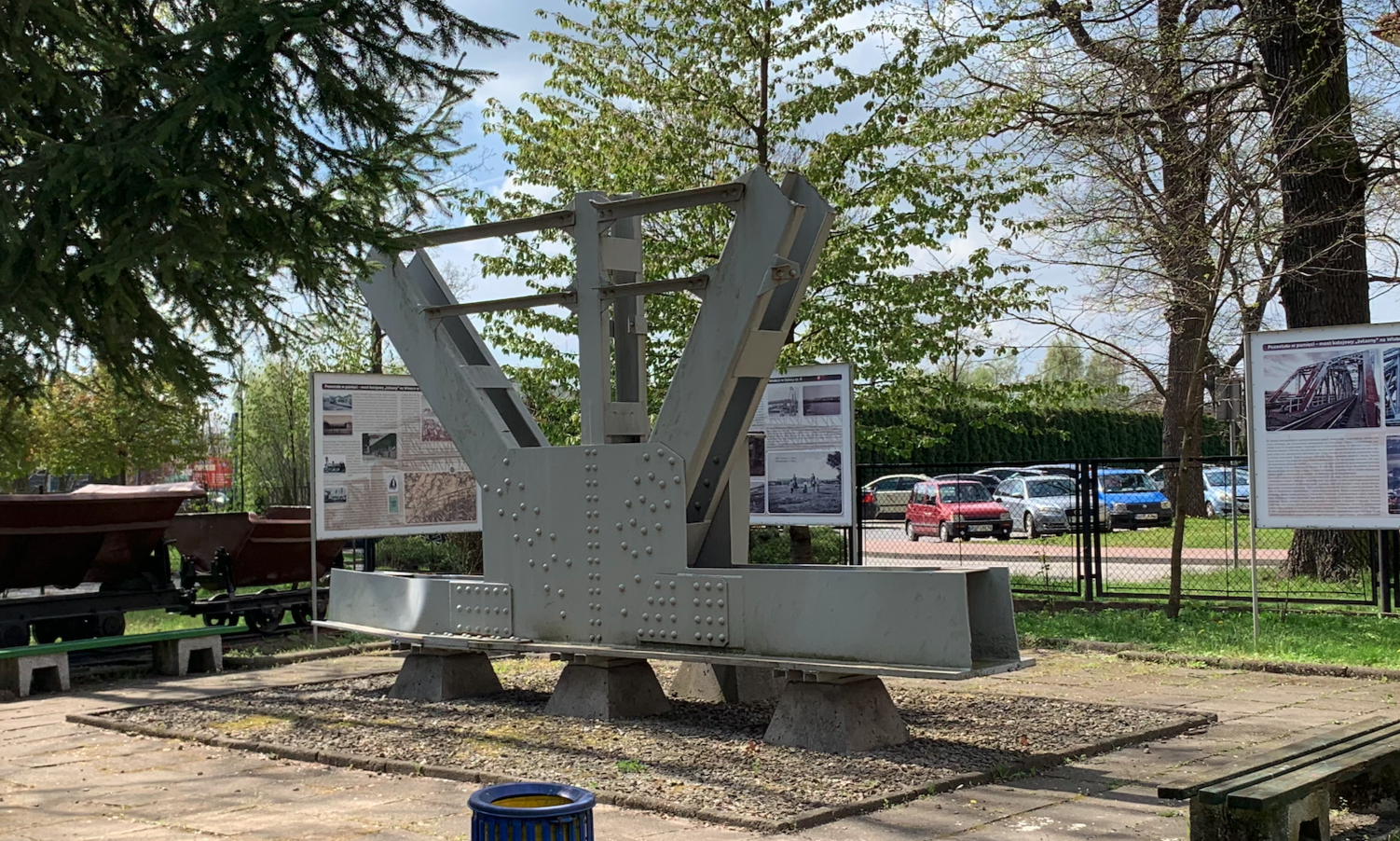
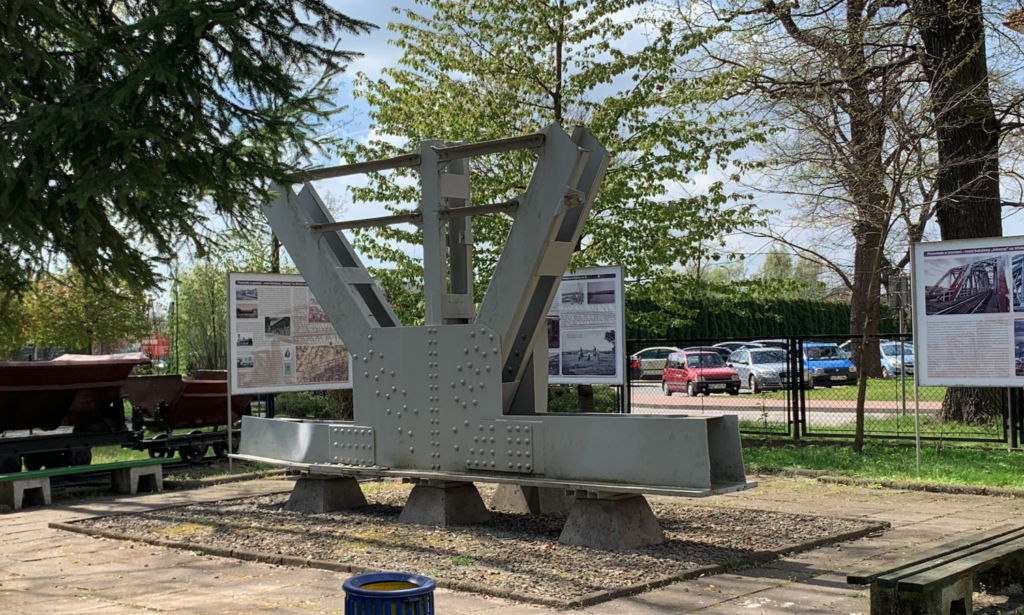
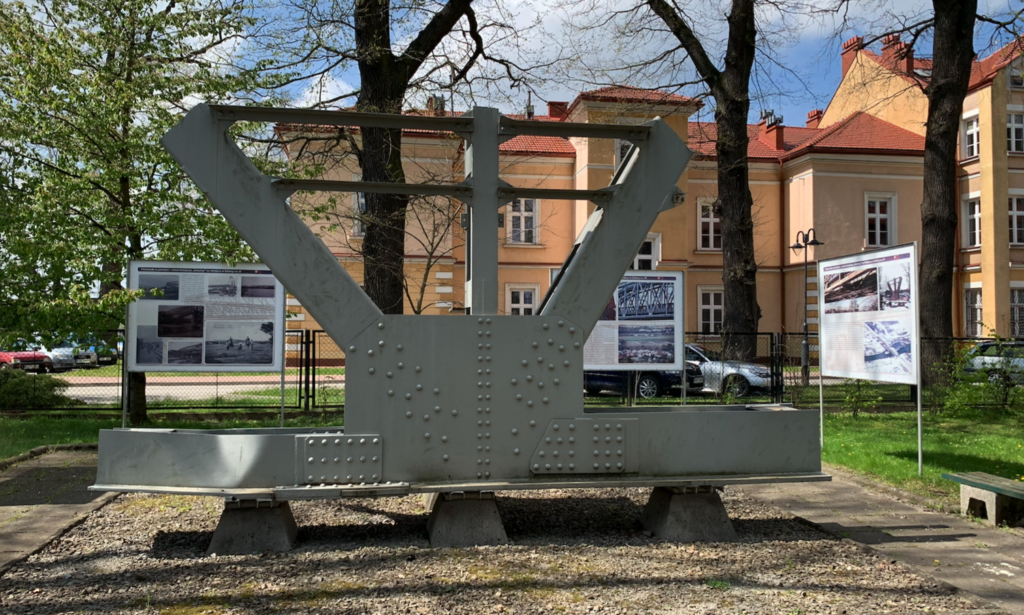
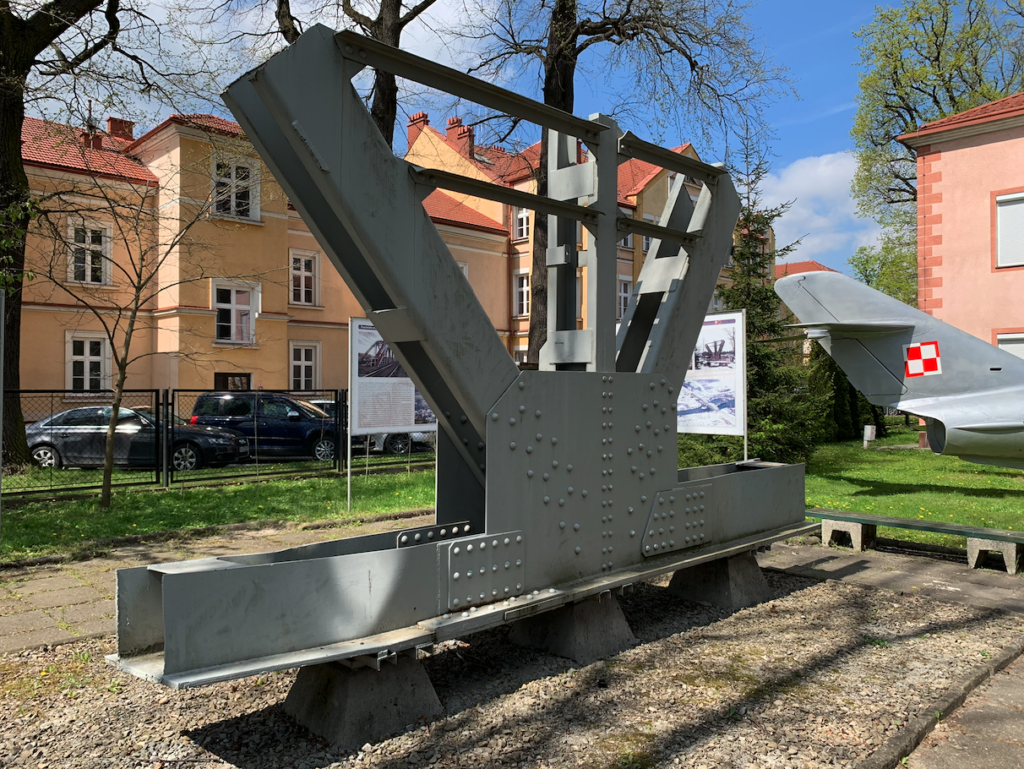
Due to the renovation of the Kraków-Przemyśl line and the increase in train speed to 160 km/h, a new bridge was planned to be built in a new location, which was completed in 2015. In 2013, the historic bridge was not scheduled for dismantling. Plans were underway to add it to the main register of historical monuments. A committee was formed to preserve the bridge and adapt it to vehicular and pedestrian traffic. The high costs of maintenance and modification effectively discouraged further development of this idea. Between December 2015 and February 2016, the bridge was dismantled. The only remaining element is a section of the cross-brace, which is preserved at the Regional Museum in Dębica. This was done courtesy of PKP Polish Railway Lines SA. A fragment of the bridge pillar remains in place.
The new railway bridge was placed approximately 40 meters north of the old bridge. The new bridge is located at km 108.400 of the line, and the line has a more gentle curve profile. The new bridge over the Wisłok River is a steel and reinforced concrete beam structure, suspended, modern, durable, and quiet. It is also a three-span, double bridge. Each track is on its own spans. Part of the “Jedność” Family Allotment Gardens, on the eastern side of the river, was occupied for the new track.
Written by Karol Placha Hetman