Busko Zdrój 2026-06-23
Busko Zdrój.
Busko-Zdrój is a town in Poland, located in the Świętokrzyskie Voivodeship, Busko County, and Busko-Zdrój Commune. The town had city rights from 1287 to 1870. In 1916, it was re-granted city rights. Currently, the town has an area of 12.28 square kilometers. The population is 14,469, as of 2023. Vehicle license plates are TBU. During the period 1975–1998, the town was in the Kielce Voivodeship. The distance from Busko-Zdrój to the cities is; Kielce 50 km, Tarnów 64 km, Krakow 87 km, Sandomierz 95 km, Warsaw 220 km. Busko-Zdrój is located in the Ponidzie region, on the Wójczańsko-Pińczowski Garb. More generally, it is the Nida Basin. The city’s elevation is 250-260 m. The area is characterized by: Gently rolling hills. Loess soils. Valleys of small watercourses flowing into the Nida River. A relatively warm and dry climate. Busko-Zdrój has a lowland climate with features of a continental climate. About 40% of days a year are comfortable. Only 13% are hot and scorching days, and less than 2% are very frosty. The average annual air temperature is 7.8 degrees Celsius. There are many sunny days.
Spa; The city is known primarily for: sulfur waters, medicinal brines, sanatoriums and natural medicine facilities. It is one of the most important health resorts in Poland, next to the health resorts of Ciechocinek and Krynica Zdrój. Busko Zdrój is a spa town, known already in the 12th century under the name Bużsk. The city is located in the historic Lesser Poland, in the Sandomierska Land. The settlement was founded by the knight Dzierżko in 1166. This knight founded the SS Norbertine monastery. In 1241, a Tatar invasion destroyed the settlement. In 1287, Prince Leszek the Black granted the settlement city rights. It happened under Środa Śląska law. Since 1395, land courts met in Busko. In 1412, King Władysław II Jagiełło confirmed the city rights and granted the city the privilege of weekly markets and two fairs a year; for Saint Florian and Saint Procopius. Until the 16th century, the city was owned by the Norbertine SS. In 1537, King Sigismund the Old confirmed and developed city rights. The land and municipal courts received a permanent seat. In 1563, the city was destroyed by a great fire, but it was quickly rebuilt. There were weaving workshops, distilleries, a mill, inns and inns. There was a municipal bathhouse. In 1590, a fire destroyed the church, which was rebuilt by 1595. In 1661, the city was hit by a great plague. In 1780, the closed brine springs were reopened. 8 brine shafts were exploited. Professors analyzed these brines and confirmed their healing properties. The Salt Campaign was established, based on the king’s privilege. Salt was brewed and sold to other regions of the Republic of Poland. King Stanisław August Poniatowski visited Busko several times.
As a result of the partition of Poland, Busko was occupied by the Austrians. They banned the brewing of salt to destroy the competition. In 1815, under the Congress of Vienna, the city was incorporated into the Kingdom of Poland, completely dependent on the Muscovites. In 1819, the Muscovites dissolved the SS Norbertine order. At that time, 47 monasteries were liquidated in the Kingdom of Poland. Their property was taken over by the authorities of the Moscow state. On August 23, 1820, another fire destroyed part of the city. Busko had about 500 inhabitants. In 1823, the first spa facility was founded. In 1836, the first spa baths were built, now the “Marconi” Sanatorium. In 1852, there was a cholera epidemic, and in 1873, another one. In 1859, the city had over 900 inhabitants, and in 1880, about 1,500. In December 1918, the first meeting of the city council elected by the inhabitants, and not by the Austrian occupation authorities, took place. After the Great World War, patients started arriving again. Intensive expansion of the health resort took place in the interwar years. The “Górka” children’s sanatorium was founded. In 1927, the name of the city was officially changed from Busk to Busko.
On September 9, 1939, the 22nd Mountain Infantry Division fought a battle with Germans near the town of Bronia, in which 200 Polish Army soldiers were killed. The German occupation began. The Home Army (AK) operated very efficiently, killing the local Gestapo chief. On August 6, 1944, the Home Army attempted to capture Busko, but this only lasted a few days, as the Germans retook the town. On January 13, 1945, Busko was occupied by the Muscovites. In 1952, a standard-gauge railway line was built to Busko. In 1972, the largest of the sanatoriums, “Włókniarz,” was opened. In 2008, the “Las Winiarski” Mining Spa Plant opened, supplying Busko sanatoriums with sulfur waters from a new borehole in Las Winiarski. In 2024, public transportation was launched in the city.
The spa zone is located in the southern part of the city, within Spa Park and its surroundings. Thirteen spa facilities offer a total of 2,066 beds for patients. The spas are constantly modernized and expanded, and new ones are being built. Approximately 1.5 million spa treatments are performed annually, including 800,000 sulfur baths. In addition to the spas, the city also has six hotels and several private guesthouses. The fenced Łazienki Gardens cover 16 hectares. This is where the “Marconi” Sanatorium and the fountain in the center are located. Mickiewicz Avenue is an 850-meter-long promenade with two rows of trees, connecting Łazienki Gardens with the market square. It is dominated by chestnut trees. It is a representative street with limited traffic, and is home to: City Hall, District Office, Police, Cultural Center, “Zielona” Gallery, three secondary schools, and one primary school. The market square is currently a 0.70-hectare park with a central fountain.
Busko-Zdrój Railway Station.
Busko-Zdrój railway station is located approximately 3 km from the city center. Address: Siesławice, 28-100 Busko-Zdrój. Geographic coordinates: 50.461 N 20.685 E. Elevation: 245 m.
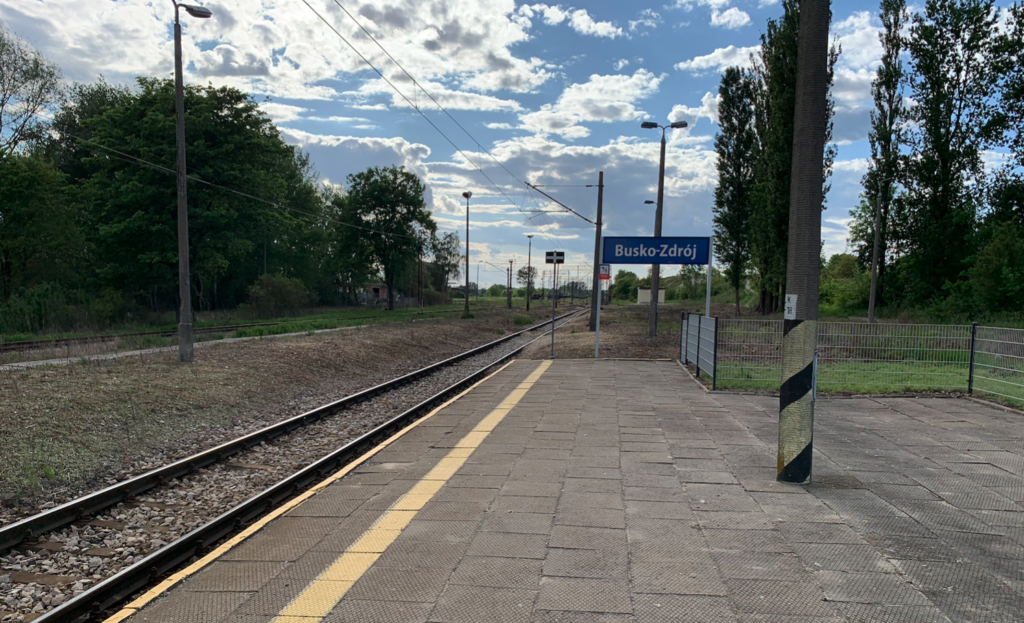
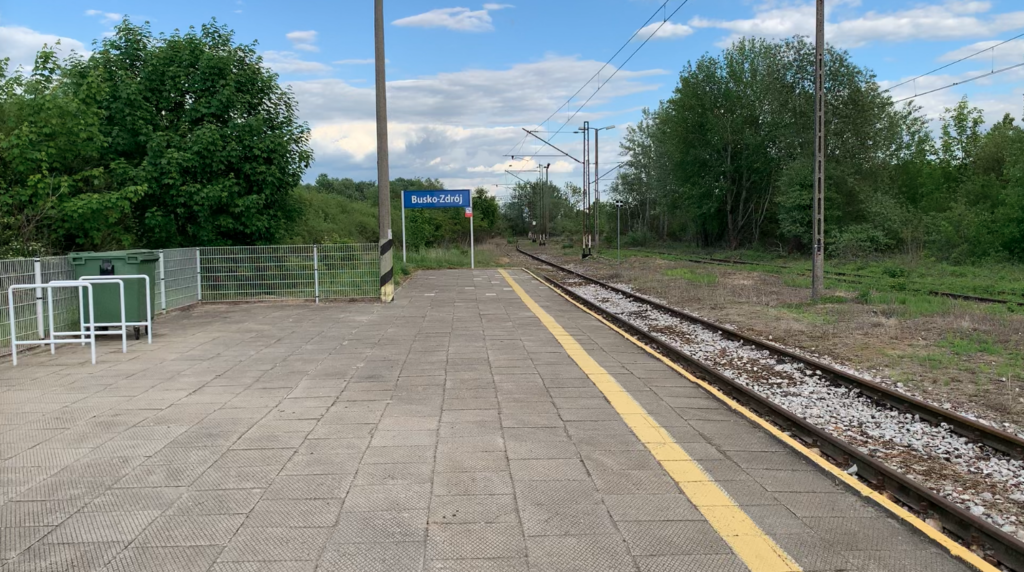
Busko Zdrój railway station is the terminus of railway line No. 73 Sitkówka – Busko Zdrój. The station opened on May 17, 1953, with the commissioning of the railway line. The station served regular passenger traffic until April 18, 2005. Subsequently, sporadic freight traffic followed. Following the renovation of railway line No. 73, passenger service resumed on June 30, 2018. This was a weekend service on the Kielce – Busko Zdrój route. In 2020, daily passenger train service resumed. The station is operated by the PolRegio carrier. In 2020, there were four pairs of trains on weekdays and three pairs of trains on weekends. The station served up to 150 passengers per day. On June 22, 2026, five passenger trains departed from the station. You could travel to Kielce and Częstochowa.
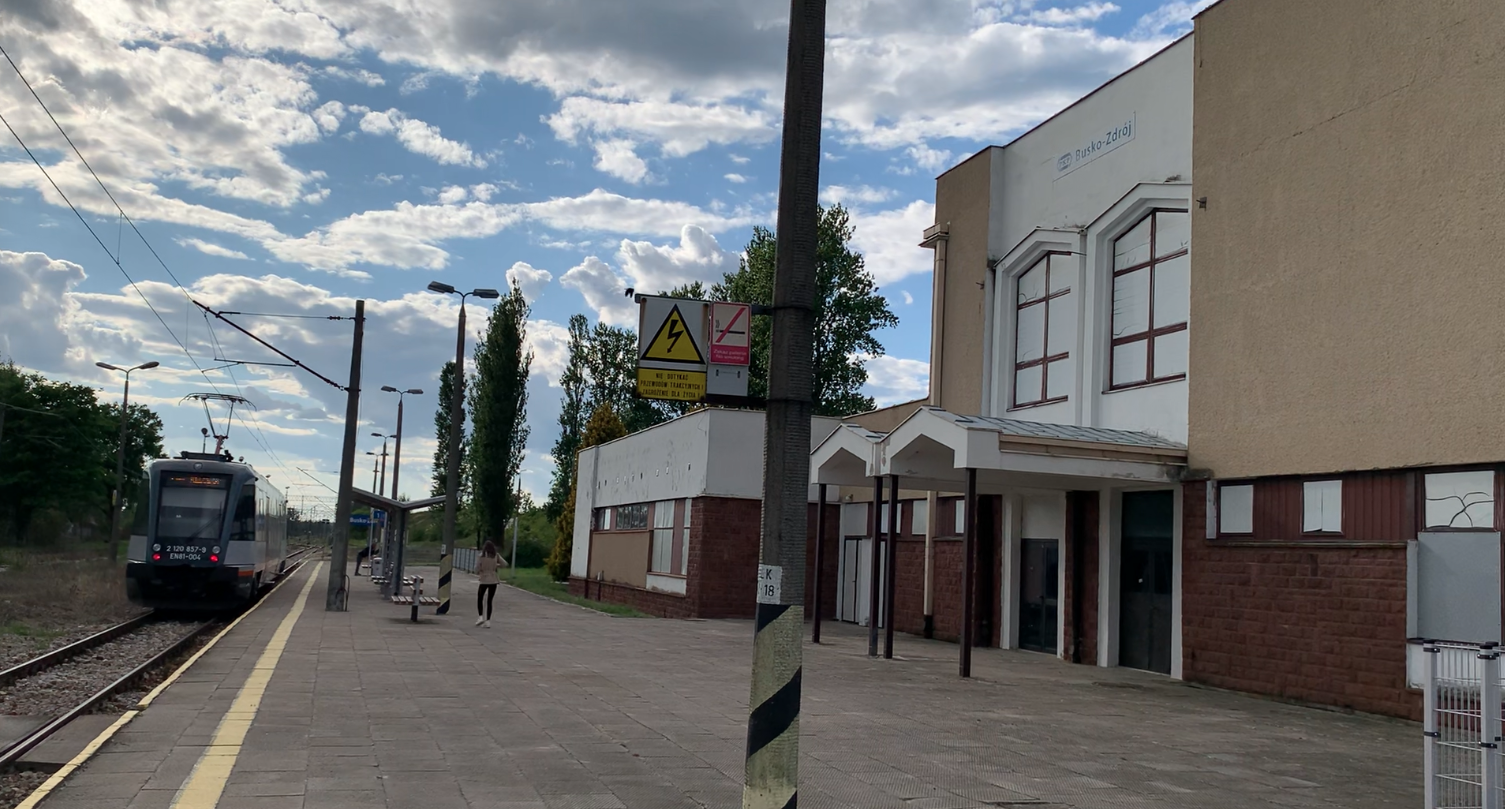
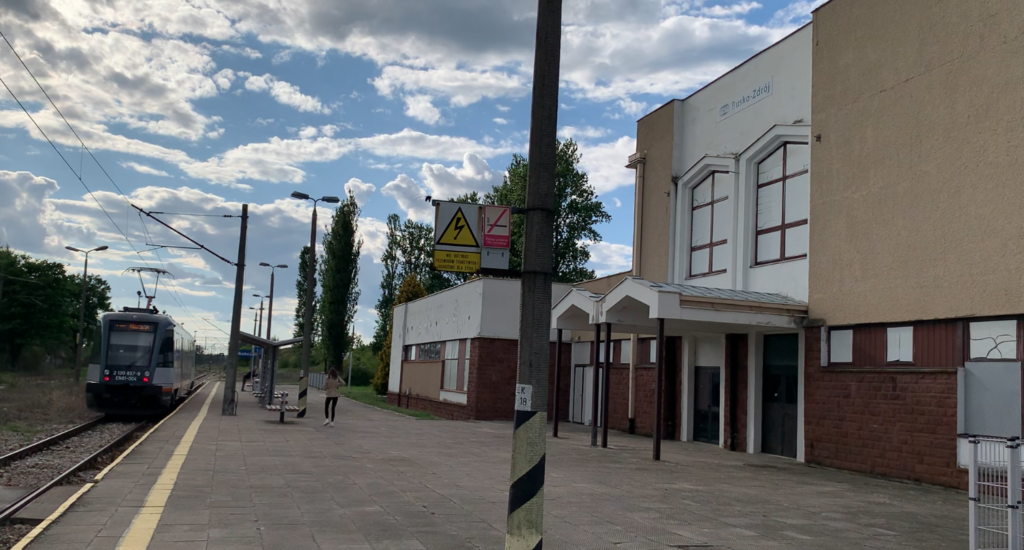
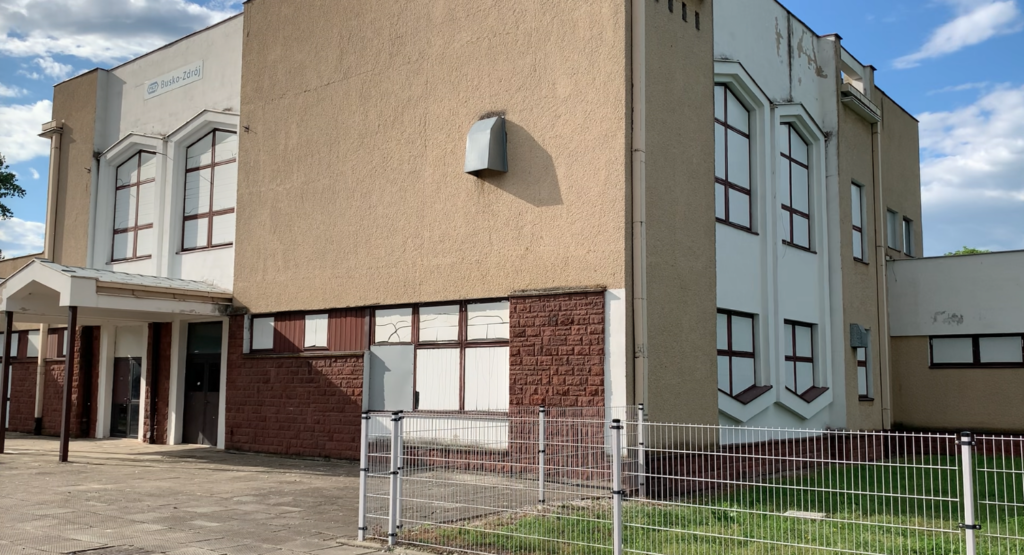
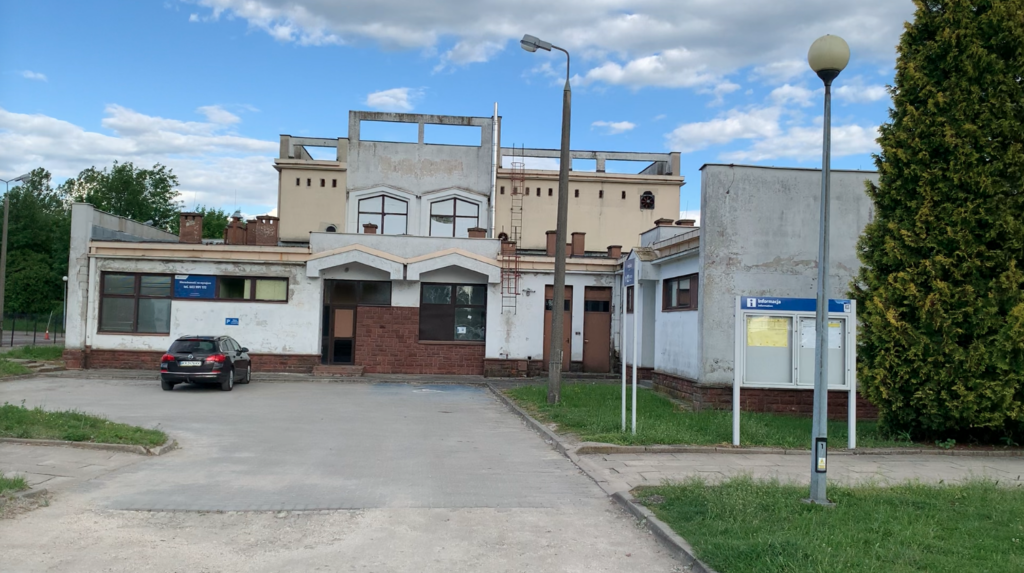
The station building, which is currently inaccessible, is located at the station. The ticket offices are closed. The station building, with a usable area of 841 square meters, was opened in 1995. The building is a single-story polygonal structure at its base, with a second-story extension on one side. The building has four exits on the platform side, on the south side. There are two main entrances on the north side and two on the west side. There are no doors on the east side. The main doors have projecting brick canopies supported by steel pillars. The windows are rectangular, while the main windows have decorative cornices, giving them a pentagonal appearance. The building has a light brown and white plaster facade with dark brown stone cladding. The former station building housed a disco from 2007 to 2013.
In front of the station building, there was a station yard, which is now the “Mila” maneuvering area for driving lessons. On the west side of the station, there is an unused parking lot. Currently, the station has one platform, a single-edge platform next to the station building, 120 meters long. The platform has a single shelter with benches. There are information boards and, most importantly, lighting. The platform surface is made of 0.5 m x 0.5 m paving stones. There is a yellow warning line and a yellow edge line. There are handrails for securing bicycles. Much of the station level is overgrown with self-seeded weeds. A second platform, made of concrete slabs, is located next to the next track, but it is not in use.
In front of the passenger station, on the western side, there is a freight station. There are as many as 12 tracks at this station, which makes it relatively large. From the freight station there was a long siding leading to industrial plants in Wola Zagojska; Leszcze gypsum mine, Atlas – Nidy Valley, BałtykGaz, Etex Poland and others. The siding was single-track, non-electrified and approximately 12 km long. There was a stop in Skorocice, with three tracks. Here the line from the south turns west. The siding has been closed. Staro-tor is used as a dirt road. The railway line embankments have been preserved, and new asphalt is laid on the former railway crossings.
Railway line No. 73.
Railway line No. 73 Sitkówka Nowiny – Busko Zdrój. The line is 45,685 km long. The line is double-track to Włoszczowice and single-track, normal gauge 1,435 mm. Electrified with 3 kV DC. Maximum speed 100 km/h. The line was planned to cross the Vistula River and join the railway line No. 115 Tarnów – Szczucin.
LK No. 73 Sitkówka Nowiny – Busko Zdrój, located in the Świętokrzyskie Voivodeship. It was opened on May 17, 1953. The section from Sitkówka Nowiny station to Włoszczowice is double-tracked, and further to Busko Zdrój it is single-tracked. The double-track section was electrified on December 30, 1976, and the single-track section on August 5, 1987.
Passenger traffic was suspended on January 11, 2004 or April 18, 2005. Thanks to the actions of local governments, on December 9, 2012, railway traffic was resumed, but with a break (2013-2018) due to the poor condition of the tracks and general renovation. After the renovation, rail traffic resumed with the December 2018 schedule.
On April 29, 2019, during the government of the United Right, LK No. 73 was included in the list of railway lines of state importance, together with the construction of the Busko Zdrój – Szczucin railway line and the connection with LK No. 115. It should be noted that the route of the line was not final and the connection could take place at the Dąbrowa Tarnowska station or Żabno station. Unfortunately, after the Volksdeutsch, communists and freemasons took over the government, the program of a new connection between Tarnów and Kielce was shelved.
On August 12, 2023, the tender for the modification of the Włoszczowice – Busko Zdrój section was concluded. The decision was made to replace the rails with contactless ones. The work was carried out by the PPMT Gdańsk/Gór-Tor Stupsk consortium. Train speed increased from 80 km/h to 100 km/h.
Route of railway line No. 73: Sitkówka Nowiny (0.00 km), Brzeziny (4.77 km), Nida (6.82 km), Dębska Wola (13.79 km), Włoszczowice (19.54 km), Kije (24.74 km), Stawiany Pińczowskie (27.75 km), Szarbków (33.92 km), Grochowiska (38.62 km), Busko Zdrój Loading Bay (43.20 km), Busko Zdrój (44.05 km).
In 1953, a short standard-gauge railway line was built from Stawiany Pińczowskie station to Pińczów Towarowy station. Pińczów Towarowy was not a narrow-gauge railway station. The line was approximately 10 km long. It was single-track and not electrified. According to one source, the line opened on January 12, 1950, as a narrow-gauge line. However, in 1953, it was converted to standard-gauge. It is undoubtedly true that part of the line from Włochy was laid along the narrow-gauge railway line from Hajdaszek to Erdmanówka to Pińczów. The Pińczów Towarowy station had to be built because standard-gauge trains could not negotiate the serpentine Pińczów Garb (Garb Pińczowski). The main purpose of the line was to provide commercial services to Pińczów: transporting construction materials, supplying industrial plants, and servicing local sidings. In 2006, the Stawiany Pińczowskie – Pińczów Towarowy railway line was dismantled. Currently (2026), the old tracks of the former railway line are visible.
Written by Karol Placha Hetman