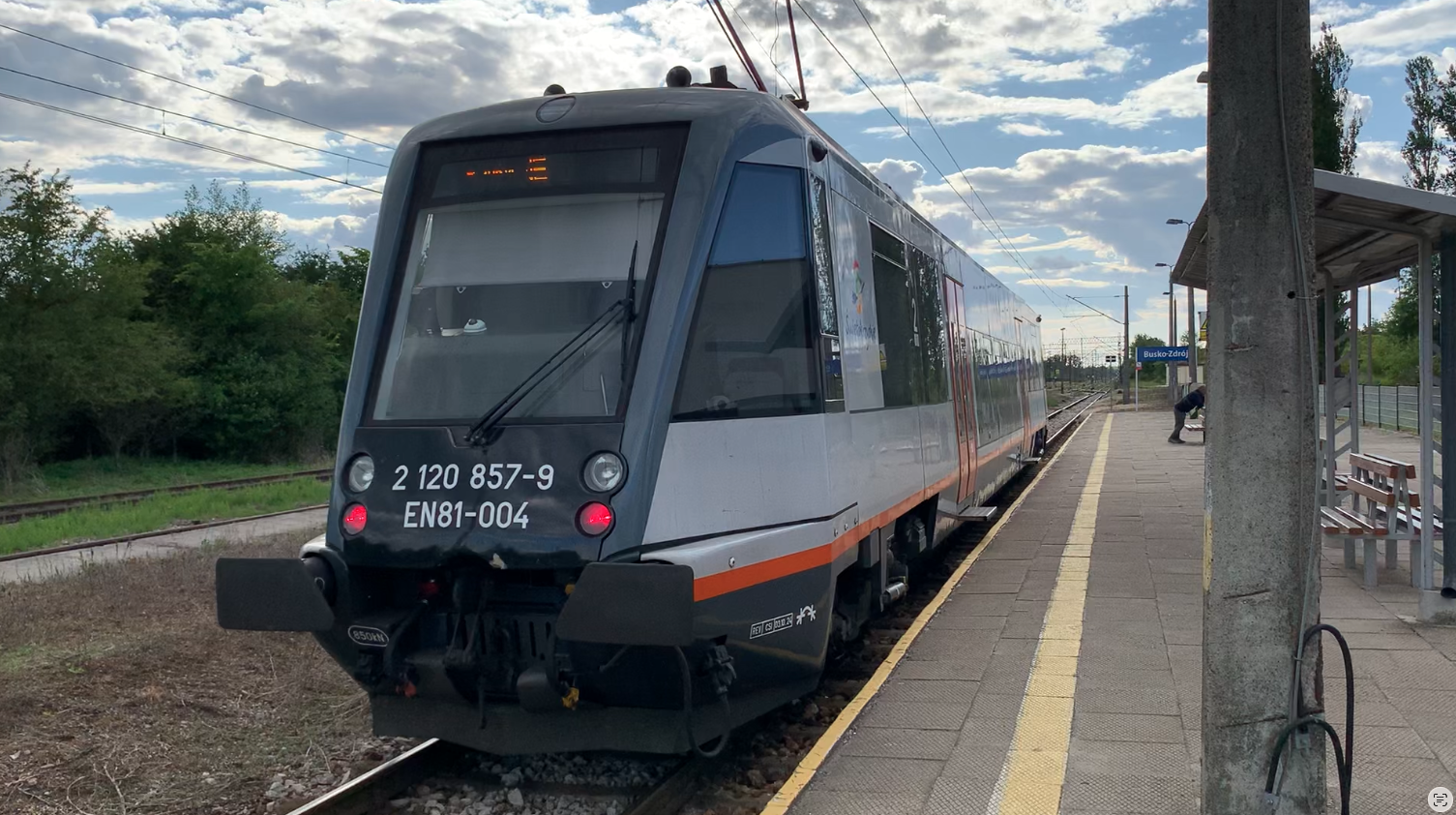
Busko Zdrój 2026-06-23
PESA EN81-004 Power Car.
PESA 308B Electric Power Car, EN81.
In Poland, we have problems with the naming of single-carriage electric and diesel vehicles. This stems largely from the period when Freemasonry gleefully dismantled the Polish Railways. The public was told that they didn’t need trains, local and regional connections, or train stations. They said we didn’t need to commute to work, schools, or offices. Ideally, we should leave Poland. They accused us of technical, cultural, and especially religious backwardness. Freemasonry claimed that small rail vehicles would suffice because there were few passengers. But when, in 2005, Bydgoszcz-based PESA developed the successful Type 308B vehicle, only eight orders were placed. Why? Because the vehicle proved too small for the actual passenger flow.
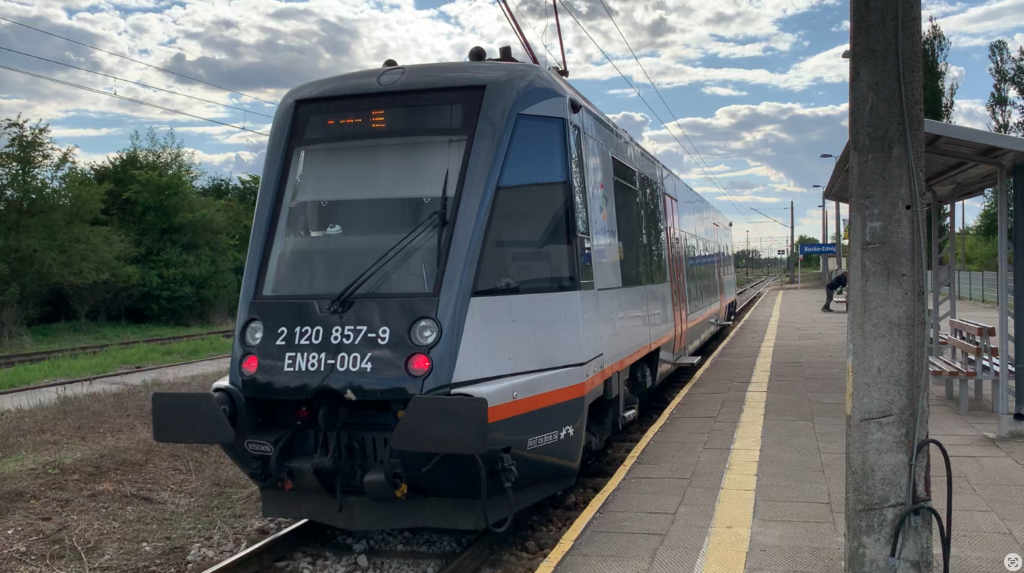
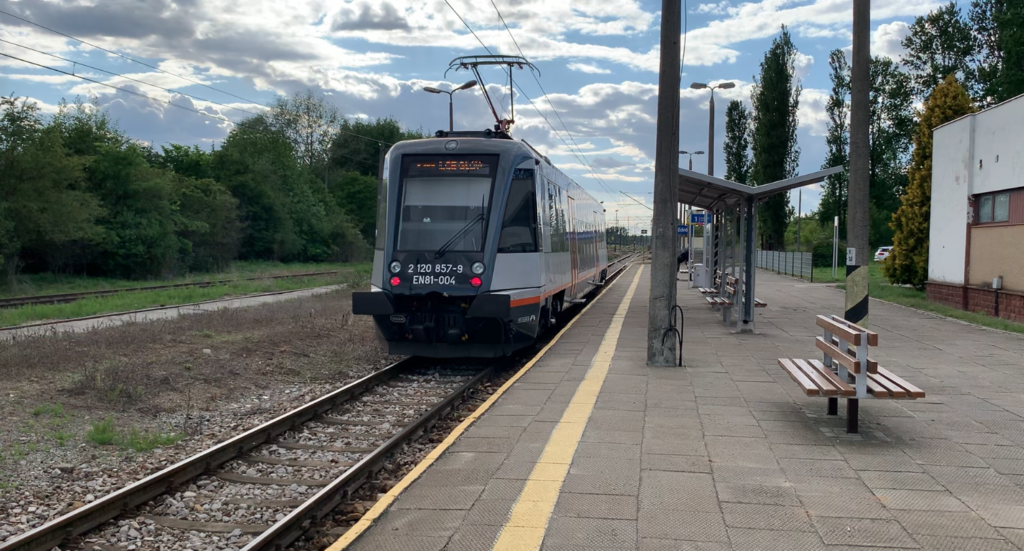
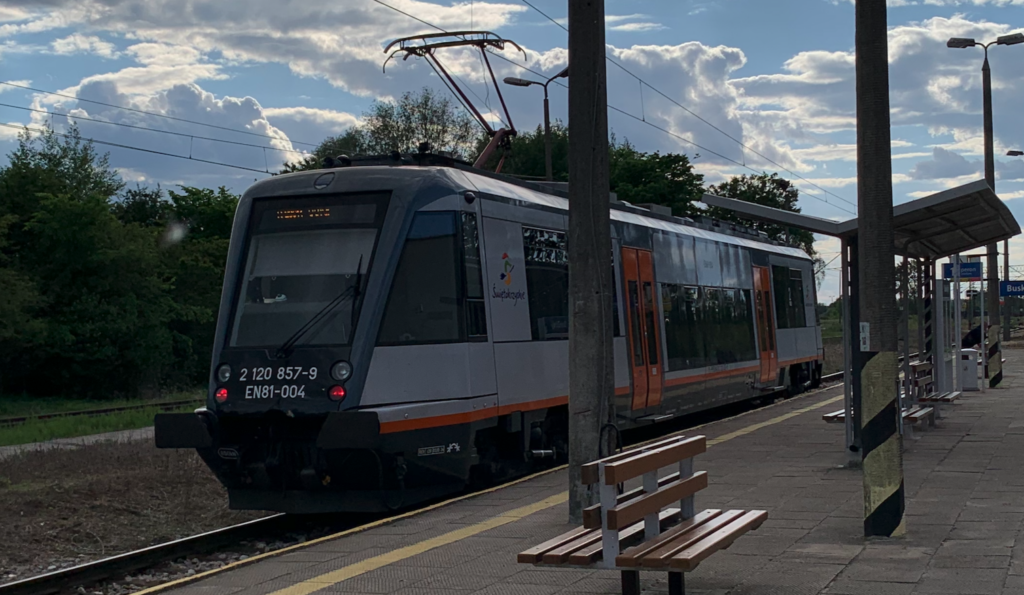
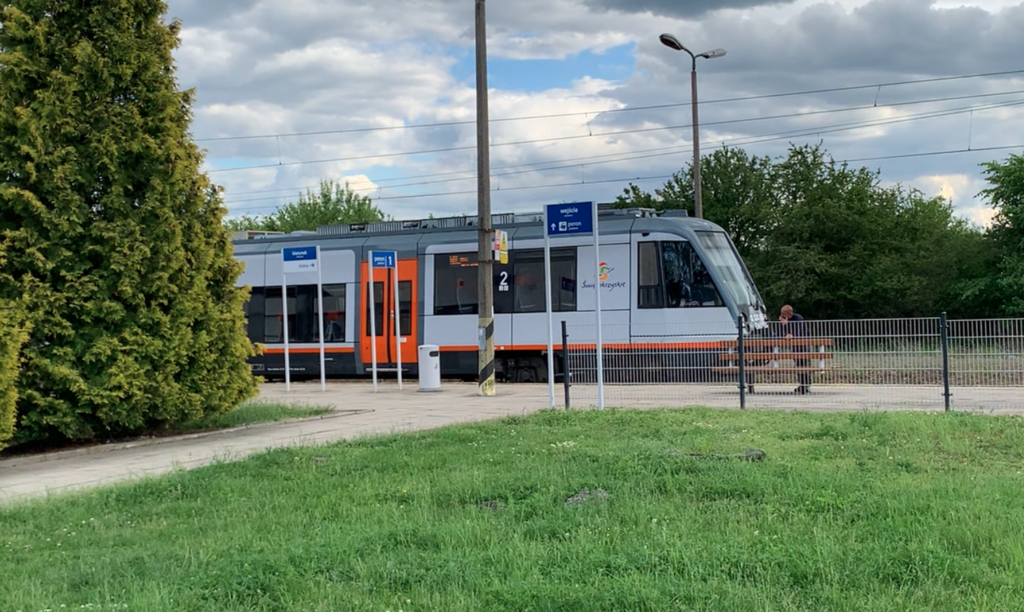
The PESA 308B is a single-carriage rail vehicle, and the Polish State Railways (PKP) designated it EN81, meaning Electric Low Platform. Using the name “EZT” is a bit of an exaggeration, as it is not a multi-unit vehicle. However, the car can be coupled into three-carriage trains. In the railway press, the terms “Electric Rail Bus” and “Electric Railbus” are used. According to PKP designations, it is an Independent Motorized Railcar, regardless of the drive unit used. The manufacturer, PESA, called the vehicle “Shield Bus.” Nevertheless, using the name “EZT” is not a mistake, especially since rail buses are currently a marginal part of the rolling stock in Poland. The Pesa 308B is a single-carriage, motor-powered vehicle powered by 3 kV DC electric traction. The car uses a Bo’2′ axle configuration, meaning it has one driving bogie and one trailing bogie. The car configuration is designated “s,” meaning motor-powered.
When comparing diesel railcars with railcars powered by electric traction, it’s important to remember that the operating cost of diesel railcars is 4-5 times higher than electric railcars. Therefore, electrifying railway lines is effective. Furthermore, EMUs offer higher travel speeds, accelerate faster, and have a simpler drive system that is easier to operate.
PESA Bydgoszcz.
Since 1998, PESA Bydgoszcz has undergone significant restructuring. In 2001, the plant began producing diesel railcars from the 214M family. In 2004, production of an electric multiple unit (EMU) for the Warsaw Commuter Railway (WKD), designated EN95, began. In 2005, Bydgoszcz began producing the first electric railcar. Experience gained in the design of previous railcars was utilized, utilizing bogies and seats installed in 214M trains. The train heads were adapted from the EN95 EMUs. The floor between the bogies was lowered.
History of the EN81.
The PESA 308B wagon was designated EN81 by PKP (Polish State Railways). It was produced in 2005 and 2007. A total of eight units were built. The wagon is still in the manufacturer’s offer, but no orders have been received since 2007. The wagons were produced for the Świętokrzyskie and Małopolskie Voivodeships. They were intended for electrified routes with very low passenger traffic.
In 2005, the Małopolska region decided to modernize and electrify the important railway line No. 118, Kraków Główny (Main Railway Station) – Balice Airport. However, the appropriate rolling stock was not available. On December 30, 2004, the Małopolska region signed a contract with PESA for the delivery of two EN81 units for the Małopolski Zakład Przewozy Regionalnych (Małopolski Zakład Przewozy Regionalnych). These vehicles were officially unveiled at Kraków Główny station on September 30, 2005, and began operating on the Wieliczka – Kraków Główny – Krzeszowice and Skawina – Kraków Płaszów – Kraków Główny – Krzeszowice routes. The route to Balice Airport was not yet electrified and was operated by diesel vehicles. In November 2005, the first two EN81 vehicles, for the Świętokrzyski Zakład Przewozy Regionalnych (Swiętokrzyski Zakład Przewozy Regionalnych), were presented in Kielce. The vehicles were assigned to routes to Skarżysko Kamienna, Ostrowiec Świętokrzyski, and Sędziszów.
In 2014, the Małopolska Voivodeship discontinued the operation of its two EN81s. Already in 2016, the Małopolska Voivodeship decided to discontinue the operation of the EN81s. The vehicles were not sent for P4 level repairs. In 2018, the vehicles were put up for sale. In January 2021, Piotr Mieczkowski’s Rail Vehicle Service became the owner of both units.
EN81 Design
The EN81 is a single-compartment motor car powered by 3 kV DC traction. The car is designed for multiple traction operation. Three EN81 cars can be coupled into a single unit, without allowing passage between the cars while the train is running. A single standard passenger car can also be attached to the EN81.
The side wall of the vehicle features two doors and 11 large windows. The vehicle is symmetrical. The front of the vehicle is narrowed. The front of the vehicle is equipped with a large window, the upper part of which houses a display with information about the destination station. The window is equipped with a single large windshield wiper. Above the window is a third white spotlight. Below the window are white and red halogen lights, a screw coupler, pneumatic and electrical lines, and buffers.
Entrance to the car is provided by two pairs of double-leaf doors that open automatically. The doors are of the sliding-sliding type. The door opening width is 1.30 m. The entrance threshold is at a height of 0.80 m from the railhead. At lower platforms, an additional step extends from the car frame. Inside the car, above the bogies, the floor is raised and accessed by two steps. The floor height is 1.29 m from the railhead.
The car can accommodate 140 passengers. Passengers have 60 seats at their disposal. A single, closed-loop toilet is located in the middle section. The car also has two wheelchair spaces. The vehicle is equipped with a visual information system, monitoring, and air conditioning. At both ends of the train are identical driver’s cabins, separated from the passenger compartment by glass doors. The vehicle is designed for single-person operation (engine operator) plus a conductor. The engineer faces a control panel equipped with LCD screens and a clear view through the windshield. Cabin “A” is located next to the driving bogie, and cabin “B” is next to the trailer bogie, near the pantograph. The high-voltage cabinet is located next to cabin “A.”
The wagon is equipped with two bogies. The driving bogie is a type 22MNa. The trailing bogie is a type 22MNb. Both bogies are used for braking and are equipped with disc brakes. The driving bogie is equipped with two DKLBZ0910-4A asynchronous motors, manufactured by VEM Sachsenwerk. Rotational motion is transferred from the motors via SZH 495 gearboxes manufactured by Voith. Each 280 kW electric motor is powered by a single FT-300-3K transistor inverter, manufactured by Medcom. The drive system allows for acceleration of 0.65 m/s², up to a speed of 25 km/h. The vehicle has a maximum speed of 130 km/h, and a design speed of 200 km/h. A single half-length current collector, type DSA200-PKP, manufactured by Stemmann, is mounted on the car’s roof. The pantograph is located above the trailer bogie. The pantograph is 2.03 m long.
During operation, some vehicles received new compressors, new air conditioning, and new seats. The inverters caused the most problems for the mechanics.
T-T EN81 data:
Length 26.53 m. Width 2.83 m. Height 4.01 m. Wheel diameter 0.84 m. Weight 53,000 kg. Track gauge 1,435 mm. Motor type DKLBZ0910-4A, with a power output of 2 x 280 kW. Continuous power 560 kW. Acceleration 0.6-0.8 m/s². Travel speed 130 km/h. Maximum speed 200 km/h. Disc brakes and ElectroDynamic braking. Entrance to the carriage is 0.80 m from the railhead. The carriage has 60 seats and can accommodate 140 passengers.
Written by Karol Placha Hetman