Dębica 2026-05-08
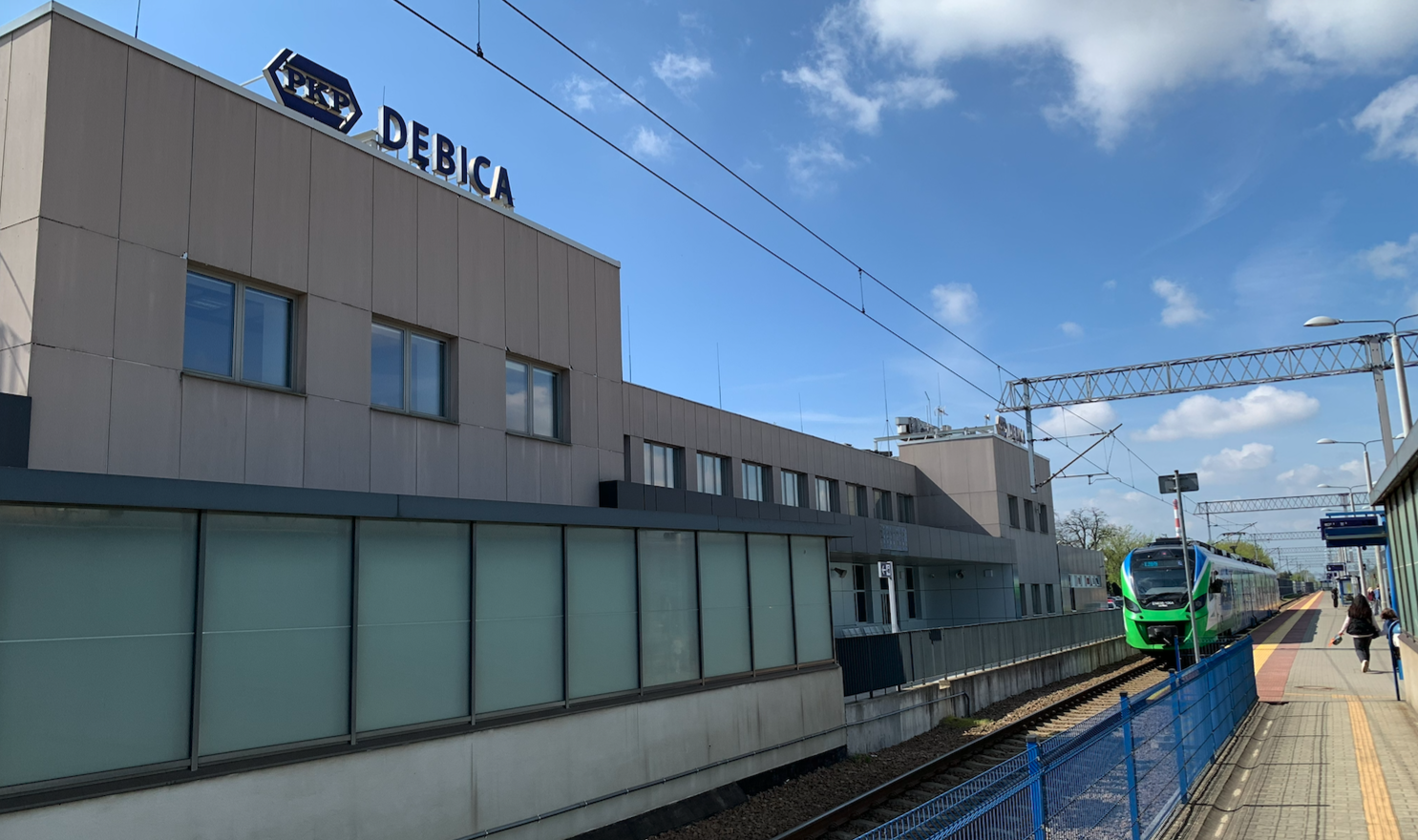
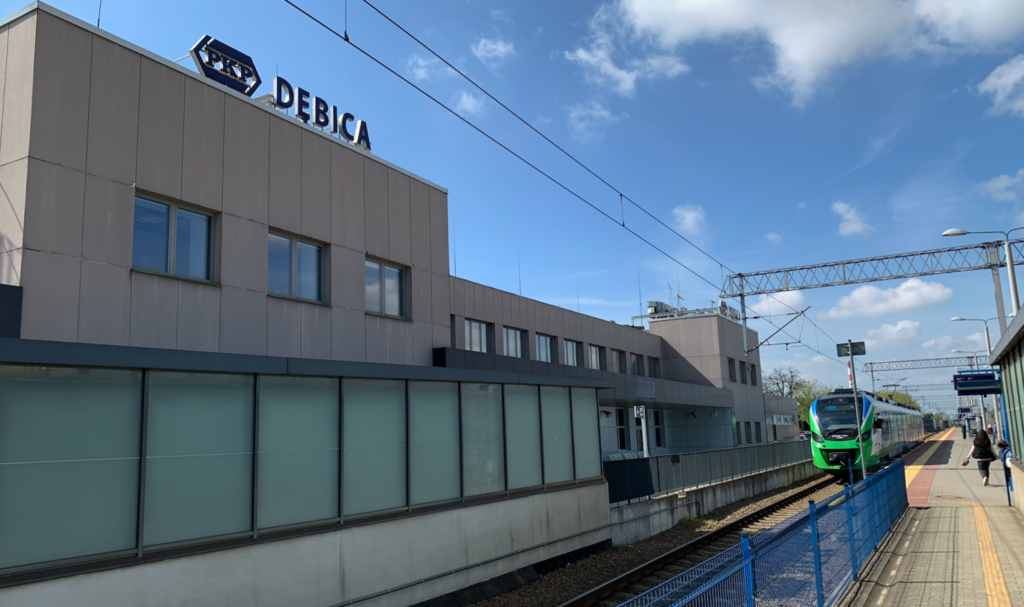
PKP Dębica Station.
Address: Kolejowa Street 1, 39-200 Dębica. Geographic coordinates: 50.051N 21.411E. Elevation: 195 m.
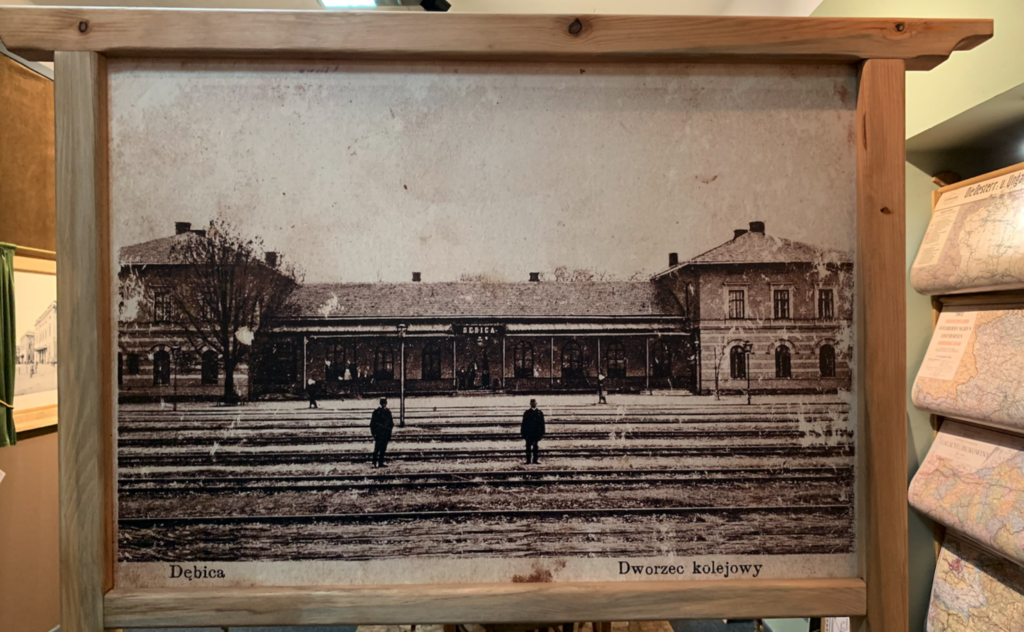
The station opened in 1856. Initially, the station buildings were wooden. Between 1863 and 1867, a brick station was constructed. The building was relatively large, three-block, rectangular, measuring 52 m x 15 m. The central section was lowered, single-story, and covered with a gable roof. A roof supported by eight pillars was added on the station side. This created a veranda, which, in summer, housed tables and chairs. The wings of the building were two-story, three-bay, and covered with hipped roofs. The lower windows were topped with a full arch, but their size was similar to that of the windows on the upper floor. The station was plastered. Architectural details were sparse: cornices, rustication, and simple window frames. The building housed ticket and luggage offices, as well as two-class restaurants and waiting rooms. Third-class passengers did not have a restaurant. Passengers in this class bought food at stalls outside the station. The building housed railway staff, police, and staff rooms. Apartments for the station master and restaurateur were located on the upper floors. Young trees were planted between the tracks and the station building. At that time, there were four through tracks on the station level. There were no platforms, and the sleepers were covered with gravel, leaving only the rails visible. Trees were also planted in the square in front of the station. The square was unpaved. Passengers arrived at the station by cart, carriage, or even on foot. Some Dębica residents offered transportation to passengers from the Dębica market square to the station square. The distance was approximately 600 meters.
In the following years, additional railway buildings were constructed. A locomotive shed was built approximately 100 meters to the east. It was a brick building, built in an L-shaped plan, with three locomotive bays. A turntable was not needed. The other half of the building housed workshops and forges.
Between the station building and the locomotive shed, a two-story, two-staircase residential building was constructed, covered with a gable roof with four swallowtails. Currently (2026), the building is abandoned and will likely be demolished. Further east, another two-story residential building has been constructed.
A rectangular, brick water tower with two reservoirs was built on the northern part of the station level. It is a classic 19th-century tower, typical of the Austrian railway. The building still stands today (2026). Another water tower is clearly visible from the Dębica railway station. The tower is not a railway tower, but belongs to the Meat Processing Plant. The tower is very attractive, octagonal, and forms part of a larger building.
Dębica station contained numerous warehouses belonging to individual manufacturing plants or trading companies. Most of these warehouses were wooden. Transport from the wagons to the warehouses and vice versa was performed using handcarts. These were typically single-axle, two-wheeled carts.
Around 1965, the historic station was rebuilt, completely losing its original architectural form. The central section received a second story. The sloping roofs were removed and the entire structure covered with a flat roof. The water, sewage, electrical, and central heating systems were rebuilt. Windows and doors were replaced, while their sizes were altered. The layout and purpose of the rooms were changed. The post office was moved to a new building. The militia and SOK stations were also relocated. A small WSW (Military Internal Service) facility remained, due to the presence of several military units during the communist era. The nearest military unit was only 500 meters from the train station, on Kościuszki Street.
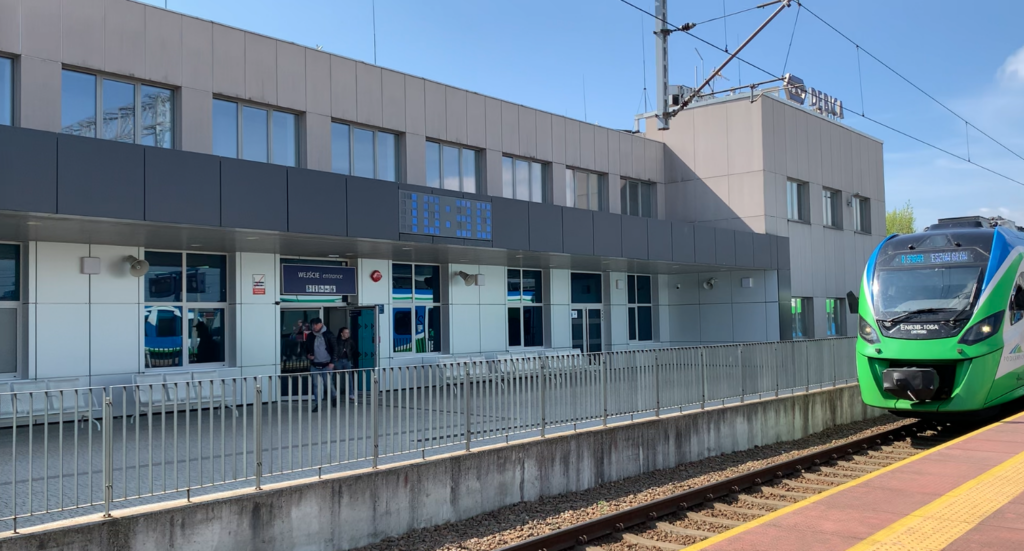
In January 2015, a major renovation of the main station building began. The work primarily covered the interior. New restrooms, ticket offices, and a service and catering area were installed next to the waiting room. Windows, doors, internal installations, roofing, and ceilings in the building’s wings were also replaced. The building’s façade was renovated, constructed of sandstone slabs. The passage between the building and the pavilion housing the restrooms was covered. The entire area surrounding the station was cleaned up. In December 2015, the passenger section reopened to the public.
The station building houses two ticket offices, a city ticket sales point, the Anatolia bar, the WAGABUNDA travel agency (offering flights, ferries, buses, holidays, camps, and summer camps), a newsstand/newsstand, a shop, an express bar, an ice cream parlor, and a hairdressing salon. A digital clock is located above the main entrance, and the “PKP RAILWAY STATION” sign is illuminated on the roof. Two PKP DĘBICA signs and an identical digital clock have been placed on the platform side.
The station square has been rebuilt. A roundabout named after the Sybiraków was built, and a monument to the Sybiraków is located. There are parking lots, including an illegal parking lot on undeveloped land. There is a taxi rank. The bus station is a long shelter on Głowackiego Street. A little further on Głowackiego Street is the Polish Post Office building. In front of the station are numerous kiosks and service points, as well as the Jubilatka department store.
Dębica station currently serves as a regional station. Rail traffic is managed by the “Db” signal box, using computerized equipment. The track system of the passenger and freight stations is extensive. There are numerous railway sidings leading to the following plants: the Dębica Tire Company, a former military siding for the 33rd Light Infantry Battalion of the Territorial Defence Forces (WOT), a furniture service plant, the Municipal Heat and Power Company (Miejskie Przedsiębiorstwo Energetyki Cieplnej), and the Dębica Industrial Park. In the eastern part of the city, there is the Dębica Wschodnia passenger stop, which has two single-edge platforms.
Located on Saperów Street is the PKP Cargo plant, which repairs freight wagons, primarily coal wagons. It also provides logistics, freight train assembly, and shunting services for local companies. The company also handles damage repair after rail disasters and accidents, as it has heavy-duty rail cranes. The PKP Cargo plant is housed in a former locomotive shed, though not the original one from the 19th century. A new fan-shaped locomotive shed with a turntable was built near Saperów Street at the beginning of the 20th century. Years later, the shed was rebuilt and significantly enlarged. A section of the fan-shaped building remains and currently serves as an office. A monument to technology stands next to the office: a narrow-gauge steam locomotive Px48-1921. A triangle for turning locomotives operated around the shed. The tracks still remain. Several other buildings were constructed near the shed. Northeast of the locomotive shed is the Municipal Heat and Power Company (Miejskie Przedsiębiorstwo Energetyki Cieplnej), the municipal central heating boiler house. The plant has its own railway siding. Traveling eastward along the track, the tracks intersect Świętosława Street and the Gawrzyłowski Stream. There are two viaducts here: one for LK No. 91 and LK No. 25, and a remote-controlled rail-road crossing on the tracks leading from the locomotive shed. The crossing’s guardhouse remains at the crossing. Further north from the track, the single-track, non-electrified LK No. 25 branches off towards Mielec station. Further east is a large freight yard with a dozen or so tracks and eight gantry cranes for unloading and loading wagons. The large Dębica Rolling Stock Depot operates in this area, with several large halls. Wagons are repaired here, and old locomotives and wagons are also dismantled. The Saint Brother Albert Aid Society and the Dębica Prison are also located here.
The Dębica Rolling Stock Depot was formerly affiliated with PKP Cargo, and before that with PKP. Currently (2026), it serves as the railway’s technical base, servicing and maintaining rolling stock. The company maintains locomotives and wagons, performs inspections, repairs, and prepares vehicles for operation.
Northbound from the Baza Tabor Dębica company, on Mościckiego Street, on LK No. 25, is the Proclean Dębica transshipment terminal. This was formerly the DĘBICA TOWAROWA railway station. The brick station building with signs remains. The station is electrified.
Further beyond the station is a non-electrified railway siding that leads north to the Dębica Industrial Park (an economic zone). There is another siding that leads east to the Metkom – Skup Złomu company on Sandomierska Street. From this point, LK No. 25 is not electrified.
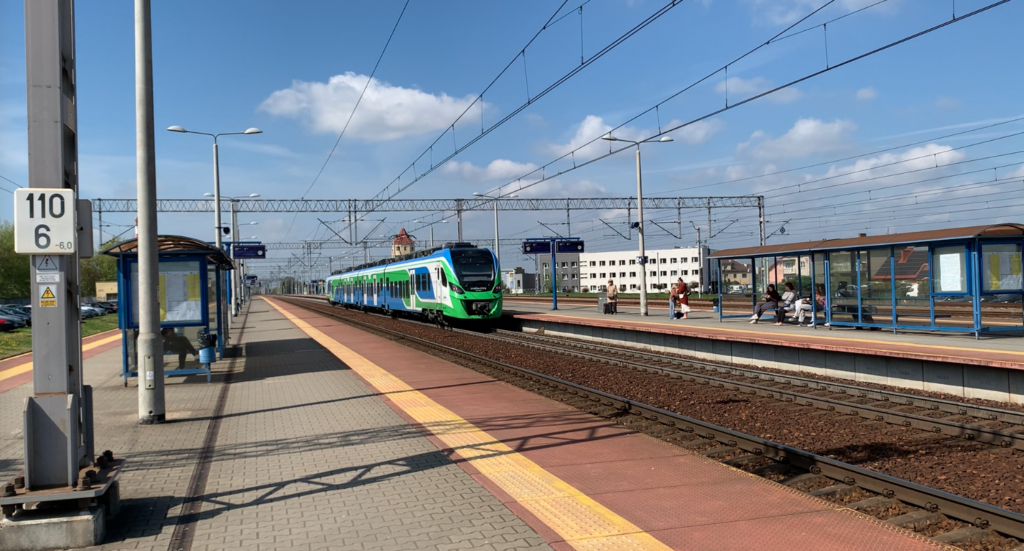
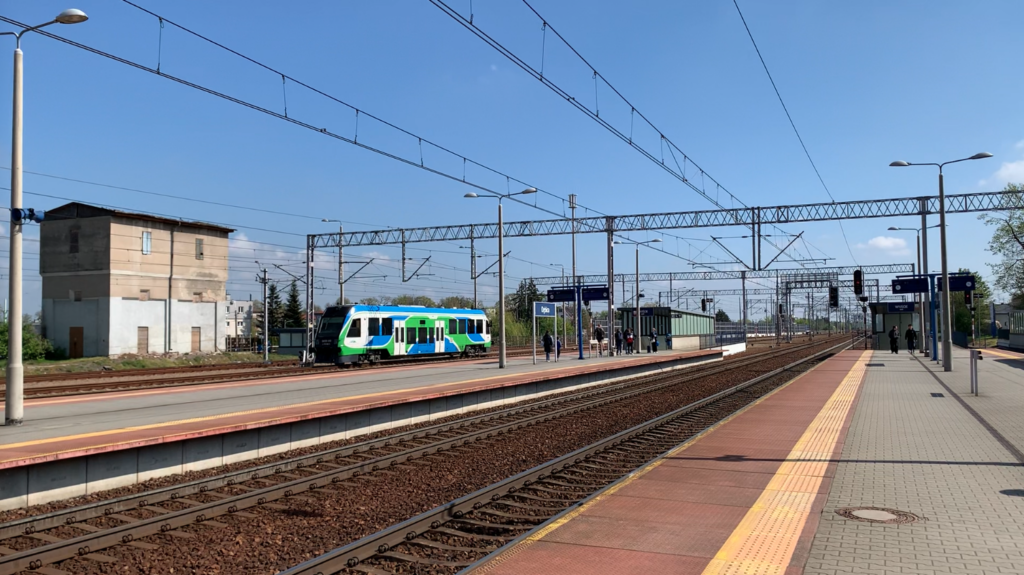
Dębica station has two island platforms and four platform edges. The old platforms were shifted eastward. They were low-rise, with a paving stone surface. There were approximately 30-meter-long canopies. There were lighting, benches, and a sound system. New platforms; Platforms 1 and 2 are identical. Entrances are located at both ends of each platform. The platforms are 400 meters long, their length determined by the location of the platform entrances. Four bus shelters are located on each platform. The platform surfaces are paved with concrete blocks. The platform edges are paved with burgundy tiles, with yellow warning lines and buttons. There is lighting, an audio system, information boards, and displays with dynamic train information.
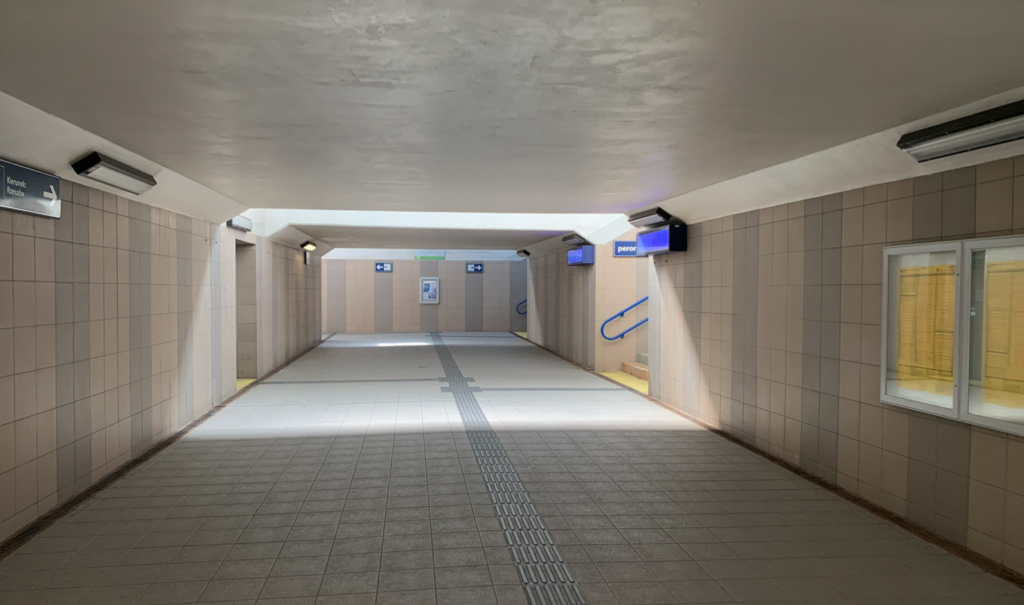
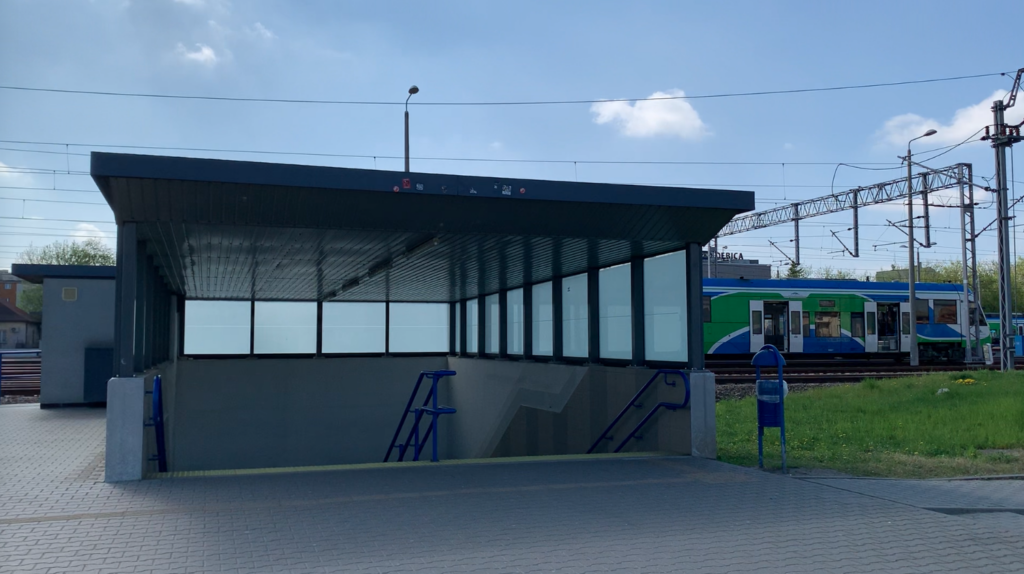
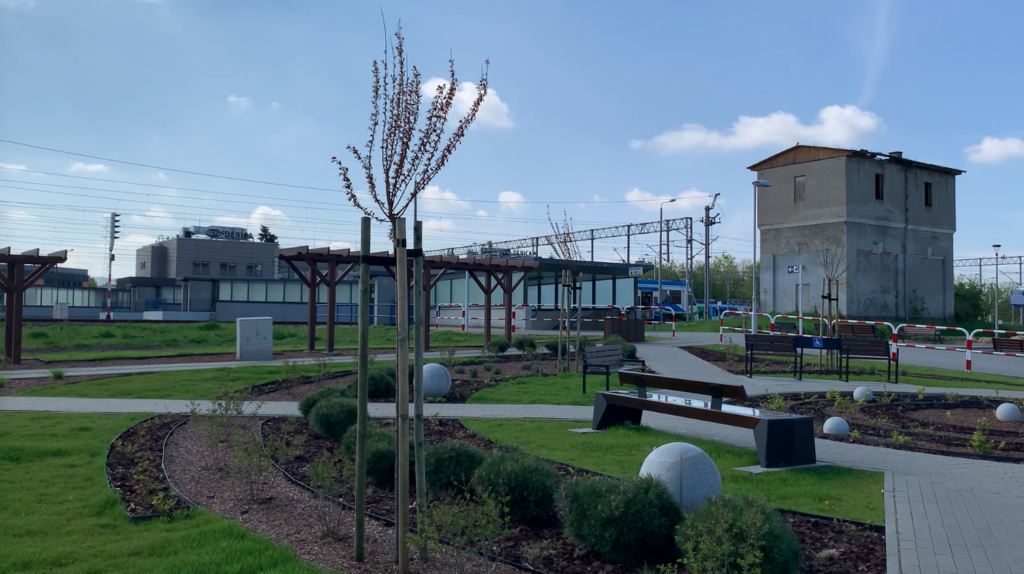
On either side of the passenger station, Fabryczna Street (to the west) and Kościuszki Street (to the east) run beneath the tracks. In recent years, both viaducts have been renovated, providing roadways and sidewalks. Access to the Fabryczna Street tunnel has been built from Platforms 1 and 2 (stairs and elevators). Previously, there was a level crossing along Fabryczna Street. A reinforced concrete pedestrian bridge over the tracks was located nearby. The bridge has since been dismantled. The passenger tunnel has been renovated. It connects the station square, Platforms 1 and 2, and Słoneczna Street. A new parking lot for 128 cars, including 6 spaces for disabled persons, was built on Słoneczna Street, next to the historic water tower. A bus stop area was built to the east.
Two railway lines run through the station: LK No. 25 Łódź Kaliska – Dębica and LK No. 91 Kraków Główny – Medyka. Seven through tracks run through the passenger station. It’s worth noting that LK No. 25 was completely renovated several years ago. A new trackbed was constructed, new prestressed concrete sleepers, and new rails were laid. The level crossings were automated.
Passenger traffic at Dębica station is steadily increasing, a phenomenon unique in Poland. Even the Chinese coronavirus pandemic did not halt its growth. In 2018, the station served 1,500 passengers daily. In 2022, the station served 2,300 passengers daily. In 2023, the station served 2,900 passengers daily. On May 5, 2026, 96 passenger trains departed from the station. You could go to the following stations: Bohumin, Frankfurt/Oder, Gdynia Główna, Horka, Hrubieszów Miasto, Kołobrzeg, Kraków Główny, Lublin Główny, Mielec, Padew, Poznań Główny, Przemyśl Główny, Rzeszów Główny, Sławno, Stalowa Wola Rozwadów, Szczecin Główny, Świnoujście, Tarnów, Wrocław Główny, Zebrzydowice, Zielona Góra Główna.
Written by Karol Placha Hetman