Nowe Skalmierzyce 2026-05-04
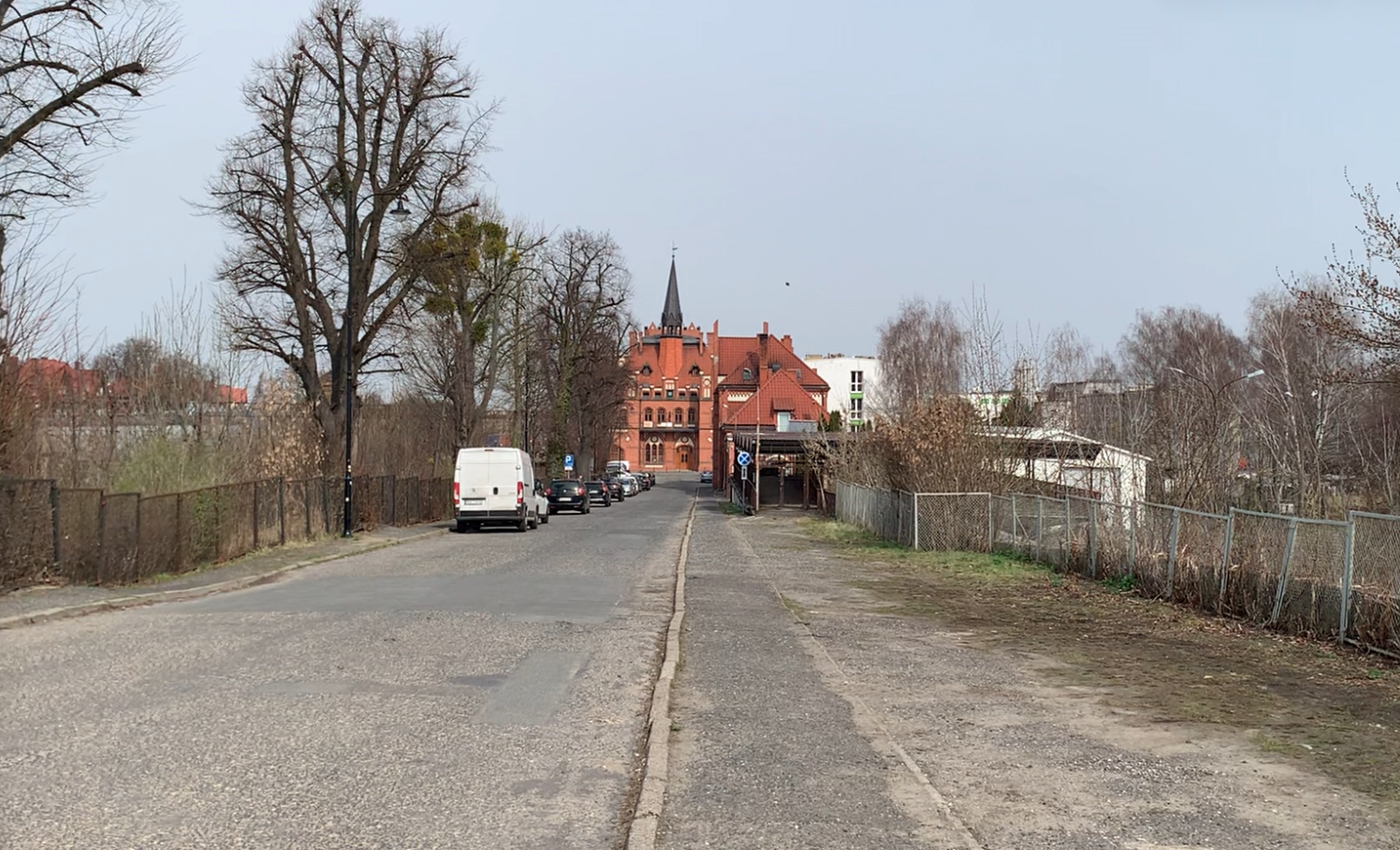
PKP Nowe Skalmierzyce Station.
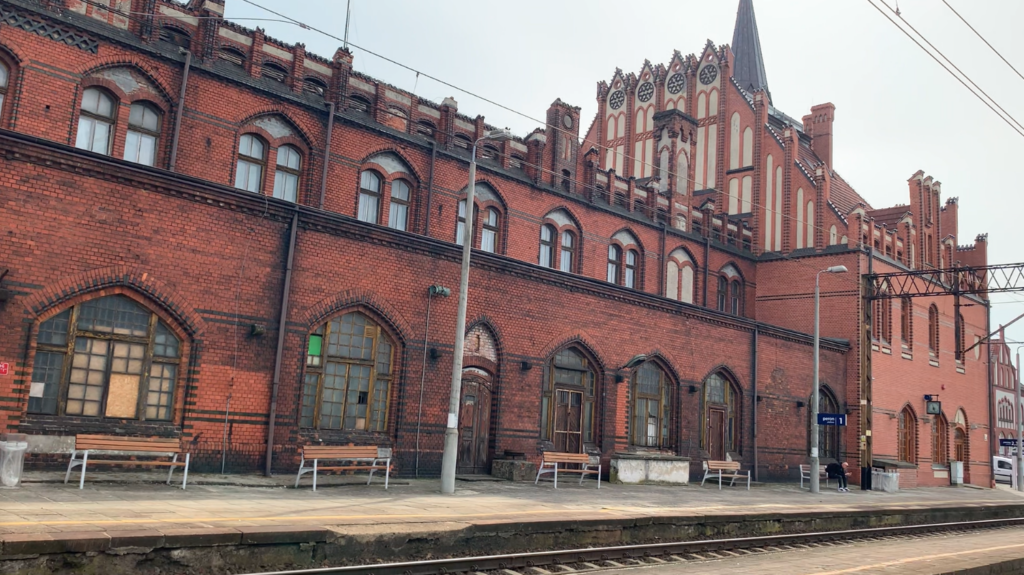
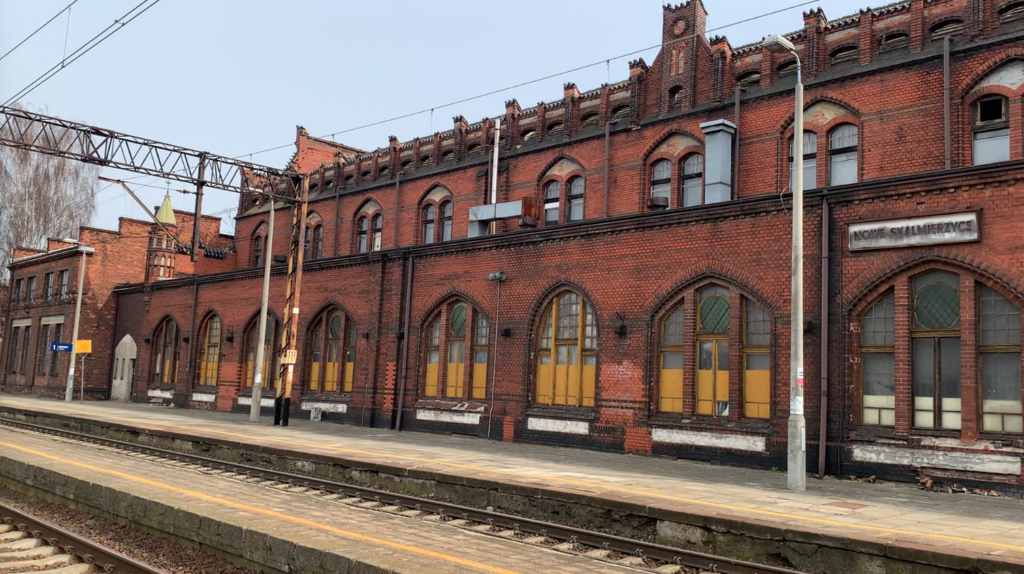
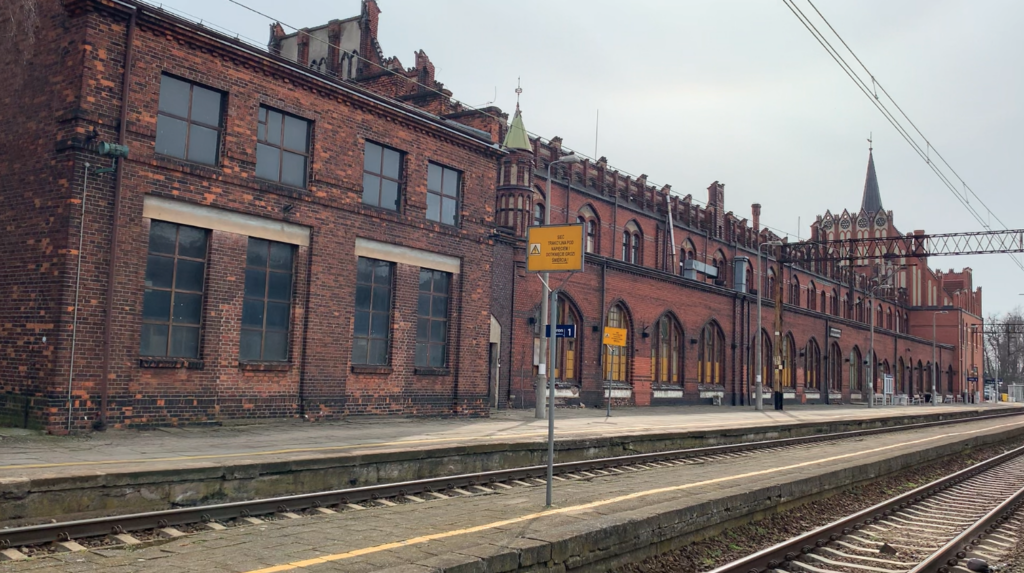
Railway line No. 14 Łódź Kaliska – Nowe Skalmierzyce – Tuplice runs latitudinally, east to west. The line is 388.578 km long, partially double-track, and partially electrified with 3 kV DC. The maximum speed is 120 km/h. The current gauge is 1435 mm. The line historically consists of several sections built at different times, by different companies, with different track gauges, and for different reasons. Individual sections were built between 1846 and 1915. Electrification occurred between 1965 and 1981. Currently (2026), only some sections are important to the national economy. The railway line is equipped with the SHP system along its entire length. Line No. 14 belongs to Freight Corridor No. 8.
On Line No. 14, a second track was opened: in 1916, Łódź Kaliska – Ostrów Wielkopolski; in 1943, Ostrów Wielkopolski – Leszno; in 1888, Kąkolewo – Leszno; and in 1901, Leszno – Żagań – Żary – Sieniawa Żarska.
On February 14, 1896, the Ostrów Wielkopolski-Skalmierzyce line opened, on the then Prussian-Muscovite border. In 1902, full border traffic opened. On the Prussian side, a large station with a representative railway station was built: Skalmierzyce, now Nowe Skalmierzyce. The distance between the Skalmierzyce and Ostrów Wielkopolski stations is 18 km. The line ran from Ostrów Wielkopolski station along present-day Osadnicza and Torowa streets. Additionally, along Melchiora Wańkowicza Street, there are present-day railway sidings to factories and wholesalers. In the area of Czekanów station, the line already followed its current route. Because this line route hindered the development of the eastern part of the city, a new line was built. From Czekanów station, the line was routed more northward. It then passes under the Ostrów Wielkopolski-Pleszew line viaduct, reaching Ostrów Wielkopolski station on its western side. This reconstruction took place in the period 1940–1943, i.e. during the Second World War, which was started by Germans and Muscovites.
Nowe Skalmierzyce.
Nowe Skalmierzyce is a town in central Poland, in the Greater Poland Voivodeship, located between Kalisz and Ostrów Wielkopolski. The town belongs to the Kalisz-Ostrów agglomeration. It has the status of an urban-rural commune. The settlement was founded in 1908 and received municipal status on July 18, 1962. The town has an area of 1.58 square kilometers. The town’s population in 2025 was 4,546. Registration plates are POS. Nowe Skalmierzyce was known in German as Neu Skalmirschütz. Nowe Skalmierzyce shares a border with Kalisz. Geographically, the town lies on a flat, slightly undulating terrain. Its elevation is 130-140 meters. There are no distinct hills or valleys in this area. The area is typically agricultural, covered with a patchwork of cultivated fields. The city lies in the Prosna River basin, but there is no major river within the city itself. Numerous small streams and drainage ditches exist here, ensuring the fields are well-watered. Rainfall is low. Forests are scarce, having been converted into farmland many years ago. The climate is temperate, with warm summers and mild winters.
The history of the town’s origins. In 1815, after the Napoleonic Wars, the Kingdom of Poland was established, which was entirely dependent on the Muscovite state. The borders were drawn between Kalisz and the village of Skalmierzyce. The town became part of the Germanic state. Nowe Skalmierzyce was established in 1908, as a result of the then Germanic authorities setting aside part of the land of the village of Skalmierzyce. On the Prussian side was the village of Skalmierzyce, and on the Muscovite side was the village of Szczypiorno. In 1896, a railway line was built on the Germanic side. The line began at the Ostrów Wielkopolski station and ran through Czekanów and Ociąż. From the Ociąż station, a siding was built northward, to the towns of Kurów, Kotowiecko, Głuski, and Kucharki. The main railway line ran to Nowe Skalmierzyce, but in a slightly different location. A little to the west, where the first station building still stands. In 1906, the Muscovites decided to connect the Kalisz-Skalmierzyce railway line, and thus the Warsaw-Kalisz Railway. Nowe Skalmierzyce and Szczypiorno stations became transshipment stations. However, Nowe Skalmierzyce also served as a passenger station. Passenger documents on the Moscow side were checked at Kalisz station. Both stations (Nowe Skalmierzyce and Szczypiorno) had 1435 mm and 1524 mm gauge tracks. A customs house was built at this location. This situation led to the rapid development of the town. The stations served their purpose until 1919.
Between 1904 and 1913, Nowe Skalmierzyce station was expanded. Within 11 months, between 1905 and 1906, a new station building was constructed. Many describe this building as monumental and neo-Gothic. The word “monumental” is an exaggeration, but one could agree that it is neo-Gothic. The building is an example of Germanic arrogance and didn’t quite fulfill its intended purpose. In 1913, a meeting between two bandits, Emperor Wilhelm II and Tsar Nicholas II, took place in the station building. In 2017, the station was added to the register of historic monuments; registration number 1017/Wlkp/A of January 4, 2017.
In 1907, a neo-Gothic post office was built on Kolejowa Street. Currently, it houses the Community Center for the Disabled. In 1910, a large, five-story railway signal box was built on Kolejowa Street, near the viaduct. The signal box was placed between the tracks. Currently, only the tracks remain on the western side. In 1913, a neo-Gothic water tower was built. In 1908, a canteen building was constructed, which later served as the “Kolejarz” cinema. Currently, it is the “Stare Kino” cinema and performance hall at 1 Mostowa Street.
On December 27, 1918, many Polish residents of Skalmierzyce joined the Greater Poland Uprising, taking part in fighting along the border between Boczków and Szczypiorne. Two days later, the insurgents took control of the settlement of Nowe Skalmierzyce. After the Great War and the rebirth of the Polish-Lithuanian Commonwealth, a demarcation line was established in 1923, which became the Polish-German border. These decisions were a result of the Treaty of Versailles. As a result, the town and its railway station lost their role as a border station. The pace of life in the town slowed down, and economic development also stalled.
Around 1926, a locomotive shed was founded, where steam locomotive repairs and inspections were carried out. The school was expanded, which also housed vocational training courses for railway workers. The school is located at 52 Kaliska Street. It was built in 1909 and expanded in 1929. A Catholic parish dedicated to Corpus Christi was also established on 3 Maja Street, west of the railway station. Within 30 years, Nowe Skalmierzyce had a population of approximately 3,000. There were approximately 153 buildings, most of which belonged to the Polish State Railways (PKP).
In September 1939, Germans and Russians invaded Poland. The town was occupied by the Germans and incorporated into Germanic territory. The Germans changed the town’s name to Neu Skalden (1940-1943) and then to Kalmen (1943-1945). During the occupation, a Germanic transit camp was set up in the local school. A commemorative plaque is located on the school building. From the very beginning of the occupation, the Polish Underground was organized. In 1943, Polish partisans – railway workers – burned 40 railway wagons carrying fodder. In 1944, a Germanic military transport was derailed.
After World War II, from 1956 to 1962, Nowe Skalmierzyce had the status of an industrial estate. On July 18, 1962, the town gained city status and changed its name to Nowe Skalmierzyce. The town served as the commune’s seat until December 30, 1999. In 2015, a historical square was established at the current border between Nowe Skalmierzyce and Kalisz, commemorating a historic border crossing from the partition era. A bugle call inspired by regional melodies was composed for this occasion. In 1945, the town belonged to the Poznań Voivodeship, Ostrów County. In 1989, it belonged to the Kalisz Voivodeship. Since 1999, the town has belonged to the Poznań Voivodeship, Ostrów County. An auxiliary unit of the commune was established, encompassing the entire town of Nowe Skalmierzyce, called the Nowe Skalmierzyce Residents’ Self-Government. The legislative body is the general meeting of permanent residents. The executive body is the chairman of the board, assisted by an auxiliary body. The board consists of three to seven members.
The systematic liquidation of the Polish State Railways (PKP) resulted in the city losing as much as 14% of its population between 2002 and 2022. The city lies within a subzone of the Łódź Special Economic Zone.
The first station building was located at Wolności Square. It was constructed in 1895-1896. Today, it serves as residential space. It is a two-story, two-unit building with a usable attic. It was constructed of red brick and left unplastered. A warehouse was added to the station building, which is also currently a residential building.
Nowe Skalmierzyce Railway Station.
Address: Kolejowa Street 2, 63-460 Nowe Skalmierzyce. Geographic coordinates: 51.708N 17.986E. Elevation: 135 m.
The station is located on LK No. 14 Łódź Kaliska – Tuplice. The station has three single-edge platforms, very narrow, located between closely spaced tracks. For such a large airport, rail traffic is low. In 2017, the station served up to 50 passengers per day, and this figure remained unchanged in 2022. In 2023, the number of passengers transported increased to 100 per day.
On January 31, 1896, after the Railway Construction Society received a concession, a railway line to Ostrów Wielkopolski was opened via Śliwniki, Ociąż, and Czekanów. The railway line terminated next to the old station, which stands at Wolności Square. The track was located on the eastern side of the station building. The building is currently a residential building.
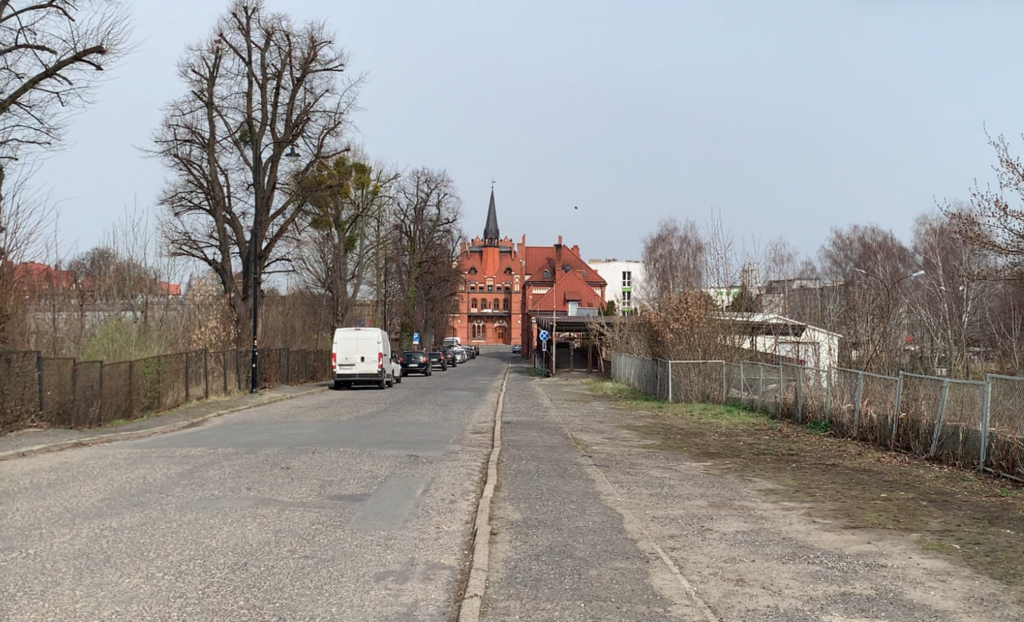
In 1905-1906, a new station building was constructed. Within 11 months, the station building was completed. Many describe this building as monumental and neo-Gothic. The word “monumental” is an exaggeration, but one can agree that it is neo-Gothic. The building is an example of Germanic hubris and did not entirely fulfill its intended purpose. In 1913, a meeting between two bandits, Emperor Wilhelm II and Tsar Nicholas II, took place in the station building. In 2017, the station was added to the register of historical monuments; registration number 1017/Wlkp/A of January 4, 2017. The building was designed by the architect Hermann Blunck, associated with the Prussian railways.
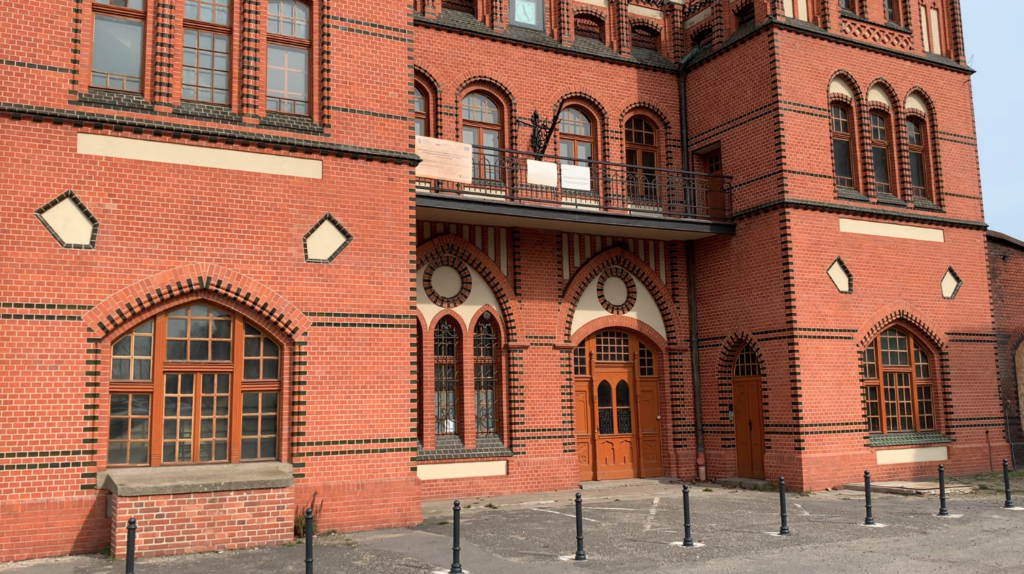
Germaniec incorporated elements of Neo-Renaissance, symmetry, elements used centuries ago, unusual features, numerous details, turrets, stepped attics, rosettes, medallions, and an elaborate form. The building was incorporated into an elongated rectangle with dimensions; The building is 23 meters wide and 90 meters long. The building is generally two-story, with a basement and a partially utilized attic. It has three main volumes. The first faces the station square. The representative entrance is a single entrance. Above the entrance and an additional window is a balcony, typical of Germanic railway stations.
The central section is the longest and serves as the primary functional element. The third section is the smallest and served official functions, although it likely housed the imperial hall. It is essentially an extension, measuring 10 meters by 11 meters, and is positioned asymmetrically, offset to the west. Construction uses red facing brick and black brick for the ornamentation and window frames. The exterior parapets are made of green-glazed clinker. The walls are up to 0.70 meters thick. The building resembles a three-nave temple, culminating in an octagonal turret. The roof is covered with red tiles. The roof is very steep. The roof features parapets, intended to resemble another floor of windows. Coat of arms and medallions, currently blank, are placed on the façade. The windows vary greatly in shape, size, and layout. Windows with mullions are often used. The windows have brown frames, and some feature decorative metal grilles. There are also so-called blind windows, intended to maintain the building’s symmetry. Initially, platform canopies were placed along the building, on both sides.
The interior features several areas. Ticket and baggage claim offices are located at the front. There are two staircases, two ticket offices, and train rooms. In the central part of the building, along the western wall, runs a corridor up to 6 meters high. Centrally located are the restaurant-waiting rooms for Classes 3 and 4, and Classes 1 and 2. The Class 1 and 2 waiting rooms boasted richly ornamented walls, high-quality furniture, and numerous fresh flowers. Between the waiting rooms is another third staircase and other service rooms. Each waiting room had direct access to the eastern platform. Behind the waiting room were further service rooms and a fourth staircase. Next was the largest room: the Customs Hall, or Zollsaal in German. Zoll means customs, Stal means hall. The room has an area of 836 square meters. Customs inspection took place here. Luggage and goods were inspected, and customs fees were collected. The room had to be very well lit, and large windows were standard. The hall had to be representative to impress potential fraudsters and smugglers. It was the country’s calling card. Every border crossing had one. Every traveler had to pass through it. A single entrance from the main corridor led to the hall. The hall was located between the main walls of the building, running from west to east. Each wall had two entrances to the platforms. The hall was divided into three additional rooms: a ticket office, a personal inspection room, and a customs officer’s room. Fourteen columns support the upper floor. Around 40 tables were set up in the hall for inspections. The upper part of the building housed railway service rooms, warehouses, staff rooms, and other facilities. Although the building was undamaged during the Great War and World War II, there is a clear repaired hole in the western wall, similar to a shell-hit hole. When the Polish-Lithuanian Commonwealth was reborn, a passenger bridge was built connecting the station building with the locomotive shed. The pier still exists today.
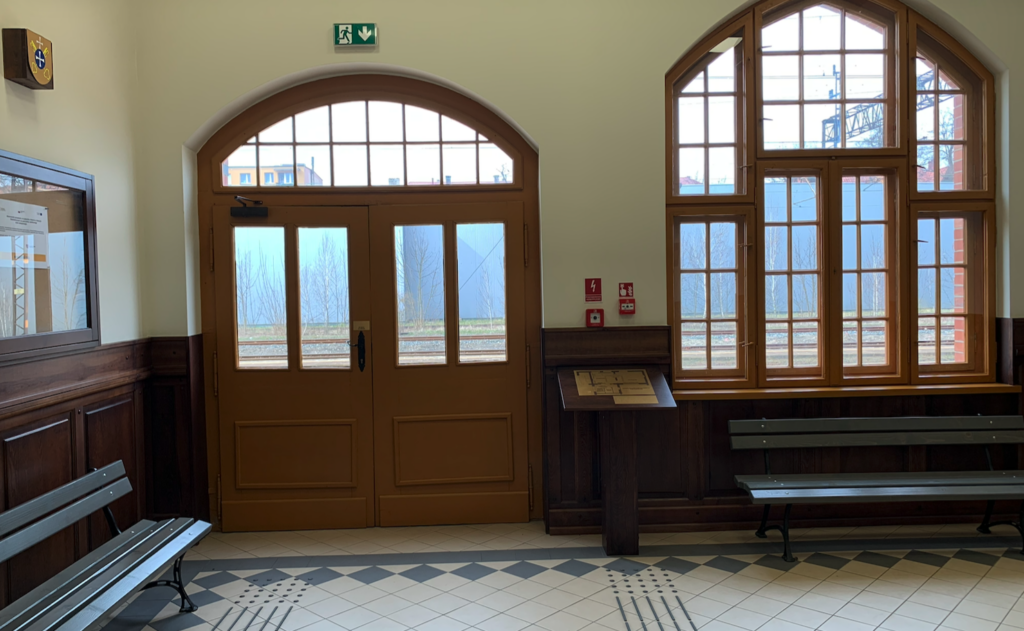
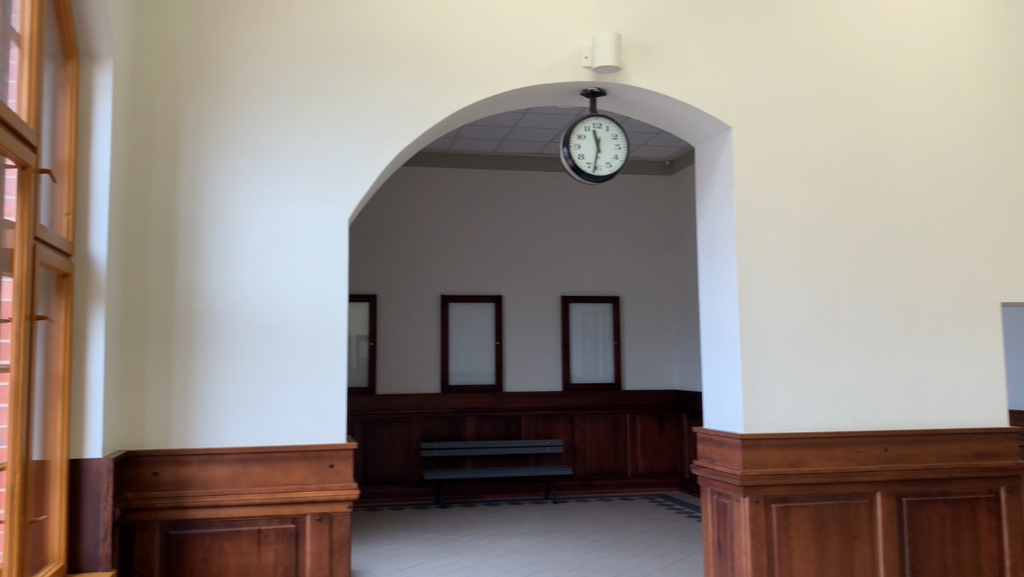
Currently (2026), a waiting room and restrooms are available to passengers free of charge. The floor is cream terracotta with a gray pattern. The walls are covered with dark brown wood paneling to a height of 1.30 meters. The walls are painted cream. Railway information displays are located on the walls. Park benches are available for seating. There is also a board with a station map for the visually impaired.
Behind the station building, to the north, stands another historic building, opened in 1909. It served as a railway canteen and overnight accommodation. The building is two-story, six-bay, and covered with a flat roof. It was likely initially covered with a gable or hipped roof. Further north is another historic building, which served as an electrical transformer. Also at Platform 1, at its southern end, is a brick bunker.
In the western part of the station is a water tower, and next to it is the pumping station building. The water tower still stands and is in good condition.
At the same time, the first cross-border track between stations was built: Nowe Skalmierzyce – Szczypiorno – Kalisz. On October 28, 1906, a rail (1435 mm) – rail (1524 mm) connection was opened. Goods were transferred between wagons. For convenience, the tracks on which the wagons were unloaded were higher than those carrying the wagons for loading. Ramps (troughs) were placed between the wagons, allowing goods to be easily moved: sacks, crates, and barrels. From 1906, trains on the Warsaw Kaliska – Wrocław Główny and Warsaw Kaliska – Poznań Główny routes passed through Nowe Skalmierzyce station.
After 1919, Nowe Skalmierzyce station lost its role as a border station. In 1922, after the construction of the connection through Kutno, the long-distance Warsaw – Nowe Skalmierzyce – Poznań connections were discontinued.
Signal Tower.
The signal box at Nowe Skalmierzyce station is an important element of the entire railway system, both technically and architecturally. However, this signal box has a unique appearance and is the only one in Poland. The signal box is very high, reaching five stories. It was located near the railway viaduct, from which Kolejowa Street branches, leading to the station building. Additionally, a signal box was placed between the tracks, which then bypassed the station building on the east and west sides.
Platforms.
Currently (2026), the station has three platforms, located only on the west side of the station building. All platforms are single-edged, low, and narrow. The platform surface is paved with paving slabs measuring 0.30 m x 0.30 m. All platforms are 280 m long. Platforms 2 and 3 are 1.8 m wide.
In the 1990s, successive governments systematically destroyed the Polish State Railways (PKP). Connections, stations, and even entire railway lines were closed. This degradation did not spare Nowe Skalmierzyce station. The number of connections and passenger numbers gradually decreased. The station building fell into disrepair. In 2001, the station’s train dispatcher station was removed and the ticket offices were closed. On December 29, 2015, PKP (Polish State Railways) acquired the station building through a donation to the Nowe Skalmierzyce Municipality and City authorities. A thorough revitalization of the building was planned, adapting the premises to accommodate various local government organizations, cultural institutions, a performance and cinema hall, and a youth club, while maintaining its function as a railway station. In 2016, a multi-stage renovation of the historic building began. Work began with the renovation of the roof, which has an area of approximately 1,800 square meters. New gutters and downspouts were installed. Between 2021 and 2023, the representative front section of the station was renovated. The waiting room and restroom were renovated. The restroom is accessible and free of charge. The building’s façade was cleaned. The windows and doors were replaced. New railway clocks were installed. In 2020, during the renovation of the waiting room, a bottle containing a letter dated March 15, 1941, was found bricked up in the wall. The letter was written by two bricklayers from Kalisz: Jan Karalewski and Władysław Sobański. They were eyewitnesses to the forced deportations of people to concentration camps during the German occupation.
In 2017-2018, InterCity trains on the following routes stopped at the station: Węgliniec – Legnica – Wrocław Główny – Nowe Skalmierzyce – Warszawa Zachodnia – Warszawa Wschodnia – Białystok. On May 4, 2026, 32 trains departed from Nowe Skalmierzyce station. They served the following stations: Kalisz, Krotoszyn, Leszno, Łódź Kaliska, Opatówek, Ostrów Wielkopolski, Poznań Główny, and Warszawa Wschodnia. All trains were operated by Koleje Wielkopolskie, PolRegio, and Koleje – Łódzkie Voivodeship. EN57, Newag Impuls, and Pesa Elf EMUs were frequently seen at the station.
The eastern station area.
The eastern station area was practically sold to the Germans. The locomotive depot and the entire eastern station area were located there. Vossloh Skamo operated temporarily on the site of the former locomotive depot. Vossloh and Škoda Transportation are two companies whose collaboration gave rise to the name “Vossloh–Škoda (SKAMO).” This was not a single, independent company in the classic sense, but a joint venture between the German Vossloh and the Czech Škoda. Where does the name “SKAMO” come from? It stands for Škoda + MOtor (or modifications/modernizations). The company manufactured and modernized diesel locomotives, shunting vehicles, and equipment for the railway industry. This company was undoubtedly another example of Poland divesting itself of national assets.
Currently, two companies operate here: Halfen and Vossloh Locomotives. Both companies are associated with the railway industry. Halfen is a German company specializing in construction solutions, particularly assembly components and structural connection systems. The company produces systems used in building construction, infrastructure (bridges, tunnels, railways), and prefabrication. Halfen is primarily known for its components: mounting rails (also known as Halfen rails), concrete anchors, and fastening elements. These components are used for facade assembly, installations, and steel structures. They can be used for fastenings in tunnels, bridges, and railway structures.
Vossloh is a German company associated with the railway industry. Currently, it operates primarily in the track industry, not in the vehicle industry. The company produces systems for fastening rails to sleepers and maintaining track stability. The company produces railway switches and other railway track components. The company also grinds rails and repairs damaged tracks. Vossloh once manufactured locomotives. The locomotive division was sold to Chinese companies.
Written by Karol Placha Hetman