Lidzbark Warmiński 2026-02-24
Lidzbark Warmiński.
Although Warmia and Masuria are always mentioned together, they are two distinct regions of northeastern Poland. Lidzbark Warmiński is a town in the Warmian-Masurian Voivodeship, in Lidzbark County, within the rural commune of Lidzbark Warmiński. Town rights were granted to the settlement in 1308. From 1975 to 1998, the town administratively belonged to the Olsztyn Voivodeship. Currently (2026), the town has an area of 14.35 square kilometers.
The population of Lidzbark was 14,459 inhabitants as of 2024. As is the case across Poland, the population has been steadily declining for the past 30 years. In 1996, the city had a population of 17,897. Migration to larger cities and abroad is contributing to this downward trend. This process is fueled by the closure of businesses and the lack of higher education institutions in the city, as well as poor, ongoing transportation. Yet, residents consistently vote for Freemasons, leftists, and Volksdeutsche (Volksdeutsche) in elections. The constant attacks on the institution of family, especially those with many children, and the marginalization of the Catholic faith are also contributing factors. In 2006, unemployment in the city exceeded 30%. Currently, the situation is slightly better. According to Central Statistical Office data, the estimated registered unemployment rate in the Lidzbark Warmiński commune at the end of 2024 was 11.1%. This is higher than the average for the Warmian-Masurian Voivodeship and significantly higher than the national average. The average unemployment rate nationwide is 5.1%, as of mid-2025.
Lidzbark Warmiński is the Polish name for the city. In the Germanic language, the name Heilsberg was used. From 1350 until the 19th century, Lidzbark Warmiński was the capital of Warmia and formerly its largest city. The city was a center of faith and culture in the Polish-Lithuanian Commonwealth. The city was, and still is, called the Pearl of Warmia. For a long time, it was under the rule of the Warmia bishops. It was also a significant economic center, second only in importance in Warmia to the city of Braniewo. The city is home to the castle of the Warmia bishops, considered of great artistic and historical value on a global scale. Since 1973, the castle has been classified as a Class “0” monument. This classification is currently obsolete. The formal system of monument classes (0, I, II, III, IV) ceased to apply after a new law came into effect in 2003.
The town is home to the Polmlek dairy plant, which is the headquarters of the Warmia dairy group. A Polish Army unit, the 9th Warmia Reconnaissance Regiment, is stationed in the town. Currently, Lidzbark Warmiński is a town attracting a growing number of tourists and vacationers.
Lidzbark Warmiński is located in the northwestern part of the Warmian-Masurian Voivodeship. It lies at the confluence of the Łyna River and its tributary, the Symsarna, and at the junction of three geographical regions: the Sępopolska Lowland, the Olsztyn Lake District, and the Górowskie Hills. The surrounding areas are tourist and recreational areas: Redy Osada, Koniewo Osada, Markajmy, Pilnik, Wielochowo, and Lake Wielochowo. Lidzbark Warmiński lies in the historic Warmia region. Historically, the border between Prussian tribes ran here: Warmia Plemienna (Land of the Warmians) to the west, and Barcja (Land of the Barts) to the east.
Currently, the commune has 31% agricultural land and approximately 5% forested land. Warmia’s landscape is diverse, with gentle glacial hills and numerous rivers, including the Łyna and Pasłęka. There are lakes, though fewer than in Masuria, but with more hills and river valleys. The landscape is peaceful, agricultural and forested. Although we often hear the words “Warmia” and “Masuria” in the same breath, the two regions differ significantly. Warmia is Catholic and loyal to the Warmia bishops. There are strong Polish traditions here. As a dominion of the Warmia bishops, Warmia had its own administration and a network of roads connecting the chapter towns. The landscape is different and there are fewer lakes. Warmia is a region with a strong sense of identity. Many associations that cultivate the Warmian tradition, dialect, and customs remain active to this day. The population is more educated, and the cities are better developed. Masuria is Protestant, primarily in culture. Loyalty to the Prussian princes is evident here, and Germanic influences are stronger. There is less attachment to religion, culture, and history. Cities are less developed and were founded primarily as tenement villages. Masuria was more vulnerable to invasions by Lithuanians, Belarusians, and Muscovites. Masuria is primarily the Land of the Great Lakes; it is known for tourism and recreation.
Lidzbark Warmiński is only 40 km from the border with Moscow. Königsberg is 81 km away. Distance to the cities: Olsztyn 47 km, Elbląg 89 km, Gdańsk 160 km, Białystok 231 km, and Warsaw 245 km. The main cities of Warmia: Olsztyn – the largest city in the region, the former seat of the Warmia Chapter. Lidzbark Warmiński – the historic capital of the Warmia bishops. Frombork – the workplace and burial place of Nicolaus Copernicus. Orneta – the former chapter town. Braniewo – one of the oldest towns in the region.
The name Lidzbark is the name of an Old Prussian settlement, which in Polish was pronounced Lecbarg, Licbark, or Lidzbark. The Germanic name, Heilsberg, means Holy Mountain. The holiday refers to a pagan holy day celebrated in the Pilnik area on “Krzyżowa Góra” (Cross Mountain). Other names also existed, such as “Ellsbergas,” which referred to the Prussian name for the castle on the Łyna River. Later, Lidzbark began to be called Warmiński, to distinguish it from Lidzbark Welski.
Lidzbark Warmiński lies in the historical Warmia region. Historically, the border between Prussian tribes ran here: to the west, Warmia Plemienna (Land of the Warmians), and to the east, Barcja (Land of the Barts). These tribes, like all Prussian tribes, did not develop their own state structures. They had their own beliefs, cults, and deities, strongly connected to nature and ancestral traditions. But these tribes were not defenseless. They built watchtowers along trade routes from Baltic ports to Lithuania and Belarus. The Prussians engaged in hunting, animal husbandry, and “foraging expeditions,” especially in Masovia. The Teutonic Knights were brought to Poland in 1226, and from then on, the Prussians’ fate deteriorated until the 15th century, when they practically disappeared. The outbreak of Prussian uprisings did not save the tribes. They were slaughtered, killed in combat, or Germanized. In theory, the Teutonic Order was supposed to introduce the Roman Catholic religion and culturally elevate the local inhabitants. In practice, the Teutonic Knights relentlessly plundered, raped, and murdered. They repeatedly reprimanded the Order in writing.
The first written mention of the settlement of Lidzbark dates back to 1240. The town was often at the center of Prussian-Teutonic struggles. In 1243, Lidzbark became one of the towns of the newly established Warmia diocese. The wooden castle standing in the town was transferred to the bishops in 1251. The town was granted the right to establish a foundation under Chełmno Law on August 12, 1308. As part of the grant, the town received 140 włókas of land. One włóka of land is approximately 18 hectares. The land was parceled out for buildings, vegetable gardens, gardens, pastures, and church property. The then bishop of Warmia came from Silesia, which influenced the town’s development. Germanic and Polish settlers were brought in from Silesia. The buildings were also modeled on those in Silesia. Flax cultivation, following the Silesian tradition, was also introduced. A school, a type of seminary, was founded in the town, preparing students for clerical life. Construction of the castle began at the confluence of the Łyna and its tributary, the Symsarna Rivers. As early as the 14th century, a town hall, church, and hospital were built. The first wooden church was consecrated in 1315. In the second half of the 14th century, the town began to be surrounded by walls with towers and gates. Access to the town was through three gates and a church gate. Around 1390, a simple waterworks was built, which operated until 1904. It housed baths and toilets. The bishopric’s central administration was located here, where laws were passed, courts were held, diplomatic and trade negotiations were conducted, and a hospital and school operated.
In 1410, Lidzbark deployed its army in the Battle of Grunwald against the Polish Army. However, this army was quickly defeated. In 1414, Lidzbark was burned by the Polish Army besieging the town. In June 1440, Lidzbark joined the Prussian Confederation at the Congress of Elbląg and recognized the authority of the Polish King. In 1454, Casimir IV Jagiellon declared war on the Teutonic Order. In the first year of the war, Lidzbark covered the financial burden and paid 600 marks, and two years later, 1,350 marks. The war ended with a victory for Poland and the signing of the Second Treaty of Toruń, which ceded Warmia and Royal Prussia to Poland. The treaty document remains in Lidzbark Castle to this day. In the following years, the town repeatedly and unsuccessfully attempted to retake the Teutonic Order.
From 1350 to 1795, Lidzbark was the seat of the Warmia bishops and the capital of Warmia. After the Thirteen Years’ War ended, in 1466, Lidzbark became part of Poland. The city was made famous by renowned Warmia bishops and Nicolaus Copernicus. Gallus’ Chronicle was found here and subsequently published. In 1525, in Kraków’s Main Market Square, the Teutonic Grand Master paid homage to the King of Poland. However, the Teutonic state soon became secularized, and the Grand Master proclaimed himself a duke. He then entered into a strong alliance with the Germans in the west. He also introduced mandatory Lutheranism, thus creating the first Protestant state in Europe. During the Swedish Deluge, Ducal Prussia sided with the Swedes.
According to documents from 1572, Lidzbark had 152 houses and 98 craftsmen. In 1586, the convent of Saint Catherine was founded. In 1648, the city began to develop outside the walls. In 1656, Swedish and Brandenburgian troops besieged all of Warmia, including Lidzbark. In 1672, Lidzbark defended itself against a Swedish invasion. Between 1703 and 1709, Lidzbark was occupied by the Swedes once again. After the First Partition of Poland in 1772, Warmia fell to Prussia. The bishops and chapter lost their authority, the country was divided into districts, and a military garrison was placed in the castle. By 1772, there were 230 houses within the walls, and another 50 in the suburbs. The population, including the castle garrison, numbered 3,049. However, the town, along with the castle, fell into ruin.
In 1813, the town had 2,412 inhabitants. Between 1821 and 1823, the first Evangelical church in the Warmia region was built. In 1829, the first printing house was established, but it did not survive even 20 years. In the 19th century, the castle’s interior was successively adapted into a field hospital, a bakery, barracks, and a hospital. In 1840, the Prussians demolished the Middle Castle, while the High Castle, at the request of the Prussian king, remained and was given to the Catherine Sisters, who used it as an orphanage. During the Spring of Nations in 1848, rebellions broke out in Lidzbark. During the 19th century, the town was ravaged by fires several times. Part of the city walls and gates were demolished. The walls that served as the rear walls of houses and the High Gate remained. The Prussians systematically demolished and rebuilt every historic building in Warmia. Catholic churches, in particular, were stripped of their historic altars, pulpits, organs, and paintings. Lidzbark was a poor district town, devoid of culture, schools, printing houses, or libraries.
In 1899, a railway line was built to the city. In 1902, the town hall in the market square was demolished. In 1903, a new town hall was built next to the former northern walls. At the turn of the 20th century, the bishop’s gardens were converted into a cemetery. During the Great War, a large prisoner-of-war camp operated near the city. During the interwar period, persecution of the Catholic religion continued. In 1937, police attacked a Corpus Christi procession. These events were dubbed the “Rosary War.” In 1939, the city had three grain mills, an oil mill, a power plant, two brickyards, a sawmill, two iron foundries, a carpentry workshop, and a waterworks.
Despite the numerous wars that raged in the area, the city suffered the most during World War II, when a decisive showdown between the Germanic and Muscovite brothers took place. The Muscovites entered the city on January 31, 1945. The old town was completely destroyed. Eighty percent of the buildings in the entire city were destroyed, most after the Germans had fled the city. However, the castle of the Warmia bishops and the parish church survived. Recall that the brothers took matters into their own hands after Stalin refused to supply Hitler with oil.
After 1945, the city was settled by immigrants from central Poland, primarily from Mazovia and the Eastern Borderlands, primarily from the Vilnius and Grodno regions. Germans from the Königsberg Oblast also arrived. These were refugees from the savage Soviets. By 1956, this population had emigrated to the Federal Republic of Germany. Another wave of emigration occurred in the 1970s, when Polish citizens had to prove they had German ancestors.
During the communist era, the city was systematically devastated and its development became chaotic. In 1958, the decision was made not to rebuild the Old and New Towns from the ruins. Subsequently, apartment blocks were built on the remains of Lidzbark’s Old Town. Many valuable historic buildings, untouched by eastern architects, were also demolished. These included 18th-century houses near Mill Square and Klasztorna Street, and the 19th-century frontage of Wysoka Brama Street. Two pro-German cemeteries were also completely devastated. The so-called Romanian cemetery, a cemetery for prisoners of war and soldiers from the Great War, was destroyed. Only in 1989 were its remains preserved and cleaned up. A characteristic feature of all the buildings is the use of red brick and red roof tiles. This material proved to be extremely durable. Furthermore, brick walls were rarely plastered.
The Castle of the Warmia Bishops is now the Warmian Museum. The Collegiate Church of St. Peter and Paul still stands and serves its purpose. The High Gate remains. The bishops’ palace, “Krasicki’s Orangery,” has been restored. The former mill and groats mill building at Plac Młyński 5 is preserved. In the 1990s, several arcaded tenement houses were reconstructed. The PKO BP bank is located there. The railway water tower is also a historical monument. The largest museum in Lidzbark is a branch of the Museum of Warmia and Mazury – the Warmian Museum in Lidzbark Warmiński, located in the Castle of the Warmia Bishops.
In 2006, there were 1,619 registered businesses in the city. There are wood processing plants, door and window manufacturers, and dairy, meat, and grain processing plants operating in the city, utilizing the district’s crops and livestock. The main industrial center in the city is the Polmlek dairy plant. The plant employs 400 people and is one of the largest of its kind in the country. 40% of its production is exported outside the district. The city also hosts the Warmińska Spółdzielnia Inwalidów (Warmia Disabled People’s Cooperative), which produces disposable medical clothing. The tourism sector is developing rapidly.
Lidzbark Warmiński has had free public bus service since the fall of 2021. Buses run on five routes, serviced by four electric vehicles. The city has one higher education institution: the Warmińska University, and the Higher Vocational School – a non-public institution of higher education established by a decision of the Minister of National Education and Sport on November 20, 2003.
The 14th-century collegiate church in Lidzbark Warmiński is one of the most valuable historical monuments in the panorama of the former capital of Warmia. Along with the cathedral in Frombork and the Church of St. John the Baptist in Orneta, it is one of the most significant examples of Gothic-style churches in the region. There are several historic Catholic churches in the region, their architecture and furnishings worth seeing. Fortunately, these churches survived the ravages of war.
There are several interesting tourist destinations near Lidzbark. Stoczek Klasztorny is a popular tourist and pilgrimage destination in the region. It is a popular pilgrimage destination to the Marian sanctuary in the Basilica of the Visitation of the Blessed Virgin Mary. The site is associated with Cardinal Stefan Wyszyński, the Primate of Poland, who was imprisoned within the walls of the local monastery for nearly a year by the communist authorities of the Polish People’s Republic. The sanctuary is 11 kilometers eastward from Lidzbark.
Warmia Railway Station.
Unfortunately, the town of Lidzbark has been deprived of rail service and is one of many towns in Poland where residents are excluded from using this type of transport. The railway station currently serves as a bus station.
In the 19th century, Warmia was part of East Prussia. The construction of the railway was part of the state’s development strategy and the region’s integration with the rest of the Prussian monarchy. In 1872, a railway line through Olsztyn was opened, connecting Olsztyn to the East Prussian Railway network. Connections to Braniewo and then towards Königsberg were soon established. Local lines were gradually built, connecting smaller towns, including Lidzbark Warmiński and Bartoszyce.
With the railway’s construction, travel times were significantly reduced. Travel became safer and more convenient. It enabled the export of grain and timber, and allowed the import of machinery and equipment not produced locally. The railway accelerated the urbanization of the region. The railway network, although it had only developed in earnest at the beginning of the 20th century, was well-developed and dense. Most lines were single-track, although some engineering structures were built to accommodate a second track.
By 1914, Warmia already had a relatively dense network of lines: main lines connecting Berlin, Königsberg, and Moscow, and local branches to smaller centers. Imposing railway stations, water towers, locomotive sheds, bridges, and viaducts were built. Railways were the primary means of long-distance transport at the time. The network survived the Great War without significant damage. Over the next 20 or 30 years, the infrastructure was gradually modernized, with new rolling stock introduced. Local lines continued to operate, although their profitability declined.
The truth is, the foolish Germans started World War II and lost heavily. At the beginning of 1945, when the Soviet offensive began, railway units converted standard gauge tracks into wide gauge tracks, while trophy units dismantled railway lines irrelevant to the advancing front and transported everything to Moscow. When the Muscovites handed over administration to the Polish authorities, reconstruction of some railway lines began, such as the Olsztyn-Braniewo line. However, many routes, such as the Orneta-Lidzbark Warmiński line, were never rebuilt.
Simultaneously, regional and national road networks were modernized. Bus transport (PKS) developed. As a result, the number of rail connections decreased and funds for routine maintenance decreased. From the 1960s onward, road transport began to dominate, as it was faster and more suitable for smaller volumes of goods. Rail traffic on less frequented sections was gradually reduced. Despite this, rail transport continued to play an important role, especially for the transport of bulk goods and over long distances of over 300 km.
It is widely believed that 1989 was a breakthrough year, allowing for the transition from the era of socialism to the era of capitalism. The problem is that capitalism was not born in Poland because there was no capital. The communists transformed into businessmen, and a significant portion of society remained poor and unemployed. Thousands of factories and production plants were closed. Many passenger rail connections were eliminated. Railway stations were closed. Buses and minibuses took over over 60% of passengers, and the remaining people began using private cars. There was a clear decline in the importance of rail transport in favor of road transport. Warmia lost a significant portion of its former local rail network. The situation was most difficult for schoolchildren, who had trouble getting to schools and universities. The same was true for the elderly, who found it difficult to get to specialized health centers and hospitals.
After 1989, increased investment was made in road expansion and modernization. Among other projects, expressway No. S51 Olsztyn-Olsztynek was constructed. Railway line No. 221 Olszyn-Braniewo was revitalized. New rolling stock, in the form of more economical DMUs, began to be introduced. Warmia did not become a highly industrialized region, so transportation developed primarily in administrative, agricultural, and tourist/recreational capacities.
After 2000, the physical liquidation of railway lines accelerated. Post-communist businessmen dismantled railway tracks and profited from this type of scrap. They also participated in the scrapping of rolling stock, particularly steam and diesel. During this period, many valuable railway museum exhibits were irretrievably lost. Steel viaducts and railway bridges were not immune to the scrapping process. Officially, it was said that the roads under the viaducts were narrow, impeding traffic. This practice peaked in 2006-2008.
The United Right government began to reverse this unfavorable trend. A revitalization of selected railway lines was undertaken. One example is the Olsztyn-Braniewo railway line No. 221. The tracks and substructure were replaced. New platforms and access roads were built, eliminating barriers for people with disabilities and the elderly. The traffic control system was modernized. Local rail traffic is slowly being restored, using modern rolling stock. The railway network has not regained its former density, but it remains an important element of regional transport. The railway has been and remains a key factor in the modernization of Warmia, although its role today is smaller than in the 19th and early 20th centuries.
Lidzbark Warmiński Railway Station
Address: Kolejowa Street 5, 11-100 Lidzbark Warmiński. Geographic coordinates: 54.131N 20.575. Elevation: 84 m.
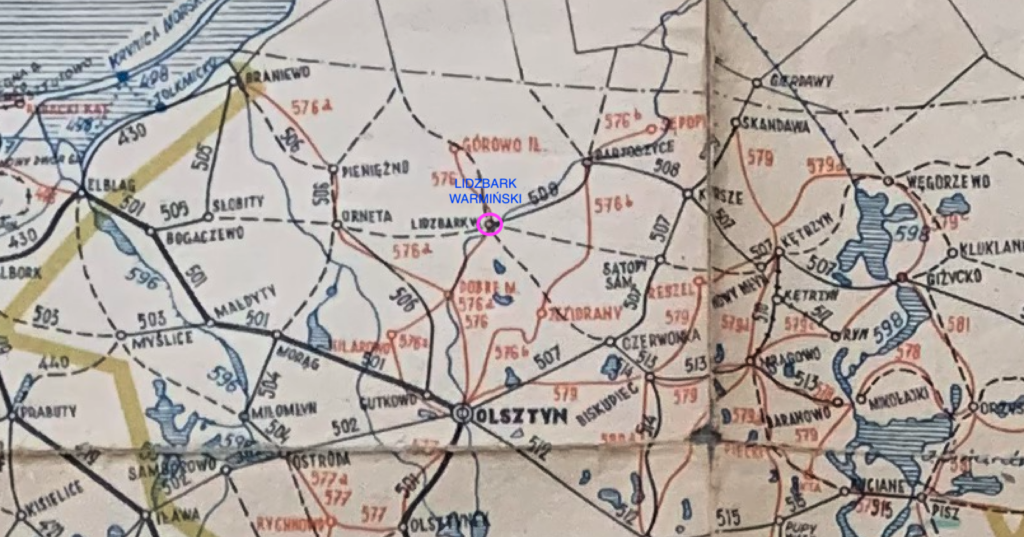
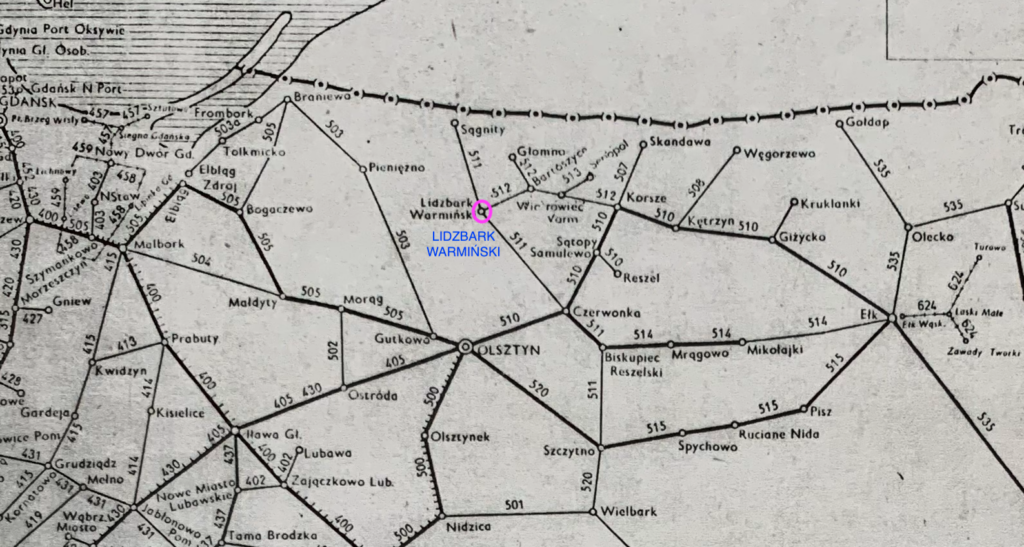
The first rail connection from Lidzbark was launched on October 1, 1899. A train departed from the new station on a line to Górowo Iławeckie, heading north. In January 1900, another section was opened, this time to Czerwonka, and from there there was a connection to Olsztyn.
Lidzbark Warmiński gained railway access relatively late compared to the region’s larger cities, but for several decades it served as an important local transportation hub. In 1905, a railway line connecting Lidzbark Warmiński with Orneta, running east-west, was opened. This shortened the journey to Königsberg. The railway line to Sątopy station was an extension of the line from Orneta through Lidzbark. This was a private initiative of local entrepreneurs. This incorporated the town into the East Prussian railway network by connecting it to the Olsztyn-Braniewo-Königsberg and Olsztyn-Korsze-St. Petersburg-Moscow routes. A station, freight infrastructure, and technical support were built. The railway enabled the export of agricultural products and timber, and the development of local trade. Thanks to the railway, machinery and equipment not produced locally were imported.
The Lidzbark Warmiński station opened on October 1, 1899. The building was constructed as a two-story structure. The eastern section is two-story, while the western section is single-story. The entire structure is covered with a high roof covered with red tiles. The attic is usable. The building was constructed of red brick. Initially, the station was unplastered. Over time, the station received extensions on the eastern side and on the station square. During the most recent renovation, a pavilion was added on the western side of the station, which serves as a waiting room for the bus station.
During the Great War, a connection was established towards Bartoszyce, i.e., towards the northeast. In 1916, the connection to Bartoszyce was opened. Additional connections were also built: Lidzbark Warmiński – Bisztynek – Korsze (eastbound), Lidzbark Warmiński – Jeziorany – Czerwonka (southbound), and Lidzbark Warmiński – Górowo Iłowieckie – Korniewo (northbound). Lidzbark became a hub connecting several local routes. The railway played a significant role in the city’s administrative and economic role. Before World War II, the city developed around a five-way railway junction. Railroads were a major factor in shaping the city. Houses and industrial plants sprang up around the stations. Many people also found work on the railways or in maintaining and expanding the railway infrastructure.
The Great War had little impact on the development or dismantling of the railway network. Railway lines operated stably. Regional connections within East Prussia were maintained. Passenger traffic was moderate but regular. During the 1920s and 1930s, two modern railway bridges were built over the Łyna River valley. The first bridge was built on the Lidzbark–Sątopy Samulewo line, the second on the Lidzbark–Czerwonka line, and the adjacent one on the Lidzbark–Sątopy Samulewo line.
In January 1945, with the Soviet offensive, rail transport collapsed, becoming ineffective both for supporting the retreating Germans and for evacuating civilians. Part of the infrastructure was destroyed during the war. Soviet railway troops converted the standard gauge to wide gauge, while trophy troops dismantled lines no longer essential to the Soviet army and transported the rails, switches, and railway equipment to Moscow. The line towards Orneta was dismantled and never rebuilt. This meant the city lost its direct connection to the main line in northern Warmia. This marked a turning point in the history of Lidzbark’s railways.
After World War II, the line towards Bartoszyce was maintained. Passenger traffic was limited, but it remained operational. Traffic was restored on the Lidzbark Warmiński – Jeziorany – Czerwonka line (southbound), as well as northbound traffic: Lidzbark Warmiński – Górowo Iłowieckie – Sągnity. This meant the city had a junction station in three directions. In 1950, the line to Czerwonka station was rebuilt. In 1952, the route was rebuilt, without a further connection to Górowo Iławeckie. In 1953, this route was extended to Sągnit station. Beyond lies the state border with Moscow, the Kaliningrad Oblast. Due to the extensive damage to facilities, bridges, and viaducts caused by retreating Germans and westward-moving Muscovites, reconstruction of the line to Orneta and Sątopy Samulewo was not undertaken. The railway’s importance declined with the growth of bus and truck transport. During the period of the Polish People’s Republic, Lidzbark station had connections with Górowo Iławiecki, Bartoszyce, and Czerwonka, which provided a direct train connection to Olsztyn.
After 1989, the number of connections was gradually reduced. The number of routes decreased, and services were frequently canceled. Trains were increasingly short. Timetables were inadequate for the needs of residents, leading to a decline in passenger numbers. Furthermore, steam and diesel locomotives were already uneconomical and worn out. Existing DMUs were already old and highly unreliable. Ticket sales did not cover even 50% of transport costs. No research and development was conducted in Poland on small, economical DMUs (motorized wagons). The last scheduled passenger train from Lidzbark departed on June 1, 1996.
In 1991, passenger service on the routes to Górowo Iłowieckie and Bartoszyce was suspended. The former was dismantled in 1994, and the latter in 2013. Passenger rail traffic towards Czerwonka finally ceased in June 1996, and freight traffic ceased at the beginning of the 21st century. By 1998, due to a lack of repairs, freight trains were traveling at 30 km/h, and in many places even as low as 15 km/h. The journey from Olsztyn to Lidzbark took approximately 1 hour and 35 minutes. The 38 km section from Czerwonka to Lidzbark was covered by train in 60 minutes, and by bus in 38 minutes. Furthermore, there were 36 pairs of buses on the Olsztyn-Lidzbark route.
Freight transport also declined. The main commodity was hard coal, delivered from the east. Hard coal accounted for 70% of rail transport. This share quickly dropped to 40%. Freight was taken over by trucks, which ran from Braniewo and Elbląg. In 1996, 51,700,000 kg of goods were brought to Lidzbark. In 1997, only 30,000,000 kg. In 1998, only 14,000,000 kg. Most of the cargo shipped from the Górowo Iłowieckie station was timber, averaging approximately 2,000,000 kg annually.
In 2005, passenger service was finally suspended. Since then, the station has been closed to passenger traffic. In 2012, track dismantling began.
The liquidation of the railway in Lidzbark Warmiński was not a one-time decision by a single institution. The process took place in stages, with different entities responsible at different times. Over the past thirty years, the main decisions were made by the Polish State Railways (PKP), and then by the companies formed from the division of that company, PKP Polish Railway Lines. The main argument was the unprofitability of individual routes. However, the final decisions were always made by the Council of Ministers in Warsaw. Transferring the regional railways to local governments was a bad decision. Local governments were given additional responsibilities but did not receive funding for their implementation. Large and wealthy voivodeships resolved this problem within a few years. However, weaker voivodeships, such as the Warmian-Masurian Voivodeship and the Lubusz Voivodeship, were unable to bear the burden.
In 2012, the station was not formally closed, but passenger rail connections to Lidzbark Warmiński were suspended. The decision to discontinue funding for passenger rail transport rested with the Warmian-Masurian Voivodeship. Regional rail transport was organized by the Marshal’s Office of the Warmian-Masurian Voivodeship. At that time, rail transport was operated by various operators, including companies from the PKP group and later PolRegio. The carrier operated the connections under a contract with the local government. The infrastructure was managed by PKP Polish Railway Lines (PKP PLK), but PLK did not decide on train operations, only on track maintenance. In 2012, the Warmian-Masurian Voivodeship was governed by a coalition of the Civic Platform (PO) and the Polish People’s Party (PSL). The PO-PSL coalition held a majority in the regional assembly after the 2010 local elections, allowing it to form the regional board. It was this local government, as the organizer of regional rail transport, that made decisions regarding the financing or suspension of passenger services in the region in 2012. The return of rail to Lidzbark Warmiński is a topic that occasionally arises in local and regional discussions, but the chances of restoring regular services are currently rather slim. All railway lines have been dismantled, and not even the sleepers remain. In 2026, it could be said that trains will not return to Lidzbark.
Lidzbark Warmiński – Górowo Iłowieckie – Sągnity – Moscow State Railway Line No. 224. The line was completely dismantled, as were the station tracks. Only some station buildings, railway embankments, culverts, and some viaducts remain. In some places, wooden and reinforced concrete railway sleepers can be found piled up. All level crossings have been removed. On the Górowo Iłowieckie – Dzikowo Iłowieckie section, an unpaved bicycle path was marked out on the old track. Line No. 224 Czerwonka – Lidzbark Warmiński – Sągnity was 68.58 km long. In the 1980s, the line was operated by the following locomotives: ST43, ST44, and Ty51.
Railway Line No. 224, Lidzbark Warmiński – Czerwonka. The line was completely dismantled. The Lidzbark Warmiński Old Bridge remains. It has a steel span with a roadway above it. The bridge trusses are preserved. The bridge is supported by concrete pillars. Nearby, a brick pillar for the second track, the second railway line, remains. A little further, above Bartoszycka Street, is a stone viaduct with a steel span. Further on, the lines branch off towards Czerwonka and Sątopy Samulewo. Further on, on Line No. 224, the rail-road crossing along DW No. 513 was recently removed. The curve of DW No. 513 has been rebuilt and is now more gentle. The old track has been converted into dirt roads or is overgrown with self-sown trees. Several rail-road crossings with rails and concrete slabs remain along the route. Near the town of Czerwonka, the line passed under the Olsztyn-Korsze railway line. The line then turned eastward and reached Czerwonka station.
Lidzbark Warmiński-Bartoszyce Railway Line No. 255. The line was completely dismantled. The Old Markajmy Bridge over the Łyna River remains, along with concrete piers for two tracks and three steel spans. Two viaducts, culverts, embankments, and excavations remain. All passenger stops and stations have been dismantled. The line was 26.31 km long. It opened to traffic on July 10, 1916. It was dismantled in 1994.
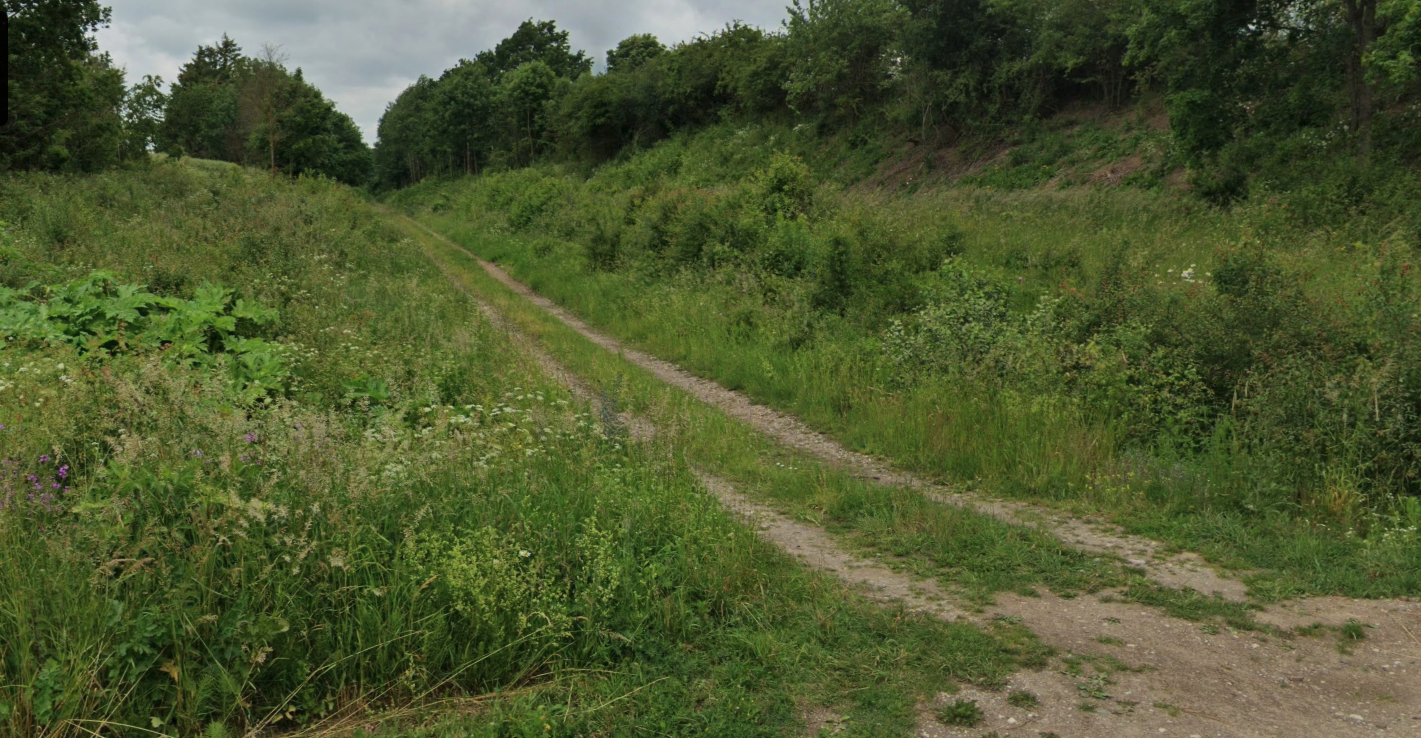
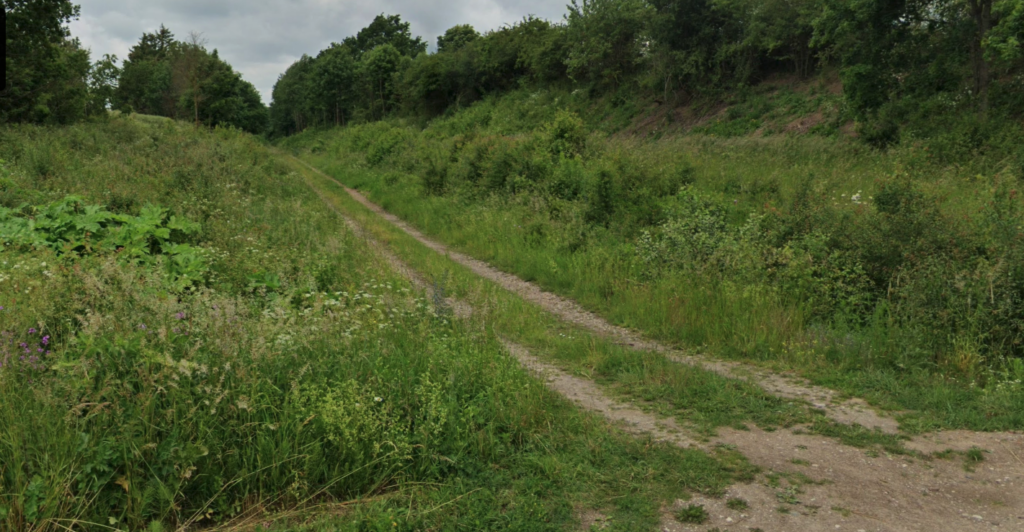
Lidzbark Warmiński-Sątopy Samulewo Railway Line. The line was completely dismantled. Its first section was transformed into the “Green Eastern Cycling Trail.” An interesting element of the trail is the causeway built on the lake before the town of Sarnowo. Further afield, it’s difficult to locate the old track, which is overgrown with self-sown trees or converted into dirt roads. Especially near the Sątopy Samulewo station, it’s difficult to determine the original track alignment. This area is now covered by farmland. The line was 33,500 km long. It opened to traffic on September 1, 1905.
The Lidzbark Warmiński – Orneta railway line was closed in 1945 by the Muscovites. The line was never rebuilt. It is currently a bicycle route, part of the Green Velo network. The line is approximately 33.70 km long. Maximum elevation: 91 m, minimum elevation: 61 m.
In 2021, the station building, which serves local residents, was renovated. The station serves bus passengers. The building currently houses a tourist information point, a health clinic, the local Perła Warmii association, and a small regional museum. We just don’t know why the old “Heilsberg” signs were hung in the waiting room. They’re neither pretty nor Polish. The station square used to have bus platforms. There were seven bus stands. However, in 2024, the square was rebuilt, adding one bus stop, a bus shelter, and five benches. There is a separate restroom building.
At Lidzbark Warmiński railway station, a large loading yard, warehouses, and a signal box remain. The building on the eastern side, on Spółdzielców Street, is privately owned. The signal box building at the western station head near Olsztyńska Street, Voivodeship Road No. 511, has already been demolished. In the eastern headland, there was a rail-road intersection along Spółdzielców Street and a steel viaduct over the tracks along Tadeusza Kościuszki Street. Olsztyńska Street runs through a tunnel, as the tracks and switches of the western headland were located above. In the western part of the station stands a disused railway water tower, built around 1920. Nearby is a large grain warehouse. A little further on is a railway warehouse building with a distinctive tower topped with a quadrangular dome, and a railway wheel placed on its peak. Nearby was a railway scale, converted into a truck scale.
In the northern part of the station, next to the station building, stands the building of the former fan locomotive shed. In 1993, the shed was transferred to non-railway purposes. It housed five stations. The turntable has been removed. The former locomotive shed now houses a furniture store. There’s a sign on the building that says it’s been put up for sale by PKP (Polish State Railways). As of 2025, the building hasn’t found a new owner.
The former railway buildings house various service establishments and shops. For example, two hairdressers, a taxi office, the PHU Maraton company, and others are still in operation. Earthworks are underway on the station level, in its western part. This area has likely been sold for development. The rest of the station level is overgrown with grass and self-seeded trees, even over the former tracks and platforms. Concrete pillars with street lamps, which no longer illuminate, remain. The platform edges are easily identifiable.
In its heyday, the station had three platforms and five platform edges. There were plans to build passenger tunnels. During the communist era, the platforms were low-rise, with concrete paving slabs. Streetlights were used for lighting, as were railway clocks mounted on the pillars. The station had shaped signals.
During the Germans’ rearmament, several bunkers were built at the station, which were also placed within the city limits.
Written by Karol Placha Hetman