Orzysz 2026-02-07
PKP Orzysz. 2026
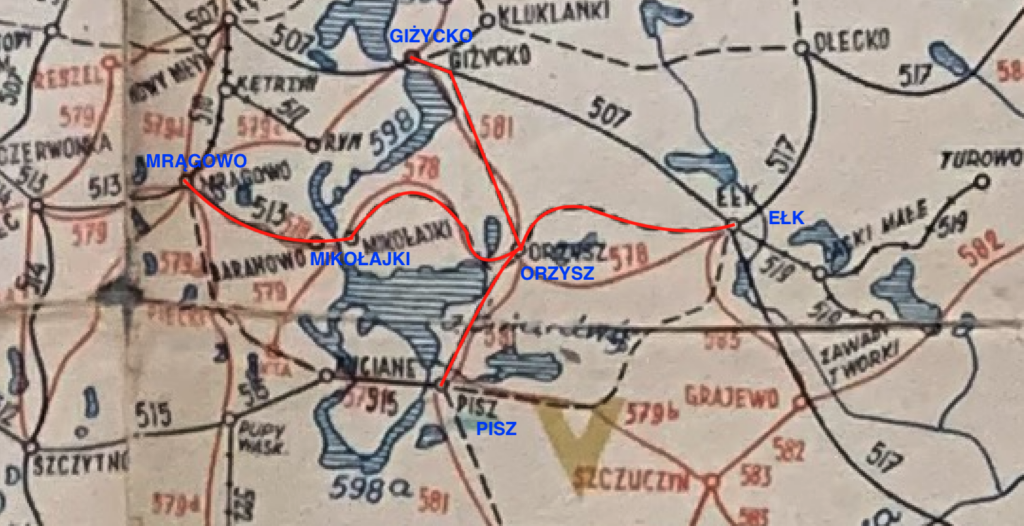
The area we are interested in is located in a quadrangle defined by four towns: Orzysz, Ełk, Biała Piska, and Pisz. This area lies in Masuria and for most of its history belonged to the Polish Crown, and then to East Prussia, which in 1772 was seized by Germanic tribes after the murder of the indigenous inhabitants – the Yotvingians and Old Prussians. Subsequently, it was; The Prussian Province from 1772 to 1871, Prussia from 1871 to 1918, the German Empire from 1919 to 1933, and the Weimar Republic, the Third Reich, from 1933 to 1945. During the Great World War, from 1914 to 1915, the Great Lakes region was occupied by the Muscovites. Despite the Germans losing the war, East Prussia remained under their administration. In 1920, a plebiscite was held among the local population, which voted for affiliation with East Prussia. As a result of World War II, started by the Germans and Muscovites, in 1945, this area was incorporated into the Republic of Poland. Administratively, it falls within the Warmian-Masurian Voivodeship.
At the beginning of the 20th century, the Orzysz training ground was very well connected by rail. The Orzysz station opened in 1905. Standard-gauge railway lines ran practically from every side of the training ground. These lines were established with state support to develop the most backward parts of East Prussia and to bring goods from the Middle East via the Muscovite state. However, as a result of World War II, in 1945, the Soviets dismantled all railway lines leading to the Orzysz station. After the war, only the Orzysz-Ełk line was rebuilt. Its purpose was to transport troops and weapons to the training ground, with the transport of goods coming second.
The town of Orzysz.
The Orzysz region was inhabited by the Prussian tribe, a Baltic people related to the Lithuanians and Yotvingians. All these peoples were not Slavs. Their area of residence included Warmia, Masuria, northeastern Poland, and southern Livonia. They spoke the Prussian language, which has since become extinct. The areas of Orzysz, Pisz, and Mikołajki were inhabited by the Galindians (Latin: Galindi), one of the main Prussian tribes. This tribe lived from fishing, hunting, animal husbandry, agriculture, and the amber trade. These people lived in settlements and practiced the cult of nature, fire, and sacred groves. They did not develop state structures, and individual settlements were led by elders. In the 13th century, the Prussians began to be conquered by the barbarian Teutonic Order. The Plamionas were killed in battles, their settlements were burned, the remaining were expelled, and the last representatives were Germanized. In the 16th century, the Prussians disappeared completely. The name “Prussia” was adopted by the Germans. The territory of present-day Orzysz was incorporated into the Teutonic Order by force of arms. In 1477, the Teutonic Commander granted the von Lehndorff brothers the right to establish a settlement for the Germans. In 1505, the settlement received town privileges. The town developed as a craft and agricultural center, taking advantage of its lakeside location. In 1525, the Teutonic Order was secularized. Orzysz became part of Ducal Prussia, a fief of the Polish-Lithuanian Commonwealth. Most residents spoke Polish, and masses were celebrated exclusively in Polish. The town was repeatedly ravaged by fires, epidemics, and wars. From 1701, Orzysz belonged to the Kingdom of Prussia. Germanic settlement began in 1702. As late as the mid-18th century, the majority of Orzysz’s inhabitants were Poles. From 1871 to 1945, the town of Orzysz was incorporated into the Germanic borders.
In the 14th century, the village of Orzysz (Arys) was founded under Chełmno law as a tenement village, like others in the region. Arys is a Prussian name, but it was pronounced and spelled differently: Ares, Ariss, Orsisch, and Orzyc. Furthermore, the initial name was Nowa Wieś (Neudorf). In this region, a large population spoke Polish, and a significant percentage were bilingual. Orzysz was founded in 1443. The first village head was Wawrzyniec Polin (Lorenz Polun), of Polish descent. The location of the village was not accidental. Commercial and defensive considerations were decisive. Its location amid lakes and marshes ensured security and allowed for full control of passages on historical trade routes. Furthermore, a forest inn and several farms already existed here. Castles built by the Teutonic Knights in Okartów and Pisz, whose garrisons were Germanic and brought from the west, were already in operation in the region. The next settlers in Orzysz were of Polish and Prussian origin. There were no Germans from the west. Orzysz’s area was 44 łans, and 1 łan was 16.8 hectares. The village head received 4 łans, and later an additional 10 łans. The head was obligated, at the request of the Teutonic Order, to provide an armed detachment and one supply wagon.
The village began to develop along the main road, as a typical linear village. A few years after its incorporation, Orzysz received the right to hold markets and fairs on specific days. This led to the establishment of new inns, warehouses, stables, and forges. By 1540, there were five inns in Orzysz. Administratively, Orzysz fell under the Ryn starosty, and the entire starosty had approximately 76 inns. A mill, sawmill, brickyard, slaughterhouses, sheepfold, and fulling mill were founded in Orzysz. New bridges were built over the rivers towards Ełk and Pisz.
Initially, at the end of the 15th century, Orzysz belonged to the Catholic parish in Otokarów (6.5 km to the west). The Otokarów parish fell under the Ryn deanery. At the beginning of the 16th century, a branch church was built in Orzysz. When East Prussia was secularized, the Reformation took hold in the area, forcing it to accept Lutheranism. This was the decision of the Prussian Duchy, which was dependent on the Germans. Church inspections began, and priests who did not accept Lutheranism were removed. As a result, Protestant priests were brought in from the West. Around 1538, a Protestant parish was established in Orzysz. The parish priest was assigned four łans. The parish encompassed approximately 15 neighboring villages.
Around 1550, a local court was established in Orzysz, subordinate to the district court in Ryn. This court adjudicated disputes between fishermen, beekeepers, and merchants. In the 17th century, this court was transformed into the Office of Justice (Justizamt) and subordinated to the court in Mikołajki. The office also handled tax collection.
During the Swedish Deluge, Orzysz suffered. At that time, the Polish-Lithuanian Commonwealth was at war with Sweden, supported by East Prussia. Lithuanian and Tatar forces fought on the Polish-Lithuanian side. The Tatars invaded the starosty of Ryn. In the Orzysz area, they devastated 11 villages and took 72 inhabitants into captivity. In the Otokarowo area, they destroyed 9 villages and took 55 inhabitants into captivity. At the beginning of the 18th century, in 1709-1710, Orzysz was struck by a plague epidemic. The town’s population dropped to 200, while neighboring villages retained 10-20 inhabitants.
In March 1725, King Frederick William I of Prussia granted Orzysz town rights. The town was headed by a mayor, assisted by six councilors and nine deputies. Orzysz received a coat of arms depicting an eagle holding a cornucopia, with a scepter and a sword crossed within it. By the mid-18th century, Orzysz had a population of approximately 700. In 1753, a post office and a permanent mail and passenger coach service to Ełk and Ryn were established in the town.
In 1753, the decision was made to establish a military garrison in Orzysz. The garrison influenced the town’s further development. Barracks, warehouses, stables, kitchens, a dining hall, and a training ground were built. Military units stationed here included the 9th Bosniak Regiment, the 5th Hussar Regiment, the 14th Infantry Regiment, and the 58th Infantry Regiment. During the Napoleonic Wars, French and Muscovite troops were stationed in Orzysz. During this time, the town was ravaged by fires. The largest fire burned down 44 farms, 23 barns, and 70 stables. The tragedy affected approximately 700 people. Some residents left the town, but soon returned. Reconstruction took a long time. In the 19th century, the town was impoverished.
Despite crises, the population grew, primarily due to the influx of Polish people from Mazovia. Polish was the native language of most residents. In 1880, Orzysz had a population of 1,300, and by 1910, it had reached 2,200. At that time, land improvement work began to create new arable fields and increase food production.
In 1890, the Arys military training ground, one of the largest in Prussia, was established. It was established on land purchased from the villages of Wierzbiny, Szwejkówko, and the Grądowskie and Drygalskie Forests. In 1895, the Orzysz garrison camp was built in Wierzbiny. The town began to develop as a military garrison. Infrastructure was expanded, and the population grew.
Railway lines were built to Orzysz. In 1905, a railway line connecting Pisz and Orzysz was built. On June 1, 1906, a railway connection to Giżycko opened. In early October 1911, the Orzysz–Mrągowo railway line was launched, and in mid-June 1915, trains began running on the Orzysz–Ełk route. At the beginning of the 20th century, extensive barracks were built next to the railway station, with 80 buildings for soldiers and 30 for officers. This resulted in the creation of a small town with separate street names, a separate water supply system, electric lighting, restaurants, and an officers’ casino.
Around 1910, the Catholic Church was revived in Orzysz. A chapel was built, which in 1913 was dedicated to the Sacred Heart of Jesus. Masses were celebrated in the chapel once a month, and later weekly. On December 20, 1937, a parish was established here.
In 1914, German-Russian fighting raged around Orzysz, as the brothers established their influence. From November 1914 to February 1915, the town was occupied by the Muscovites.
In 1918, the Polish-Lithuanian Commonwealth was reborn. As a result of the victors’ decisions, plebiscites were held in many areas of Central Europe, deciding whether or not to belong to Poland. This was the case, among others, in Warmia, Masuria, and Powiśle.
The plebiscite took place on July 11, 1920, and ensured the German side complete victory in Warmia and Masuria. The advantage was overwhelming and left no doubt.
During the interwar period, Orzysz was a destination for tourism, fishing, sailing, and hunting, especially in the summer. Even Berliners came here. In 1937, the training ground was expanded once again. The training ground was expanded to include the displaced villages of Szwejkowo and Oszczywilki. A barracks camp was expanded in Wierzbiny, and summer barracks in Bemowo Piskie. Tank and artillery guns were tested here. In 1939, the training ground was renamed Orzysz Training Camp, and Wehrmacht units were stationed there, marching into Poland on September 1, 1939. Before the outbreak of World War II, Orzysz had a population of approximately 3,550.
At the turn of January and February 1945, the residents of Orzysz were victims of atrocities committed by the Muscovites. French prisoners of war and other war refugees also perished. The town suffered damage, but was not completely destroyed. After the front passed, Orzysz became significantly depopulated. By the end of 1945, the town had about 300 inhabitants. These were mainly Masurians, who felt a strong attachment to Poland. However, the Muscovites treated them as Germans. In 1945, the town was occupied by the Soviet administration. The Soviets massively removed railway tracks, switches, traffic control equipment, wagons, and other items from the conquered Masurian territories. All railway lines from Orzysz were dismantled. The destruction in Orzysz was less severe than in many other towns in the region. Residents fled, and the rest were expelled. Orzysz found itself within Polish borders. Settlers arrived mainly from Mazovia, the Vilnius region, and Volhynia. In October 1945, the Soviet military command transferred the town to Polish administration. The destruction in Orneta was estimated at 30%, but it is unclear how much of the damage was caused by the front and how much was due to the savagery of the Muscovites.
The city once again became an important military center, but for the Polish Army. For decades, the Polish Army was the main employer and driver of the city’s development. Military units stationed here included the 32nd Operational-Tactical Missile Brigade, the 32nd Missile and Artillery Specialist Training Center, the 7th Disciplinary Unit – Military Unit 1370 (until 1991), the 4th Armored Cavalry Brigade, the Lithuanian-Polish Peacekeeping Battalion, the 15th Giżycko Mechanized Brigade, and the 15th Masurian Engineer Battalion. Since 2017, NATO allied forces have also been stationed here, forming a battalion battlegroup. During the Polish People’s Republic, a military unit, the 7th Disciplinary Unit, operated in Orzysz, which was incorrectly described as a penal unit. Soldiers serving in the unit were hostile to compulsory military service. All soldiers were trained according to the applicable regulations.
In December 1945, a Catholic parish was re-established in Orzysz. A small church on Ełcka Street was used. The rectory was established in a neighboring house. The Roman Catholic parish also took over the former Evangelical church.
The town has an area of 8.17 square kilometers. The population in 2014 was 5,797, and in 2017, it reached 5,615. On November 12, 1946, the town was given the Polish name Orzysz, a Polonization of the Latin name.
PKP Orzysz.
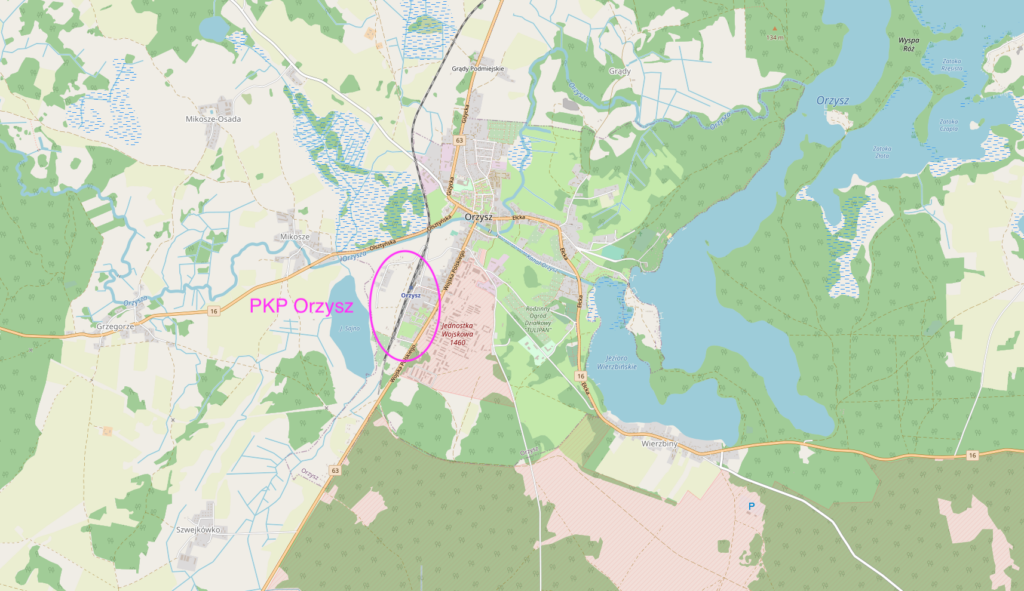
Address: Kolejowa Street, 12-250 Orzysz, Poland. Geographic coordinates: 53.804N 21.938E. Elevation: 125 m.
Orzysz received its first railway connection in 1905. In 1905, a railway line was built connecting Pisz with Orzysz. On June 1, 1906, a railway connection to Giżycko was opened. In early October 1911, the Orzysz–Mrągowo railway line was launched, and in mid-June 1915, trains began running on the Orzysz–Ełk route.
The first longitudinal railway line connected Giżycko–Orzysz–Pisz. The route passed through the following towns: Upały–Ruda Staświny–Miłki–Konopki–Ublik–Pianki–Orzysz–Nowe Guty–Trzonki–Snopki–Pisz. The line connected two important east-west routes: Korsze–Ełk and Olsztyn–Ełk. The first Giżycko–Orzysz section opened on June 1, 1906. This explains why the Orzysz railway station is located longitudinally. In 1945, the Muscovites dismantled the line and transported it to Moscow.
In 1911, the Mrągowo-Orzysz-Ełk railway line was built, creating a third latitudinal line: Czerwonka-Ełk. Orzysz thus became a junction station. However, due to the theft of the Giżycko-Pisz line in 1945, Orzysz was left with only one latitudinal railway line, and, moreover, the train head was changed at Orzysz station. In 2009, passenger traffic on this line was suspended. In 2018, the railway station was renovated. The military rail ramp, used for transporting military equipment to the Orzysz-Bemowo Pilskie training ground, was also renovated.
The Orzysz station building is relatively large, two-story, with a developed attic. The roof is hipped, relatively steeply pitched, and covered with sheet metal. The lower windows are larger and arched. The building is plastered. On the track side, there is an annex, which once housed a signal box. At both ends of the building are single-story annexes, as well as a warehouse. There is also a boiler room and a separate restroom building. In front of the station building is a large station square, paved with basalt paving stones and fieldstone. In 2013, the station building was put up for sale by the Polish Railway Lines (PLK PKP). The windows were boarded up with OSB boards.
A water tower has been preserved at Orzysz station. The tower’s core was built of red brick, is octagonal and reinforced with anchorages. The water tank has been timbered, is octagonal, and covered with a sheet metal roof. The tower area is fenced. The station level features two low island platforms and six tracks. Some tracks are in use, while others are unused. The platforms are low, unpaved, and only the platform edges are brick and painted white. Access to the platforms is at track level, from the north. Platform 1 houses tracks 1 and 5. The platform surface is grassy. There are street lighting and concrete flower beds with grass. There are no benches, shelters, or trash cans. There is a sign with the station name in the old design; it has a blue background and white lettering.
The station’s three-station locomotive shed will remain, with the possibility of adding more. The locomotive shed is located on the northwest side of the station. The shed is built of red brick and covered with a wooden roof covered with roofing felt. In addition to the standard shed, there is also a small shed for the handcar. The turntable is small, measuring only 16 meters. It is manually operated by a crank with a geared ring gear. The riveted construction dates back to the early 20th century.
Rail traffic is controlled from the “Or” signal box. Apartment blocks for railway workers’ families were built alongside the station.
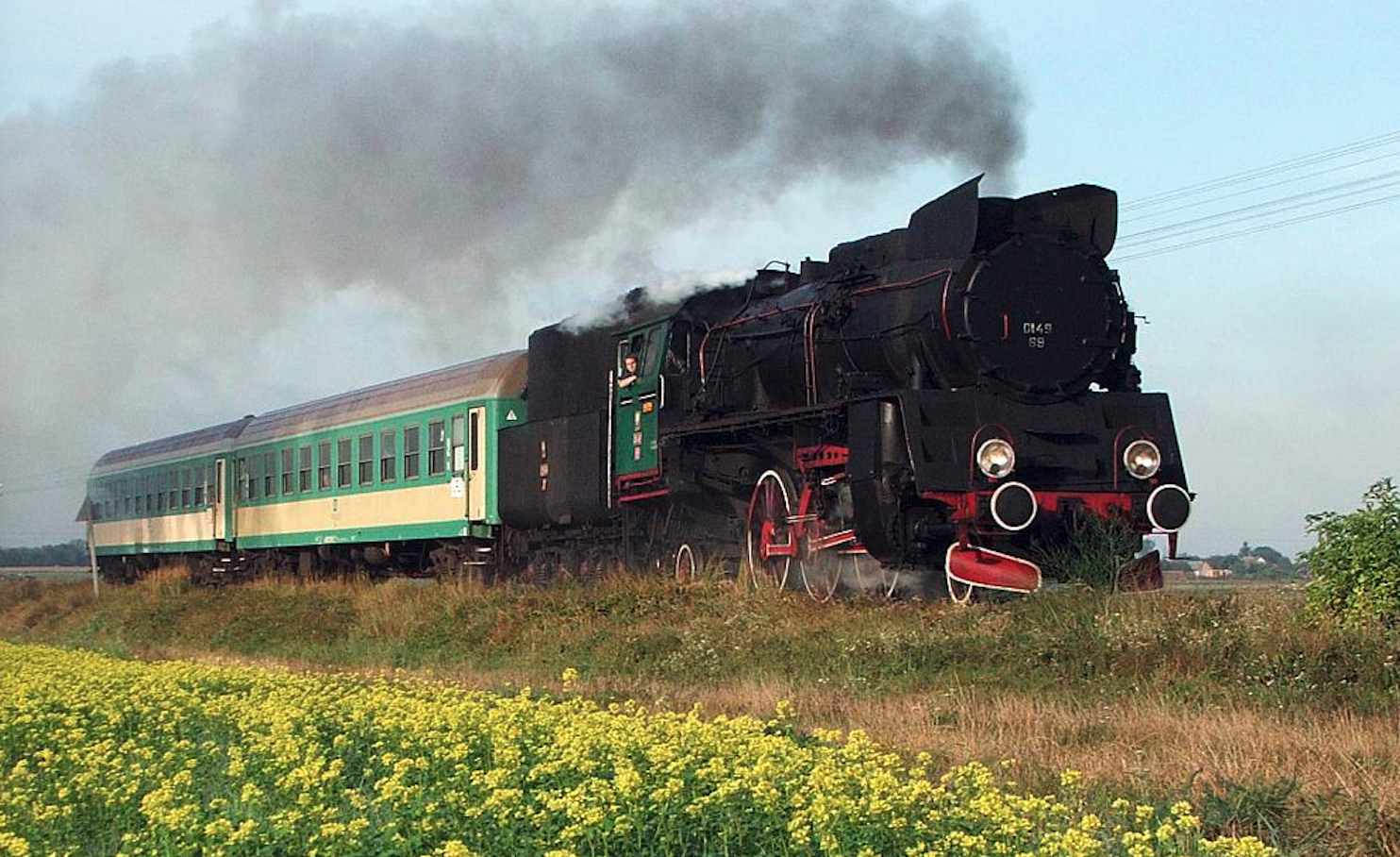
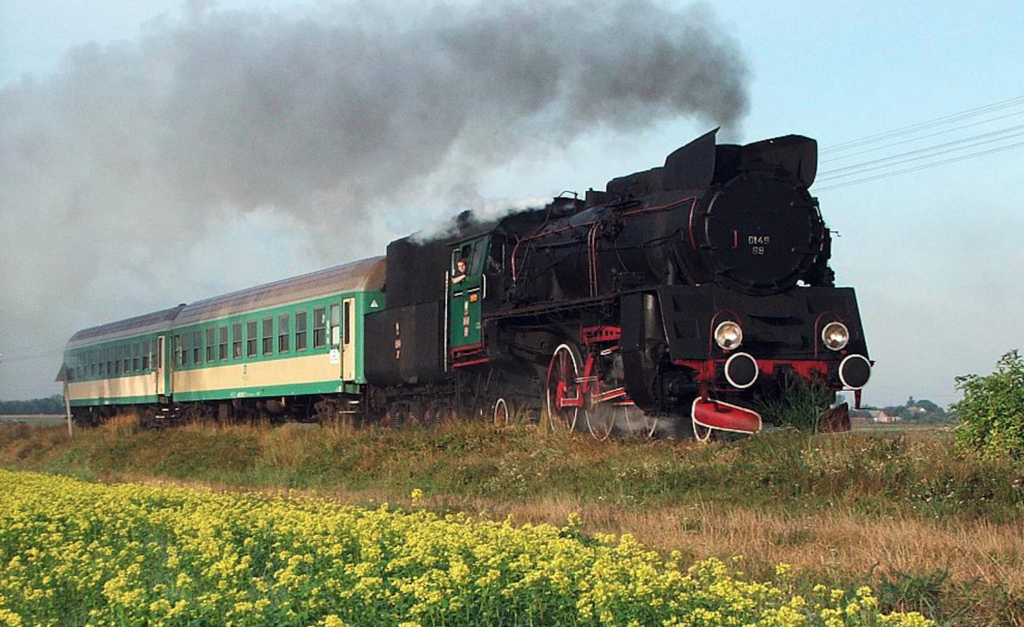
At the beginning of the 21st century, Orzysz station was dominated by trains pulled by SU45 and SP46 diesel locomotives. ST44 locomotives also operated. Passenger traffic was handled by carriages pulled by SM42/SU42 diesel locomotives and SA106 diesel carriages, often coupled with a passenger carriage. Such trains ran, for example, on the Orzysz – Mikołajki – Olsztyn Główny route.
A double-track military siding leads from Orzysz station to the military training ground area. The tracks reach the loading ramp at National Road No. 63, Wojska Polskiego Street. The siding terminates with a front-side ramp. The siding is also illuminated by streetlights.
In 2011, the station underwent track modernization. Wooden sleepers were replaced with reinforced concrete ones, as were most of the rails and turnouts. Shaped semaphores were replaced with light signals. The ramp was renovated, and the storage yard was tidied up. New barriers were installed at the crossings along Mazurska and Stanisława Moniuszki Streets.
A bridge over the Orzysza River and a crossing are located at the northern station head; National Road No. 16, Olsztyńska Street.
Pisz – Orzysz railway line.
The Pisz-Orzysz railway line opened on November 15, 1905. The line was 24.670 km long. It was built as a single-track line by the Prussian authorities during the era of the Germanic Empire in the province of East Prussia. It had both military and economic significance. It connected Pisz with Orzysz, and was later extended further to Giżycko. The line established a route connecting several military garrisons and facilitating the transport of agricultural and forestry goods. The line ran north-south between Pisz (south) and Orzysz (north). The railway line included towns such as Trzonki, Nowe Guty, and Orzysz. In practice, this connection was part of the longer Giżycko-Orzysz-Pisz main line. In addition to transporting soldiers and weapons, the trains also transported timber, agricultural goods, fish, and passengers. The line integrated the region with the main Prussian railway lines. In 1945, part of the tracks (including the Pisz–Orzysz section and further towards Dłutów) were deliberately dismantled by the Soviets and taken as “war booty” to Moscow. After World War II, the line was not rebuilt in its former form, and passenger traffic was not restored. Fragments of the infrastructure (embankments, bridges, and culverts) are still visible in many places today as traces of the old gauge. Currently, the Pisz–Orzysz railway line is defunct. The route is served by buses and minibuses.
Giżycko–Orzysz Railway Line.
The Giżycko–Orzysz railway line is a historic, now defunct, railway line in the Warmian-Masurian Voivodeship, connecting the two Masurian towns of Giżycko and Orzysz. The 29,250 km long line was opened on June 1, 1906, as part of the railway strategy of the Prussian administration in East Prussia. It was single-track and served both passenger and freight transport. The route connected with main lines leading to towns such as Ełk, Pisz, Korsze, and Olsztyn, strengthening the regional rail network and facilitating the movement of troops and supplies. This was crucial in the context of the Prussian state’s strategic plans at the time. The line ran through Upałty, Ruda Staświny, Miłki, Konopki, Ublik, and Pianki, all the way to Orzysz and on to Giżycko. In 1945, at the end of World War II, Soviet railway units dismantled the line. The tracks and infrastructure elements were removed and taken to Moscow as war trophies. After World War II, the line was not rebuilt, and its former traces, in the form of embankments and an old track, can only be found as traces of the historical railway infrastructure in Masuria. The exception is another historic line, Orzysz – Ełk, which was renovated and kept in operation in the 21st century.
Railway Line No. 223 Czerwonka – Ełk.
Railway Line No. 223 is a single-track, non-electrified railway line in Poland. It connects Czerwonka (Warmian-Masurian Voivodeship) with the city of Ełk via Mrągowo, Mikołajki, and Orzysz. The line is 121.270 km long. Currently, most of it is closed to passenger traffic, with some sections used for freight and military purposes. The line was built in sections: On June 15, 1898, the Czerwonka – Biskupiec Reszelski section was opened. On September 1, 1898, the Biskupiec Reszelski – Mrągowo section was opened. On October 2, 1911, the Mrągowo – Orzysz section was opened. On June 15, 1915, the Orzysz – Ełk section was opened. The route provided an important connection between Warmia and Masuria and an alternative to the railway line through Giżycko and Kętrzyn. The line operated intensively in the first half of the 20th century, serving both passenger and freight traffic. During World War II, the line was damaged and then rebuilt between 1947 and 1949. On September 1, 2009, passenger services on the Ełk–Mrągowo section were terminated. On May 1, 2010, passenger service was also suspended on the Mrągowo–Czerwonka section. Currently (2026), the line does not serve regular passenger traffic. However, parts of the route have undergone renovations and modernization, particularly the Orzysz–Ełk section. The Polish Army participated in the financing. Military and freight traffic is maintained, with the participation of the Polish Army and allied forces. PKP PLK is currently preparing a feasibility study and design documentation for the revitalization of Line No. 223, along the entire Czerwonka-Mrągowo-Mikołajki-Orzysz-Ełk route. The plan aims to restore passenger traffic and improve communication in the Warmia and Mazury region. The line runs through the following towns: Czerwonka, Biskupiec Reszelski, Parleza Wielka, Dąbrówka Kobułcka, Sorkwity, Bagienice, Mrągowo, Kosewo, Baranowo, Zełwągi, Mikołajki…and continues on to Orzysz and Ełk.
Written by Karol Placha Hetman