Kraków 2026-01-12
Newag Impuls Electric Multiple Unit.
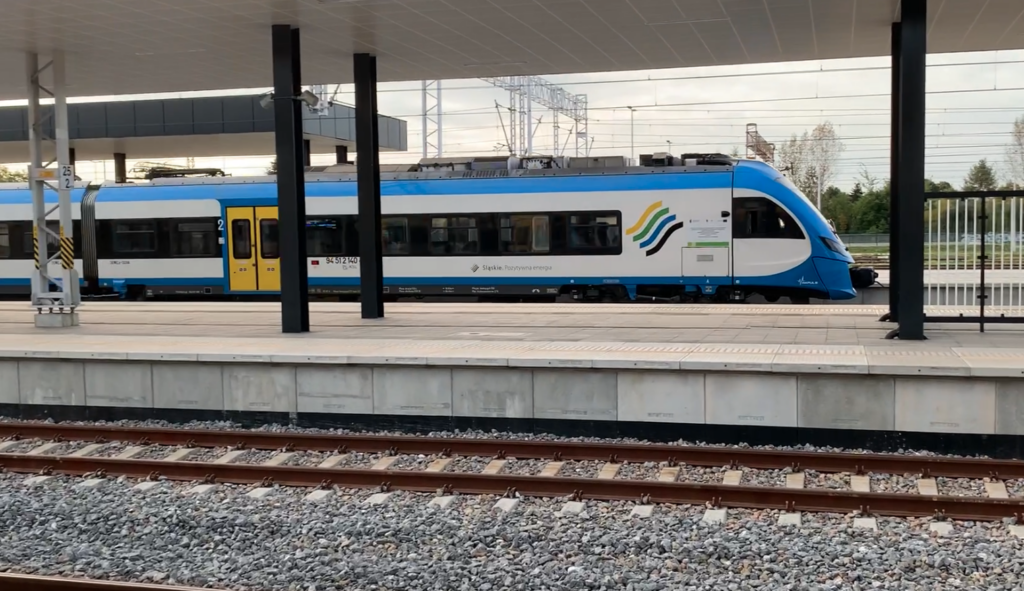
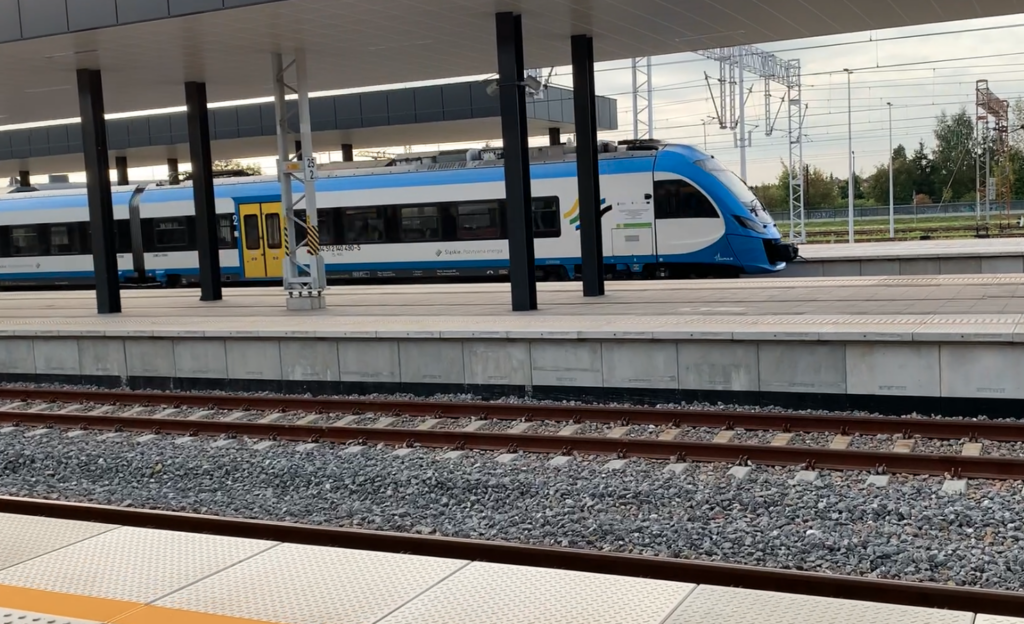
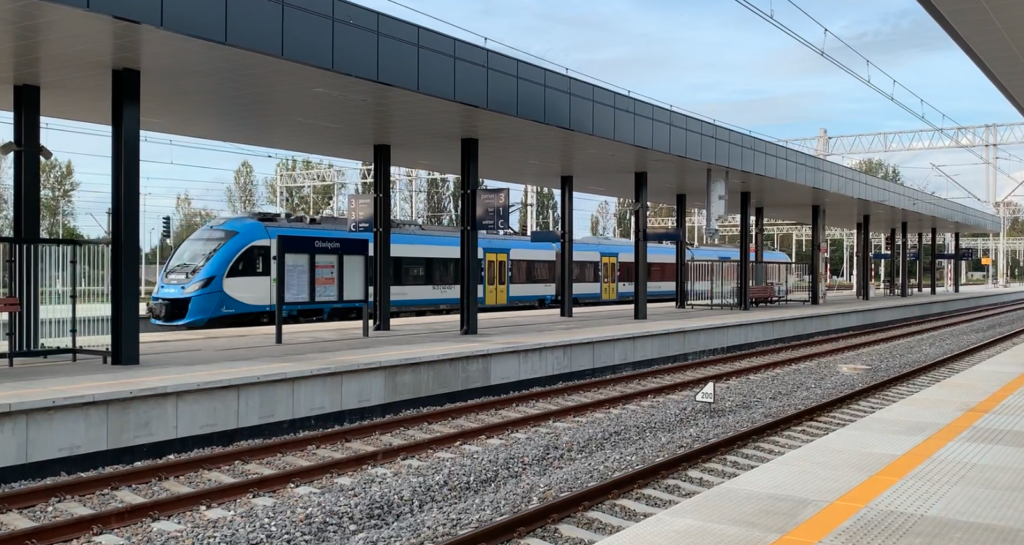
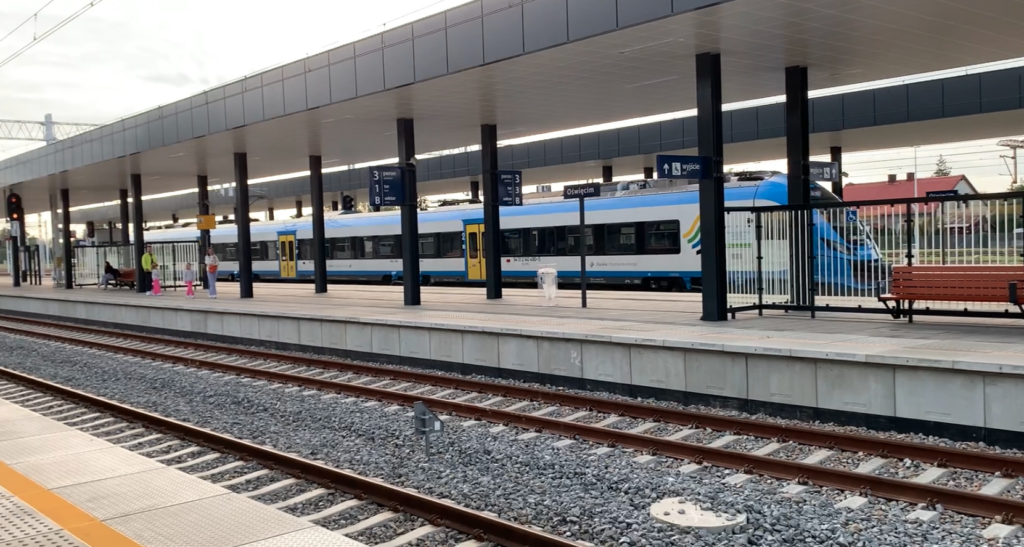
Newag Impuls is a family of electric multiple unit (EMU) passenger trains built by the Newag plant in Nowy Sącz. The plant was established in 2005, based on the Railway Rolling Stock Repair Plant (Zakłady Naprawy Taboru Kolejowego). Newag won the tender to build six 14WE type EMUs for the Fast Urban Rail (SKM) in Warsaw. The trains were assigned numbers 14WE-01 to 14WE-06. In addition to these six trains, a single “Papieski” train, type 14WE-07, was built, designated by PKP as EN61-001.
The ETZ type 14WE is a train based on the iconic EN57 series, consisting of three cars. The car mainframe, bogies, and their traction motors remain unchanged. The train body has been completely redesigned. The vehicle uses glued aluminum sheet skins and stainless steel and plastic components. The windows are glued in. The cars are connected using concertina joints without additional walls, similar to articulated buses. Each car has two automatic doors on each side. An opening step, used for low platforms, is installed under each door. Driver’s cabins are located at both ends of the ETZ, accessed by internal doors from the passenger cabin. Both ends of the train are aerodynamically designed. All headlights are integrated into the train’s outline and do not interfere with airflow. Only the automatic coupler extends beyond the train’s outline. The driver does not have external rear-view mirrors. Instead, a camera system has been installed.
The driver’s and passenger cabins are air-conditioned. The floor is level throughout the entire length of the train. Passenger seats are upholstered in fabric. The overall seating arrangement is second-class. The passenger cabins have LCD monitors for information. Two half-pantographs are mounted on the roof of the middle, power-driven car. The air conditioning systems are visible on the car roofs. The train is equipped with a video surveillance system. The drive uses electronic control, making the train quieter than the traditional ETZ EN57. The braking system uses a new screw-type compressor.
The Origin of the ETZ “Impuls”
From the very beginning, Newag has collaborated with Energocontrol, a company from Kraków specializing in vehicle design and testing. The two companies jointly developed the 14WE train. In 2007, Newag, in collaboration with the same company from Kraków, designed a completely new high-floor ETZ train, the 19WE. Only four trains were built.
Interest from carriers in the new ETZ trains was significant. However, the requirement for a low floor, similar to that used in trams and public buses, began to emerge. To compete with foreign companies, Polish manufacturers decided to develop Polish designs that met the new requirements. The first such vehicle was an EMU from the “Elf” family, manufactured at the Pesa plant in Bydgoszcz. Newag also decided to build this type of vehicle, i.e., with a low floor.
In Nowy Sącz, the first prototype, designated type 31WE, a four-car ETZ, was built. On the night of February 18-19, 2013, during tests on the Central Main Line, the 31WE train set a speed record of 211.6 km/h (130.6 mph) for a vehicle of entirely Polish design.
Then the 35WE, a 6-car train, and the 36WE, a 3-car train, were developed. These were followed by the 37WE, a 2-car train. The final version was the 45WE, a 5-car train. On the night of August 28-29, 2015, the 45WE set a new speed record of 225.2 km/h (149.7 mph). Together, these trains became a single family, dubbed “Impuls.”
In addition to the differences in the number of cars, the trains differ in the number of entrance doors to individual carriages, the seating arrangement, the number of restrooms, spaces for wheelchair users and bicycles, the passenger information system, internet access, 230V power outlets, and USB ports.
In addition to electric trains, diesel trains have been developed for non-electrified routes. They are powered by diesel engines mounted in MTU power units. These are typically two-car trains. By the end of 2018, 167 “Impuls” EMUs had been ordered, and by the end of 2020, 186 “Impuls” trains had been ordered.
In 2020, Newag unveiled a hit in Polish industry: a hybrid train. In Polish conditions, a hybrid drive involves a dual drive: electric traction power, and on non-electrified routes, the train runs on an MTU power unit diesel engine.
The first Newag “Impuls” train.
Construction of the first Newag Impuls train, a 6-car type 35WE, began in November 2011. The idea was to develop an intercity train for routes of 200-300 km. Testing began in April 2012.
Back in 2011, work began on the 4-carriage Type 31WE. This train was based on the solutions used in the 6-carriage Type 35WE. In December 2012, the 4-carriage Type 31WE was ready. Testing began in January 2013. On the night of February 18-19, 2013, during tests on the Central Railway Main Line, the Type 31WE reached a speed of 201.4 km/h, and on the final test, it reached 211.6 km/h, setting a Polish record for vehicles designed and manufactured exclusively in Poland. The Lubusz and West Pomeranian Voivodeships ordered Type 31WE trains for their regional railways.
In September 2013, the first 3-car type 36WE-001, manufactured for the Podkarpackie Voivodeship, began testing and certification.
Mazowieckie Railways were the first to order the 5-car type 45WE in November 2014. To expedite testing and certification, a train built for the West Pomeranian Voivodeship was used, increasing the number of cars to five. After certification, the train was removed from one car and handed over to the user as type 31WE. On the night of August 28-29, 2015, a type 45WE-010 train for Mazowieckie Railways set another speed record on the Central Main Line, reaching 225.2 km/h.
In 2015, construction began on a 4-carriage type 31WE train for PKP SKM Trójmiasto. The problem was that the platforms in the Tricity area are high, which required raising the floor of the cars. The train had to be redesigned, which was done.
In 2015, Newag won an order for an ETZ for the Italian carrier Ferrovie del Sud Est.
In June 2016, the first 3-carriage “Impuls II” train was built. The front of the train underwent minor changes. Additionally, external side doors to the driver’s cabs were installed.
“Impuls” for Małopolska.
On August 28, 2013, a contract was signed for the delivery of 19 3-carriage type 36WE EMUs for the Southern Procurement Group, covering the following voivodeships: Małopolska, Podkarpackie, Silesia, and Świętokrzyskie. The trains were designated for Przewozy Regionalne, now PolRegio. Six trains were designated for the Małopolska Voivodeship. The first four trains were delivered in September 2014. The trains began carrying passengers on October 1, 2014. The vehicles were assigned to serve routes from Kraków to Tarnów, Rzeszów, Kielce, and Katowice. Each “Impuls” train received its own name: Galicja, Jagiełło, Krak, Podhalańczyk, Trzy Korony, and Góral. The 4-carriage “Impuls” type 31WEa train in Małopolska is designated EN78. Two more trains of this type were acquired later. On March 30, 2016, a contract was signed for the delivery of eight four-carriage 31WE electric multiple unit (EZT) trains and five five-car 45WE electric multiple unit (ETZ) trains for the Marshal’s Office of the Małopolska Voivodeship. The trains were ordered for the Fast Agglomeration Railway (SKAG). In September 2016, the first two EZTs were delivered: 31WE-029 and 45WE-014. Subsequent trains were delivered, and they began carrying passengers in December 2016. In February 2017, the last ETZ trains were delivered.
In June 2020, nine more 4-carriage “Impuls” 31WE electric multiple unit trains were ordered.
Koleje Śląskie and PolRegio of the Silesian Voivodeship.
In 2012, the Silesian Voivodeship acquired one 6-carriage Impuls 35WE train. In 2014-2015, six 3-carriage Impuls 36WEa trains were acquired. Each car has one pair of doors. In 2023, the Silesian Voivodeship ordered 31 4-carriage Impuls 31WEbc electric multiple unit trains. Deliveries began in 2025.
The “Impuls” train design.
The “Impuls” train is a standard-gauge electric multiple unit train with a low floor. The standard floor height is 760 mm from the railhead. The train is designed as a Second Class vehicle. There are no doors between carriages, meaning it is designed as a single-space vehicle. The interior is tailored to the customer’s needs. The number of entrance doors can vary; one or two on each side of the carriage. Various passenger seating arrangements are available. Folding seats can also be installed. A closed-system toilet may be located in the passenger compartment. Typically, there is one accessible toilet on the train. There may also be a space for passengers with limited mobility, large luggage, or bicycles. Near this area, there is a door with a fold-out platform for wheelchair access. Vehicles can be equipped with an internet access point, electrical outlets, ticket machines, ticket validators, and a door-mounted passenger counting system. Vehicles are equipped with a passenger information system consisting of loudspeakers, monitors, and illuminated directional boards. The trains are equipped with CCTV, air conditioning, and heating with automatic control.
The engine compartment is located between the driver’s cabs and the passenger compartment.
The trains are powered by four or eight asynchronous electric motors, with power ranging from 400 kW to 500 kW. This is why the train type designation includes a lowercase “a.” The motors are controlled by inverters. The train’s design speed is 160 km/h and acceleration is 1 m/s². In the 2-, 3-, 4-, and 5-carriage versions, the first and last bogies are type 70RSNe power bogies. Each bogie has one motor per axle. Jacobs-type bogies, type 72RSTc, are placed between the cars. The ends of two cars rest on one bogie. The wheel diameter is 0.84 m, allowing for a significantly lower floor in the gangway. A Knorr-Bremse braking system is used.
The 6-carriage version has a slightly different design. The last bogie of the third carriage and the first bogie of the fourth carriage are powered bogies. There are no Jacobs bogies. Additionally, there are electrical cabinets in the compartment, which means passengers only have a narrow passageway to pass from the third to the fourth carriage.
All carriages are 2.84 m wide. The carriages are 4.15 m high. Each train has two half-height pantographs.
The 4-car type 31WEa train operated by the Małopolska Railways has a 1-2-2-1 door arrangement. The doors are of the “push-and-slide” type. It seats 184+16. The train is 74.40 m long. The engines are 4 x 500 kW. The train is equipped with air conditioning, bicycle storage, 230 V sockets, Wi-Fi, and a toilet. The interior is gray and green. The seats are upholstered in gray fabric. All handles are painted green. The “Impuls” type 31WEa, a 4-carriage train in Małopolska, is designated EN78.
The Małopolska Railways’ type 36WEa, a 3-carriage train, has a 1-2-1 door configuration. Seating capacity is 138+6. The train is 58.40 m long and has 4 x 400 kW engines. The train is equipped with air conditioning, bicycle storage, 230 V power outlets, Wi-Fi, and a restroom. The “Impuls” type 36WEa, a 3-carriage train in Małopolska, is designated EN64. Interestingly, the Bydgoszcz Pesa train also carries the designation EN64.
The 5-carriage type 45WEa trains operated by the Małopolska Railways have a 1-2-2-2-1 door configuration. Seating capacity is 230+20. The train is 90.40 m long and has 4 x 500 kW engines. The train is equipped with air conditioning, bicycle storage, 230 V sockets, WiFi, and a toilet. The 5-carriage “Impuls” type 45WEa train in Małopolska is designated EN79.
Written by Karol Placha Hetman