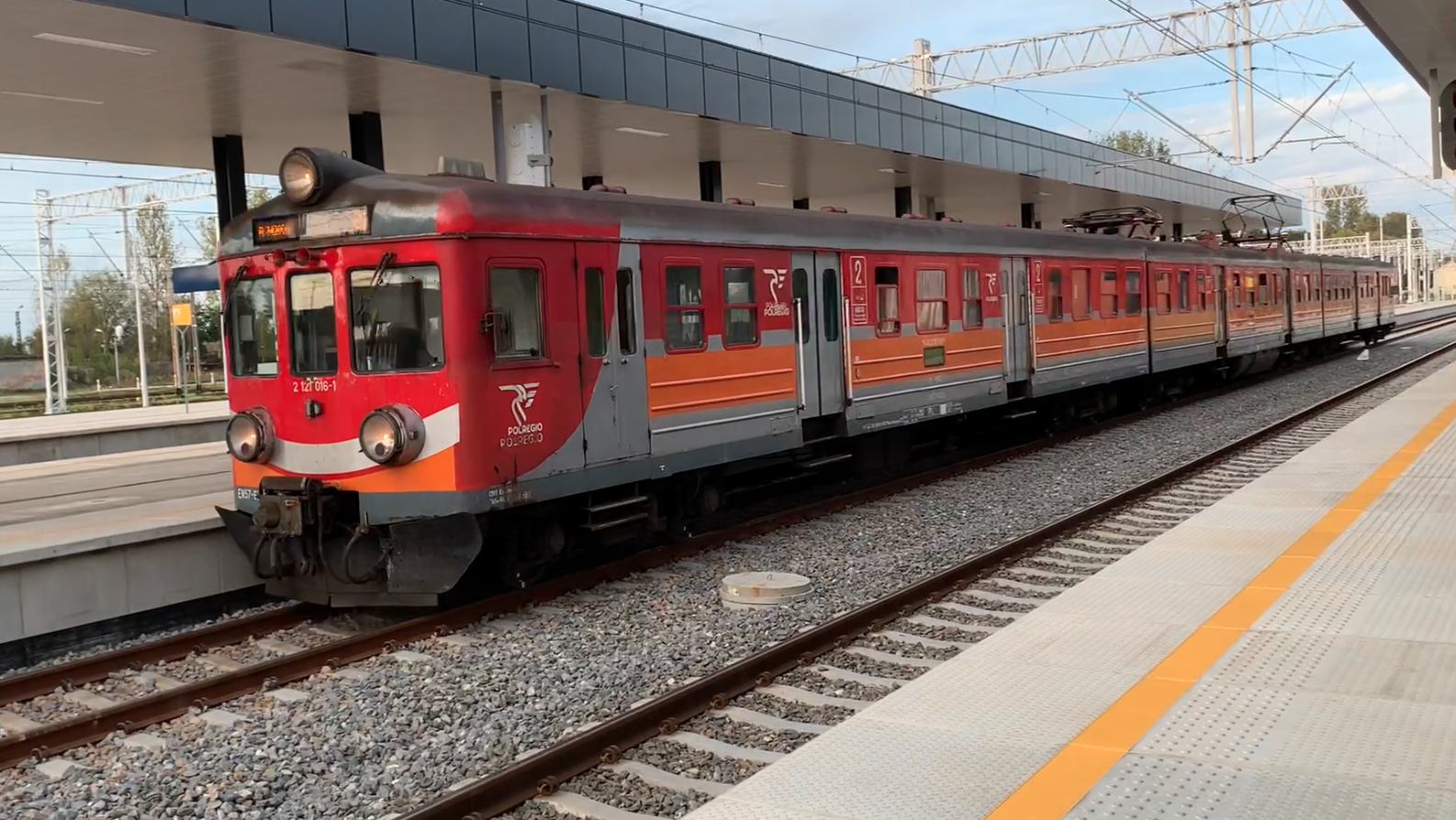
Kraków 2026-01-12
EN57-672
EN57-672. Car numbers: EVN: 94 51 2 121 014-6 (PL-PREG ra), EVN: 94 51 2 121 015-3 (PL-PREG s), EVN: 94 51 2 121 016 (PL-PREG rb). The train was built in December 1967 and has factory number 205. The train was still in service in 2026.
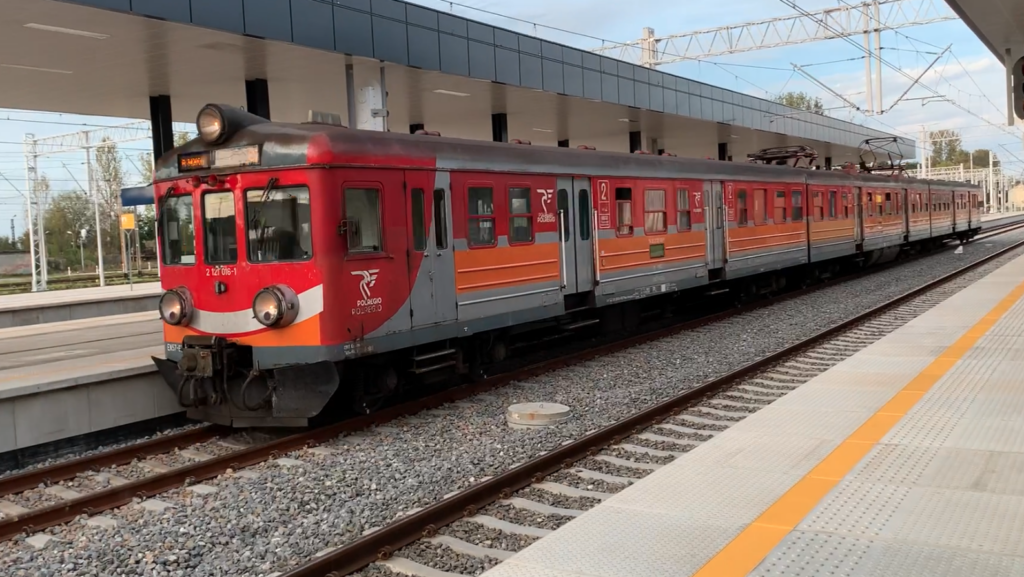
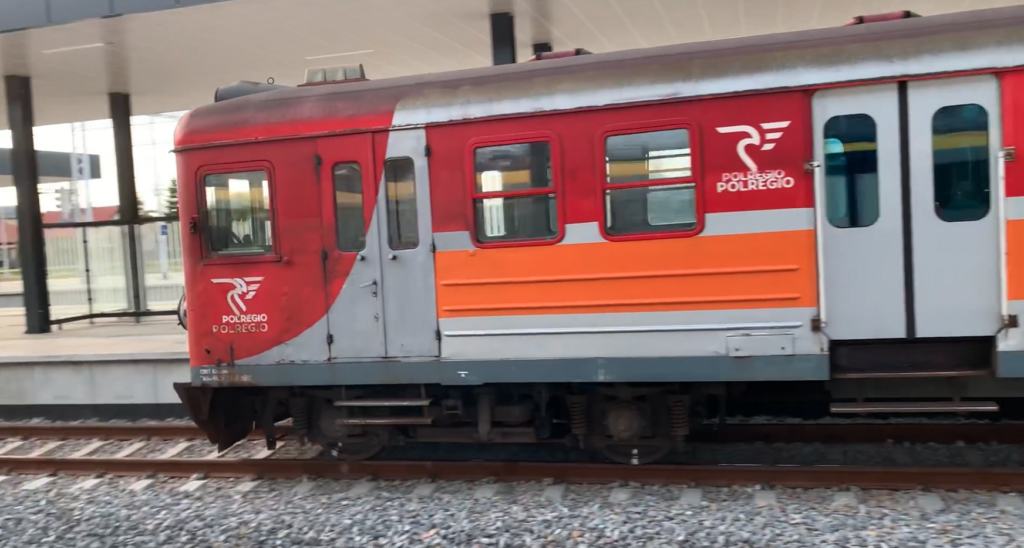
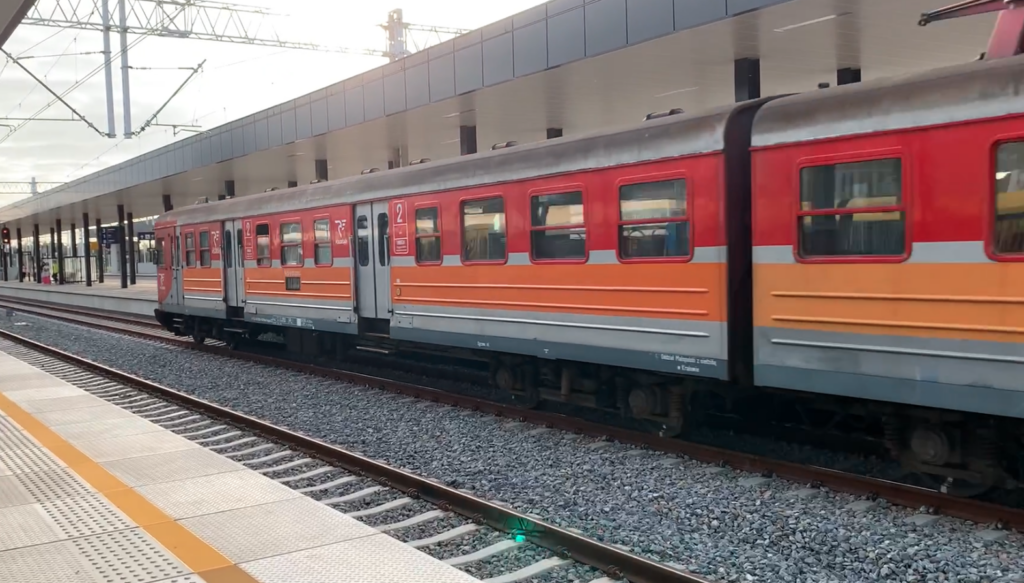
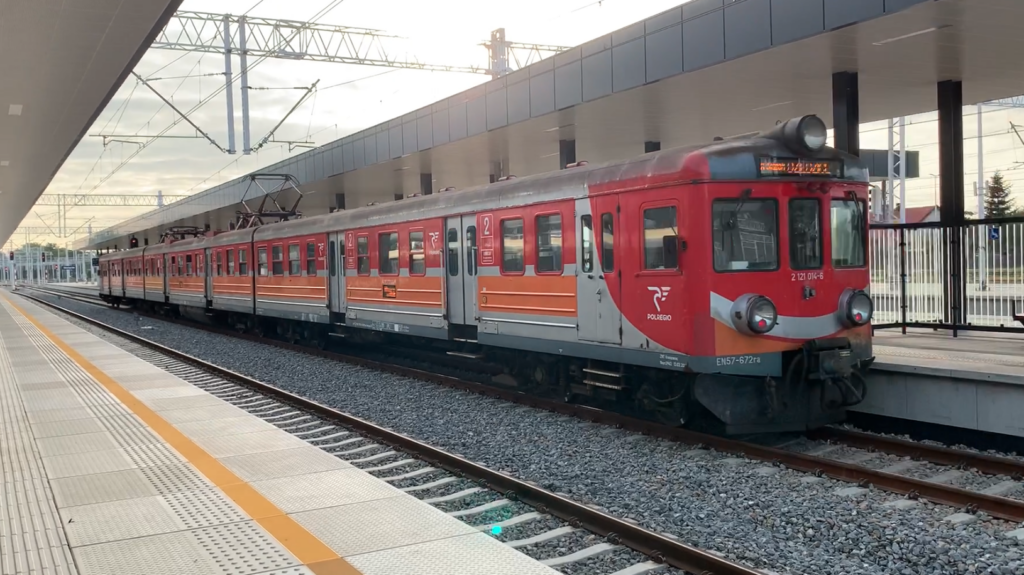
Service: Manufacturer of Pa-Fa-Wag in Wrocław. Since December 28, 1967, MD Kraków Prokocim. Since November 1976, MD Gdynia Chylonia. Since July 1997, MT Gdynia. Since September 1997, MT Katowice. Since January 1998, MT Kraków. Since April 1999, MZ Gdynia. Since October 2001, Przewozy Regionalne, Warmińsko-Mazurskie in Olsztyn. Since March 2019, Przewozy Regionalne in Kraków.
EN57 Electric Multiple Unit.
The EN57 Electric Multiple Unit is a legend on Polish tracks.
Election of the main railway junctions was already planned and implemented in the 1950s. Electric suburban passenger trains were already being considered. An additional problem was that main stations had high platforms (40-50 cm from the railhead). However, secondary stations had low platforms, sometimes as high as the curb. Therefore, future passenger trains would have to serve all platforms.
Design work on the new passenger train was carried out between 1959 and 1961, in parallel with the EW55 EMU for the Warsaw and Gdańsk junctions. Therefore, the EN57 and EW55 trains are very similar. They differ in the number of doors per car and the entrance steps. The documentation was prepared by the Central Design Office of the Rolling Stock Industry in Poznań (currently OBRPS Poznań). The prototype EN57 train made its first run in December 1961. Production began at the Pafawag factory in Wrocław. At the Pafawag factory, the power cars were designated Type 6B, and the control and marshalling cars were designated Type 5B.
The EN57 EMU is a Polish design and was produced from January 1962 to July 1993, a total of 31 years. The EN57 is the longest-produced rail vehicle in the world. 2021 marks the 60th anniversary of the first electric train being built. A total of 1,429 units were built. Other sources indicate 1,452 units, including those exported to Yugoslavia and four-carriage trains.
Based on the EN57 EMU, the “Pafawag” factory also built four-car units with an additional motor section, designated EMU EN71. The first such train was built in 1964. These trains were initially built to serve the demanding Kraków-Zakopane route. In 1965, Yugoslavia purchased these trains. In Yugoslavia, the trains were reportedly called “Gomułka,” after Władysław Gomułka (First Secretary of the Polish United Workers’ Party), during whose time the trains were deployed to the Balkans.
Generally speaking, there were three production series of the EN57:
Serial numbers 001-130 and 601-1113, which featured corrugated sides and three windows in the front wall. Corrugated sheet metal increases the structural rigidity, similar to longitudinal members in aircraft fuselages. Additionally, some trains had a first-class compartment.
Serial numbers 1114-1825 have smooth box sides and three windows in the front wall.
Serial numbers 1900-1953 have smooth car sides and two windows in the front wall, similar to the EW58. Additionally, the driver’s cab equipment is different due to slightly different systems installed.
Serial numbers 2001-2075 were assigned to trains modernized under the SPOT program (Sectoral Operational Program for Transport). The train’s front wall was completely redesigned. It is sloped to reduce wind resistance. It is equipped with a single window and a new set of lights. The lights vary depending on the company that performed the modernization. Passengers received individual upholstered seats. Air conditioning was not installed.
Serial numbers 3001-3010 were assigned to trains that returned from the former Yugoslavia and were refurbished and retrofitted.
EN57 EMU Operation.
In the 1980s, ETZ EN57 trains began to feature central door opening by the driver, rather than by the train manager. Additionally, an audible warning signal was introduced when the doors were closing.
In 1993, during modernization, trains were also built with a dedicated Class 1 section in the Rb carriage. These had upholstered airline seats, window shades, and a sound system. There was also a so-called bar compartment with a stove, sink, and refrigerator.
The long service life of EN57 EMUs led owners to undergo various modifications. As a standard practice, from 1989 onward, the trains were repainted. The traditional yellow and blue livery was characteristic of the communist era. This is why the trains were nicknamed “zółtki” (yellow trains). New carriers painted the trains in their own colors. Currently (2021), the most famous livery in Poland is that of the PolRegio carrier.
For 90 years, modernization has involved, among other things, adapting vehicles for disabled passengers. The IT system was modified and a sound system was introduced. The heating system was improved. Air conditioning was installed in the driver’s cabs and passenger compartments. Windows were replaced with double-glazed windows. Bicycle compartments were introduced.
A major change was the replacement of the traction motors with asynchronous motors, which are controlled by an inverter. These motors are more powerful, with each motor having a power output of 250 kW. Trains equipped with these motors can reach speeds of up to 125 km/h, compared to 90 km/h with the previous 125 kW motors.
Interestingly, many components from scrapped trains are used in new rolling stock. This is not the case with the drive bogies, for example. The underframes and body frames are also reused. Sometimes, trains built on this basis still bear the EN57 designation, but with very high serial numbers. Others, however, receive a completely new designation, and their appearance reveals no trace of their EN57 origins. This was the case, for example, with the Newag 14WE trains, of which nine were built between 2005 and 2009.
As part of the SPOT program (Sectoral Operational Program for Transport), 75 EN57 EMU trains were modernized in 2006-2007 and assigned serial numbers 2001-2075.
The modernized trains were equipped with an anti-theft system with motion detectors and 16 cameras, which are displayed on a screen in the driver’s cab, continuously monitor the vehicle’s interior, and record on memory cards.
In 2007, several trains for SKM Trójmiasto and Koleje Mazowieckie were modernized to the EN57 KM version, with significant improvements to the electrical systems, including the replacement of resistance starting with impulse starting.
In 2008, Koleje Mazowieckie ordered the modernization of 10 trains to the EN57 AKM version. The trains were equipped with LK450X6 AC (asynchronous) motors, developed by the Żychlin-based company EMIT. The new motor has a power output of 250 kW, and the entire train has a power output of 1 MW, significantly improving the traction parameters of the vehicles. Acceleration increased, and the maximum speed was raised to 125 km/h.
Other local governments, such as those in the Łódź and Greater Poland Voivodeships, also decided to modernize their EN57 EMU trains. The modernization was carried out individually for each entity. Therefore, the trains received various additional letter designations. Mainly, the motors were replaced with asynchronous ones. New passenger seats and wall cladding were installed. Closed-system toilets and toilets for disabled passengers were installed. Driver’s cabins were replaced, new train fronts were installed, and air conditioning was installed. The external doors were replaced with sliding, more airtight doors. Ticket machines and beverage and sweets vending machines were installed.
In September 2017, the PolRegio operator received its first extensively modernized EN57-2205 train. This train no longer resembles the classic EN57 at all, although it bears the designation EN57ALc. A total of 36 units were rebuilt. These trains have already undergone their second P5 level overhaul. The overhaul was carried out at the ZNTK plant in Mińsk Mazowiecki, which is part of the PESA Group. The modernized trains feature a single-space interior throughout and are equipped with air conditioning. The seats are aircraft-style, well-upholstered, and very comfortable. Wi-Fi and 230V power outlets are also available. Each train has two closed-system toilets, one of which is designed for disabled passengers and includes a baby changing table. The toilets also feature electric hand dryers.
In 2017, the EN57-001 train stationed in Przeworsk was placed under conservation protection and will not be scrapped. It is a significant artifact in the history of Polish Railways.
The problem with the unpleasant odor stemmed from the air intake for the compressors being located in the toilet. Drunk men urinated on the wall grates instead of the toilet. Initially, the intake grates were moved to the outside of the car body. However, the grate then drew in rain. Eventually, the intakes were placed under the car body, and the problem was solved.
Construction of the EN57 EMU.
The EN57 consists of three cars. The leading cars are control cars and equipped with driver’s cabs. They are designated “ra” and “rb” (shunting). These cars have two trailer bogies. The middle car is the driving car and is designated “s.” It has two driving bogies (four motors) and two pantographs (current collectors). Initially, it had a single shoe, later a double shoe. The pantograph is a scissor-type design. Each car has two passenger doors. The rolling wheels have a diameter of 0.94 m. The driving wheels have a diameter of 1.00 m.
The wagons are connected by a so-called “factory” short coupler, which can only be disengaged in a workshop. Automatic Scharfenberg couplers are installed at the train ends, enabling multiple traction.
The wagon frame and bodies are made of welded steel profiles. The wagon floor is located at a height of 1.153 m from the railhead. Entrance to the wagon has two steps.
For various reasons, you may encounter EMU EN57 trains composed of different wagons.
EN57 EMU interior.
In the 1960s and 1970s, the cars had soft seats upholstered in leatherette (green, brown, or blue) and were of medium thickness. Unfortunately, due to vandalism, new or renovated trains were equipped with hard plastic (composite) seats in red.
The walls and ceilings in the cars are lined with a wood-like laminate (light pine). Electric lights are installed in the ceilings. The windows are divided in half, with the upper section lowered downwards. The windows are single-glazed. All windows are made of tempered glass. Aluminum luggage racks are located above the windows. The floor is made of wood covered with plastic. The automatic external doors, operated by compressed air, are 1.30 m wide and lead to a small corridor, where the internal doors are manually closed and lead to spacious compartments with a maximum capacity of 32 seats or a standard capacity of 24 seats. Passengers move through the center of the compartments. Passages between the carriages are for passengers and the conductor’s crew, with manually closed doors. The train has open-plan toilets, which can only be used while the train is in motion. The toilet contains a toilet (toilet) and a sink, usually with cold water only. Electric heaters are located under passenger seats. In other rooms, heaters are placed vertically against the walls and covered with sheet metal with perforations. The control carriages contain compartments for passengers with larger luggage or those carrying bicycles and skis.
The control carriage has a separate door for the train crew only. In the driver’s cabin, the right-hand position was occupied by the driver (mechanic), while the left-hand position was occupied by the train manager, who operated the central automatic doors.
Written by Karol Placha Hetman