Łuków 2026-01-07
The City of Łuków.
Łuków is a city in eastern Poland, in the Lublin Voivodeship, Łuków County, located in the South Podlasie Lowland. The city is an important railway junction and a local administrative and service center. The city has an area of 35.75 square kilometers. The population in 2022 was 27,569. Elevation: 162 meters. License plate: LLU.
Geographically, Łuków lies on the Łuków Plain, which is part of the South Podlasie Lowland. The area is primarily agricultural, with some forest areas. The largest is the Jata Nature Reserve, which includes the Jagoodne air and artillery range. The Łuków region is a lowland, flat area, crisscrossed by numerous small, slow-flowing rivers. The Łuków stronghold was located on a bend of the Southern Krzna River and stood at an elevation of 160 meters. The former market square of the incorporated city (now Solidarity and Freedom Square) lies at an elevation of 161 meters, while Gabriel Narutowicz Square, in the newer city center, has an elevation of 162 meters. The Freedom Oak in Gabriel Narutowicz Square was planted in November 1918 and is currently a natural reserve. Within the city limits are forests: Zimna Woda to the northwest, Góry to the northeast, Zapowiednik to the east, Lasek west of the village of Podgaj, Lasek Kierkut to the south, and several smaller ones. The settlement of Łuków was founded in the mid-12th century as a defensive stronghold on the eastern border of Mazovia. In 1233, the town was granted its charter, and Łuków became an important royal stronghold. Its town rights were renewed in 1369 under Polish law and in 1403 under Western law, granted by King Władysław Jagiełło. Throughout its history, Łuków was included in Mazovia, but also in the northern regions of Lesser Poland. In the 13th century, Łuków was located in the Sandomierz Region. In the 13th century, the Łuków bishopric was established, with Bartholomew of Prague as its first bishop. However, due to pressure from the Teutonic Knights (Germanic tribes), the Pope reversed his decision and left Christianization solely to the Teutonic Order, which had a tragic impact on the fate of the local population. As early as the 13th century, a wooden castle with earthen and wooden ramparts existed in Łuków, manned by a permanent knightly garrison. The castle was located on the left bank of the Southern Krzna River.
However, the town’s development was hampered several times by invasions by the Teutonic Knights, Prussians, Tatars, Yotvingians, Lithuanians, and Muscovites. The Swedish Deluge also wreaked significant havoc, both on the town’s buildings and population. The parish of Łuków was established after Łuków was incorporated into Sandomierz. During the reign of Casimir the Great, the parish had 192 inhabitants. In 1455, Casimir IV Jagiellon granted the town the privilege of holding a market every Monday. In 1505, Alexander IV Jagiellon granted a privilege allowing the construction of a town hall in the town and the introduction of a unified Polish standard of weight and measure. In 1385, the Polish-Lithuanian Union was concluded, which calmed the situation in the Łuków region. Łuków was plagued by fires and plagues, the dense wooden architecture contributing to the fires. There were fires in 1517, 1528, 1533, and 1601. The 1533 fire was so severe that King Sigismund the Old exempted the city from paying tolls, a levy, and providing a war wagon and a conscript for 18 years. Additionally, the king granted the right to produce vodka for trade. From the 15th century, Łuków hosted sessions of the nobility’s courts, both land and municipal. In 1629, at the initiative of Łuków’s starost, Erazm Domaszewski, the Bernardine Order was brought to the city. On the land designated for the monks, a wooden church of the Holy Cross and a monastery were first built. A brick church and a brick monastery were then built. The work was finally completed in 1770. By 1620, the Łuków Land had an area of approximately 8,000 square kilometers. Łuków suffered greatly during the Khmelnytsky Uprising and then during the Swedish Deluge. Of the over 200 households, only 37 houses remained. Churches, a monastery, and the town hall were destroyed. In 1676, Łuków had a population of just 304. The town was threatened with complete depopulation. This situation was saved by the town’s renewed status as a castellany. In 1696, the Piarist Fathers arrived in Łuków and developed education. The Piarist college maintained a high standard of teaching. From 1733, the university had a boarding school; the Szaniawski convent. By the beginning of the 18th century, the town’s population had reached 2,000. Jews were also arriving.
As a result of the Third Partition of Poland, the Łuków region fell to the Austrian partition, known as New Galicia. In 1815, after the Napoleonic Wars, Łuków fell under the Muscovite partition. Łuków’s men and youth actively participated in the November and January Uprisings. The Patriotic Union operated here. As a result of patriotic actions, the Muscovites closed the secondary school in 1844. Approximately 350 residents of Łuków participated in the January Uprising. The insurgents attempted to seize the Tsar’s barracks on Międzyrzecka Street, but were unsuccessful.
A significant moment in the town’s development came in 1866, when the Warsaw-Łuków-Terespol railway line was opened. The railway contributed to the region’s economic and social development. In the second half of the 19th century, three railway lines were built through Łuków. The Warsaw–Terespol railway opened on September 18, 1867, but the Siedlce–Łuków section began operation in the winter of 1866–1867. On December 1, 1866, the first train from Siedlce arrived at Łuków station. Simultaneously, between 1866 and 1867, the railway station building was constructed. On February 3, 1873, the decision was made to build another line through Łuków, connecting the fortress in Dęblin with the fortress in Brest. Construction was completed in 1880. In 1898, the line from Łuków to Lublin was completed. Between 1951 and 1954, railway line No. 12 Skierniewice–Łuków was built.
In 1894, the Łuków Volunteer Fire Department was founded. In 1819, the town had a population of 2,270. There were approximately 350 houses, including only 25 brick ones. Since 1844, there had been no school system in Łuków. Only in 1902 did the Moscow curator approve a four-grade school, equivalent to the four lower grades of a gymnasium, with Polish as an optional subject. In 1899, a two-grade private school for girls, the so-called girls’ boarding school, was established. In 1912, a trade school was founded. The flourishing of Polish education did not occur until 1918. By that year, POW (Polish Military Organization) units were already operating.
During the Great War, Luków was unaffected. The city was multinational. Of the 12,000 inhabitants, approximately 3,770 were Polish. The Jewish population and the Muscovites were the largest, as they occupied all state institutions, administration, and the judiciary. The Jewish population primarily came from the Muscovite state and had the right to trade and sell alcohol. Jews were exploited to incite hatred towards the Polish population. The outbreak of the Great War resulted in the evacuation of the Ruthenian and Jewish populations into the interior of the Muscovite state. On August 12, 1915, Luków was occupied by Austro-Hungarian and Germanic troops. At the end of 1917, the Austro-Hungarian troops withdrew, and Germanic civilians took over the administration. On November 10, 1918, the City Council called on the Germans to hand over power to the Polish population. On November 11, 1918, units of the Polish Military Organization entered the city. By November 12, 1918, the Germanic formations were disarmed. By that time, the Germans had already evacuated to the West.
From August 11–17, 1920, during the Polish-Soviet War, Łuków came under Soviet occupation. On August 17, 1920, units of the Polish Army entered the city, and Józef Piłsudski paid a short visit. At that time, the remaining Jews in the city strongly sympathized with the Bolsheviks. It is not true that a pogrom against the Jewish population took place. Most of them fled to the East, leaving behind their property.
In 1924, the city had 850 residential buildings, 150 of which were brick. During the interwar period, reserve squadrons were stationed in Łuków: the 25th Greater Poland Uhlan Regiment, the 26th Greater Poland Uhlan Regiment named after the Grand Hetman of Lithuania, Jan Karol Chodkiewicz, and the 27th Uhlan Regiment named after King Stefan Batory. During the Second Polish Republic, Łuków saw the construction of a power plant, a municipal bathhouse, a third primary school, and the regulation of the Southern and Northern Krzna rivers.
Łuków suffered enormous population and infrastructure losses during World War II. At the same time, partisan resistance against both occupiers, the Germans and the Muscovites, developed rapidly. On September 4, 1939, the Germans bombed the town. They attempted to hit the train station, but their attack was ineffective and only destroyed surrounding buildings. However, the bombs fell on a train carrying refugees from Mława and Ciechanów. On September 7, 1939, another air raid targeted the British and French consulates. The raid resulted in a massacre of civilians, killing nearly 500 people. After the Germans entered Łuków, they committed a massacre on the very first day, killing 34 people in Narutowicz Square. They also set fire to all the houses in the town center. They arrested over 200 men and herded them on a death march toward Siedlce and then Węgrów. As a result of the Molotov-Ribbentrop pact, the city was occupied by the Soviets until 1941, when one brother attacked the other. The Germans established a Jewish ghetto in Łuków, a process they mastered to perfection. Before the ghetto’s liquidation in 1943, over 11,000 people from Łuków and other towns in the Lublin region were crammed into it. Public executions took place in Łuków almost daily, primarily murdering Jews and Poles. The city and surrounding area were the area of operations of the Polish Resistance Movement, including the Home Army, Peasant Battalions, and the National Armed Forces. On the morning of July 22, 1944, the Soviet air force bombed the railway station. In the afternoon, the Soviet army entered the city. Łuków was 80% destroyed. The first postwar years were a period of terror used by the UBP, IW, and NKVD to consolidate Stalinist rule. Anti-communist underground soldiers were detained, tortured, and executed at the District Office of Public Security. On the night of January 23-24, 1946, a WiN unit attacked the PUBP building. The office manager, two officers, and one woman were killed, and 27 prisoners were released.
After World War II, the devastated city quickly rose from the ruins. New industrial plants were built, and above all, the destroyed railway was rebuilt. The city boasts a shoe industry (1958), a meat processing plant (1973), a food processing plant, and a local agricultural service center. Between 1957 and 1962, a new hospital was built. A community center, two new primary schools, two kindergartens, pharmacies, and a new courthouse were constructed. In 1966, a new sewage treatment plant was commissioned. Łuków is the largest urban center between Lublin, Siedlce, Puławy, and Biała Podlaska. During the city’s industrialization, factories were located in the eastern part of the city, close to the railway line. Meanwhile, near the Łuków Łapiguz railway station, some of the former barracks were occupied by commercial companies and warehouses. Not all production plants survived the transformation process, and the facilities are used by retail and service companies. In 2012, the Tarnobrzeg Special Economic Zone “Europark WisłoSan” was expanded to include investment land in Łuków. An area of 13 hectares was designated for the zone. Much of the city consists of housing estates with apartment blocks built since the 1950s, as well as estates of single-family homes. Family Allotment Gardens (Family Allotment Gardens), of which there are five in Łuków, are typical of this type of town.
Today, Łuków is a quiet district town, known for its railway traditions, the food industry, and as a local center of education and culture. Additionally, there are medium-sized and small-scale clothing, footwear, construction, machinery, and metalworking factories, a feed factory, and a thermal power plant. In addition to large meat processing plants and small meat processing plants, there is a dairy plant, a cold store, and numerous small bakeries and confectioners, which also ship their products to other cities. There are shopping centers and a municipal market. Market day in Łuków is traditionally Thursday. The town boasts many restored historic monuments, including the Collegiate Church of the Transfiguration of the Lord, the District Office and City Hall buildings, the Regional Museum, and, above all, a large railway station.
Railway in Łuków.
Geographic coordinates: 51.941N 22.390E Elevation 162 m. Address: 1 Dworcowa Street, 21-400 Łuków.
The Warsaw-Terespol Railway is described in another chapter. The Warsaw-Terespol Railway (in Russian: Варшавско-Тереспольская железная дорога) was built between 1865 and 1867, thanks to the initiative of the Warsaw entrepreneur and banker Leopold Kronenberg (1812-1878). These were difficult times, immediately after the fall of the January Uprising. After the Warsaw-Vienna Railway and the Warsaw-St. Petersburg Railway, it was the third railway line to be built in the Kingdom of Poland, i.e., during the partition period. Polish railway investments undertaken by Polish entrepreneurs, in the absence of statehood, were to be subordinated to the military, political, and economic goals of the occupying powers: the Muscovites, the Germans, and the Austro-Hungarians. Importantly, the Muscovites refused to build the line on the European gauge (1435 mm) for military reasons. They ordered the construction of tracks with a 1524 mm gauge.
Warsaw’s location on important trade routes, east-west and north-south, inevitably led to the connection of two railway systems: the European and the broad-gauge Moscow railway. As a result, Warsaw initially had two, and soon four, independent railway stations: Warsaw Wiedeńska (Marszałkowska Street and Alej Jerozolimskie) on the western bank of the Vistula and on the eastern bank; the Petersburski Station (later Wileński), the Terespolski Station (now Warszawa Wschodnia), and the Nadwiślański Station in Pelcowizna. A connection between these stations was established in 1864, when the Kierbedzia Bridge over the Vistula, with its horse-drawn tram line, was opened. In 1876, the so-called Circular Railway was launched, with a railway bridge at the Citadel, connecting the railways on both sides of the Vistula. In 1862, a founding committee was established for a railway from Warsaw to the Bug River, the border between the Kingdom of Poland and the Moscow (Tsarist) state. The concession for the construction of the Warsaw-Terespol Railway was issued on October 21, 1864. Engineer Tadeusz Chrzanowski was initially the chief designer and technical director.
The history of the Terespol Railway dates back to 1864, when banker Leopold Kronenberg (1812-1878) obtained a Tsarist concession and established the Warsaw-Terespol Railway Company. He sought assistance from foreign companies, and ultimately, a partnership was established with the English company of Charles Vignoles and Thomas Brassey (1805-1870). They prepared the technical documentation, supervised the earthworks, and supervised the construction of bridges, road-rail crossings, embankments, and excavations. They supplied rails, sleepers, switches, electric telegraph equipment, and rolling stock. The physical work was performed by Warsaw-based companies Henryk Reichman and Emanuel Wolff. The Polish side was responsible for erecting buildings at the stations and passenger stops, including earthworks, installing station equipment, constructing workshops and a locomotive shed at Praga station, and purchasing steam locomotives and wagons.
The renowned Warsaw-based Lilpop, Rau, and Loewenstein factories were also involved in the construction of the Terespol Railway. Founded in 1866 by Stanisław Lilpop (1817-1866) and Wilhelm Elis Rau (1825-1899), they were joined in 1868 by the Belgian industrialist Baron Seweryn Loewenstein. These factories produced steel rails, machinery, and means of transport, including railway and tram wagons. Workshop machinery and station equipment for the Terespol Railway were also produced at Count Andrzej Zamoyski’s Steamship Machine Factory in Solec, Warsaw.
Work on the Terespol Railway began in the spring of 1865. Embankments and gullies were prepared, and rail laying began on the Praga side. Construction of railway stations also began, based on designs by architect Alfons Ferdynand Kropiwnicki (1803-1881), who headed the architectural department of the Terespol Railway. He collaborated with Witold Lanci, Andrzej Rajkowski, Kazimierz Granzow, Henryk Reichman, and Emanuel Wolff. The founder of the Warsaw-Terespol Railway, Leopold Kronenberg (1812-1878), was personally involved in every stage of the station and bridge design. Through Józef Ignacy Kraszewski, who was based in Dresden, he imported station building plans from Germany, which were to serve as models and typical examples for the buildings designed by Alfons Ferdynand Kropiwnicki in his Warsaw office. All station buildings were completed between 1866 and 1867. After studying at the Faculty of Fine Arts at the University of Warsaw, Alfons Ferdynand Kropiwnicki obtained a construction license in the Kingdom of Poland in 1826, and in 1843 became the chief architect of the city of Warsaw. He collaborated with Antonio Corazzi on the construction of the Grand Theatre. Among the many projects in Warsaw, the unpreserved Terespol Station in Praga, built in 1866-1867, stood out for its scale and richness of detail. Its architecture, similar to other stations in the Kingdom of Poland from that period, drew stylistic inspiration from the palace-villa forms of the Italian Neo-Renaissance. Other station buildings, built along the Terespol railway line, were smaller and more modestly equipped, but maintained a certain standard. They were constructed in a simple brick style with simplified arcade details to reduce costs. The facades were made of burnt brick and were characterized by simple divisions that emphasized the layout of the rooms, while window and door openings were finished with semicircular or arched arches at the top. The solid construction was characterized by a lack of significant architectural detail. All stations were built on an elongated rectangular plan, either single-story or two-story, with seven- or five-axis facades. The building’s form is diversified only by projections, placed either centrally or on the sides, which were topped with a triangular gable. The surviving stations in Mrozy (story), Kotuń (story), and Międzyrzec Podlaski (also two-story), along with Alfons Ferdynand Kropiwnicki’s own palace in Zielonki near Warsaw, are the architect’s only works to survive after World War II. Therefore, photographs taken in 1866 by Maksymilian Fajans, showing the construction stages of the Praga, Mrozy, and Kotuń stations; have exceptional historical value.
Kolej Warszawsko-Terespolską realizowano w dwóch etapach. Pierwszy odcinek, od stacji Praga do Siedlec, oddano do użytku w dniu 9 października 1866 roku. Na tej trasie wzniesiono budynki dworcowe w miejscowościach: Warszawa-Praga, Miłosna, Mińsk Mazowiecki, Mrozy, Kotuń, Siedlce. Poza stacjami głównymi, wybudowano skromne przystanki osobowe, zwane wówczas podstacjami w Dembem Wielkiem, Szaniawach i Rembertowie.
The cornerstone-laying ceremony in Prague took place on May 30, 1866. The second section of the route, leading to Terespol, was officially opened on September 17, 1867. This section was served by stations in Łuków, Międzyrzec Podlaski, Biała Podlaska, Chotyłów, and Terespol. In 1871, a railway connection was established from Terespol to Brest. The station in Brest was built by the Muscovites. The route continued through the stations of Baranowicze and Mińsk to Moscow.
In total, fourteen brick station buildings were built on the route from Warsaw to Terespol. Only the stations in Mrozy (story-high) and Kotuń (single-story) survive in their original form, essentially from the 19th century. On the route between Siedlce and Terespol, the station in Międzyrzec Podlaski retains its historic appearance.
Leopold Kronenberg, as chairman of the Management Board of the entire investment, exercised the right to appoint railway workers based on his own knowledge and discretion. He entrusted these positions to true professionals, Poles who had sometimes faced repression after the fall of the January Uprising, including those returning from exile in Siberia. It was not without reason that the Terespol Railway was nicknamed the “Siberian Railway” at that time. After Leopold Kronenberg’s death in 1878, the presidency of the Warsaw-Terespol Railway Company was assumed by his sons: first Stanisław until 1887, and then Leopold Julian until 1891, when the Terespol Railway was taken over by the Muscovite state.
The Kronenbergs were prominent members of the Warsaw bourgeoisie, deriving income from banking, trade, and industry (railways and coal mining). They actively participated in the work of important Warsaw institutions. Leopold Kronenberg founded the Commercial Bank in Warsaw – with the participation of Warsaw’s financial and aristocratic intelligentsia circles and prominent Moscow dignitaries. It was Leopold Kronenberg who appointed engineer Tadeusz Chrzanowski (1822-1892) as the railway’s chief manager, a truly distinguished appointment. His appointment took place in 1866.
Stanisław Kierbedź was the bridge builder. In 1868-1869, under his supervision, an iron bridge over the Bug River was built. Then, between 1873 and 1875, he designed and built a steel rail-road bridge near the Citadel in Warsaw, connecting the railway networks on the right and left banks of the Vistula. Simultaneously, he built the so-called Circular Railway. This railway operated on a 12 km section, between the Vienna Railway Station on Aleje Jerozolimskie and the Petersburski and Terespolski railway stations in Praga.
The organizational structure and administration were modeled on the Warsaw-Vienna Railway. Between 1866 and 1868, the Warsaw-Terespol Railway employed 590 people. In the following years, this number steadily increased, reaching 1,504 employees in 1878. In 1868, in addition to the Praga station complex, a brick residential building for railway workers’ families was also constructed. The railway police service and the traditional police ensured the safety of passengers and transported goods. Station masters, engineers, workshop managers, telephone operators, mechanics, engine drivers, and stationmasters were exempt from military service throughout their employment with the railway. This stemmed from the military importance of the Warsaw-Terespol Railway, which was subordinated to the imperial policy of the Muscovite state. Military personnel and conscripts, equipment, and weapons were transported by rail. The transit nature of the Terespol Railway, connecting the industrialized West of Europe with Muscovy, with its raw materials and agricultural-livestock economy, is also noteworthy. Extant reports detail the range of goods transported by this railway. For example, industrial goods such as cotton, sugar, paints, agricultural machinery, iron products, iron and galvanized sheet metal, rails, paper, books, wool, cloth, and raw materials (zinc, salt, coal) were transported towards Terespol and Brest. Agricultural and food products such as peas, tallow, eggs, flour, groats, flax, hemp, leather, wool, grain, cattle, pigs, timber, and charcoal were transported towards Warsaw. The number of passengers on the Warsaw-Terespol Railway reached 500,000 annually.
Specialized rolling stock was needed to transport people and goods. In 1868, it consisted of 20 steam locomotives, 34 passenger cars of various classes, 8 boxcars (for luggage and mail), 102 covered wagons, 48 flatcars, 6 open cattle wagons, 2 poultry wagons, 1 racehorse wagon, 30 iron wagons (coal wagons), 20 timber wagons, and 70 gravel wagons. In 1867, two more steam locomotives and 74 wagons were purchased. The steam locomotives and wagons for gravel, stone, and firewood were purchased from the English company Vignoles and Brassey, contractors of the Warsaw-Terespol Railway. The remaining rolling stock, spare parts, and tools came from the Germanic Reutz, Wohler, and Krupp factories in Essen, from a factory in Berlin, and from the Lauenstein factory in Hamburg. High-powered steam locomotives were imported from the renowned works of Georg Sigl (1811-1887) in Vienna. An electric telegraph with Morse code equipment was installed along the railway line at all stations, as well as a bell telegraph. 193 watchtowers were built for the crossing guards supervising train traffic (114 brick and 62 wooden, covered with sheet metal). Water was also provided for the steam locomotives at individual stations; Praga, Miłosna, Dembe, and Kotuń had their own wells. Mińsk, Łuków, and Międzyrzec had special reservoirs. Siedlce, Biała, and Terespol drew water from nearby rivers. The Terespol Railway had seven locomotive sheds. Primarily in the 1B axle configuration, with 3-axle tenders. In Praga, two locomotive sheds could accommodate 26 locomotives, in Mrozy and Łuków, two locomotives each, in Biała, one locomotive, and in Terespol, four locomotives. The railway was operated by its own workshops, located next to the Terespol station in Praga, where repairs were performed on locomotives, wagons, traffic equipment, and road tools. Mechanical workshops and carpentry shops eventually began producing their own wagons.
The first specialist employees were recruited from the Vienna Railway. Thanks to Leopold Kronenberg, a Technical School was opened at the Warsaw-Terespol Railway in August 1878, training future foremen and engine drivers. 120 students were educated annually in its own building. A large percentage were the sons of railway employees.
The Warsaw-Terespol Railway line runs latitudinally, except for the central Siedlce–Łuków section, which runs meridionally. The current length of the line is 214.227 km. In Terespol, the line connects with the Moscow–Brest Railway. In 1873, the Brest–Kiev railway connection was opened in Brest. All three lines had a wide gauge of 1524 mm. At that time, the Warsaw-Terespol Railway was connected to the Warsaw-St. Petersburg Railway in Warsaw’s Praga district.
The Terespol Railway Station was located near Brzeska Street, now Kijowska Street. This was then a suburb of Praga. Later, the station was renamed Dworzec Brzeski, and is now the Warsaw East Station.
The Warsaw-Terespol Railway was 190 versts long. It passed through Mińsk Mazowiecki near Kałuszyn, Siedlce, then turned south to Łuków, then Międzyrzec, Biała, and finally Terespol. Most of the route ran through plains, descending only before crossing rivers and rising again. These included small rivers: the Kostrzyn, Muchawka, Zbuczyn, Żelazna, and other smaller watercourses. Throughout the entire length of the route, the standard grades, elevations, and curves for the railway lines of the time are maintained. The bridges constructed are small, with the exception of the bridge over the Bug River. All bridge spans are constructed of sheet metal and supported by brick abutments. The line uses Vignola rails, the latest design and heavy, weighing 25 pounds per foot.
The official opening of the Warsaw-Terespol Railway took place on September 27, 1866. In 1881, the Warsaw-Terespol Railway was taken over by the Muscovite state. A side effect of this decision was the Russification of the railways and the gradual removal of the Polish language from timetables. Subsequently, employees who did not speak Russian were replaced. In 1896, the Warsaw-Terespol Railway was merged with the Vistula Railway, the fourth railway line in the Kingdom of Poland. During the Great War, during the German occupation, the tracks of all lines were converted to standard gauge. In 1918, the Republic of Poland was reborn, and all railway lines were incorporated into the Polish State Railways (PKP). The current (2025) route of the line coincides with the Warsaw West-Terespol Railway Line. No. 2
Line No. 2 has a total length of 214.227 km. Individual sections were opened: Siedlce on October 9, 1866, Łuków on December 1, 1866, Międzyrzec on June 1, 1867, Biała on July 10, 1867, and Terespol on September 17, 1867.
Line No. 2 Warszawa Zachodnia – Terespol is an electrified, double-track line and is part of the international railway line E20. The line is electrified with 3 kV current. Currently, the line is adapted to a speed of 160 km/h for passenger trains and 120 km/h for freight trains on the Warszawa Rembertów – Biała Podlaska section (on approximately 80% of the route). In 2016, a tender was announced to adapt the Biała Podlaska – State Border section to the above-mentioned parameters.
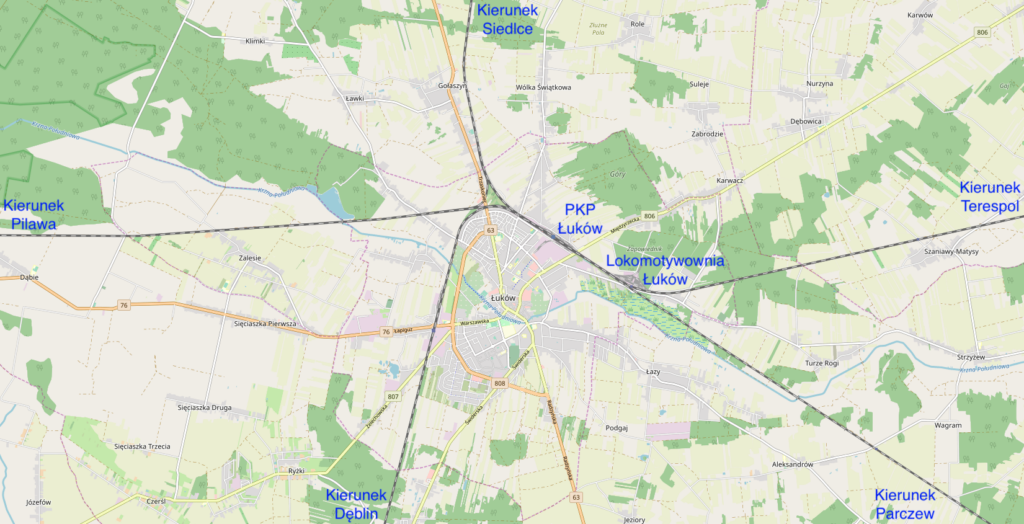
A significant moment in the development of the town of Łuków came in 1866, when the Warsaw-Łuków-Terespol railway line was opened. The railway contributed to the region’s economic and social development. In the second half of the 19th century, three railway lines ran through Łuków. The Warsaw-Terespol railway opened on September 18, 1867, but the Siedlce-Łuków section began operating in the winter of 1866/67. On December 1, 1866, the first train from Siedlce arrived at Łuków station. Simultaneously, between 1866 and 1867, a railway station building was constructed. On February 3, 1873, the decision was made to build another line through Łuków, connecting the fortress in Dęblin with the fortress in Brest. Construction was completed in 1880. In 1898, the line from Łuków to Lublin was completed. In the period 1951–1954, railway line No. 12 Skierniewice – Łuków was built.Linie kolejowe w Łukowie:
Railway Line No. 2 is a section of the international railway line E20, which connects Berlin and Moscow via Warsaw and Terespol. Railway Line No. 2 Warszawa Zachodnia – Terespol is 214.227 km long, double-track, and electrified at 3 kV DC. The line runs north-south. Currently, the line is designed to accommodate passenger trains at 160 km/h and freight trains at 120 km/h on the Warsaw Rembertów – Biała Podlaska section. In 2016, a tender was announced to upgrade the Biała Podlaska – State Border section to 160 km/h.
Railway Line No. 12 Skierniewice – Łuków is also known as the Warsaw Freight Bypass. The line is electrified at 3 kV DC, double-track, and has a length of 161.567 km, connecting Skierniewice station with Łuków station, in the central eastern part of the country. The line, commonly known as “S-Ł” or “esełka,” runs through the Łódź Voivodeship, Masovian Voivodeship, and Lublin Voivodeship. The line runs meridionally. The line is classified as a line of national and international importance, belonging to the AGTC network of international combined transport lines, as transport corridor C-E 20. Currently used almost exclusively for freight traffic, as the southern bypass of the Warsaw Railway Junction. The line constitutes the Warsaw bypass railway, designated for rail freight transport.
LK No. 26 Łuków – Radom. It is double-track and single-track, electrified at 3 kV DC, and has a length of 117.108 km. Train speed is 120 km/h.
Train line No. 30 Łuków – Lublin Północny via Parczew was restored to service in June 2017 due to the modernization of Tram line No. 7 Warsaw – Lublin. Trains traveling from Lublin to Warsaw and vice versa use it.
The Łuków-Ivangorod Railway.
The Łuków-Ivangorod Railway was launched in 1876 as a branch of the Vistula Railway. The route was 56.78 versts long and connected the Warsaw-Terspol Railway with the Ivangorod-Dąbrowa Railway. Two railway stations were built on the route: Krzywda and Rossosz (later Leopoldów). In May 1875, J. A. Kraszewski became the chief engineer of the route. By November 1875, the line was equipped with a telegraph line. The first trains departed on September 1, 1876, following its technical acceptance on August 25, 1876. On October 22, 1876, a government commission issued a certificate of operation for the Łuków-Dęblin line. From December 2, 1876, military and local freight trains ran on the route. Long-distance passenger trains were not operated on this route. Civilians were not allowed on courier and passenger-freight trains if they were carrying military personnel. Civilians had to wait for the next train. Freight trains primarily transported firewood and construction timber to Prague and Warsaw. Transport tariffs were established. In 1885, landowners submitted an application to build a loading station on Wola Okrzejska land, between the Krzywda and Leopoldów stations. Eventually, the Okrzeja (Okszeja) stop was built. Additional stops were built: Łapiguz, Sarnów (March 1927), and Ryki. On November 9, 1891, a disaster occurred at the 45th verst. Unknown perpetrators spun the rails, derailing the locomotive, wrecking four wagons, and damaging another four. Fortunately, no one was injured. In March 1892, the last wagon of a train carrying hard coal caught fire on the line. The wagon was detached and the fire extinguished. The fire was likely caused by sparks from the locomotive. Forest fires near the tracks were common on this line. Sparks from steam locomotives ignited the forests. This forced the railway to introduce firebreaks. At that time, locomotive breakdowns were common on the line, requiring the dispatch of reserve locomotives. Locomotives sometimes had to be repaired on the line. There was never a head-on collision between trains on the line, despite it being a single-track line. However, on October 1, 1909, a freight train was dispatched to the line, while sectional rail replacement was underway. The locomotive and two carriages were damaged. Removing the locomotive and carriages took several hours. No one was injured. Special trains carrying the Tsar, his family, or Moscow governors passed along the route several times. They bypassed Warsaw on this route, traveling to their residence in Spała, near Tomaszów Mazowiecki. In October 1913, the decision was made to build a second track on the route. This was part of a larger project: Kovel – Brest – Łuków – Dęblin. In 1929, brick station buildings and platform restrooms were built at the stations and stops along the route. In 1930, quarters for railway workers’ families were built at the stations, and residential buildings for track workers were built at the stops. On the Łuków – Dęblin route, the second track was not opened until 1931. As part of the work, bridges and culverts were widened. Railroad crossings were rebuilt. Much of the work was performed by railway troops and bridge construction troops. Construction took five weeks and was carried out in unfavorable weather. Finishing work continued until 1932. During World War II, partisans derailed several German trains. The disruptions to service typically lasted 10-15 hours. Partisan losses included 10 killed, 17 seriously wounded, and 62 slightly injured. In retaliation, the Germans carried out public executions of those arrested in Dęblin and Łuków. In subsequent cases, Poles from neighboring towns fled into the forest for several days.
Łuków Railway Station.
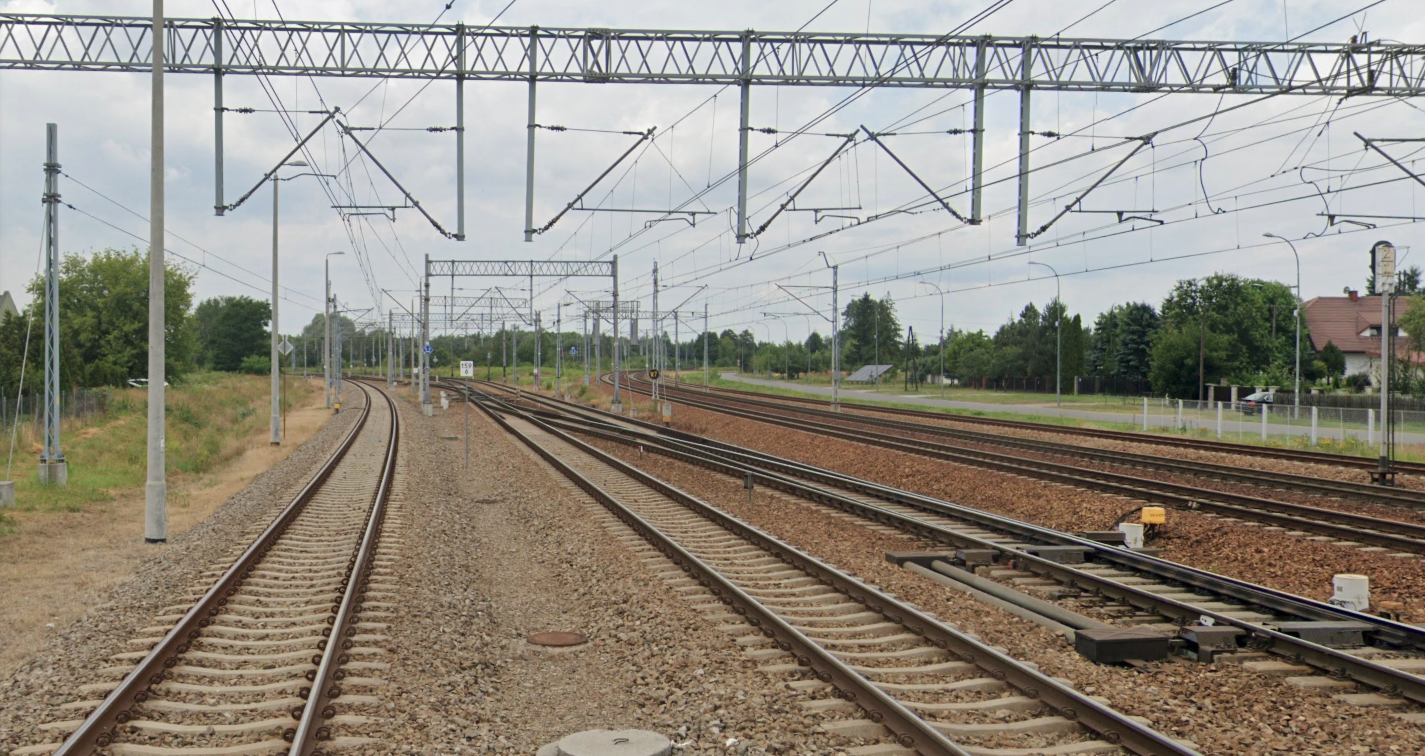
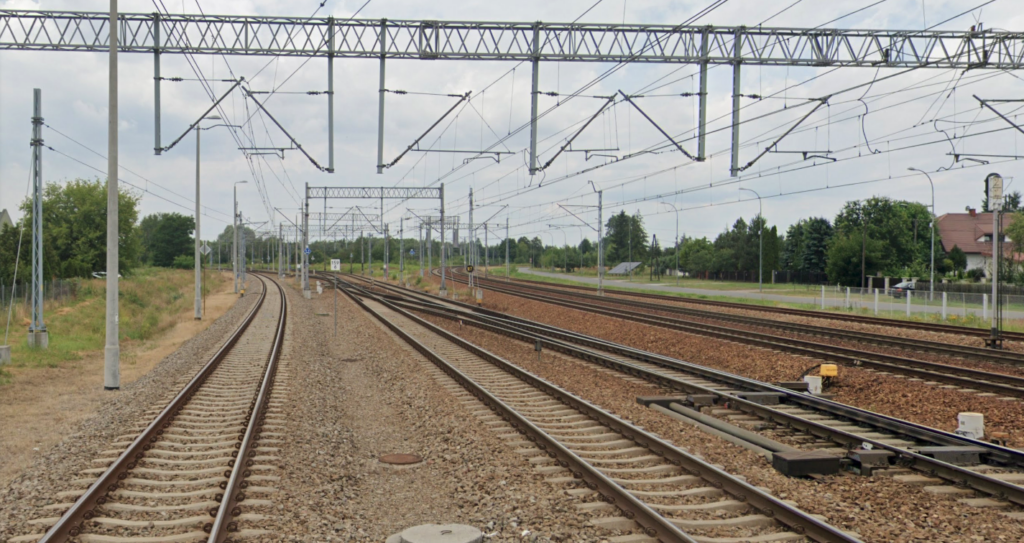
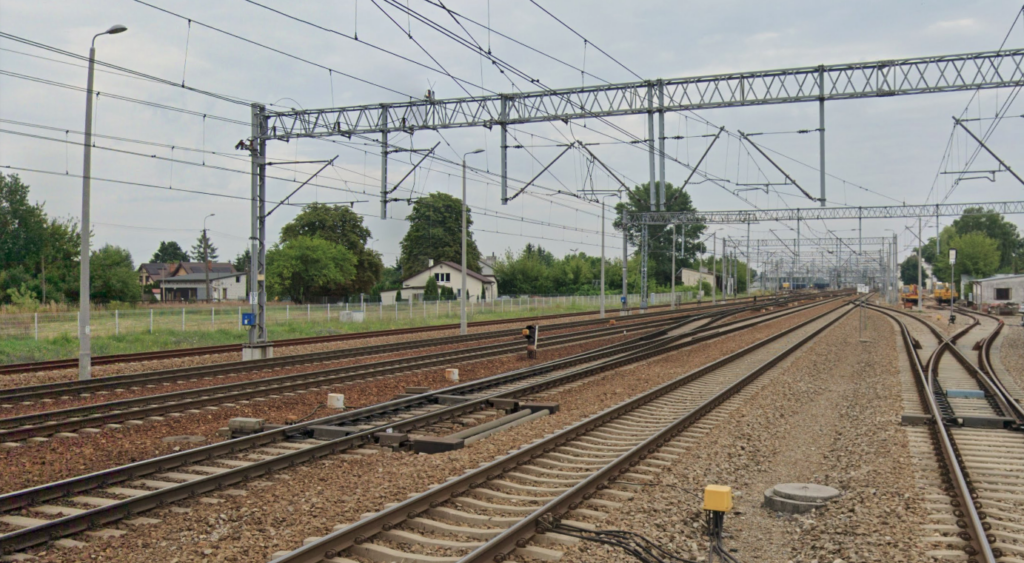
Łuków is one of the most important railway junctions in eastern Poland, and the railway had a significant impact on its development. Łuków has two railway stations. Łuków railway station is located approximately 2 km northeast of the city center. The Łuków Łapiguz freight station with a train stop is located approximately 1.5 km west of the city center. Łuków also has a passenger stop, Łuków Zapowiednik, located in the eastern part of the city, next to the Łuków locomotive depot.
As early as 1866, construction began on technical facilities, including a locomotive depot, a water tower, coal entanglements, mechanical workshops, and a housing estate for railway workers’ families. Between 1873 and 1880, Łuków became a railway junction following the opening of the Dęblin (Ivano-Grod) – Brest railway line. Railway sidings were added, leading to military installations and industrial plants. The railway became the largest employer in the region.
The Great War caused significant destruction of the railway infrastructure. Railway stations and military transports were the main targets of attack. After the rebirth of the Polish-Lithuanian Commonwealth, the railway infrastructure was rebuilt. Freight trains served the army, transporting agricultural produce, timber, and passenger trains.
During World War II, the railway in Łuków and the surrounding area was heavily used by Germans. Germanic transports were targeted for sabotage by Polish partisans from the Home Army, the National Armed Forces, and the Peasant Battalions. Łuków station played a tragic role in the deportations of the Jewish population to extermination camps, primarily to Treblinka.
After 1945, the railway infrastructure was rapidly rebuilt and expanded. The locomotive sheds were expanded. The shed serviced and repaired trains, primarily EMU EN57s. The number of freight and passenger trains increased dramatically. At that time, the railway was the main lifeblood of the national economy. More apartments were built for railway workers’ families. The peak of rail transport was in the 1980s. In 1989, socio-economic changes occurred, and the importance of rail transport declined. In Łuków, part of the railway infrastructure was liquidated.
Łuków Station.
In 1866–1867, the railway station building, which still stands today, was built. Throughout its history, the station was named Łuków, although during the partition period, the name was written in Cyrillic. On September 7, 1976, the building was added to the list of historical monuments under registration number A/1112. Currently, the building is managed by PKP Polish Railway Lines.
The station was built in a palatial, classicist style, with an entrance hall over which a representative balcony is located. The building has two main floors and 15 axes. There are also two wing extensions with a typical Polish roof. The Polish roof is a variation of the mansard roof, where both roof surfaces have the same pitch. The lower floor of the building served passengers. It contained a waiting room, a restaurant, and ticket and baggage offices. The upper floor contained service rooms and apartments for railway workers’ families. A large square was paved in front of the station. Horse-drawn carriages, private carriages, and passenger carriages stopped there.
Throughout its history, the station building was modernized. The roof was raised. A colonnade was constructed in the Classicist (Greek) style in front of the entrance. The windows were replaced, and on the second floor they were given semicircular arches. A semicircular window was installed above the main entrance, illuminating the main hall. The decorative ornamentation on the facade was changed. During the Great War, the building suffered damage but did not collapse. Between 1918 and 1920, the building was rebuilt. For a time, the station was served by a small brick building, which later served as a luggage storage facility.
During the Second Polish Republic, the building’s functional layout was redesigned. Ticket offices, a restaurant, a buffet serving cheaper food, a RUCH kiosk, and a waiting room were added. On January 25, 1960, a train accident occurred. A steam locomotive pulling nine passenger cars was traveling with a train from Dęblin to Łuków. The train ran onto a side track, struck a buffer stop, smashed through a wooden shed, and crashed into the station building. The Citizens’ Militia station was located there. There were no fatalities or serious injuries. The renovation was completed in 1962, and the functional layout and interior design were also changed. Currently (2025), the station building is closed to ticket offices, although three windows remain, and ticket machines from Koleje Mazowieckie and InterCity have been installed. In 2022, part of the station’s usable space was leased by the Łuków Cultural Center for a 15-year lease. Among other things, a 350-seat auditorium was installed there.
The station currently has two island platforms and four platform edges. Currently, there are no platforms at the station level, as the platforms were moved southeast, behind the footbridge over the tracks.
In 1974, a monument commemorating the railway workers who fought against the German invaders was unveiled near the station.
Modernization of Łuków station lasted from 2014 to 2016. In 2016, the modernization of the station’s track system was completed: the tracks, switches, and electrical work were replaced, two new double-edge platforms with shelters were built, the platform next to the station building was removed, the existing footbridge over the tracks was rebuilt, and elevators were added. The track system in the freight section was completely rebuilt, and a Local Control Center (LCS) was constructed. A tunnel was built under the tracks along Międzyrzecka Street, DW No. 806.
Over the past 10 years, the station has served over 1,000,000 passengers. A slump occurred during the 2020 Chinese coronavirus pandemic, when the station served 584,000 people. In 2024, the station served 1,061,400 passengers. On January 7, 2026, trains departed for the following stations: Chełm, Dęblin, Lublin Główny, Łuków Łapiguz, Siedlce, Terespol, Warszawa Służewiec, Warszawa Wschodnia, Warszawa Zachodnia, and Żyrardów.
Written by Karol Placha Hetman