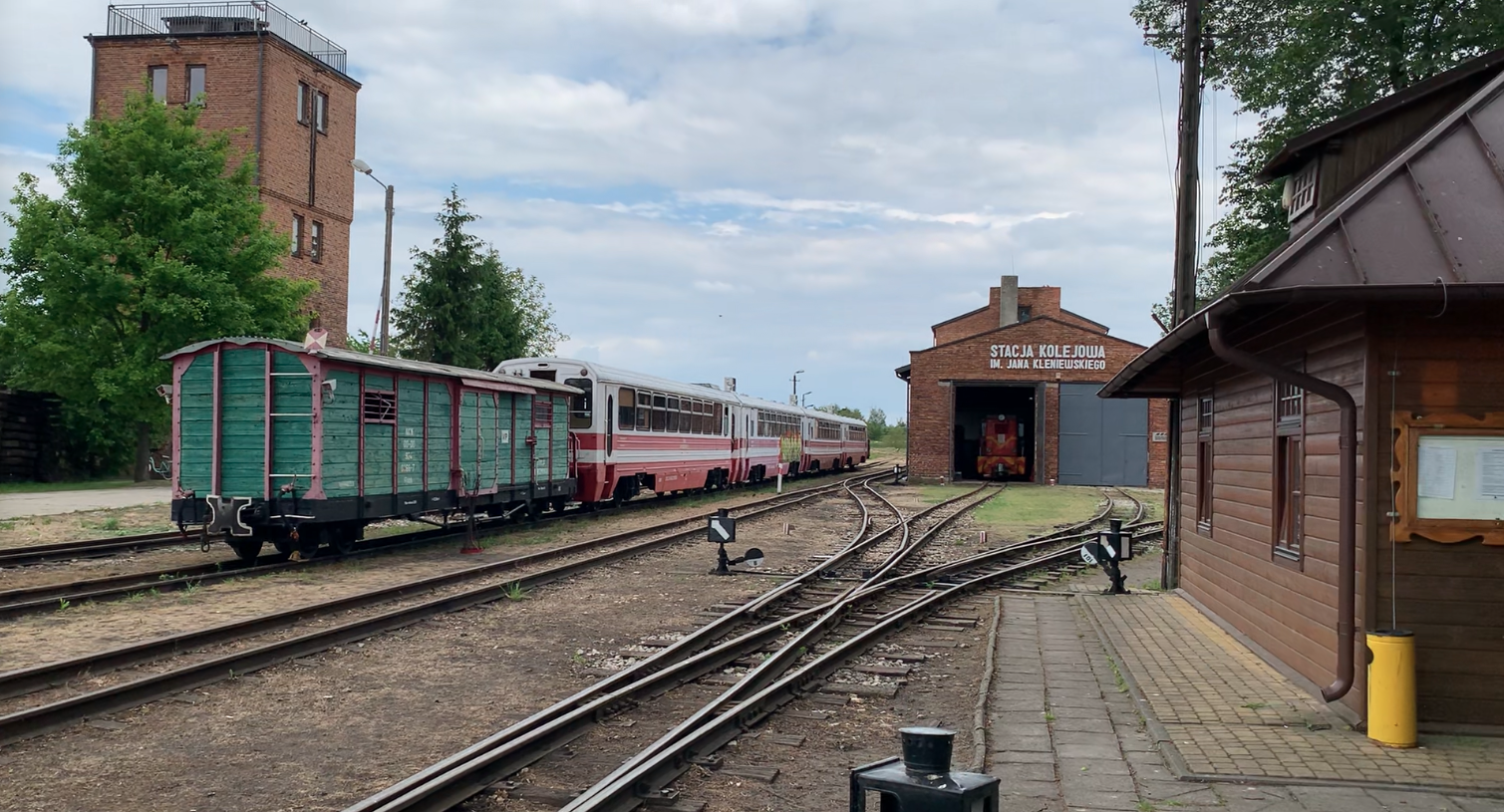
Karczmiska 2026-07-06
Vistula Narrow Gauge Railway.
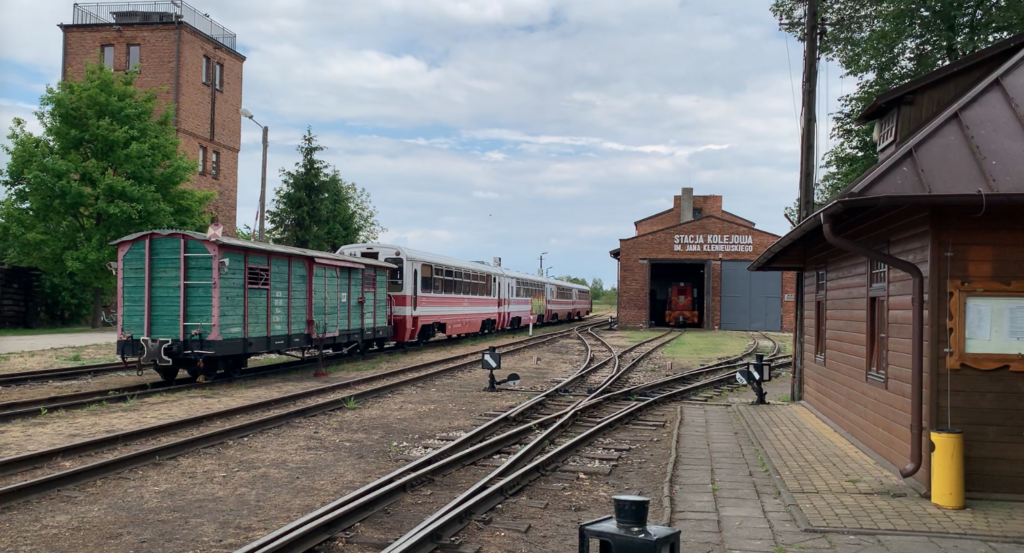
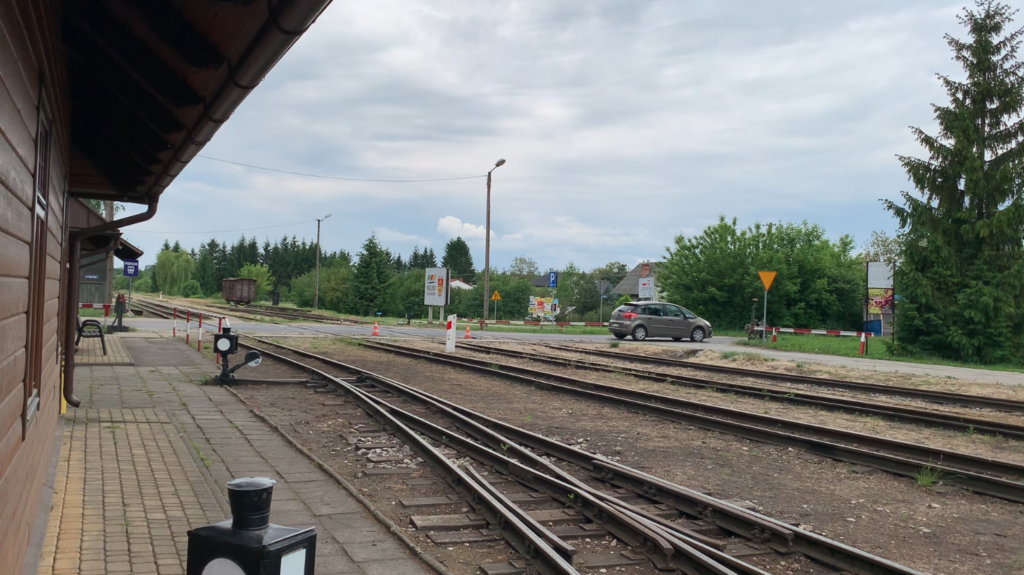
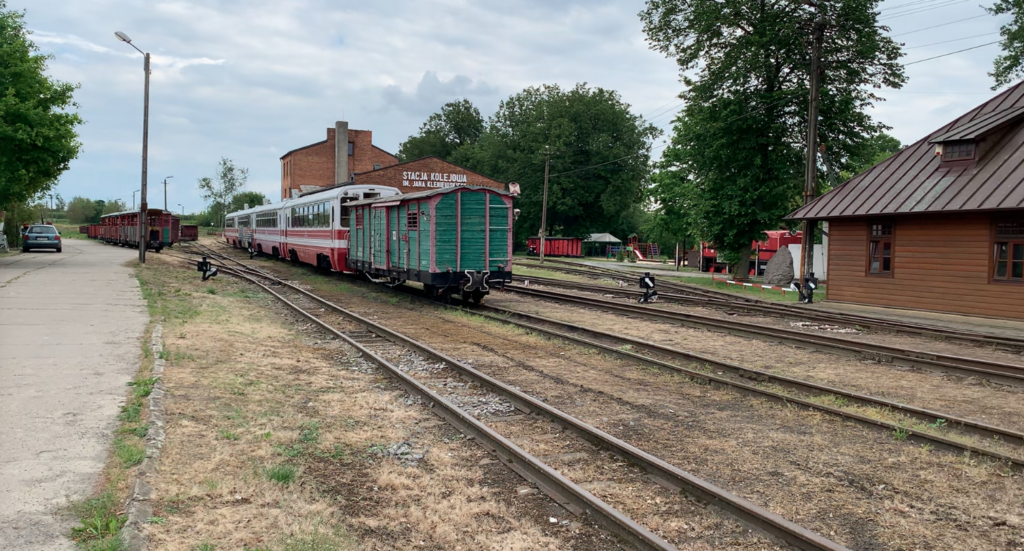
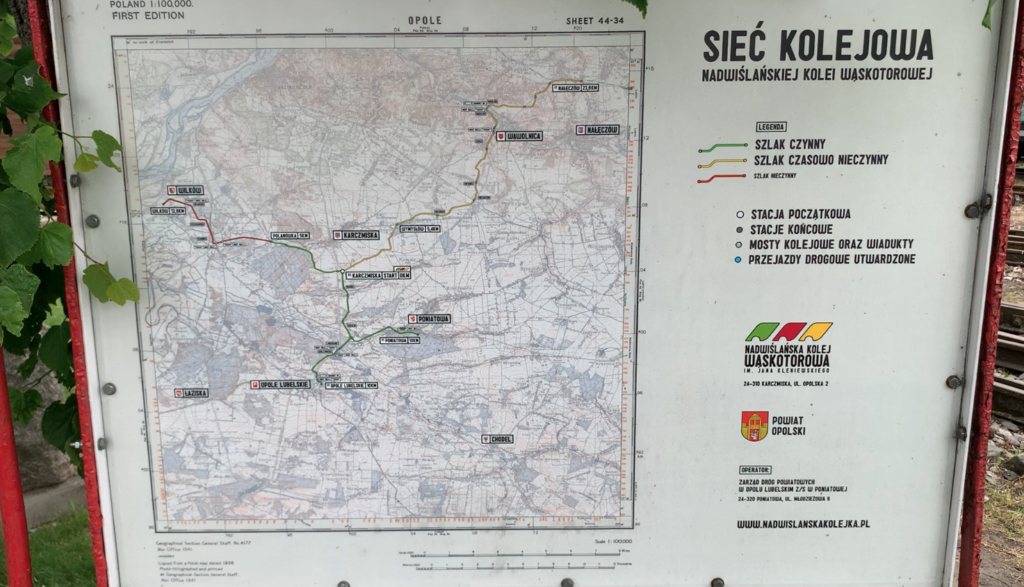
The Vistula Narrow-Gauge Railway was formerly known as the Nałęczowska Commuter Railway. It is a historic narrow-gauge railway with a 750 mm gauge located in the western part of the Lublin Voivodeship, in the Opole and Puławy counties. It is the only operating narrow-gauge railway in the Lublin Voivodeship. The Vistula Narrow-Gauge Railway is currently a valued tourist attraction in the Lublin Voivodeship. The railway route runs through the most charming and interesting places in this part of the voivodeship. The train regularly runs between Karczmiska and Opole Lubelskie, as well as Karczmiska and Polanówka. The Vistula Narrow Gauge Railway was established in 1892 on the Kleniewski family estate.
Currently (2026), the railway is operated by the District Road Authority in Opole Lubelskie, Poniatowa branch. 18.80 km of line are available. The rail gauge is 750 mm. The central station of the railway is Karczmiska station. Technical support facilities are also located here. At Nałęczów Wąskotorowy station, the Vistula Narrow Gauge Railway connects with the standard gauge railway network, on the Dęblin – Lublin section; LK No. 7.
Chodelka Valley
The area where the Nałęczów Railway, now the Vistula Narrow Gauge Railway, is located is known as the Chodel Basin. The Chodel Basin is a mesoregion, the Lublin Upland, located in the western part of the Lublin Voivodeship. Despite its name, the basin is not a deep basin, but a broad, gentle depression surrounded by higher loess plateaus. The Chodel Basin lies between the Nałęczów Plateau to the north, the Bełżyce Plain to the northeast, the Urzędów Heights to the south, and the Lesser Poland Vistula Gorge to the west. The region’s most important city is Opole Lubelskie. The region’s landscape is characterized by: altitudes ranging from about 120 m near the Vistula River to about 180–200 m on the outskirts, gently undulating terrain, very fertile loess soils, numerous valleys and small gorges. The Chodelka River, from which the region derives its name, flows through the valley. It is a right tributary of the Vistula River. The Chodelka Valley is one of the most fertile areas in Poland. Fruit growing (apple, sour cherry, sweet cherry, and plum trees), raspberry and currant cultivation, hop growing, and grain and sugar beet cultivation have flourished here. The areas around Opole Lubelskie and Poniatowa are among the largest fruit-growing areas in the country. Since the Middle Ages, the region has been an important agricultural area of Małopolska. The proximity of the Vistula River facilitated trade in grain and timber. In the 19th and 20th centuries, the Narrow Gauge Railway also played a significant role, connecting Opole Lubelskie, Karczmiska, Poniatowa, and Nałęczów with the Vistula Valley, transporting primarily agricultural produce, sugar beets, and fruit. The region is famous for its extensive spring-blooming orchards, its peaceful agricultural landscape, its proximity to Kazimierz Dolny and the Vistula River Valley, the historic urban layout of Opole Lubelskie, and the preserved infrastructure of the Vistula Narrow Gauge Railway in Karczmiska. The Chodel Basin is less well-known than the neighboring Nałęczów Plateau, but it is one of the most fertile and scenically distinctive regions of the Lublin region.
The Chodelka River (also known as Chodelica, Chodlik, or Chodel) is a small but picturesque river in the Lublin region. It is a right tributary of the Vistula River and irrigates almost the entire Chodel Basin. Basic information: Length: 49.3 km. Basin area: 566.3 km². Its sources are near Kłodnica Górna, on the northern edge of the Urzędów Hills. Its mouth is near Podgórze, south of the town of Kazimierz Dolny. The Chodelka River flows through some of the most fertile areas of the Lublin region. It flows through Chodel, Opole Lubelskie, and the areas around Karczmiska and Wilków, among others. Finally, it flows into the wide Vistula Valley. Although it lies in the lowlands, in its upper reaches the Chodelka River has the characteristics of a foothill river: it flows with a swift current, has numerous underground springs and outflows, and the bottom is in places gravelly and rocky. Lower down, the river slows, and meanders strongly. The lower section has been partially transformed by a system of fish ponds and drainage canals. During high Vistula water levels, its waters can recede up the Chodelka River for up to several kilometers. The Chodelka Valley is one of the most valuable natural areas in the western Lublin region. It contains riparian forests and wet meadows, peat bogs, numerous springs, and habitats for beavers, otters, and many bird species. A significant portion of the river valley lies within the Chodelka Protected Landscape Area. The Chodelka’s waters are so clean that crayfish, considered an indicator of good water quality, have long been present there. For centuries, the Chodelka River has supplied watermills, fish ponds, and irrigation facilities for orchards and fields in the Chodelka Valley. Today, it is valued primarily as a river of high natural and scenic value. Hiking and cycling trails have been established along its valley.
History of the Railway.
The history of the railway begins with the sugar refinery railway (also known as the sugar beet railway), whose purpose was to cheaply transport sugar beets from the fields to the plants. The initiator of the railway’s construction was Jan Kleniewski, a local landowner and industrialist, owner of, among others, the Zagłoba sugar refinery. The first line was built to serve this refinery. In 1892–1893, a temporary railway with wooden rails operated for a short period between the Polanówka farm and the Zagłoba sugar refinery. It was horse-drawn. The wagons had a gross weight of 5,000–6,000 kg. In 1900, a railway was built between the Zagłoba sugar refinery and the farm in Brzozowa, and the marina in Kępa Chotecka. The rail gauge was 750 mm. The line was systematically expanded until 1914. In 1911, the Zagłoba-Wymysłów section was built, with a branch line connecting Szczekarków-Wilków-Urządków to the Vistula River. Initially, horse-drawn traction was used. The rolling stock consisted of 10 carriages, two flatcars, and several horses. The first steam locomotives were purchased in 1912.
At the same time, a separate railway was being organized to serve the Opole Lubelskie sugar refinery. In 1908, a line was built between this refinery and the peat mine in Łaziska. During the period 1911-1913, a section was built to the river port in Piotrawin. This was the second time the railway had been connected to the Vistula River.
In the summer of 1915, retreating Muscovites destroyed both the sugar refineries and their narrow-gauge railways. They dismantled the tracks and transported them eastward, dumping the rolling stock in the Vistula River. During the Great War, after the Muscovites withdrew, the Chodel Valley area came under Austrian occupation. The Kleniewski family rebuilt some sections of the railway.
On October 1, 1916, a new section was opened to Wąwolnica station and then to Nałęczów station, where the narrow-gauge railway connected to the standard-gauge line. Regular passenger service was introduced on the Nałęczów–Opole Lubelskie route.
After the Great War, Poland regained independence. The total length of the railway line was then 54 km. The railway was taken over by the Ministry of Railways. Shortly thereafter, part of the line returned to private management. In 1928, the state owned 43 km of routes. In the 1920s, the Polish State Railways (PKP) owned the Nałęczów–Opole Lubelskie line and the Karczmiska–Rybaki branch, currently the area of Polanówka station. After World War II, the Rybaki stop was closed. During this time, scheduled passenger trains were maintained on the Nałęczów–Opole Lubelskie route for 20 years. The trains consisted of a steam locomotive and passenger cars, with the option of diesel-powered carriages. Tourist services were also operated on the Piotrawin–Nałęczów route. In the second half of the 1930s, the railway was incorporated into the Central Industrial District’s transport system. A rail link to the electrical works in Poniatowa was established.
Railway traffic was operated by steam locomotives purchased from the Kolomynia Steam Locomotive Factory in the Muscovite State. The locomotives were known in local dialect as “kołomyjkas” or “samovarki.” These locomotives operated for up to 1950. In the 1920s, freight wagons with a load capacity of 8,000 kg and 15,000 kg were purchased. In the 1930s, another Polish Px29 steam locomotive was purchased.
Polish steam locomotive Px29. Until 1945, the locomotive was designated Wp29 and called Wilno. These locomotives were produced in 1929. Axle arrangement “D.” The locomotive’s operating weight was 21,800 kg, plus tender. The locomotive length was 7.00 m, and including the tender, 12.805 m. Coal box capacity was 4 m3. Water capacity was 6 m3. Design speed was 35 km/h. Locomotives were built for 750 mm and 760 mm gauge. The Wp29 steam locomotive was designed by the Warsaw Joint-Stock Company for the Construction of Steam Locomotives, commissioned by the Ministry of Railways. This locomotive proved to be a successful design, favored for its smooth running and ease of operation. 21 examples were built. The Px29 steam locomotive could pull a train weighing 300 tons at a speed of 25 km/h and negotiate curves with a radius of 35 m. They were in service until 1978.
In addition to the PKP Nałęczów – Opole Lubelskie line, the Opole Sugar Factory also operated railways during the interwar period. There was a line to Piotrawin and its sidings with horse-drawn traction. A new 13 km long section to Świdno (Opole Lubelskie – Świdno) was also built with steam traction. Within the Opole Lubelskie sugar factory itself, there were also tracks for manual wagons. Freight trains, passenger trains, and special trains, such as those carrying children to summer camps or excursions, ran on the narrow-gauge railway network.
The Szczekarków – Urzędków – Wilków – Vistula River line was also rebuilt. The section leading to the Vistula River itself was the first to be dismantled. There was also a 5-kilometer Niezabitów–Łubki line. It was a private line with horse-drawn traction. This line was probably dismantled around 1948.
During World War II, the German occupation continued, and all narrow-gauge railways were used to meet the needs of the occupiers. In Poniatowa, the Germans established a camp for Jewish prisoners of war and their Russian brethren. They transported the prisoners to the camp by rail. In 1942, the 3-kilometer Zagłoba–Kępa Chotecka line was rebuilt. Later, a narrow-gauge utility railway was built in Bełżyce, which was planned to connect to the rest of the network, but this was never realized.
In August 1944, as the Soviet front approached, the Germans took the functioning rolling stock west and threw the damaged ones into the Vistula River. Polish railway workers managed to hide a small portion of the rolling stock in the forests. After the war, the motor cars were found in Wrocław.
After World War II, all narrow-gauge railway lines were incorporated into the Polish State Railways (PKP). In the Vistula Railway area, the final section to Piotrawin was incorporated into the PKP. A connection across the Vistula River to Starachowice was planned. Unfortunately, only a short section from Starachowice to Iłża was built, as standard-gauge tracks were installed there. By the end of the 1940s, the number of passenger trains had significantly increased. Poniatowa, Wilkowa, and other lines were included in the timetables. Passenger trains to Wilków were discontinued around 1965.
During the 1950s, the primary locomotive was the Px48 steam locomotive and the Las type. The Px48 is the most famous Polish narrow-gauge steam locomotive, produced from 1949 to 1955 at the Fablok factory in Chrzanów. The Las type is a Polish narrow-gauge industrial steam locomotive, designed primarily for operation on forestry, sugar, brickyard, and mining railways. It was produced at the Fablok factory in Chrzanów from the late 1940s. Approximately 640 units were built, some of which were exported to Romania, Bulgaria, and Albania. Later, diesel locomotives were introduced: the Romanian Lxd2, the Polish Lyd1, the Polish WLs150, and the WLs180.
On the Opole Lubelskie–Piotrawin sugar line, due to the fire hazard posed by steam locomotives, a bypass bypassing the village of Niezdów was built in 1959. In the 1960s, the railway was used by the “EDA” Electromachinery Plant in Poniatowa and the Opole Sugar Factory in Opole Lubelskie. Approximately 300 employees worked directly on the railway.
Around 1966, the sugar refinery closed its railway network. In 1968, the tracks to Piotrawin were dismantled, and in 1970, to Świdno. Until the sugar refinery’s closure, a track system existed on the plant’s premises. Also at the end of the 1960s, the tracks to Kępa Chotecka were dismantled via the ZPOW “Zagłoba” (Zagłoba Military District). The first stage involved dismantling the Brzozowa–Kępa Chotecka section, and the second stage involved the remaining sections.
Nevertheless, PKP invested in maintaining its infrastructure and rolling stock. The rails were replaced with heavier ones. In 1968, Lxd2 diesel locomotives were purchased from Romania. Steam locomotives were gradually phased out. The last Px48 steam locomotive was retired in 1980. In the 1970s, standard-gauge wagon transporters were introduced. In 1988, new Bxhpi passenger cars, also manufactured in Romania, were introduced. In 1990, the railway employed approximately 250 workers.
Nie udało się połączyć Nadwiślańskiej Kolejki Wąskotorowej ze stacją normalnotorową Kraśnik. Odcinek Świdno – Kraśnik miałby długość 20 km. Ta inwestycja ożywiłaby transport w Kotlinie Chodelskiej. Także nie zbudowano żadnego mostu przez rzekę Wisła, a były trzy możliwe takie miejsca; Piotrowin, Kępa Chodecka, Wilków. Mogłoby to ożywić południowe Mazowsze, po lewej stronie Wisły.
Following the socio-economic changes of 1989, a sharp decline in passenger and freight transport was noted. In 1991, passenger trains to Poniatowa were discontinued. In 1995, the last passenger connection to Opole Lubelskie was discontinued. At that time, the first tourist and excursion trains were introduced. In 1994, approximately 3,400 people used 35 excursion trains. In 1998, there were 187 excursion trains, carrying over 17,000 passengers. Freight trains primarily transported agricultural produce, timber, and coal dust.
Despite this, the railway was unprofitable. Therefore, at the end of 2001, the Polish State Railways (PKP) management suspended rail traffic entirely. Buses and trucks took over. Additionally, in 1999, a truck damaged a railway viaduct in the village of Mareczki, along provincial road No. 830.
Following ongoing negotiations, PKP transferred the entire railway to the district office in Opole Lubelskie. On September 10, 2008, a notarial deed was signed, under which the district took over the Nałęczowska Commuter Railway assets from PKP. In 2002, the rolling stock and tracks were transferred, and finally, in 2008, the land and buildings. In December 2002, the right to use the railway was granted to SKPL, the Association of Local Railway Transport (SKPL) from Kalisz. A new entity, the Association of Local Railway Transport (SKPL), was selected to operate the railway on behalf of the district. This entity managed railway operations from 2003 to 2008. Regular runs of the “Nadwiślanin” tourist train were conducted. On selected Sundays, during the season from April to October, on the Nałęczów Wąskotorowy – Karczmiska Polana route. Also, once a year, in September, a pilgrimage train ran on the Opole Wąskotorowe – Wąwolnica – Nałęczów Wąskotorowy route. In 2008, due to damage to the viaduct in Mareczki, the route was shortened to Wąwolnica station. This was the second time this viaduct had been damaged. Individual transport was also organized on available routes, usually for workplaces. During this period, attempts were made to reactivate freight transport. However, only one trip was made in 2003.
In 2008, SKPL withdrew as the operator. The District Roads Authority in Opole Lubelskie became the new operator. In the summer of 2011, the new operator resumed tourist trips under the name “Nadwiślańska Kolejka Wąskotorowa” (Vistula Narrow-Gauge Railway).
During the 2012 season, the cable car carried over 13,000 tourists. Trips were operated on the Karczmiska–Polanówka route, Karczmiska–Opole Lubelskie route, and, upon request, Karczmiska–Poniatowa route. Following the reconstruction of the damaged viaduct in Mareczki and the renovation of the Karczmiska–Nałęczów section, service on this section was scheduled to resume in 2020. The total cost of the investment was PLN 8.5 million. Further investments were planned, but no specific dates were announced. In 2018, the cable car carried 19,800 tourists. During this time, services operated over a distance of 20 km.
During 2020-2021, due to the Chinese coronavirus pandemic, the cable car was closed. In 2022, it carried 13,000 people, and in 2023, 16,600. At that time, the distance covered was 18,600 km. On July 4, 2021, a new attraction was launched: bicycle trolleys.
In 2024, the season began on May 1. Rides were offered on two routes: Karczmisk – Polanówka and Karczmisk – Poniatowa. Stops at the final stations lasted 20-30 minutes. Guests could enjoy catering facilities and souvenir kiosks in the renovated station building in Poniatowa. A hotel and restaurant were also located here. Bicycle trolleys ran on the route to Pustelni. In 2025, four bridges on the railway route were planned to be renovated to open the route to Opole Lubelskie. By 2026, the railway boasts 17,000 tourists transported during the season, 64 km of railway lines, five stations, and 7 tourist wagons.
The Vistula Narrow Gauge Railway Viaduct in Mareczki.
The railway viaduct in Mareczki is often referred to as the Rogalów Viaduct, after the nearby town. The viaduct is one of the most distinctive engineering structures of the former Nałęczów Access Railway, currently the Vistula Narrow Gauge Railway. It was built in 1917–1918, simultaneously with the construction of the Nałęczów Narrow Gauge – Karczmiska section, with a 750 mm gauge. The viaduct was built over what is now Voivodeship Road No. 830 Lublin – Nałęczów – Bochotnica to eliminate a level crossing and ensure safe train and vehicle traffic.
The structure is a steel beam viaduct supported by reinforced concrete abutments and an additional central pillar, which divides the carriageways into left and right sides. The permitted vehicle height is 3.30 meters on both carriageways. At the time of construction, it was one of the most important engineering structures of the entire railway. The track runs above the road at a height of approximately 4 meters, and the viaduct itself is located on km 6.371 of the railway line. For decades, passenger trains from Nałęczów to Opole Lubelskie and Karczmiska passed through this bridge. Trains transporting sugar beets, grain, and fruit from the orchards of the Chodelska Valley also carried standard-gauge wagons on conveyors. It was one of the most recognizable landmarks on the railway route.
In 2008, the viaduct was damaged by a car exceeding the permitted height. One of the main support beams was damaged, resulting in the immediate closure of rail traffic on this section.
For several years, this prevented tourist trains from reaching Nałęczów. The services terminated in Karczmiska. After the railway was taken over by the Opole County, preparations for its renovation began. Technical documentation was developed to preserve the historic character of the structure while adapting it to modern safety requirements. In subsequent years, the viaduct was renovated, allowing tourist trains to run again along the entire route to Nałęczów.
Karczmiska Station.
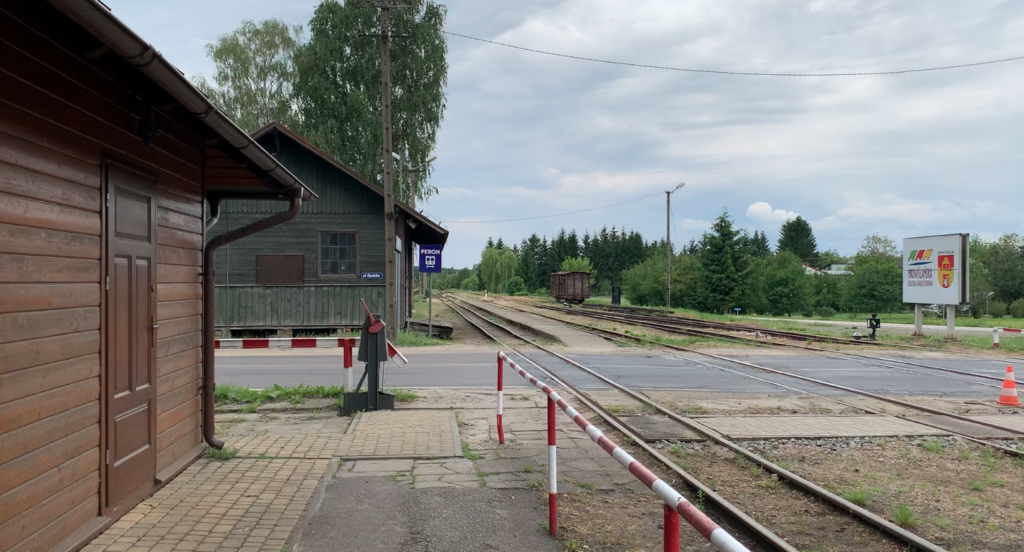
Jan Kleniewski Railway Station. Vistula Narrow Gauge Railway. Address: 24-310 Karczmiska, Opolska Street 2. Operator: District Roads Authority in Opole Lubelskie, branch in Poniatowa. Address: 24-320 Poniatowa, Młodzieżowa Street 6. Geographic coordinates: 51.216N 21.997E. Elevation: 165 m.
The station was built in 1911. Passenger rail traffic was operated until 1993, and freight traffic continued until 2001. Since 1994, seasonal tourist traffic has been operated, with interruptions, from May 1st to the end of September. On July 3rd, 2022, a monument commemorating the 130th anniversary of the railway was unveiled.
The railway operates seasonally from May to September. The route passes through charming and interesting places in this part of the voivodeship. The train regularly runs along the Karczmiska – Opole Lubelskie and Karczmiska – Polanówka routes. In recent years, the railway has been renovated and refurbished, and it is a great place to travel. Bicycle trolleys are also available. Railway enthusiasts can tour the station complex and the Karczmiska Railway Museum. A major attraction is climbing the observation tower, where reprints of old photographs on canvas are displayed on each floor. The entire structure is topped with an observation deck, from which you can admire the panoramic view of the surrounding area through a telescope, stretching to the horizon. The Vistula Bicycle Trolleys run on the following routes: Karczmiska – Pustelnia – Karczmiska, Karczmiska – Poniatowa – Karczmiska, and Karczmiska – Polanówka.
The starting station is in Karczmiska. The road distance to Nałęczów is 20 km, to Puławy is 24 km, to Lublin is 45 km, to Ostrowiec Świętokrzyski is 67 km, to Radom is 80 km, to Warsaw is 150 km.
Written by Karol Placha Hetman