Skawina 2025-12-27
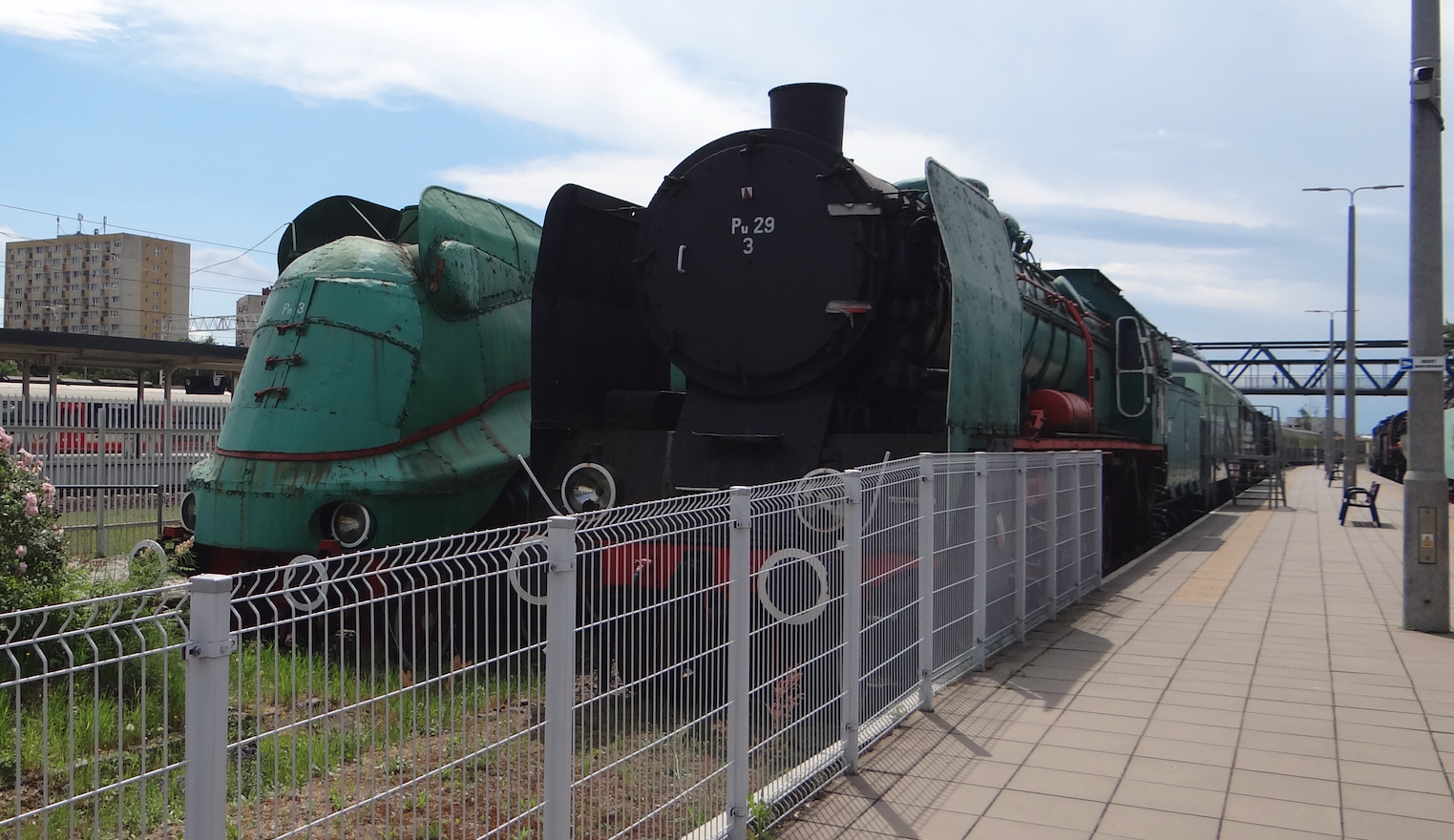
Steam Locomotive Pu29-3.
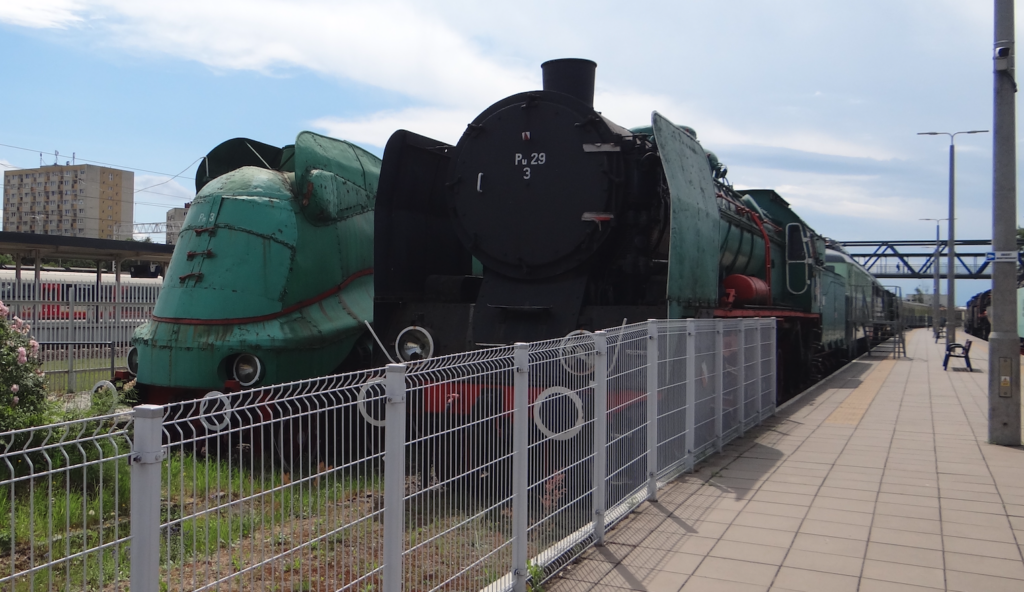
The Pu29 series steam locomotives were a short series of Polish express steam locomotives built during the Second Polish Republic, at the Hipolit Cegielski works in Poznań. The number 29 denoted the year of development, i.e., 1929. Most express trains at that time were hauled by, among others, obsolete Pk1, Pk2, and Pn12 series locomotives. There were also Ok1 and Ok22 steam locomotives, which operated in express service.
The Pu29 steam locomotives were designed to handle long and heavy express trains. This was particularly true for the operation of Germanic trains on the Chojnice-Tczew-Malbork section, the railway line of eternal German-Muscovite friendship. These trains were launched in 1927. The Treaty of Versailles guaranteed Germans the passage of express trains to their Muscovite brethren, as transit trains. It was not possible to board or disembark the carriages within Poland. The carriages were Germanic, but the locomotives were Polish and operated by Polish teams. It should be added that the Germanic compatriots remaining in Polish territory pelted the trains with stones and even planned attacks, with the narrative that the “primitive” Poles were seeking another war. The concluded agreements guaranteed that the trains could weigh up to 750 tons. The scheduled speed was to be 65 km/h, on gradients of 5‰. Dual traction was attempted, but this increased transport costs. However, the use of Ty23 series locomotives always caused delays. A new steam locomotive capable of meeting these requirements was necessary.
Studies undertaken indicated that the locomotive would have four driving axles. The front bogie also posed a problem. Most express and universal locomotives at the time had two leading axles. Discussion among engineers led to the conclusion that both solutions should be implemented: a single axle and two axles. Operational operation was to determine which system was better. Both systems guaranteed a speed of 100 km/h (62 mph). In the spring of 1929, the Ministry of Communications commissioned the construction of three units of each version of the steam locomotive. Construction of the steam locomotives with a two-axle trailing bogie, later designated Pu29, was entrusted to the HCP works in Poznań. The steam locomotives with a single-axle Krauss-Helmholtz bogie, later designated Pt31, were entrusted to the First Locomotive Factory in Chrzanów. Both designs were to be subjected to thorough testing, and the better one was to be put into mass production.
Production of the Pu29 locomotive encountered problems. Boiler production was delayed. As a result, the locomotive was completed in 1931. The first run of the new locomotive, with a train of 19 four-axle carriages, took place on September 9, 1931, on the Poznań-Zbąszyń section, and acceptance tests were conducted at the Poznań locomotive shed. During the trial run, with a train weighing 818 tons, the locomotive demonstrated its considerable capabilities, maintaining a constant speed of 105 km/h and reaching a maximum speed of 112 km/h, and 80 km/h on a 5‰ gradient.
The Pu29 was the largest Polish steam locomotive built before World War II, another war started by the Germans. The Pu29 locomotive had very good performance and performed exceptionally well on the line. With good coal, the locomotive could pull a 715-ton train at a speed of 100 km/h. However, it was too large. It did not fit on most turntables, and the triangles used to reverse locomotives required a larger area. It is worth mentioning that at that time, turntables with a diameter of 22 m were rare in Poland. Furthermore, the locomotive was heavy and could not be operated on all routes. Further production of the Pu29 locomotive was discontinued in favor of the more versatile Pt31 series locomotive. Furthermore, the Pt31 locomotive had a higher rated power.
The Pu29’s running gear guaranteed quick starting, without any tendency for wheel slippage, and smooth running throughout the entire speed range. The new locomotive also proved to be very economical. It offered good visibility from the cab, simple operation, and a logical design. Minor defects were detected during the initial period of operation, but these did not negatively impact the reputation of the Pu29 steam locomotive. During its two-month operation at the Poznań Railway Station (DOKP), the Pu29-1 locomotive covered approximately 8,000 km, pulling trains on the Poznań-Zbąszyn and Poznań-Toruń routes. After completing the observed run, the locomotive was submitted for testing by the Experimental Department of the Ministry of Transport, under the supervision of Professor Albert Czeczott. Subsequently, the Pu29-2 and Pu29-3 locomotives began normal operation in Chojnice, operating transit trains.
The wartime fate of the Pu29 series steam locomotives is not fully known. At the beginning of 1940, only one Pu29-3 was in the possession of the German Railways; the others were stolen by the Muscovites. This single locomotive, along with 18 other locomotives from the Ostbahn, was transferred to Poznań. Interestingly, the German plan for renumbering locomotives taken over from the Polish State Railways, which was developed in the summer of 1941, did not include the Pu29 series. Its renumbering to No. DRB 12 201 must therefore have occurred later. During the German attack on the Muscovites (June 22, 1941), the Germans captured the Pu29-01 locomotive. In May 1942, this locomotive was stationed in a depot in Lviv. By the end of 1943, both locomotives were stationed in a depot in Kraków. As the Soviet front approached, both locomotives were taken west.
In total, only three Pu-29 locomotives were built. The first locomotive was assigned the number HCP 200/1931. All locomotives of this series operated at the Chojnice locomotive depot until the spring of 1939, when two of them were transferred to Toruń and one to Zajączków Tczewski. As a result of World War II, only one locomotive of the Pu29-3 series returned to Poland in 1949. After the war, the Polish State Railways found only one Pu29 locomotive in Czechoslovakia, bearing the number DRB 12 201. On April 27, 1949, this locomotive, along with nine other locomotives, were returned to Poland. The Pu29 locomotive was damaged and incomplete; there was no tender operating with another locomotive. The drive system, accessories, air compressor, and compressed air tanks were missing. In reality, it was a wreck. The wreck was handed over in Zebrzydowice. The Polish Commission classified the Pu29 locomotive as a Pt31 and assigned it the series designation Pt31-46. It was added to the Lublin locomotive depot inventory. In 1950, the locomotive was transferred to the ZNTK (Local Railways Transport Company) in Bydgoszcz. At that time, the locomotive was assigned the series number Pu29-1, although it should have been Pu29-3. The locomotive operated at the Gdańsk Railway Station until the end of its service. It was transferred to the Gdańsk Railway Station, and then operated in Bydgoszcz, Inowrocław, Toruń, and Iława. The locomotive ended its service at the Toruń depot in 1970. For eight years, the locomotive stood on a slope, intended for museum purposes. The locomotive was last overhauled at ZNTK Bydgoszcz in 1978, returning it to exhibit status and No. Pu29-3. The locomotive was transferred to the Kościerzyna Open-Air Museum. In 2012, the locomotive was transferred to the Railway Museum in Warsaw, now the Station Museum.
The exact service history of the Pu29-3 has not been reconstructed. The approximate service history of the Pu29-3 was as follows: 1952, Bydgoszcz. 1956, Inowrocław and Toruń. 1958, Iława. 1959, Toruń. 1961, Iława. 1966, Toruń. 1970, end of line service. The locomotive was removed from the inventory on March 20, 1970. The locomotive still has boiler No. 2202/1931. Only minor changes were made during periodic repairs, such as the removal of the side ash boxes and the installation of a Metcalfe exhaust steam injector on the auxiliary side.
The Pu29-1 locomotive never returned from the West and served with the Germans until its scrapping. The Pu29-2 locomotive was never found and was likely melted down in a Soviet steelworks.
T&T data for the Pu29 locomotive:
Manufacturer: HCP. Year of manufacture: 1931. Axle configuration: 2’D1′. Empty weight: 136,300 kg. Operating weight: 181,300 kg. Locomotive curb weight: 105,600 kg. Operating weight, excluding tender: 114,900 kg. Length: 15.65 m, with buffers: 15.96 m. Length with tender: 24.60 m. Width: 3.05 m. Height: 4.63 m. Wheelbase: 13.20 m. Drive wheel diameter: 1.85 m. Front wheel diameter: 0.86 m. Rear wheel diameter: 1.20 m. Boiler pressure: 15 atmospheres. Boiler heating area: 237 m². Superheater area: 86.8 m². Grate area: 4.88 m². Cylinder diameter: 2 x 630 mm. Piston stroke: 700 mm. Rated power: 1,820 hp (1,338 kW). Maximum tractive effort: 18,000 kg. Other specifications: 135 kN. Drive axle load: 18,500 kg. Design speed: 110 km/h.
Tender type 32D29. Number of axles 4. Wheel diameter 1.00 m. Water box capacity 32 cubic m. Coal box capacity 10,000 kg. Empty tender weight 26,500 kg. Service tender weight 68,500 kg.
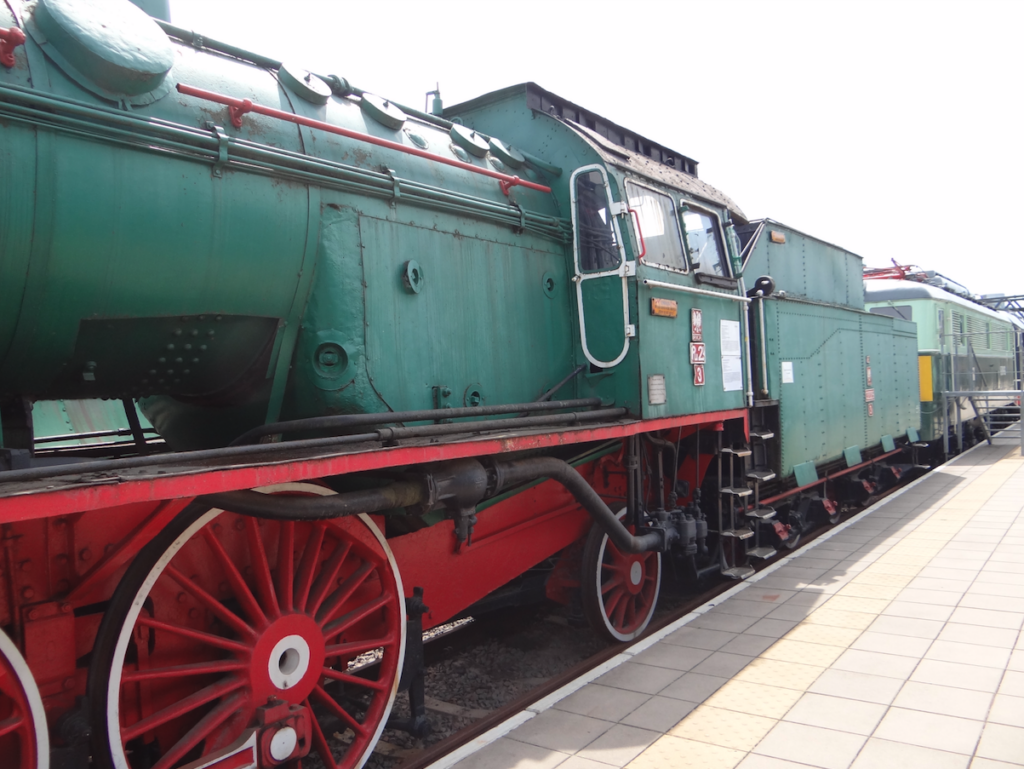
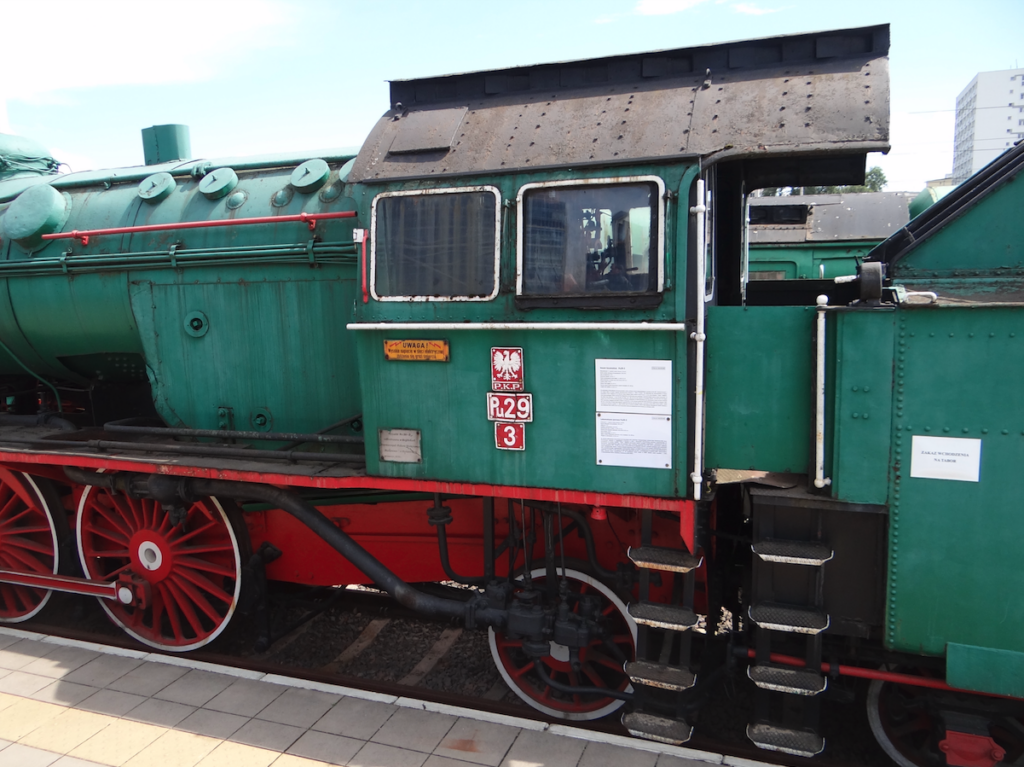
The locomotive’s frame is made of 35 mm thick sheet metal. At the front, under the smokebox, and at the rear, under the driver’s cab, are steel-reinforced boxes. The entire structure is reinforced by cross members. The high frame made it difficult to install the ash pan, which has side pockets outside the frame. A two-axle trailer bogie is mounted at the front, and a Bissel half-bogie at the rear. Both trailer bogies can move 100 mm laterally and have spring-loaded return adjusters. The third, tied axle also has 33 mm lateral shift, while the second, driven axle has its edges cut 15 mm. The running gear allows for good cornering on curves with a radius of 150 m. The wheel axles are hollow. The boiler is large and has an operating pressure of 15 atmospheres. A device for blowing out the fire tubes is installed. The firebox is made of copper. The doors are of the Marcotti type. The grate has a tipping section operated by a crank from the cab. The steam superheater allows for temperatures of up to 360 degrees Celsius. The Schmidt superheater consists of two separate boxes for superheated and saturated steam. An extensive water purification system was installed, including Friedmann drain gates, Pop-Coale safety valves, and others. After World War II, the chemical Sodafos began to be widely used to soften water in steam locomotives. The boiler equipment was standard, the same as in the Ty23, Ok22, and Os24 locomotives. Water was supplied to the boiler by two Friedmann live steam suction-pressure injectors. The system was efficient, but there was no way to regulate the amount of water fed to the boiler and required the team’s experience.
The Pu29 steam locomotive’s twin engine, with an internal steam inlet, powered the second linked axle. The piston slides have an increased diameter of 320 mm, which reduces steam choking. The cylinders are symmetrical, allowing for installation on either side of the locomotive. Smooth steam operation is ensured by a Tatary pressure equalizer system, equipped with an increased diameter pipe and Łopuszyński air valves. The steam distribution mechanism is typical, using the Heusinger system.
The locomotive has a Westinghouse automatic brake. The Pu29 locomotives were also equipped with an additional, non-automatic brake. Air for the brakes was supplied by a three-cylinder H11a3 compressor. Lubrication of the cylinders, slides, and stuffing boxes, as well as the axle bearings and journals of both locomotive bogies, was provided by two Friedmann lubricators. The Pu29 locomotives were equipped with a 24 V electrical system, powered by a 0.5 kW turbogenerator. The locomotive’s front lighting consisted of two 100 W spotlights and one 250 W spotlight, located on the smokebox door. Two 100 W spotlights were located on the rear of the tender. Three lamps were installed under the bridge on each side to illuminate the drive system, along with a socket for a portable lamp. The locomotive was equipped with large smoke deflectors, the first of its kind on a PKP locomotive. The sander is pneumatically operated.
The driver’s booth is a counter-booth type, with part located on the locomotive frame and part on the tender frame. The booth has rear-view mirrors on both sides, making it easier for the crew to see. A manual windshield wiper is mounted in the front window on the driver’s side. There’s also a speedometer with a Hasler-type recorder.
Written by Karol Placha Hetman