Warszawa 19-12-2025
Pm2 Steam Locomotive.
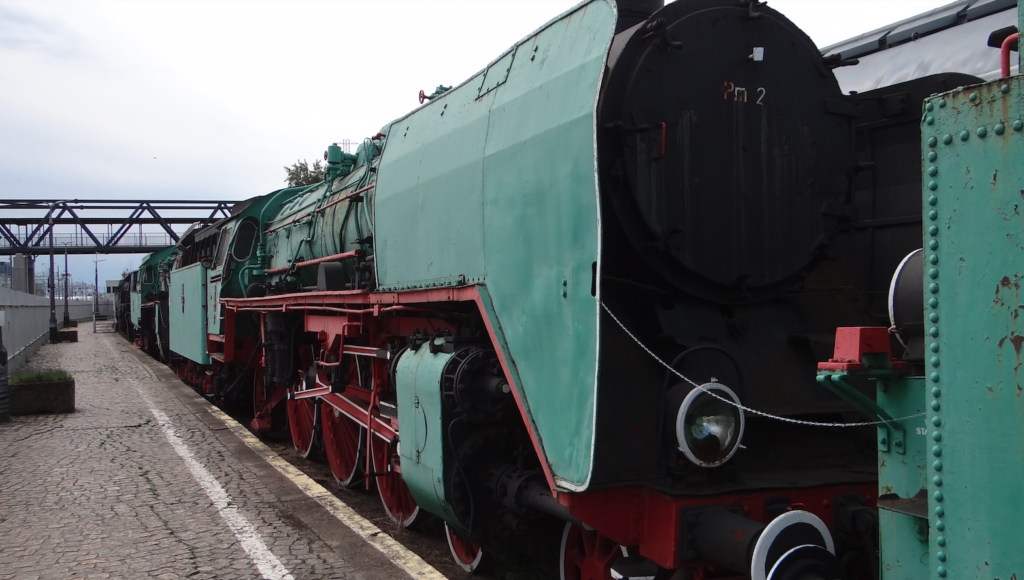
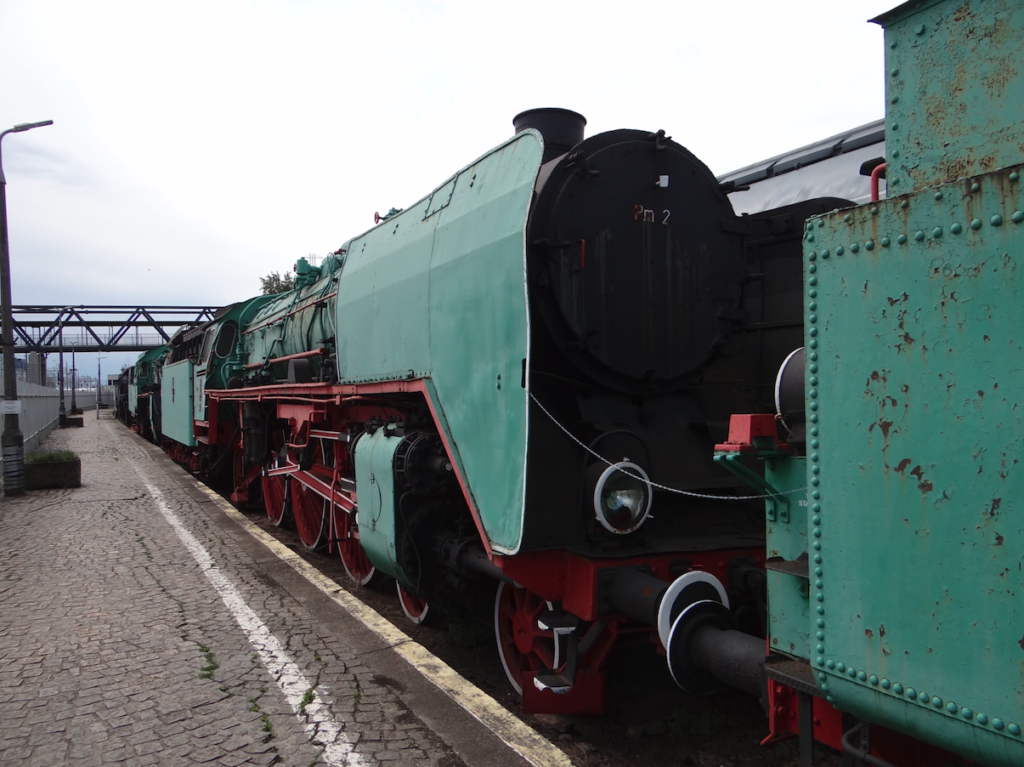
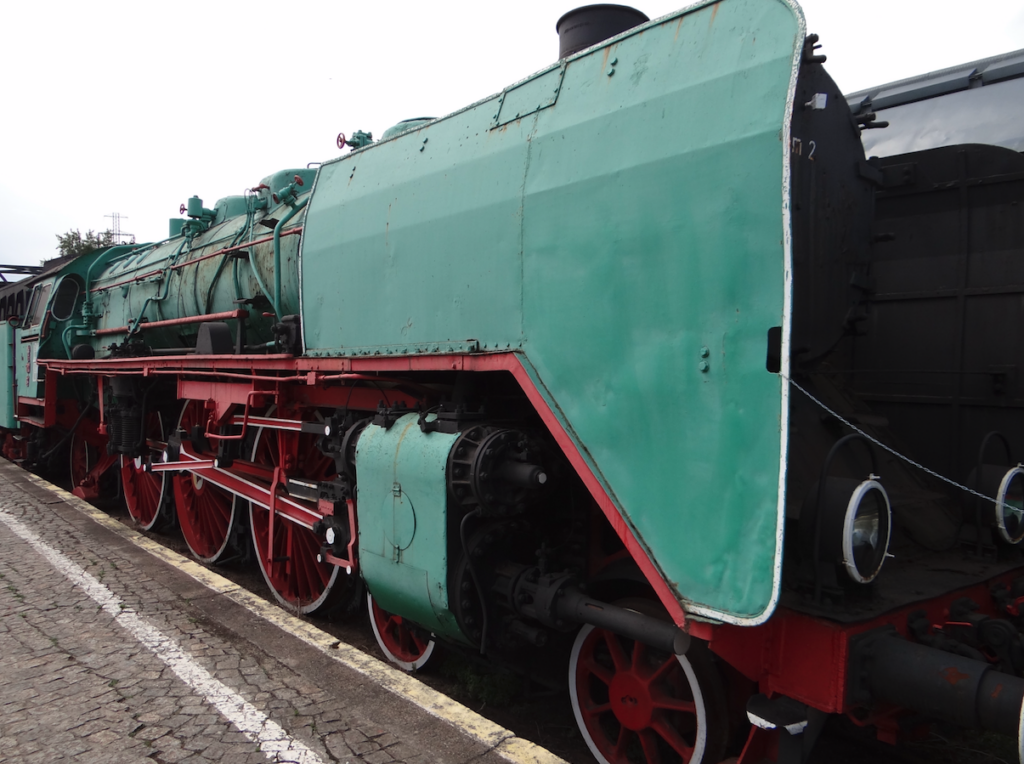
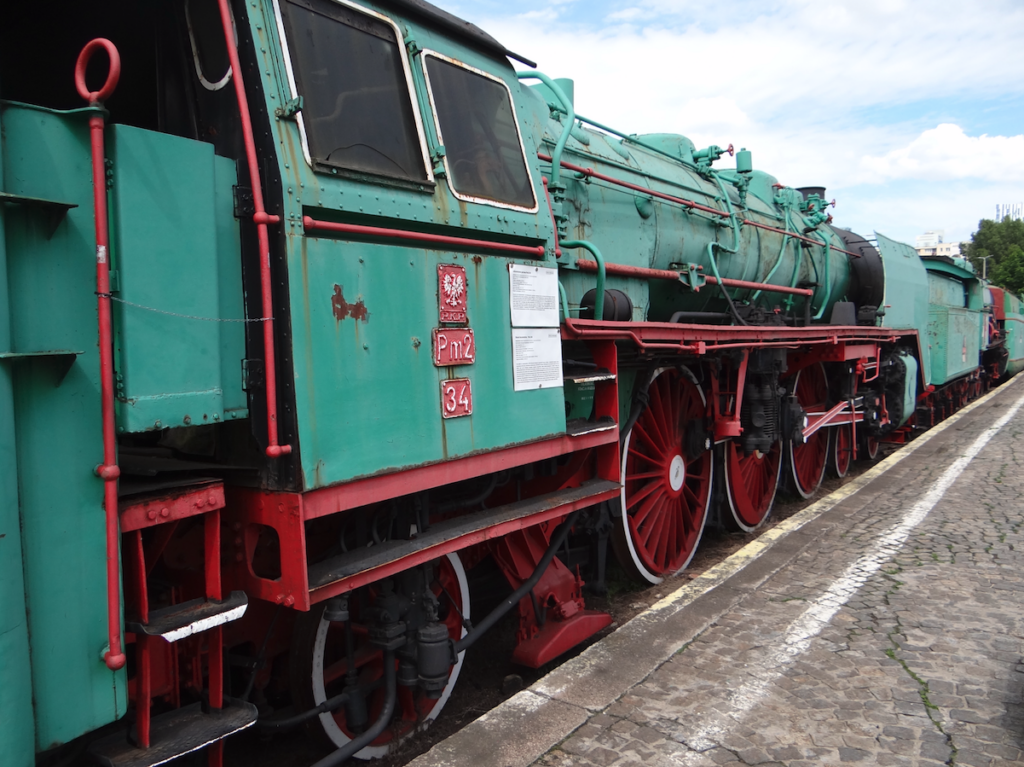
The Pm2 steam locomotive is a Germanic design of the 03 series, designated Pm2 in Poland by the Polish State Railways (PKP). The locomotive has a 2’C1′ axle arrangement, also known as a 2-3-1 or Pacific. The locomotive was standardized during its construction. Serial production lasted from 1930 to 1937. The global economic crisis had a significant impact on the locomotive’s development. This crisis delayed the introduction of the Series 01 express locomotive into service. As the German railway modernization plan collapsed, a decision was made to develop a lighter express locomotive. The goal was to reduce axle load from 20,000 kg per axle to 17,500 kg per axle. This would allow the locomotives to run on unmodernized tracks. On March 8, 1929, in Dresden, the decision was made to begin work on the Series 03 express locomotive. Furthermore, it was decided to utilize proven or ready-made solutions already lying around. In 1930, the German company Borsig built three Series 03 prototype locomotives. The first 03-001 left the Borsig factory on July 2, 1930. The locomotive was presented for evaluation to participants at the Second World Power Conference in Berlin-Tempelhof. The locomotive was then sent for testing. The remaining two prototypes were also tested. The evaluation of the Series 03 locomotive was positive. In 1931, series production began at four factories. In the first year, 52 units were delivered. By 1937, 298 units had been built: the Borsig factory built 116 units, the Henschel factory built 66 locomotives, the Schwartzkopff factory built 64 units, and the Krupp factory built 52 units. The Series 03 locomotives were assigned to Bw Schneidemühl (Piła), Frankfurt (Oder), Stargard (Stargard Szczeciński), Breslau Hbf (Wrocław Główny), and Königsberg (Kaliningrad, now Moscow). In the 1930s, it was the basic Germanic locomotive for line service with express trains.
The locomotive was equipped with a 16-atmosphere boiler. A Schmidt superheater was installed in the boiler. Water was supplied via a Strube injector, and a pump with a preheater was used. The firebox was made of copper alloys. During production, steel fireboxes were installed. A Heusinger valve gear was used. During operation, the speed was increased from 120 km/h to 130 km/h.
Attempts were made to modernize the locomotive. An aerodynamic cover was developed for the locomotive. The cover was not installed, as it was essentially a test run. The cover was tested on the locomotive’s front end, front wheels, and smoke box. The cover was tested on the driver’s cab. The cover was tested on the drive wheels. The results were used to develop further high-speed locomotives. Installation of a third cylinder was also attempted, but the benefits were minimal, and the maintenance and repair process was extremely complicated.
During World War II, series 03 locomotives operated trains between Germans and Russians until 1941. This was particularly true on the Berlin-Leningrad route, via Piła-Chojnice-Tczew-Elbląg-Königsberg. They also operated on routes from Poznań-Inowrocław-Toruń-Iława-Olsztyn, and to occupied Warsaw and Kraków. The locomotives were deployed in occupied Polish cities. The problem arose in the locomotive sheds, where the turntables proved too short, making their reconstruction impossible. As a result, the largest number of 03 series locomotives were located in Gdańsk (Gdańsk-Zaspa), as it had the longest turntable. Repairs to 03 series locomotives were performed in Stargard. When the brothers clashed and the front began to move east, the Germans occupied more and more Soviet cities. However, transport lines were extended. The tracks were rebuilt to standard dimensions. The basic locomotive in operation was a BR52 series and 03 series steam locomotive. The 03 series locomotives were more versatile than the 01 series and also pulled freight trains. It turned out that the Germans had few locomotives, and the chains of supplying the army and robbing the Muscovites were broken. In 1944, Bbd Dantzig (Gdańsk) and Rbd Königsberg (Königsberg) each had 23 series 03 locomotives, while Rbd Stettin (Szczecin) had only two. In 1945, the Germans had approximately 150 series 03 locomotives, and the Soviets probably had 98. The Russians converted several series 03 locomotives to broad gauge and designated them the TS series.
After World War II, PKP took over over 36 locomotives, 34 of which were listed as retired. A few were so worn out that they were scrapped or used as spare parts storage. The locomotives were assigned numbers Pm2-1 to Pm2-34. Twenty-five of these locomotives served with DOKP Gdańsk, eight with DOKP Poznań, and one with DOKPP Wrocław. Up to number Pm2-18, these were locomotives from the first production series. Locomotives Pm2-19, Pm2-20, and Pm2-21 were transitional, and from Pm2-22 onwards, they were from the latest deliveries. Locomotive No. 35 was not rebuilt, and number 35 was assigned to the renumbered locomotive Pm2-1. Ultimately, Pm2-1 was not rebuilt either.
During their service with the Polish State Railways (PKP), the Pm2 locomotives were equipped with a second injector instead of a pump to feed water to the boiler. These were Strube and Friedmann injectors, or Nathan and Metcalfe-Friedmann lower-pressure injectors. Locomotives that still had copper fireboxes were equipped with steel fireboxes. The boiler fittings were replaced with standard Polish-made fittings, replacing the outdated German ones. The lighting and headlights were also changed to standard Polish ones. The air compressors and water pump were relocated from the sides of the boiler to under the driver’s cab to improve visibility. The whistle was moved higher, to sandbox height. Brakes were installed on the rear running axle, which were usually removed later. The coupling between the locomotive and tender was changed to accommodate other tender types. From 1960, SHP units were installed.
Generally, the Pm2 locomotives performed well. They serviced almost all express trains in northern Poland: Gdańsk, Bydgoszcz, Toruń, Poznań, and Szczecin. Due to a locomotive shortage, “socialist competition” was introduced. Locomotive crews’ operating hours were often extended. Very often, replacement crews were waiting at intermediate stations. As a result, one locomotive covered 600-650 km per day. The steam locomotive maintenance system was modified by increasing the number of locomotive sheds capable of performing medium-scale repairs, which shortened downtime. “Sodafos,” a completely new product at the time, was used to soften the water. “Sodafos” is the name of a substance historically used on railways as an additive to steam locomotive boiler water, intended to reduce water hardness and prevent scale buildup. Drivers favored the Pm2 locomotives. In the 1950s, the scheduled speed of express trains was 90-100 km/h. Since steam locomotives could reach 130 km/h, it was possible to make up for delays. Generally, the locomotives operated continuous trains weighing 400-450 tons, but there were also trains weighing 750 tons. The routes served by Pm2 locomotives also expanded. These included virtually all routes north of Poznań, Warsaw, and Białystok. During the summer holidays, Pm2 locomotives often pulled seasonal trains. This was a result of the electrification of successive kilometers of railway lines. In the 1960s, the pace of electrification increased, and after the introduction of SP45 diesel locomotives, the role of Pm2 locomotives began to decline significantly. The locomotives began to be redirected to secondary routes. All Pm2 locomotives were transferred to the Bydgoszcz Railway Company, where they served until the end of their service. From 1974, they ran increasingly less frequently on trains to Poznań, Łódź, and Gdynia. However, they still operated on the Gorzów-Piła-Chojnice and Toruń-Grudziądz-Malbork routes. The Pm2 locomotives operated on the same trains as the Pt47 locomotives.
Pm2 locomotives served with the Polish State Railways (PKP) until the 1970s. The last locomotives pulled regular trains until 1978. After 1978, Pm2 locomotives pulled only occasional trains. The last steam locomotive to be removed from service was Pm2-13, which was withdrawn from service on November 23, 1978. One locomotive, designated Pm2-34, remains in the open-air museum in Warsaw. The Pm2 locomotive located in the Warsaw Station Museum is number 10 629 / 1936. After being removed from the PKP inventory on November 22, 1978, at the initiative of the employees of the Bydgoszcz Główna locomotive depot, the Pm2-34 locomotive (DRG 03 273) was restored and displayed at the Bydgoszcz station until 1995. It was then transported to Warsaw.
Pm2 locomotive data:
Axle configuration 2’C1. Locomotive weight 91,000 kg. Service weight 100,300 kg, excluding tender. Locomotive length 15.10 m. Length with tender 23.90 m. Height 4.55 m. Wheelbase 12.00 m. Drive wheel diameter 2.00 m. Front running wheel diameter 0.85 m initially, 1.00 m later, and 1.25 m alternatively. Small wheels have 7 spokes, and large wheels have 9 spokes. Rear running wheel diameter 1.25 m. Tender type 32D2 (32 m³ water, 4-axle, 2nd is of German origin) or 34D44 (34 m³ water, 4-axle, 44th year of approval). Boiler with a pressure of 16 atm. Boiler heating area 202.2 m2 or 203.65 m2. Superheater area 70 m2 or 72.2 m2. Grate area 4.05 m2 or 4.09 m2. The grate was inclined at an angle of 12 degrees. The furnace doors were of the Marcotti system. Engine cylinder diameter 0.57 m. Piston stroke 0.66 m. Rated power 1,950 hp (1,433 kW). Maximum tractive effort 11,500 kgf. Design speed 130 km/h. Drive axle spacing is 5.00 m. Exterior axle spacing is 12.50 m. The first steam locomotives weighed 90,400 kg, and the subsequent ones 91,000 kg. The operating weight of the first steam locomotives was 99,600 kg, and the subsequent ones 100,300 kg. Axle load 12,900-14,300 kg. Locomotive power 1,750-1,950 hp. Tractive effort 11,000-11,500 kg. Design speed 130 km/h.
The PM2 had a 90 mm thick beam underframe. The drive axles were connected to the rear Adams rolling axle by trailing arms, ensuring smooth running over uneven tracks. The front two-axle bogie could be moved 50 mm sideways in each direction and had a spring-loaded Krauss return adjuster. All drive axles were rigidly mounted in the underframe, and the middle axle had its flanges cut 15 mm lower. The rear rolling axle could be moved 80 mm and was equipped with a return adjuster. This chassis arrangement allowed the locomotive to negotiate curves with a radius of 180 m. The boiler was 13.514 m long and 1.872 m in diameter. It had 20 flame tubes with a diameter of 171 mm and 84 flame tubes with a diameter of 70 mm. A Schmidt steam superheater was installed in the spacious smokebox. A water heater was located in the upper part of the smokebox, in front of the chimney, and the smokebox door was locked with a central locking device with a locking knob. The boiler was powered by a Nilebock-Knorr piston pump with a Knorr or Tolken water heater, and a Strube suction-pressure injector with a capacity of 250 liters of water per minute. The pump had a capacity of 180 liters per minute.
The mechanics had at their disposal: two tube water gauges, a lubricator with 14 nozzles, and two Ackermann safety valves with flat springs. All steam valves were located outside the cabin, with only their knobs being inserted inside. This protected the crew from scalding. During repairs, the equipment was replaced with typically Polish ones.
The steam engine was a twin-cylinder, superheated steam engine with Nicolai piston slides. It powered the central axle via single-guide crossheads. Plain bearings with wedge-screw adjustable bushings were commonly installed. The steam distributor was a classic Heusinger design. During repairs in Poland, worn Nicolai sliders were replaced with Trofimov or other designs. The steam engine was lubricated by a Bosch lubricator, which was replaced by a Friedmann lubricator on the Polish State Railways (PKP). The locomotive was equipped with Knorr pneumatic brakes. The compressor was a four-cylinder, two-stage unit with a capacity of 3 m³/minute. A turbogenerator was incorporated into the locomotive’s Polish electrical system.
Tender type 32D2 or 34D44. Both tender types had rolling bearings. During repairs, rolling bearings were sometimes replaced with plain bearings. A Polish rolling bearing factory was established in Kraśnik in 1938, but due to the German invasion of Poland, production of rolling bearings began in the spring of 1949. The wheel diameter was 1.00 m. The water box capacity was 32 m³ or 34 m³. The coal box capacity was 11,000 kg or 10,000 kg. The empty weight of the tender was 33,500 kg or 29,900 kg, respectively. The service weight was 75,500 kg or 74,200 kg, respectively.
Written by Karol Placha Hetman