Oleśnica 2026-03-14
Railway line No. 281 Oleśnica – Chojnice.
Line opening: On June 30, 1875, the Oleśnica – Gniezno section (OGnE). On November 1, 1887, the Gniezno – Nakło nad Notecią section (KPStE). On October 1, 1894, the Nakło nad Notecią – Chojnice section (KPStE). Launch of the second track on the Jarocin – Gniezno section in 1908 (KPStE).
Electrification: On December 2, 1975, the Oleśnica – Grabowno Wielkie section (PKP). On December 17, 1986, Grabowno Wielkie – Krotoszyn (PKP). On November 28, 1987, on the Krotoszyn – Jarocin (PKP) section. On July 21, 1976, on the Jarocin – Września (PKP) section. On November 25, 1976, on the Września – Gniezno (PKP) section.
History
In 1855, the Opole-Tarnowitz Railway Company (Oppeln-Tarnowitz Eisenbahn Aktiengesellschaft; OTE) applied to the government of the Kingdom of Prussia for a concession to build a railway line between Opole and Tarnowskie Góry and other connections. Following the establishment of the Right Bank of the Oder Railway (R.O.U.E.) in 1868, leading from Wrocław through Oleśnica to Tarnowskie Góry in Upper Silesia, a project arose to establish the Oleśnica-Gniezno Railway. It was intended to shorten the coal transport route from the mines of Upper Silesia to the cities of Pomerania by 75 km. Until then, these cities had been using exported hard coal from England, delivered via seaports. This line also had military significance, as it ran along the border with Muscovy, specifically the Russian Partition of Poland, the Kingdom of Poland. Landowners from southern Greater Poland also influenced the construction of the line to Gniezno. In 1868, preparatory work for the construction of the Poznań-Bydgoszcz-Toruń route was already underway. By this time, everyone was already seeing the benefits of building railways. The railway offered an opportunity for the export of agricultural produce to the south and Silesia, and the Oleśnica-Gniezno line would connect the Right Bank of the Oder Railway with the Greater Poland Railway.
At the same time, a committee was formed to build a railway line from Poznań via Nowe Miasto nad Wartą and Pleszew to the state border towards Kalisz (Muscovite Partition), specifically to the last Germanic station, Nowe Skalmierzyce. In April 1868, the Minister of Trade, Industry and Public Works issued permission to begin preliminary study work on this route. The KOG society, however, received permission only to conduct preliminary work on the Oleśnica – Nowe Miasto nad Wartą route. Thanks to the determined efforts of KOG members, approval was obtained to extend the preparatory work of the line to Gniezno. Preparatory work on the Oleśnica – Gniezno section was completed in 1870-1871, and the documentation was submitted for approval to the Ministry of Trade, Industry and Public Works.
On June 17, 1872, King William I of Prussia signed a concession deed for the construction and subsequent operation of the Oleśnica-Gniezno line with the Oleśnica-Gniezno Railway Company (KOG). The document stipulated that the line must be completed and operational within three years of the granting of the concession. On April 16, 1872, the construction of the route was entrusted to the F. Plessner Railway Construction Company and its limited partnership. In 1872, the statute of the newly established Oleśnica-Gniezno Railway Company (Oels-Gnesener Eisenbahn-Gesellschaft) was approved. KOG for short.
In 1871, construction of a single-track railway line began towards Milicz, Krotoszyn, Jarocin, and onward to Gniezno. However, the contractor faced significant financial and logistical challenges. The contractor transferred construction management to the KOG board. The sale of shares began, which only partially covered the investment costs. The shares were sold by the Berlin Trade Association.
The Oleśnica–Jarocin section was completed on June 30, 1875. The lengthy construction period of this line was a result of the Germans’ involvement in the war with Austria-Hungary and then with France, as well as financial problems. France lost the war and was forced to pay a contribution of 5 billion gold francs. This amounted to approximately 1,450 tons of gold. The contribution was planned to be repaid over five years. France repaid it sooner, in 1873. Without a doubt, this money allowed for the economic recovery of the new German Empire, but these were still arrogant and conceited Germans.
On June 26, 1875, the line on the Oleśnica–Krotoszyn section was commissioned, and on June 30, 1875, operation of the entire route began. The official opening ceremony took place on July 4, 1875. The single-track line was 161.75 km long. Construction cost over 20 million marks. This high cost was the result of widespread corruption. Some installations and facilities were unfinished or were temporary. Even during the line’s construction, there were plans to extend it from Gniezno to Nakło nad Notecią; the Ostbahn station.
The route included 14 railway stations and 13 stops. Fourteen freight warehouses were built, five locomotive sheds (approximately every 45-50 km) with 24 locomotive berths, eight steam-powered water stations, and 32 guardhouses and guardhouses. Due to the varying terrain, most of the line ran along embankments (92 km) and cuttings (54 km), with only 16 km running on level ground. At that time, the Oleśnica Rataje (Rathau) passenger stop was built.
At the end of 1875, the KOG’s rolling stock consisted of 25 Prussian steam locomotives, 48 passenger cars (Classes 1, 2, 3, and 4; the cars were distinguished by color), and 456 freight cars. The coal wagons were two-axle with a load capacity of 15,000 kg. Class 4 carriages were open carriages and were relatively quickly phased out. Passenger and freight trains operated on the route, and the journey from Oleśnica to Gniezno took 210 minutes, with stops of just a few minutes at 12 stations, excluding Oleśnica and Gniezno. The commercial speed was 46 km/h (28 mph). In Gniezno, passengers had to transfer to a railway operated by another company. To increase passenger capacity, steam carriages were introduced. A typical passenger carriage, powered by a steam engine, could carry up to 100 passengers and reach a speed of 40-50 km/h (25-31 mph). The carriages were three- or four-axle, with one or two drive axles.
As a result of the nationalization process, in 1884, private railway companies and companies were purchased by the state, including the Poznań-Toruń-Bydgoszcz Railway and the KOG (Community Railway Company). Until then, the KOG’s management board had its headquarters in Oleśnica. This was done on the basis of the act of 1879, which provided for the nationalization of previously private railway lines in German territory.
History of the Gniezno-Chojnice Line.
On May 21, 1883, under the Secondary Railways Act, the construction of a railway line between Gniezno and Nakło nad Notecią was approved. 4.88 million marks were allocated for investment, which was not a large sum. Even then, plans were underway to continue construction of the line further to Chojnice. One of the goals was to launch trains from Wrocław to East Prussia and onward to the Russian Brotherhood.
The creation of the new line involved the modernization of Gniezno station through the construction of new tracks, the enlargement of the locomotive shed, and the modernization of the water tower and waterworks system. The 73.2 km long Gniezno-Nakło line was opened on November 1, 1887. The 75 km Nakło-Chojnice section opened on October 1, 1894.
History of Nakło nad Notecią
Nakło nad Notecią is the most important point on the Gniezno-Chojnice railway route. Excavations indicate that a stronghold existed here as early as the 10th century and was inhabited by the Pomeranian tribe. The settlement had military and trade significance. Discovered houses indicate that the houses were wooden, solidly constructed from thick beams joined using the log method. The floors were wooden, not earthen. The settlement’s location amidst floodplains, meadows, and marshes gave the future town its name, Nakło. The word “Nakieł” in Old Slavic means a marshy, wet place overgrown with young vegetation. In the territory of the later Polish-Lithuanian Commonwealth, there were several settlements named “Nakieł.” The name Nakło nad Notecią has been in use since 1981. In the 11th century, Nakło found itself on the border between the Polan and Pomeranian tribes. As a result, the settlement changed hands. Battles for Nakło were fought; Władysław Herman (1091) and his son Bolesław Krzywousty (1109). In 1121, the settlement was finally taken over by the Piast dynasty. By the 12th century, Nakło was already a castellan stronghold and had customs houses. At that time, it was a trade route from Greater Poland to Gdańsk. In 1299, the settlement received a charter under Magdeburg Law, granted by Władysław the Elbow-high, then Duke of Greater Poland, Kujawy, Gdańsk Pomerania, Łęczyca Land, and Sieradz. Nakło became a ducal town, and later a royal one. The charter granted the town landed estates to ensure its development. In addition to trade, agriculture and crafts flourished. The soil was very fertile. a forge, a mill, a bakery, a butcher, a distillery, a brewer, a shoemaker, a weaver, a tailor, fishermen, and farmers. The town’s population was 500-600 people.
Throughout its history, Nakło suffered the most from the Teutonic Knights. The monks burned the town several times: in 1328, 1329, 1330, 1331, and 1339. Houses, farmsteads, the church, and the castellany were burned. Despite this, the town’s inhabitants did not abandon the town. In 1357, during the reign of King Casimir the Great, a brick castle was built, fragments of which survived until 1772. The town had a court that resolved local disputes. In important cases, the chief judge was the starost of Greater Poland, the archbishop of Gniezno, or the king himself. In 1314, Nakło belonged to the Kalisz Voivodeship, with its capital in Kalisz. The starosty of Nakło encompassed ten rural settlements. The starost held office in the castle. In 1417, King Władysław Jagiełło married Elżbieta Granowska of Nakło, widow of the castellan of Nakło. The city received further privileges for fairs and markets. In 1520, King Sigismund I the Old renewed the earlier privileges, the documents of which had been destroyed by fire.
Between 1655 and 1660, Nakło was destroyed by the Swedes, and the town’s population dropped to 200. The town fell into ruin and stagnation. In September 1772, as a result of the First Partition, the Nakło district was taken over by Prussian authorities (Germans). At that time, the town’s population was approximately 550. In 1810, Nakło had 1,277 inhabitants.
The Bydgoszcz Canal was built in 1773-1774, on the orders of the Germanic King Frederick II. A 26-kilometer canal was constructed, connecting the Noteć River with Bydgoszcz, thus connecting the Vistula and Oder river basins. The first rafting operation began in September 1774. A poplar avenue runs along the canal, ordered to be planted during the Duchy of Warsaw era by General Wincenty Aksamitowski. This investment influenced the region’s economic and demographic development.
As a result of the Napoleonic Wars, Nakło temporarily regained independence. After the Congress of Vienna, the city was temporarily occupied by the Muscovites (1813-1814), but was ultimately taken over by the Prussians (Germans). In 1816, the Germans introduced a new administrative division. Wyrzysk County was established, and Nakło was incorporated into it. This was a deliberate degradation of Nakło, which had a majority Polish population. Wyrzysk was much more Germanized and was located closer to the city of Piła. This administrative division remained in place until 1975. The residents of Nakło were constantly under intense pressure from Germanization. One manifestation of this struggle was the establishment of Polish social and paramilitary organizations. In 1820, a volunteer fire department was established. The city developed as an agricultural and artisanal town. Industry slowly began to develop. The processing industry, particularly meat processing, dominated. The population grew rapidly; in 1842, there were 2,842 inhabitants, and in 1853, 3,567.
In 1828-1829, construction of the Berlin-Bydgoszcz-Königsberg road began. The Ostbahn railway line, running from Piła to Bydgoszcz, played a crucial role in the development of the town of Nakło. On August 1, 1851, the first train departed on the Bydgoszcz-Nakło route. Between 1886 and 1894, the Gniezno-Nakło route was launched, and between 1890 and 1893, the Nakło-Chojnice route. Thanks to the railway, the postal service developed, allowing for the transmission of letters and parcels. From 1851, daily rail mail ran on the Inowrocław-Nakło, Chojnice-Nakło, and Nakło-Szamotuły routes. In 1868-1869, a government telegraph station was opened next to the post office. In 1893, a hospital opened. In 1904, a municipal waterworks was installed, and in 1907, a sewage system was launched. In 1912, construction of a large municipal slaughterhouse was completed. At that time, the majority of the residents were Polish. Of the 372 businesses operating in the city, most were in Polish hands. The outbreak of the Great World War, started by Germans, halted economic development but also revived Polish hopes for regaining independence. In those years, the population of all nationalities exceeded 8,000. In 1919, under the influence of the Greater Poland Uprising, an insurgent unit was formed in the city.
On January 20, 1920, at 11:00 AM, in accordance with the provisions of the Treaty of Versailles, ratified by the Western Powers, the Germans, and Poland, units of the 59th Greater Poland Infantry Regiment, under the command of Colonel Stanisław Wrzaliński, entered the city from the Noteć Bridge. A mayor was appointed. Germanic institutions were disbanded, led by the Communist Workers’ and Soldiers’ Council, which was close to seizing power in all of Germany. On January 27, 1920, the Starost of Wyrzysk issued a decree declaring Polish the official language in his territory. On November 6, 1921, elections to the City Council were held, definitively consolidating Polish rule in the region. In 1939, the city had 11,333 inhabitants.
On September 1, 1939, the town of Nakło was attacked by a Germanic infantry division. The enemy’s aggression failed to stop. The town became the seat of the Germanic district authorities and the Selbstschutz command. The extermination campaign in the district was directed from Nakło. According to previously prepared lists, thousands of Poles were arrested and killed. The intelligentsia and clergy were particularly targeted. Members of the local Selbstschutz were very active. The Selbstschutz (Germanic Selbstschutz means self-defense) was a Germanic paramilitary organization formed from the Germanic population living outside the Third Reich, particularly in Poland, in 1939. The Germans chose a place called Paterek, located 2 km from Nakło, as the site of mass murders. After the war, 13 mass graves were discovered. To this day, the number of murdered Poles has not been determined conclusively. To this number must be added the Poles deported to Germanic concentration camps and to forced labor in the Raj.
As early as 1939, the town hall, located in the market square, was destroyed. However, Nakło suffered much greater damage in January 1945, at the hands of the Soviets. On January 27, 1945, the Soviets entered Nakło. The city was significantly damaged. During the communist era, the food and electrical installation industries dominated the city. Important industrial plants included the sugar refinery, the meat processing plant, ZSI Polam, the Bydgoszcz Furniture Factories, and Spomasz. The communists’ incompetent rule led to strikes and mass employee recruitment to the Solidarity trade union. On May 27, 1990, the first democratic elections to the Nakło nad Notecią Commune Council after World War II were held in the commune. This date marks the beginning of local government in the Third Polish Republic. In 1998, as part of the new administrative division of Poland, the Nakło County was established, comprising five municipalities: Kcynia, Nakło, Mrocza, Sadki, and Szubin.
In recent years, the city’s image has undergone a transformation. A number of large enterprises have disappeared from the cityscape. Numerous small private companies have been established, along with several supermarkets and a dozen or so banks.
Nakło nad Notecią Railway Station.
The railway station was built in the second half of the 19th century, during a period of intensive railway development in the Prussian Partition. The station opened on July 27, 1851. Its construction was associated with the launch of important railway connections, which were intended to improve the transport of goods and passengers and support the region’s economic development. Thanks to the railway, Nakło became a significant transportation hub, particularly for agricultural trade and industry. The station played a significant role in the development of the city and the region. A station building was constructed, with a waiting room and ticket and baggage office, platforms, warehouses, and loading ramps for goods (e.g., grain, vegetables, fruit, and timber), railway sidings for freight depots, a water tower and technical equipment for servicing steam locomotives, and a signal box for train traffic control. The station was an important transshipment point, handling both passenger traffic and the intensive transport of goods from the surrounding agricultural areas.
The railway station was located north of the historic city center. This location led to the development of subsequent buildings east and west of the center. This was also due to the course of the Noteć River.
The railway station was built as a large, two-story building with a basement and an attic. The building had 17 bays and was covered with gable roofs with a shallow pitch. A cast-iron pillar was erected in the center of the main hall to maximize the hall’s size. A tower was placed on the roof in the western part of the building. As early as 1911, a radio mast was placed on the roof of the building. A roof was added to the building on the side facing the tracks. On the approach side, there was no station square, only a very wide cobbled street. In 1912, two island platforms were built and roofed, while a passenger tunnel was constructed under the tracks with access to the platforms. The tunnel walls are lined with ceramic tiles typical of the German railways from the early 20th century, in cream (white) and blue. The platform entrances to the tunnel are covered with wooden, glazed canopies. The entrance to the building is located on Platform 1, under a canopy. At the eastern end of the station, there was a sugar mill with a large chimney.
Throughout its history, the station has had several water towers. Tower No. 2 still stands. The tower’s core is brick, octagonal, with decorative elements inspired by castles. The top of the tower, with its plank walls, conceals a water reservoir. Tower No. 1 is newer, brick, and typical.
The railway station underwent extensive renovations between 2021 and 2025. The modernization cost 28.2 million złoty. The work was carried out as part of the “Government Program for the Construction and Modernization of Railway Stops for 2021-2025.” As part of the work, a new passenger tunnel was built, connecting not only the station and platforms but also both parts of the city. Elevators were installed for disabled passengers and those with large luggage. The new passage measures 75 meters and is three times longer than the old one, wider and higher. The tunnel walls are clad with white and blue tiles, the same size as the historic ones. The tunnel exit is located on Nowa Street, where a Park & Ride parking lot and bicycle parking are located. A major convenience for travelers is the installation of elevators at the tunnel entrances on both sides of the station and on Platforms 1 and 2. Platforms 1 and 2 were renovated. The renovation included platform shelters, lighting, an audio system, and information boards. The platforms themselves and their surfaces were only improved.
As part of the same program, platforms at nearby train stops in the Kuyavian-Pomeranian Voivodeship were renovated. Approximately PLN 1 billion was allocated for the program. Passengers benefit from new stops: Tuchola Rudzki Most, Grudziądz Tuszewo, Grudziądz Śródmieście, and Grudziądz Rządz, as well as the rebuilt Bydgoszcz Zachód and Grzybno stops and a new access to the Grudziądz Mniszek stop. Further new stops were opened: Dąbrowa Chełmińska Centrum, Trzeciewnica, Nakło nad Notecią Zachodnie, and Brodnica Południowa.
August 3, 2025, marked 25 years since the last scheduled passenger train ran on LK No. 281 on the Nakło nad Notecią – Chojnice section. This is all the more saddening because residents of the Kuyavian-Pomeranian Voivodeship continue to elect Volksdeutsche, Masons, and Communists to the regional assembly. These are the political parties that systematically destroy Poland’s achievements to date. The current distribution of seats: Civic Platform – 14, Law and Justice – 11, Third Way (PO’s subsidiary) – 5. The coalition of PO and Third Way holds power, so these groups have real control over the region. Nothing good will come of this, and the region’s decline will only deepen. For 25 years, Poland has been plundered, and there’s little left to steal except the railway tracks, forests, and waterways. After that, the time will come for the partition of Poland, and armed uprisings and pompous speeches about Poland regaining its independence will begin again. Some railway experts note that this region of Poland has regressed to the times before the construction of the first railway lines, that is, before 1851, when the Piła-Nakło-Bydgoszcz railway line opened. Moreover, by 2010, practically no one had written about the history of the railway in Sępolno Krajeńskie. And when they did, the phrase “Liquidation” was typical of local rail transport throughout the country. This was untrue, as such destruction had not occurred in other regions of Poland.
In December 1999, the PKP Passenger Transport Authority in Bydgoszcz announced that passenger services were planned to be suspended on the Nakło-Chojnice section as of February 1, 2000. This information made no impression on the district governments. At that time (1999), unemployment in the region exceeded 21%. The use of the word “suspension,” not “liquidation,” was intended to soothe public sentiment. Comparing road transport to rail transport was a mistake. It wasn’t the development of the road network that led to the liquidation of rail connections. The hostile attitude toward rail transport was not limited to local governments, but especially in Warsaw. It was estimated that if the railways eliminated supposedly unnecessary regional railway lines, they would recover and achieve profits. It was not considered that if regional rail failed to transport passengers to hub stations, these passengers would not travel by long-distance trains. In the early 1990s, the Nakło-Chojnice line was not scheduled for reduction. However, by 1993, the route was stripped of the Pruszcz-Bagienica-Sośno-Więcbork and Złotów-Sypniewo- Więcbork routes. It only took a dozen or so months to eliminate the Gołańcz-Kcynia-Szubin section. At that time, passenger capacity was no longer a priority. On the Pruszcz-Bagienica- Więcbork route, over 50% of passengers were on board.
It also turned out that selling the rails for scrap did not cover the costs of dismantling them, so the budget could not achieve a positive balance. Reports prepared by the Supreme Audit Office (NIK) showed that social costs, environmental impact, function in the national transportation system, and the interests of the entire economy were not taken into account. Rising unemployment was not taken into account, as workers were unable to commute to work. The difficulties in obtaining an education were not taken into account, as young people were unable to travel to schools and universities. Commercial companies’ profits declined as customers limited their trips to larger cities.
Where local governments recognized the importance of rail, they managed to preserve and modernize rail transport. For example, the Poznań-Wągrowiec-Bydgoszcz line in the Greater Poland Voivodeship was modernized, railbuses were purchased, the number of connections increased, and thousands of new passengers were attracted. Lower Silesian Railways trains operate on the Oleśnica-Krotoszyn route. However, not a single request or motion was submitted by local governments operating under LK No. 281 Gniezno-Chojnice to suspend the closure and maintain train service.
Railway Line No. 281 Oleśnica – Chojnice.
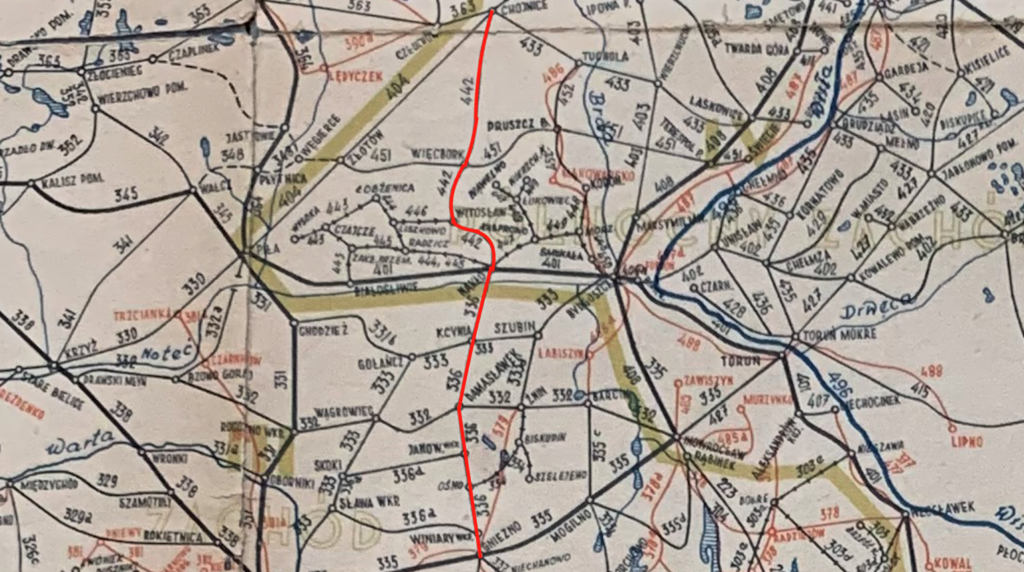
Railway Line No. 281 connects Oleśnica and Chojnice, via Milicz, Krotoszyn, Jarocin, Września, Gniezno, Janowiec Wielkopolski, Nakło nad Notecią, and Więcbork. Railway Line No. 281 is of national significance on the Oleśnica – Milicz section. The line is double-track and partially electrified. It runs from south to north. The total length of Line No. 281 is 311.387 km. From the outset, the line was built as a 1435 mm standard gauge. The first section, Oleśnica – Gniezno, is electrified at 3 kV DC. The maximum speed on the line is 120 km/h. The line runs through the Lower Silesian, Greater Poland, Kuyavian-Pomeranian, and Pomeranian Voivodeships. The lines are operated by PKP PLK (Polish State Railways) companies; Wrocław, Ostrów Wielkopolski, Poznań, Bydgoszcz, and Gdynia. The line is equipped with SHP electromagnets along its entire length. Railway line No. 281 is very diverse. On the Oleśnica–Gniezno section, it is a primary line. On the Gniezno–Chojnice section, it is a secondary line. The line is single-track on sections: -0.355–4.026 km, 18.084–94.350 km, and 161.064–311.015 km. The line is double-track on sections: 4.026–18.084 km, 94.350–161.064 km.
Since the mid-1990s, the Polish railway network has deteriorated. Timetables were designed to be unfavorable for passengers, often leaving no transfer option for the next train or bus. The number of connections was reduced. Routes were closed down as unprofitable, and even railway stations were closed. Funding for repairs was drastically reduced, and investments were limited to long-distance trains. Due to their technical condition, numerous speed restrictions were necessary. The seasonal express train No. 65503 on the Jelenia Góra/Kudowa-Zdrój-Gdynia route, along Line No. 281, was suspended on December 13, 2009.
Only after 2000 did local communities begin demanding access to rail transport. Unfortunately, at that time, national and local governments ignored the needs of the people. They were unconcerned that young people had no access to schools and universities, and that the elderly could not access health centers and hospitals. The situation improved after the United Right party came to power.
From 2012 to 2018, passenger service was suspended on the Jarocin-Chojnice section. Consideration was given to reactivating the Gniezno-Nakło section. The Gniezno-Września-Jarocin service was reactivated from May 13, 2013, to June 28, 2013. Two pairs of regional trains were launched, running only on weekdays.
In December 2013, due to the demotion of LK No. 281, Przewozy Regionalne passenger trains operating on the Krotoszyn-Wrocław route were limited to a single weekend service, the “Barycz” train. On December 11, 2016, the trains were suspended due to low passenger demand and, more importantly, the very long journey times. Another trial took place in June 2018. Six pairs of trains were launched on the Jarocin-Gniezno section.
At the turn of 2015 and 2016, construction work was completed in Orzechowo, which involved the construction of a bridge over the Warta River. A siding to the Volkswagen factory was built in Orzechowo. At the turn of 2016 and 2017, renovation of the Grabowno Wielkie – Zduny section began.
On January 20, 2017, ZRK DOM Poznań was awarded a contract for the renovation of track No. 2 on the Września – Gniezno section. In 2016–2017, Dolkom was awarded a contract for the renovation of the Dąbrowa Oleśnicka – Grabowno Wielkie section. On August 4, 2017, PKP PLK signed a contract with Torpol for the modernization of the Grabowno Wielkie – Zduny section. The contract included, among other things, the reconstruction of the Bukowice Trzebnickie station. On July 18, 2017, PKP PLK signed a contract with the Alusta Poznań Dolkom Wrocław consortium for the renovation of the Września – Gniezno section of the line. On October 3, 2017, PKP PLK signed a contract with the KB Plus, Domost Małkinia, and Settler Poznań consortium for the renovation of Track No. 1 on the Orzechowo – Miłosław – Książno section. As a result of these works, speeds of 100–120 km/h for passenger trains and 60–80 km/h for freight trains were restored. On November 9, 2017, a contract was signed with ZRK DOM from Poznań for the renovation of Track No. 1 on the Książno – Chwalibogowo section. As a result of these works, the speed was increased to 120 km/h for passenger trains and 80 km/h for freight trains.
On May 7, 2018, a new tender was announced for the renovation of Railway Track No. 1 on the Orzechowo–Miłosław section. The track surface, tracks, and switches were replaced. The overhead lines were also replaced. As a result, the speed was increased to 120 km/h. On June 20, 2018, a contractor was selected for the renovation of Track No. 1 on the Orzechowo–Miłosław section. On June 8, 2018, the inaugural service on the Gniezno–Września–Jarocin line took place, and on June 10, 2018, the service was permanently restored.
On September 8, 2019, a contractor was selected for additional works on Railway Line No. 281 on the Grabowno Wielkie–Zduny section. The work included strengthening the trackbed and embankments, improving visibility at level crossings, and installing an LCS with a computerized control system.
In October 2020, a contract was signed with ZRK DOM Poznań for the renovation of Track No. 1 on the Miłosław – Książno section. The track surface was modernized, and a Local Control System (LCS) with a computer system was installed. Culverts, drainage ditches, and level crossings were repaired.
On October 4, 2021, a tender was announced for the design and construction work on Track No. 281 Oleśnica – Chojnice on the Koźmin Wielkopolski – Jarocin section on Track No. 1. As part of the work, the track surface on the Koźmin Wielkopolski – Jarocin route was replaced, the trackbed was reinforced, and the traffic lights were replaced. The station in Koźmin Wielkopolski underwent a minor renovation, with the island platform, rails, and switches being rebuilt. Passenger train speeds increased to 120 km/h. The work was completed in April 2024.
In April 2024, a tender was announced for the design and construction of railway line No. 281 Oleśnica – Chojnice, on the Koźmin Wielkopolski – Jarocin section. The work included the renovation of engineering structures, replacement of the track surface, switches, and the expressway and interconnection system. The platforms at Krotoszyn station and the Wolenice passenger stop were also renovated. The work will be performed by Gór-Tor from Stupsk.
On March 25, 2019, Lower Silesian Railways (KD) trains entered line No. 281. The route ran from Wrocław to Oleśnica and Krotoszyn. Trains ran on weekdays. At the same time, Koleje Wielkopolskie also began services to Krotoszyn station (Poznań to Jarocin to Krotoszyn). On December 13, 2020, this route was extended to Milicz station. Here, you could transfer to a Lower Silesian Railway train and travel to Wrocław. As a result, there were seven pairs of trains on the Milicz–Krotoszyn section. As a result, LK No. 281 had quite good passenger train traffic on the Oleśnica–Jarosław section.
Railway Line No. 281 on the Gniezno – Chojnice section.
In 2018, the Kuyavian-Pomeranian Voivodeship authorities were not interested in modernizing Railway Line No. 281 on the Gniezno – Nakło nad Notecią – Chojnice section. At that time, the line was in poor technical condition. The voivodeship authorities showed open reluctance to address the issue and did not seek funding. It should be noted that at that time, the Kuyavian-Pomeranian Voivodeship was governed by the Civic Coalition (KO), Polish People’s Party (PSL), and Democratic Left Alliance (SLD), which held a majority and formed the voivodeship board. Of the 30 councilors, only 11 belonged to the United Right. It should be remembered that the PSL (Polish People’s Party) never wanted to form alliances with the Law and Justice (PiS). They said one thing and did another. The Marshal’s Office and the voivodeship authorities did not respond to PKP PLK’s suggestions. He did not submit any proposals for work on Railway Line No. 281 on the Nakło nad Notecią – Chojnice section in the future financial framework.
Train Line No. 281 in the Kuyavian-Pomeranian Voivodeship requires renovation. The line is single-track in some sections, but the entire architecture and infrastructure were designed and built for a double-track line and with future electrification in mind. The Ministry considered including this investment in the plans after 2027, provided local authorities were involved. It should be noted that the feasibility and potential for increasing the line’s operational parameters are verified during the study preparation phase. It was noted that Greater Poland is carrying out renovations, while the Kuyavian-Pomeranian Voivodeship is not interested.
Train Line No. 356 from Poznań to Wągrowiec, where the modernization took place, is already an example of a very successful revitalization of passenger connections. The Wielkopolska Voivodeship maintains regional connections with Wielkopolska Railways (Kraje Wielkopolskie) as far as Gołańcza, just before the border with the Kuyavian-Pomeranian Voivodeship. In June 2018, the Marshal’s Office of the Wielkopolska Voivodeship also launched passenger services on the section of LK No. 281 between Jarocin and Gniezno.
The issue of LK No. 281 on the Gniezno-Chojnice section was much more challenging. Since June 2000, there have been no passenger connections on this route. Residents of Janowiec Wielkopolski and Kcynia were very active. Residents of these towns felt excluded from transportation. The mayor of Janowiec Wielkopolski admitted that the closure of passenger connections a quarter of a century ago had caused an economic and social decline for the entire area. Access to Bydgoszcz or Poznań was limited to bus connections, and not always convenient. Furthermore, these towns are located significantly further from the S5 motorway. Furthermore, Janowiec Wielkopolski lacks any regional roads, while Kcynia has national roads No. 241 and 247.
Residents of Janowiec Wielkopolski and Kcynia had heard that there were towns in Poland that had regained rail service after 20 years. This gave rise to hope. The provincial authorities claimed that this was possible on Line No. 281, but tempered their ambitions. They pointed out that for the line to be interesting for the community, there would need to be a dozen or so pairs of trains per day, raising the question of whether they would have sufficient capacity. An unexpected problem was that the line on the Gniezno–Nakło nad Notecią section crosses voivodeship boundaries several times. The first dozen or so kilometers are in the Wielkopolskie Voivodeship. The next few kilometers are in the Kuyavian-Pomeranian Voivodeship, after which the line again runs through Wielkopolskie Voivodeship and re-enters the Kuyavian-Pomeranian Voivodeship. This is crucial for the carrier. This won’t be an easy task, and it’s only the beginning.
This railway line is not included in government documents. Because there is no electric traction, the rolling stock must be diesel. Due to the lack of diesel railcars on the secondary market, new railcars would have to be purchased. The cost of a single diesel railcar will range between 30 and 35 million złoty, depending on the quality of finish. To service the 75 km long route, a minimum of three diesel railcars are required.
Another problem for residents is the need to travel to Żnin, the district capital. The track from LK No. 281 there has long been dismantled, but track reinforcement on the Damasławek-Żnin section is possible. However, joint action by all municipalities and districts is necessary. The results of these efforts are limited, and LK No. 281 has been placed on the reserve list.
Local government officials from the municipalities on the Nakło nad Notecią – Chojnice section also expressed interest in resuming rail service. They, too, were fighting against the transportation exclusion. It was determined that a relationship should also be established with the Pomeranian Voivodeship government, where the line terminates. The study must encompass the entire line: Nakło nad Notecią – Chojnice.
Residents were increasingly receiving reports that where rail service had returned, clean, beautiful diesel trains were running at speeds of 100 km/h. Freight traffic was also slowly returning. It was determined that the stops, their locations, and infrastructure on Line No. 281 needed to be revitalized, including benches and shelters. There was no need for a waiting room or ticket office. It was agreed that there should be a train from Gniezno to Chojnice. This train, which passes through the Nakło junction, would prove effective, as the Marshal’s Office in Toruń is currently funding bus services along Line No. 281 from Sępólno to Nakło. It was emphasized that passenger rail transport is returning. If this is well-organized, services will operate. The Lower Silesian and Lesser Poland Voivodeships were highlighted, where bus and rail transport is interconnected and functions very well. As long as the tracks still exist, there is hope.
LK No. 281 on the Oleśnica – Gniezno section features numerous engineering structures. The line includes 38 rail-road viaducts, 5 rail-rail viaducts, 94 rail-road crossings, 8 bridges over rivers and small rivers, and 2 pedestrian footbridges over the tracks.
The route of Line No. 281 on the Gniezno – Chojnice section.
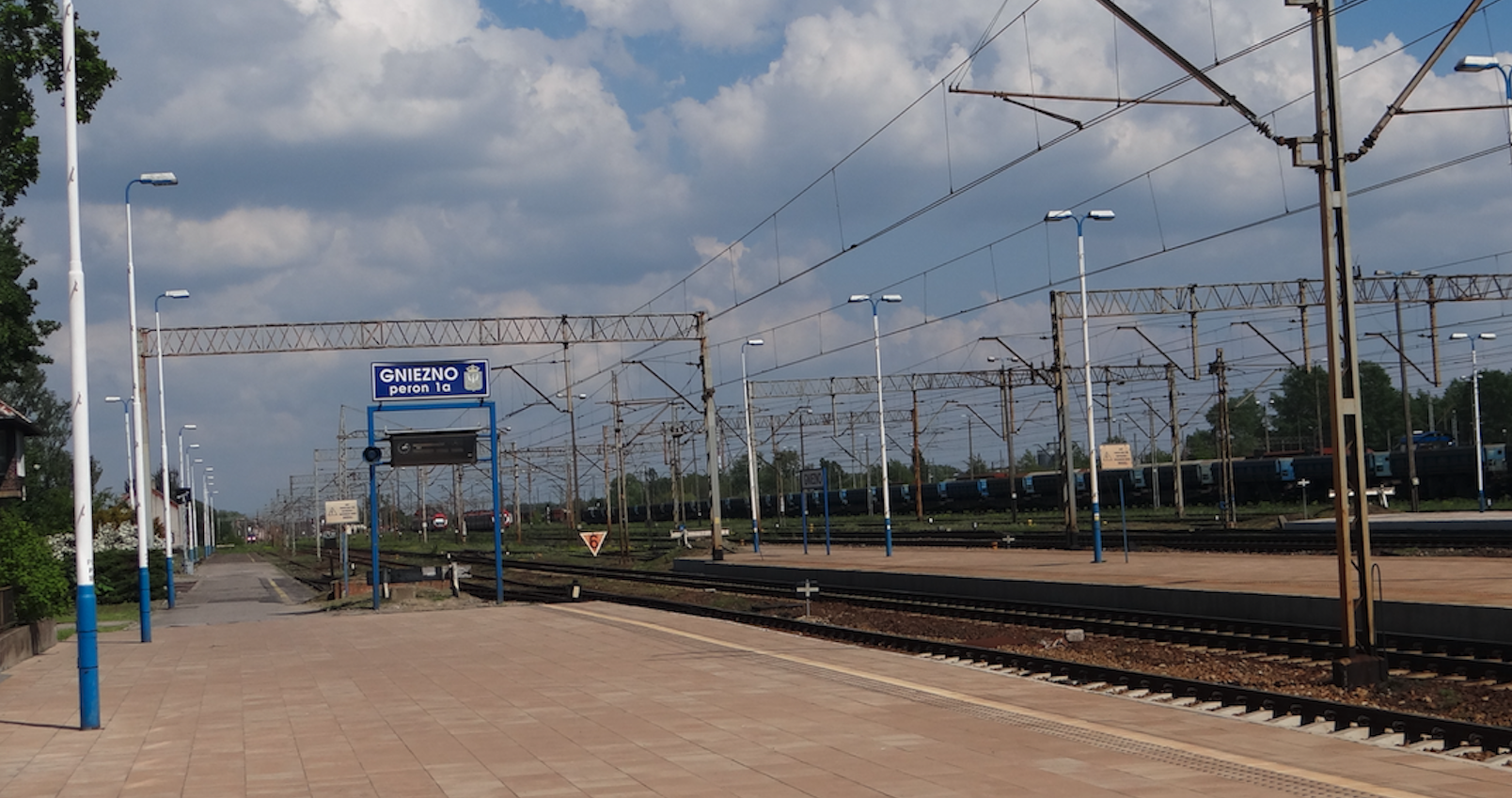
Gniezno station (160.05 km, elevation 122 m). Line No. 353, 7022. Behind the Gniezno station platforms, line No. 281 runs eastward and passes over Pod Trzema Mostami Street. The line then turns north, along Władysław Reymont Avenue. This area is covered by industrial areas. Further along, there are crossings: Wierzbiczany Street, Franklin Roosevelt Street. The line passes under the Mateusz Zabłocki footbridge. There is a crossing on Zamiejska/Spokojna Street. The line passes under national road No. 5/15 and then under Orcholska Street. There are further industrial areas: the Elevator, the Heating Plant, the EKO-LUKIOS plant, and others.
Gniezno Winiary station (164.92 km, elevation 120 m). Line No. 377. This area has three platforms (only one operational), five through tracks, sidings, a ramp, a storage yard, and a station. The station is a residential, two-story building with an adjacent warehouse. Behind the station is a crossing on Gdańska Street. Line No. 377 Gniezno Winiary – Sława Wielkopolska, single-track, branches westward and is being renovated. Line No. 281 crosses two local roads. Further on, the line passes under the S5 motorway. There is the Struga Gnieźnińska River, also known as the Welnianka River. There are seven local road crossings, as well as the Dębina River. Line No. 281 is in poor condition, but passable. The line leaves the city of Gniezno.
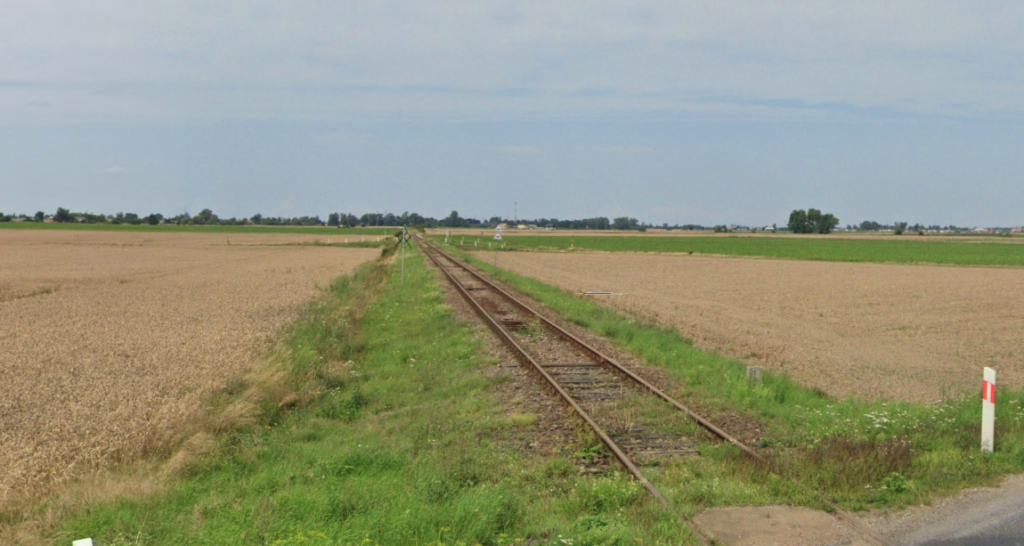
Zdziechowa, former passenger stop (km 171.04, elevation 120 m). There is no trace of the stop. There are agricultural lands. The railway crossings are equipped with signs; the St. Andrew’s Cross and a STOP sign. The crossings are concrete slabs. There are semaphores along the route.
Świątniki (Świątniki Małe), former passenger stop (km 175.11, elevation 110 m). There is no trace of the stop. The line then enters forests.
Mieleszyn, passenger stop, loading bay (km 179.23, elevation 114 m). Railway line No. 5024. There was a siding and lighting at the stop. There are station buildings built of dark red brick. Further on, there are agricultural lands. The Greater Poland/Kuyavian-Pomeranian border is 179.78 km away. There are three local road crossings. The tracks are overgrown with grass, but passable. The sleepers are wooden.
Gącz passenger stop, loading bay (km 184.72, elevation 113 m). Further on, there are three local road crossings.
Janowiec Wielkopolski station (km 189.01, elevation 98 m). Line No. 385. There are three platforms, a station, only two through tracks (though there were 7 in the past), and sidings. There was also Line No. 385 Skoki – Janowiec Wielkopolski, which left the station south and turned west. Janowiec Wielkopolski is a small town in the northwestern part of the Kuyavian-Pomeranian Voivodeship. It lies on the Wełna River and has a quiet, small-town character. Founded in the Middle Ages, it has a long history dating back to the Piast dynasty. Today, the town serves as a local center for the surrounding villages. It has basic infrastructure, schools, health centers, and services. The city currently has no active rail connections, but is well connected by road to nearby towns. Line No. 281 crosses Tadeusza Kościuszki Street after the station. The line crosses the Wełna River on a steel bridge. The line crosses Brudzyńska Street at the top. Next, there’s a local road crossing. The Kuyavian-Pomeranian/Greater Poland border crosses two local road crossings.
Dąbrowa Międzylesie passenger stop (km 194.94, elevation 106 m). Some station buildings have survived. Further on, there are four local road crossings. Some of the rail-road crossings have been renovated. The trackbed, tracks, and crossing surfaces have been replaced.
Damasławek station (km 198.93, elevation 110 m). LK No. 206. Damasławek is a small town in the Wielkopolska Voivodeship and the seat of the commune. It lies in a quiet, agricultural area, near Wągrowiec and Żnin. It serves as the local administrative and service center for the surrounding villages. It houses a school, the commune office, and basic shops. The town has a quiet, rural character.
In front of the station is DW crossing No. 251, on Wągrowiecka Street. Former Line No. 206 Inowrocław Rąbinek – Drawski Młyn (Żnin – Damasławek – Wągrowiec section) ran east-west. Line No. 281 runs north and passes the intersection of Kcyńska Street. The Damasławek railway station was opened in 1887. It served trains from Gniezno to Nakło nad Notecią, as well as from Inowrocław to Wągrowiec. The station building dates from 1900. It is constructed of dark red brick with ornamentation. A noteworthy feature is the underpass. Passenger service on the Żnin – Damasławek line was suspended in 1996. Trains from Gniezno to Nakło nad Notecią ran until 2000. Further along Line No. 281, there are seven local road crossings. The line runs alongside the main road; Tadeusza Kościuszki Street. Wapno passenger stop, loading bay (km 206.27, elevation 101 m). Formerly, there was a passing loop and a siding here. There is a station. Further on, the line crosses the Wapno-Laskownica Canal River. Then, there are two local road crossings.
Rusiec passenger stop, loading bay (km 209.94, elevation 108 m). The line crosses a local road. The Greater Poland/Kuyavian-Pomeranian Voivodeship border. Then, there are three local road crossings.
Włodzimierzewo loading bay (km 212.15, elevation 110 m). The line crosses the Kcynka River.
Kcynia station (216.44 km, elevation 107 m). Railway line No. 356. Kcynia is a small town in the Kuyavian-Pomeranian Voivodeship, located near Nakło nad Notecią. It has a long history dating back to the Middle Ages, and the layout of the old market square has been preserved. Today, Kcynia serves as a local administrative and service center for the surrounding villages, with a quiet, small-town character. The last passenger train on Railway line No. 356, from Poznań via Kcynia to Bydgoszcz, ran in 2004. Within the city limits, from the west, former Railway line No. 356 Poznań Wschód – Bydgoszcz Główna (Poznań East – Bydgoszcz Główna) joined the line. Before Kcynia station, the line passes under DW No. 247, Szubińska Street. The station has two platforms, four rail junctions, six through tracks, a station, and a water tower. Line No. 356 branched off eastward at the “Kc1” signal box. There is a crossing, DW No. 241, Nakielska Street. The line runs parallel to DW No. 241. There are three local road crossings.
Szczepice passenger stop (km 221.31, elevation 102 m). There is a station and a platform with a single edge. The line enters the forest. There are two forest road crossings.
Sudzienki passenger stop (km 226.32, elevation 71 m). The line then passes the PTS Rolling Stock Repair Plant, which is located on the eastern side. The line crosses Wyzwolenia Street.
Paterek passenger stop (km 230.06, elevation 69 m). The line crosses the Noteć River. This is the largest bridge on the route.
PZZ Nakło nad Notecią siding (km 233.18, elevation 60 m). The siding branches off to the northwest. The line passes the street. Jana Kilińskiego and, turning east, Generała Henryka Dąbrowskiego. The line is joined by LK No. 18. There are two crossings: Gimnazjalna Street and Pocztowa Street. There is a footbridge over the tracks.
Nakło nad Notecią station (km 233.18, elevation 60 m). Nakło nad Notecią is a city in the Kuyavian-Pomeranian Voivodeship, situated on the Noteć River. It is an important local economic and transportation center, with developed infrastructure and access to roads and railways. The city has a rich history dating back to the Middle Ages, and its character combines tradition with the functions of a modern district town. LK No. 18 and 5019 are located here. There are two platforms, four rails, 11 through tracks, a pedestrian tunnel, a locomotive shed, and a water tower. The tracks pass under DW No. 241, Nowa Street. On the south side is the Nakło Cukrowania plant. Further on, the lines separate. Double-track No. 18 heads east, single-track No. 281 heads north. The line passes under National Road No. 10, Powstańców Wielkopolskich. There are three local road crossings.
Karnowo, former sectional station (km 239.89, elevation 108 m). Railway line No. 5019.
Kozia Góra Krajeńska passenger stop, loading bay (km 242.48, elevation 102 m). The station buildings have survived and are occupied. They are brick, two-story with basements and a developed attic. The line crosses the Rokitka River. There is a crossing for DW No. 241. The line crosses two local roads.
Mrocza (Mroczaza) passenger stop, loading bay (km 246.31, elevation 102 m). Formerly a station with three through tracks. The station buildings have survived. One is two-story with a basement and a usable attic, occupied. Two platforms remain. Further on, the line crosses two local roads. The line turns westward. The line crosses the Orla River. There are two local road crossings.
Witosław passenger stop, loading bay (km 253.19, elevation 111 m). Local line No. 5022. The line crosses four local roads and gradually turns north.
Rajgród passenger stop (km 257.07, elevation 116 m). The line enters the forests. After leaving the forests, it crosses three local roads and Voivodeship Road No. 242.
Runowo Krajeńskie passenger stop, loading bay (km 263.42, elevation 110 m). This was once a station. There is a station. The line then passes through agricultural and forested areas. There are three local road crossings. The line gradually turns east, before turning north again. The line reaches Voivodeship Road No. 189 on Złotowska Street. To the east, appears the old gauge line, Local line No. 240 Świecie nad Wisłą – Złotów, a former military line.
Więcbork passenger stop, loading bay (km 269.80, elevation 120 m). Railway line No. 240. Więcbork is a small town nestled among lakes and forests, in Sępólno County. It has a long history dating back to the Middle Ages and a preserved market square layout. Today, it serves as a local service center, and thanks to its picturesque lakeside location, it also has tourist and recreational value. Więcbork received its first rail connection in 1894, with Nakło nad Notecią to the south and Chojnice to the north. In 1906, it was possible to travel to Złotów, and in 1909, to Pruszcz Bagienica. Railway line No. 240, Świecie nad Wisłą – Złotów, on the section including Więcbork, was recently dismantled. A large station was built then (1906?). The facility is in good condition today, thanks to the companies operating there and the people who live there. There used to be a large junction station here. Two platforms, 8 through tracks, a station, signal boxes “Wb”, Wb1. The line then passes under Starodworcowa/Wincentego Witosa Street. The line crosses a local road (Weterynaryjna Street) and national road no. 241 Gdańska Street. A new train stop is planned at Weterynaryjna Street. The line then turns north from the northeast. The line crosses a local road.
Wysoka Krajeńska passenger stop (km 276.17, elevation 122 m). The line then crosses 4 local roads.
Świdwie Sępoleńskie passenger stop (km 281.21, elevation 134 m). The line then crosses national road no. 25 Koronowska Street. Further on, there is a bridge over the Sępolna River. The line enters the town of Sępólno Krajeńskie. The line passes under Komierowska Street. There is a crossing of national road no. 241 Tadeusza Kościuszki Street.
Sępólno Krajeńskie passenger stop, loading bay (km 284.17, elevation 126 m). Sępólno Krajeńskie is a town in the northwestern part of the voivodeship, located on Lake Sępólno. It has a long history and serves as the district seat. It is the local administrative and service center, and thanks to its location by the water and surrounded by forests, it also offers recreational opportunities. This was once a medium-sized station. Two platforms, a station, three through tracks, and sidings. The station building, typical of stations on this line, has survived. The station is inhabited. Further along the line, it crosses four local roads.
Kamień Krajeński passenger stop, loading bay (km 291.53, elevation 126 m). Kamień Krajeński is a small town in Sępólno County, nestled among lakes and agricultural land. It has medieval roots and a peaceful, local character. It serves as a service center for the surrounding villages, and its surroundings are conducive to recreation and tourism. There was once a station here. However, the station is located a long walk east of the town. There are two platforms, a station, two through tracks, and a siding. The station buildings, typical of this line, have been preserved. The buildings have been plastered. One building is occupied, while the others are abandoned and protected from vandals. Further on, the line enters the forest, passing the Kamionka River. There are two local road crossings.
Obkas passenger stop (km 297.14, elevation 155 m). The stop is located amidst forests. Kuyavian-Pomeranian Voivodeship/Pomeranian Voivodeship border.
Ogorzeliny passenger stop, loading bay (km 300.49, elevation 157 m). Previously, a station. Further on, there’s a level crossing, Młyńska Street. Further on, there are two local road crossings. Three railway lines converge from the southwest: from Człuchów station (Line No. 210), Piła station (Line No. 203), and Nakło nad Notecią station (Line No. 281). The tracks pass over Angowicka Street, national road No. 22, and Dworcowa Street.
Chojnice station (km 310.04, elevation 174 m). Lines No. 203, 208, 208c, 210, 211.
Written by Karol Placha Hetman