Oleśnica 2026-03-14
Railway line No. 281 Oleśnica – Chojnice.
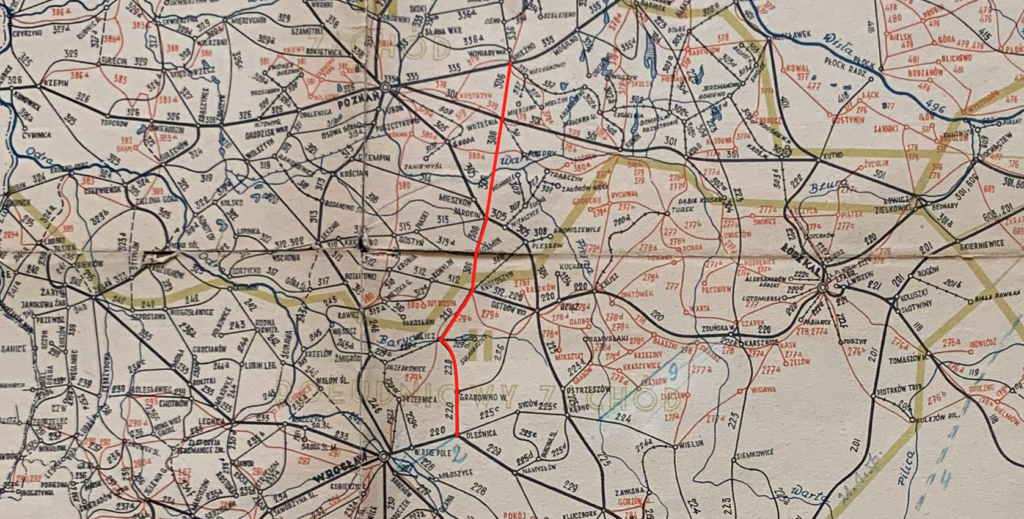
Line opening: On June 30, 1875, the Oleśnica – Gniezno section (OGnE). On November 1, 1887, the Gniezno – Nakło nad Notecią (KPStE) section. On October 1, 1894, the Nakło nad Notecią – Chojnice section (KPStE). The second track was launched on the Jarocin-Gniezno section in 1908 (KPStE).
Electrification: On December 2, 1975, on the Oleśnica-Grabowno Wielkie section (PKP). On December 17, 1986, on the Grabowno Wielkie-Krotoszyn section (PKP). On November 28, 1987, on the Krotoszyn-Jarocin section (PKP). On July 21, 1976, on the Jarocin-Września section (PKP). On November 25, 1976, on the Września-Gniezno section (PKP).
Oleśnica railway station.
In 1855, the Opole-Tarnowitz Railway Company (Oppeln-Tarnowitz Eisenbahn Aktiengesellschaft; OTE) applied to the government of the Kingdom of Prussia for a concession to build a railway line from Opole to Tarnowskie Góry and other connections. Following the establishment of the Right Bank of the Oder Railway (R.O.U.E.) in 1868, leading from Wrocław through Oleśnica to Tarnowskie Góry in Upper Silesia, a project arose to establish the Oleśnica-Gniezno Railway. It was intended to shorten the coal transport route from the mines of Upper Silesia to the cities of Pomerania by 75 km. Until then, these cities had been using hard coal exported from England via seaports. This line also had military significance, as it ran along the border with Muscovy, specifically the Russian Partition of Poland, the Kingdom of Poland. Landowners from southern Greater Poland also influenced the construction of the line to Gniezno. In 1868, preparatory work for the construction of the Poznań-Bydgoszcz-Toruń route was already underway. By this time, everyone was already seeing the benefits of building railways. The railway offered an opportunity for the export of agricultural produce to the south and Silesia, and the Oleśnica-Gniezno line would connect the Right Bank of the Oder Railway with the Greater Poland Railway.
At the same time, a committee was formed to build a railway line from Poznań via Nowe Miasto nad Wartą and Pleszew to the border of the German state towards Kalisz (Muscovite Partition). In April 1868, the Minister of Trade, Industry and Public Works issued permission to begin preliminary studies on this route. The KOG society, however, received permission only to conduct preliminary work on the Oleśnica-Nowe Miasto nad Wartą route. Thanks to the determined efforts of KOG members, approval was obtained to continue preparatory work all the way to Gniezno. Preparatory work on the Oleśnica-Gniezno section was completed in 1870-1871, and the documentation was submitted for approval to the Ministry of Trade, Industry, and Public Works in Berlin.
On June 17, 1872, King William I of Prussia signed a concession deed for the Oleśnica-Gniezno Railway Company (KOG) for the construction and subsequent operation of the Oleśnica-Gniezno line. The document stipulated that the line must be completed and operational within three years of the granting of the concession. On April 16, 1872, the construction of the route was entrusted to the F. Plessner Railway Construction Company and its limited partnership.
In 1872, the statute of the newly established Oleśnica-Gniezno Railway Company (Oels-Gnesener Eisenbahn-Gesellschaft) was approved. KOG for short. In Oleśnica, the embankment of this railway track ran near Oleśnica Castle and crossed the castle grounds, including next to a summer house – the Lusthaus, founded by the Poděbrady family. During the Württemberg era, it was a café (inn) called Monplaisir.
In 1871, construction began on a single-track railway line towards Milicz, Krotoszyn, Jarocin, and onward to Gniezno. However, the contractor faced significant financial and logistical difficulties. The contractor transferred construction management to the KOG board. Shares were sold, which only partially covered the investment costs. The shares were sold by the Berlin Trade Association.
The Oleśnica–Jarocin section was completed on June 30, 1875. The lengthy construction period of this line was a result of the Germans’ involvement in the war with France and financial difficulties. France lost the war and was forced to pay an indemnity of 5 billion gold francs. This amounted to approximately 1,450 tons of gold. The contribution was to be repaid over five years. France repaid it sooner, in 1873. Without a doubt, this money allowed the economy of the new state, the German Empire, to revitalize, but these were still the same arrogant Germans.
On June 26, 1875, the Oleśnica–Krotoszyn section of the line was inaugurated, and on June 30, 1875, the entire route began operation. On July 4, 1875, the line was officially opened. The single-track line was 161.75 km long. Construction cost over 20 million marks. This high cost was the result of widespread corruption. Some installations and facilities were unfinished or were temporary. Even during the line’s construction, plans were made to extend it from Gniezno to Nakło nad Notecią; the Ostbahn station.
The route included 14 railway stations and 13 stops. Fourteen freight warehouses were built, five locomotive sheds (approximately every 45-50 km) with 24 locomotive berths, eight steam-powered water stations, and 32 guardhouses and guardhouses. Due to the varying terrain, most of the line ran on embankments (92 km) and through cuttings (54 km), with only 16 km running on level ground. At that time, the Oleśnica Rataje (Rathau) passenger stop was built.
The first stop beyond Oleśnica was in Dobroszyce, with a station and freight warehouse built at kilometer nine. The next stop was in Grabowno Wielkie at kilometer 17.5. Grabowno also served as a station for the town of Twardogóra, as the town was located too high and extending the railway tracks was uneconomical. It wasn’t until 1910 that a track to Twardogóra, Międzybórz, and beyond, which had military significance, was built. A railway station and a freight warehouse were built in Grabowno, which were modernized in 1888 and 1905. In 1910, a water station was built, with a water tower and cranes, which still exist.
At the end of 1875, the KOG’s rolling stock consisted of 25 Prussian steam locomotives, 48 passenger cars (Classes 1, 2, 3, and 4; the cars were distinguished by color), and 456 freight cars. The coal wagons were two-axle with a load capacity of 15,000 kg. The Class 4 wagons were open-top wagons and were relatively quickly decommissioned. Passenger and freight trains ran on the route, and the journey from Oleśnica to Gniezno took 210 minutes, with stops of just a few minutes at 12 stations, excluding Oleśnica and Gniezno. The commercial speed was 46 km/h. In Gniezno, passengers had to transfer to a railway operated by another railway company. To increase passenger capacity, steam carriages were introduced. A typical passenger carriage, powered by a steam engine, could carry up to 100 passengers and reach a speed of 40-50 km/h. The carriages were three- or four-axle, with one or two driving axles.
As a result of the nationalization process, in 1884, private railway companies and companies were purchased by the state, including the Poznań-Toruń-Bydgoszcz Railway and the KOG. Until then, the KOG’s management board had its headquarters in Oleśnica. This was done on the basis of the act of 1879, which provided for the nationalization of previously private railway lines in German territory.
Between 1875 and 1886, three railway stations operated in Oleśnica. At Oleśnica station, the expansion of the tracks adjacent to the platforms and the construction of a freight station began after 1870, when freight transport increased.
On May 21, 1883, under the Secondary Railways Act, the construction of a railway line between Gniezno and Nakło was approved. 4.88 million marks were allocated for investment. Even then, plans were underway to continue construction of the line to Chojnice. One of the goals was to launch trains from Wrocław to East Prussia and onward to the Russian Brothers.
The creation of the new line involved the modernization of Gniezno station, including the construction of new tracks, the enlargement of the locomotive shed, and the modernization of the water towers and waterworks system. The 73.2-kilometer-long Gniezno–Nakło line was opened on November 1, 1887. The 75-kilometer Nakło-Chojnice section opened on October 1, 1894. In the second half of 1906, work began on converting the Jarocin-Gniezno line to double track.
Around 1890, wagon repair shops were opened in Oleśnica. A fan-shaped locomotive shed with five stations and a turntable existed. There was a freight section of the station with a loading ramp, storage yard, and warehouses. A water station with a steam engine, a water tower, and cranes were also in operation. Employees of the freight station had service and staff quarters, as well as staff apartments.
In 1900, Oleśnica station housed: the Right Bank of the Oder Railway Station; the freight station at the western station head; and the Wrocław-Warsaw Railway station buildings in the eastern part of the station. A wooden, five-station locomotive shed, built around 1870 and demolished in 1900 for the construction of a new locomotive shed. The Right Bank of the Oder Railway station building also housed ticket offices for the Wrocław-Warsaw Railway. The Wrocław-Warsaw Railway offices were located in a small palace at Gartenstrasse 22, now 11 listopada Street 22, Oleśnica. In 1903, a roof was added to the station building, facing Platform 1.
In 1941, under the supervision of the Wehrmacht, construction began on the Łukanów-Dąbrowa Oleśnicka railway line. The initial section near Lucień was built by 400 prisoners of war from the Lucień camp. The line was intended to shorten travel times from Wrocław towards Krotoszyn and Ostrów Wielkopolski and allowed the bypassing of the Oleśnica station.
On August 20, 1945, the Polish Railway Workers officially took over the Oleśnica station, which had previously been administered by the Soviets. By 6:00 PM, all stations were clear of Russians.
In the 1960s, approximately 300 employees were employed at Oleśnica station. These included conductor crews, train dispatchers, trackmasters, switchesmen, ticket counter staff, and an administrative team. Three ticket counters and one baggage claim were open. There was a station bar, a waiting room, and a youth club. There was a grocery store, a RUCH kiosk, and a hairdresser. Back then, you could travel directly from Oleśnica to Lublin, Warsaw, Jelenia Góra, or Łódź. There were more local connections than there are today (2026). Of course, there was a huge amount of freight traffic. Freight trains were formed at the freight station. The station had the capacity to shunt up to 1,200 freight wagons per day. The station dispatched and received 60 freight trains per day.
Railway Line No. 281 Oleśnica – Chojnice.
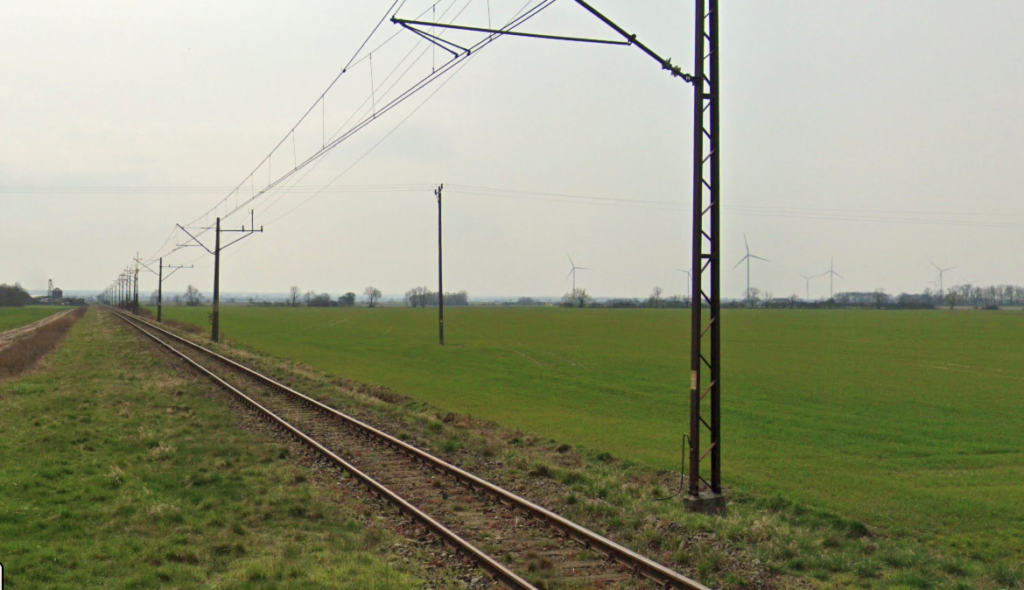
Railway Line No. 281 connects Oleśnica and Chojnice, via Milicz, Krotoszyn, Jarocin, Września, Gniezno, Janowiec Wielkopolski, Nakło nad Notecią, and Więcbork. Railway Line No. 281 is of national significance on the Oleśnica – Gniezno section. The line is double-track on the Jarocin – Gniezno section and electrified on the Oleśnica – Gniezno section at 3 kV DC. The line runs from south to north. The total length of LK No. 281 is 311.387 km. From the very beginning, the line was built as a 1,435 mm standard gauge. The maximum speed on the route is 120 km/h. The line runs through the following voivodeships: Lower Silesia, Greater Poland, Kuyavian-Pomeranian, and Pomeranian. Line service is provided by PKP PLK plants; Wrocław, Ostrów Wielkopolski, Poznań, Bydgoszcz, and Gdynia. The line is equipped with SHP electromagnets along its entire length. Railway Line No. 281 is very diverse. On the Oleśnica – Gniezno section, the line is primary. On the Gniezno – Chojnice section, the line is secondary. The line is single-track in sections; -0.355 – 4.026 km, 18.084 – 94.350 km, 161.064 – 311.015 km. The line is double-track on sections; 4.026 – 18.084 km, 94.350 – 161.064 km.
Since the mid-1990s, Poland’s railway network has been in decline. Timetables were designed to be unfavorable for passengers, often leaving no way to transfer to another train or bus. The number of connections was reduced. Routes were closed as unprofitable, and even railway stations were closed. Funding for repairs was drastically reduced, and investments were limited to long-distance trains. Due to its technical condition, numerous speed limits had to be introduced.
Long-distance trains also ran on this line. The seasonal express train No. 65503 on the Jelenia Góra/Kudowa-Zdrój-Gdynia route, along LK No. 281, was suspended on December 13, 2009.
Only after 2000 did local communities begin demanding access to rail transport. Unfortunately, during this time, national and local governments ignored the needs of the people. They were not concerned that young people had no access to schools and universities, and that the elderly were unable to go to health centers and hospitals. The situation improved after the United Right came to power.
From 2012 to 2018, passenger service on the Jarocin-Chojnice section was suspended. Consideration is being given to reactivating the Gniezno-Nakło nad Notecią section. The Jarocin-Września-Gniezno service was reactivated from May 13, 2013, to June 28, 2013. Two pairs of regional trains were launched, running only on weekdays.
In December 2013, due to the demotion of LK No. 281, Przewozy Regionalne passenger trains operating on the Krotoszyn-Wrocław route were limited to a single weekend service: the “Barycz” train. On December 11, 2016, trains were suspended due to low passenger demand and, more importantly, the very long journey times.
Another trial took place in June 2018. Six pairs of trains were launched on the Jarocin-Gniezno section.
At the turn of 2015 and 2016, construction work was completed in Orzechów, which involved the renovation of the bridge over the Warta River. A siding to the Volkswagen factory was built in Orzechów. At the turn of 2016 and 2017, renovation of the Grabowno Wielkie – Zduny section began.
On January 20, 2017, ZRK DOM Poznań was awarded a contract for the renovation of track No. 2 on the Września – Gniezno section. In 2016–2017, Dolkom was awarded a contract for the renovation of the Dąbrowa Oleśnicka – Grabowno Wielkie section. On August 4, 2017, PKP PLK signed a contract with Torpol for the modernization of the Grabowno Wielkie – Zduny section. The contract included, among other things, the reconstruction of the Bukowice Trzebnickie station. On July 18, 2017, PKP PLK signed a contract with the Alusta Poznań Dolkom Wrocław consortium for the renovation of the Września – Gniezno section. On October 3, 2017, PKP PLK signed a contract with the KB Plus, Domost Małkinia, and Settler Poznań consortium for the renovation of Track No. 1 on the Orzechowo – Miłosław – Książno section. As a result of these works, speeds of 100–120 km/h for passenger trains and 60–80 km/h for freight trains were restored. On November 9, 2017, a contract was signed with ZRK DOM from Poznań for the renovation of Track No. 1 on the Książno – Chwalibogowo section. As a result of these works, the speed was increased to 120 km/h for passenger trains and 80 km/h for freight trains. On May 7, 2018, a new tender was announced for the renovation of Railway Track No. 1 on the Orzechowo–Miłosław section. The track surface, tracks, and switches were replaced. The overhead lines were also replaced. As a result, the speed was increased to 120 km/h. On June 20, 2018, a contractor was selected for the renovation of Track No. 1 on the Orzechowo–Miłosław section. On June 8, 2018, the inaugural service on the Gniezno–Września–Jarocin line took place, and on June 10, 2018, the service was permanently restored.
On September 8, 2019, a contractor was selected for additional works on Railway Line No. 281 on the Grabowno Wielkie–Zduny section. The work included strengthening the trackbed and embankments, improving visibility at level crossings, and installing an LCS with a computerized control system.
In October 2020, a contract was signed with ZRK DOM Poznań for the renovation of Track No. 1 on the Miłosław – Książno section. The track surface was modernized, and a local control system with a computer system was installed. Culverts, drainage ditches, and level crossings were repaired.
On October 4, 2021, a tender was announced for the design and construction work on Track No. 281 Oleśnica – Chojnice on the Koźmin Wielkopolski – Jarocin section on Track No. 1. As part of the work, the track surface on the Koźmin Wielkopolski – Jarocin route was replaced, the trackbed was reinforced, and the traffic lights were replaced. The station in Koźmin Wielkopolski underwent a minor modernization, with the island platform, rails, and switches being rebuilt. Passenger train speeds increased to 120 km/h. The work was completed in April 2024.
In April 2024, a tender was announced for the design and construction of railway line No. 281 Oleśnica – Chojnice, on the Koźmin Wielkopolski – Jarocin section. The work included the renovation of engineering structures, replacement of the track surface, switches, and the expressway and interconnection system. The platforms at Krotoszyn station and the Wolenice passenger stop were also renovated. The work was performed by Gór-Tor from Stupsk.
On March 25, 2019, Lower Silesian Railways (Koleje Dolnośląskie) trains entered line No. 281. The route ran from Wrocław to Oleśnica and Krotoszyn. Trains ran on weekdays. At the same time, Koleje Wielkopolskie also began services to Krotoszyn station (Poznań to Jarocin to Krotoszyn). On December 13, 2020, this route was extended to Milicz station. Here, you could transfer to a Lower Silesian Railway train and travel to Wrocław. As a result, there were seven pairs of trains on the Milicz–Krotoszyn section. As a result, LK No. 281 had quite good passenger train traffic on the Oleśnica–Jarosław section.
In 2026, 7 pairs of trains operated by Koleje Wielkopolskie ran on the Jarocin – Gniezno section. In 2026, 2 pairs of trains operated by Koleje Wielkopolskie ran on the Krotoszyn – Jarocin section. On March 15, 2026, 28 passenger trains departed from Milicz station. It was possible to travel to the following stations: Białystok, Giżycko, Jelcz-Laskowice, Krotoszyn, Szklarska Poręba Górna, Warszawa Wschodnia, and Wrocław Główny. The carriers included PKP InterCity and Koleje Dolnośląskie. The trains included long-distance trains; IC 6128 “Mickiewicz” Białystok – Wrocław Główny, IC 6126 “Leśmian” Białystok – Wrocław Główny, IC 6124 “Krasiński” Białystok – Wrocław Główny, IC 6520 “Słowacki” Giżycko – Wrocław Główny, IC 16170 “Karkonosze” Szklarska Poręba Górna – Warsaw Wschodnia, IC 6122 “Baczyński” Warsaw Wschodnia – Wrocław Główny, IC “Asnyk” Warsaw Wschodnia – Wrocław Główny.
The route of line No. 281 on the Oleśnica – Gniezno section.
Oleśnica station (0.00 km, elevation 158 m) LK No. 143, 181. LCS. The line begins at Oleśnica station as a single-track line. It runs westward and gradually turns north. The line crosses the upper section; 3 Maja Street, Wiejska Street, and Krucza Street. The line crosses the Oleśnica River. The line crosses Leszczynowa Street at the top. There is Wrocławska Street, where a crossing used to be, now closed.
Oleśnica Rataje passenger stop (2.54 km, elevation 152 m). LK No. 766, a connecting line, approaches from the west, which bypasses Oleśnica station on the Wrocław-Gniezno route. There are two single-track platforms and a footbridge over the tracks. A viaduct also runs over the platforms, Wojska Polskiego Street. The two tracks run side by side, but they are not a single line. The route leaves the city of Oleśnica. The line passes under the S8 motorway.
Dąbrowa Oleśnicka passenger stop and junction station (4.39 km, elevation 158 m). LK No. 766, only here does it connect with LK No. 281. There are two single-edge platforms. The second one is placed between the tracks. There is a station. There is a crossing, DW No. 340. Agricultural land has begun. There are two crossings of local roads.
Dobroszyce station (km 8.84, elevation 166 m). Before the station, there’s a crossing on Kolejowa Street. There are two single-edge platforms between the tracks, a station, and a signal box. There’s a siding to the Kronoplus plant. From this station, LK No. 281 is double-track. The line enters the forest. There’s a forest road crossing. Nikodemów was a former blocking station (km 13.28, elevation 173 m). A brick building has survived.
Grabowno Wielkie station (km 17.63, elevation 187 m). LK No. 355. Local Crossing Station. Before the station, there’s a local road crossing. There are two single-edge platforms, both unusually positioned between the tracks, one behind the other. There’s a station, a water tower, and five through tracks. Behind the station, LK No. 355 branches east to Ostrów Wielkopolski station. To the west, a siding leads to the fuel depot; No. 19 Grabowno Wielkie. The line includes a local road crossing. The line is then single-track. The line passes over a forest road. The local forest road crossing is then closed. The line then passes over a forest road. Further on, there are agricultural areas.
Bukowice Trzebnickie: passenger stop and passing loop (24.59 km, elevation 147 m). There are two crossings: Mleczna Street and Wrocławska Street. There are two single-edge platforms opposite each other. Further on, there are agricultural areas and forests. The line passes under a dirt road. Then the line passes over a dirt road. There is a forest road crossing, and then a dirt road crossing. There is another dirt road crossing, and then a crossing; DW No. 439 or 448.
Krośnice: passenger stop and passing loop (32.81 km, elevation 128 m). One single-edge platform has been renovated. The second platform has not been renovated. There is a station. Further on, there is a crossing on Kolejowa/Leśna Streets. Further on, there are forest areas and wasteland. The line crosses a forest road. There is another crossing on a forest road in the settlement of Dąbrowa.
Wierzchowice passenger stop (km 36.80, elevation 137 m). Before the stop, there is a crossing on Wierzchowiska Street. There is a former station building. The platform has been renovated. Further on, there are forests and fields. There is a crossing on a dirt road, next to which is the crossing guard’s building.
Milicz station (km 41.88, elevation 116 m). The station is relatively large. There are two platforms, three through tracks, a station, and a water tower. After the station, the line crosses Kolejowa Street. There is a viaduct over a local dirt road and, a little further on, another viaduct over a road and a river. Further along is a large, five-span brick railway bridge, called “Five Bridges,” over the Barycz River. Further along are agricultural lands. There’s a crossing on Akacjowa Street. Further along, the line crosses a dirt road. There’s another crossing, Akacjowa Street. And then there’s another crossing, Sulmierzycka Street. The line enters the forest. There’s a viaduct over the forest road, Leśna Street.
Rakoniewice Milickie passenger stop (km 50.31, elevation 143 m). The stop appears to be located in a deserted area. The platform is new with a bus shelter. The line then winds through forests and fields. There is a recently renovated brick arched viaduct over the forest road. There is a crossing, national road no. 15. At the crossing, there is an abandoned brick crossing guardhouse. There is a crossing, Kwiatowa Street.
Cieszków passenger stop (km 54.70, elevation 134 m). There is a new platform, bus shelter, and station buildings (station and warehouse). The train timetable is displayed on the wall of the building. Beyond the platform is a crossing, Kolejowa Street. Further on, there is agricultural land. The Lower Silesian/Greater Poland border is 55.94 km.
Zduny station (km 56.60, elevation 131 m). There are four through tracks, an island platform, sidings, a storage yard, a station, a warehouse, and a railway forwarding building. Behind the station is a level crossing on 1 Maja Street. Further on are agricultural lands. There is a level crossing on Kobylińska Street. Another dirt road crossing, and another. Konarzew was the loading bay (59.86 km, elevation 132 m). A housing estate of single-family homes has been built on the station level. There is a level crossing on Baszkowska Street. Further on, there is a level crossing and a dirt road on Szczerkowska Street. Further on, there is the Rów Baszkowski River. The line enters Krotoszyn. The Krotoszyn railway junction begins. Line No. 281 crosses over the single-track Leszno-Krotoszyn railway line. There is a level crossing on Rawicka Street. From the east, the railway line from Leszno joins. Both lines cross over Zamkowy Folwark Street.
Krotoszyn station (63.95 km, elevation 130 m). LK No. 281a, 815, 816, 7051. The southern station head begins. The tracks cross over DK No. 36, Kobylińska Street. The station is large: two platforms, four platform edges, a tunnel under the tracks, a station, a water tower, 10 through tracks, a locomotive shed, warehouses, a storage yard, and a railway wheel repair workshop. At the northern station head, the lines split. To the east, the line to Ostrów Wielkopolski branches off. To the north, LK No. 281 runs, and above it passes the double-track Leszno-Ostrów Wielkopolski line, which bypasses Krotoszyn station. Further on, there is a crossing, Wiejska Street. And another crossing, Kopieczki Street. The line leaves Krotoszyn. There are agricultural areas. There is a dirt road crossing, Wiśniowa Street.
Bożacin passenger stop (km 67.61, elevation 133 m). There is one single-edge platform. Behind the platform is a level crossing, Ogrodowa Street. Further on, the line passes over Jagły Street. There is another dirt road crossing, Sadowa Street. Further on, there are agricultural areas. There are two dirt road crossings. There is a local asphalt road crossing and another dirt road crossing.
Wolenice passenger stop (km 72.16, elevation 149 m). There is one low-rise single-edge platform. There are streetlights. A paved road leads to the stop, but the stop is nestled in fields, and its origin is unclear. It is possible that this was previously a passing loop and a loading bay. There are concrete poles that could have supported electric traction, and the platform has two sides. Further on, there is a dirt road crossing, and next to it is a former guardhouse. There is a local asphalt road crossing, next to it is a former guardhouse. Further on, the line passes over a local road. There’s another local road crossing, Kobylińska Street. The line enters Koźmin Wielkopolski. There’s a bridge over the Orla River. There’s a crossing, Zamkowa Street, and another crossing, DW No. 438, Borecka Street.
Koźmin Wielkopolski station (km 78.61, elevation 130 m). Train No. 382. The station has two platforms, one with a single edge, the other between the tracks. The platforms were recently renovated. The station is relatively large, three-story, with annexes, and built of dark red brick. On the north side is a warehouse. The station has three through platforms, a siding, and a storage yard. There are sidings to a plant that impregnates wooden sleepers. This is one of the largest plants of its kind in Poland. Formerly, Train No. 382 branched west from the southern station head to the city of Gostyń. The line followed Spokojna Street. Behind the station, there’s a crossing, Łączna Street. The line leaves Koźmin Wielkopolski. Further on, there’s farmland. There’s a local road crossing. There’s a disused guardhouse here. The line crosses the Pogona River. There are two local road crossings. The line crosses the Obra River. There’s another local road crossing.
Obra Stara passenger stop (km 84.91, elevation 143 m). The stop features a new high-rise platform, a bus shelter, lighting, and bicycle parking. Behind the stop is a crossing on Dworcowa Street. The line then passes under a local road. It continues along a new asphalt local road and bicycle path. The street was designed for industrial areas.
Golina passenger stop (km 87.15, elevation 115 m). This is another stop where a new platform has been built, with a bus shelter and lighting. This was once a station. The two-story, three-axle station building, with annexes, remains. The building is constructed of dark red brick. Next is the crossing on Spółdzielcza Street. The line passes over the local road. There is another viaduct, with Wolności Street running underneath. There is a crossing on Siedlemińska Street, and another crossing on Pinki Street. The line enters the city of Jarocin. There’s a crossing, Wybudowanie Street, and another crossing, Siedlemińska Street, and another crossing, Folwarczna Street. The Jarocin railway junction begins. There’s a railway viaduct; the double-track line from Ostrów Wielkopolski runs overhead, and LK No. 281 runs underneath. This is the beginning of Jarocin station.
Jarocin station (94.60 km, elevation 125 m). LK No. 272, 360. After the railway viaduct, LK No. 281 splits. The track, running slightly west, joins the LK from Ostrów Wielkopolski. Between the tracks are exceptionally large railway areas. The tracks under DK No. 12 cross two viaducts. Further on, between the tracks is a large, fan-shaped locomotive shed. Currently, the Jarocin Steam Locomotive Shed Museum. A large collection of old rolling stock has been stored on the old tracks. There’s a reinforced concrete water tower. Such water towers can be found in Oleśnica and Olsztyn, among others. The station in Jarocin is an island-type structure. Access to the station square is from the north. There are four platforms and six platform edges. At the northern station head, the tracks pass under Niepodległości Avenue. Two lines depart from the station: Line No. 272 to Poznań and Line No. 281 to Chojnice. Both lines were double-track. Formerly, Line No. 360 Jarocin-Kąkolewo was also single-track. After passing the Aleja Niepodległości viaduct, this line turned west along Karola Marcinkowskiego Street. Line No. 281 continues overhead and passes over Poznańska Street. Then, there is a disused crossing. The line leaves Jarocin and enters agricultural land and forests. Further on, the line passes over the S11 motorway via a new viaduct. Further on, there is another brick viaduct over Cmentarna/Jarzębinowa Street. Next, there’s a local dirt road crossing. Then there’s a local road crossing, Szkolna Street. The line crosses the Obra River. Then there’s a local road crossing. And another local road crossing just before the Radlin Wielkopolski passenger stop.
Radlin Wielkopolski passenger stop (km 101.76, elevation 100 m). The stop has two new single-edge platforms, facing each other. The platforms feature bus shelters, lighting, and information boards. Further on is a disused dirt road crossing.
Żerków station (km 105.86, elevation 101 m). Although the town of Żerków is located 4 km east of the station, the station was named Żerków. Before the station, the line passes under Mostowa Street. At the station, there is a large, three-story station building constructed of dark red brick. A warehouse adjoins the building. Behind the platforms is a crossing on Żerkowska Street. Behind the station is agricultural and forest land. There is a local road crossing on Polna Street. The line passes over a local asphalt road. Orzechowo Most blocking station (km 110.76, elevation 80 m). A little further on is the railway bridge over the Warta River. The bridge is composed of several bridges built at different times. The oldest is a brick bridge with three arches. The rest of the bridge is steel, composed of several spans. One span, on track No. 2, is an arched structure, and under it, vessels pass. On track No. 1, there is a raised plate girder span. The total length of the bridge is 360 m.
Orzechowo station (112.66 km, elevation 80 m). Railway line No. 281b. Before the station, there is a crossing on Polna Street. There is a crossing on Średzka Street. The station houses a two-story red brick station, with an adjacent warehouse. In the past, the Orzechowo track system was expanded. There was a track to the river port and other factories in the town, such as a sawmill. The freight section of the station lies on route No. 281, but is on the eastern side of LK No. 281b. Currently, the station has two new single-edge platforms and three through tracks. Further on, the line enters the forest. There are two forest road crossings. There is a viaduct with a forest road, Dukt Leśny, running underneath. There is a crossing; the forest road, Bagatelka Street. At the crossing, there is an old guardhouse. Further on, the line crosses over DK No. 15, Poznańska Street. The line enters the village of Miłosław. And there is another viaduct, over Mostowa Street. There is a crossing, Dworcowa Street.
Miłosław station (km 121.77, elevation 88 m). The station is located on the outskirts of the town. The station has a station, the same as Żerków station. The station has two new platforms, four through tracks, and a large storage yard. There is a level crossing, Pełczyńska Street. The line leaves Miłosław. Further on, there are agricultural areas. There is a level crossing, a dirt road. Pałczyn was used for loading (km 124.30, elevation 93 m). There is another asphalt road crossing, where there is an old guardhouse.
Książno passenger stop (km 126.18, elevation 95 m). The stop is nestled in fields. There are two new single-track platforms. Access to the stop is via a dirt road. Further on, there is a local asphalt road crossing. The old guardhouse is located near the crossing. There are still agricultural areas. There are three dirt road crossings.
Chwalibogowo passenger stop (km 130.82, elevation 105 m). The former station building stands. There are two single-edge platforms. There is a local asphalt road crossing. Further on, the line passes under national road no. 432. The viaduct is recently renovated. Further on, on the western side are industrial areas, including a Volkswagen factory.
Obłaczkowo is officially a passenger stop (km 132.16, elevation 107 m). In reality, on the western side of the line is a freight station where cars, primarily delivery vehicles, were loaded. Further on, the line passes under a local road. The line then passes under national road no. 92. Further on, the line passes under the A2 motorway and reaches the border of Września. This is where the Września railway junction begins. Września has a railway layout similar to that of Krotoszyn.
Września station (km 136.31, elevation 106 m). LK No. 807, 808, 808a, 7014. The station has three platforms and five platform edges. There is a station and all the railway facilities. The station has a dozen or so through tracks. Further on, the tracks pass under Paderewskiego Street. The tracks cross the Września River. The lines separate; to the east, a line branches off towards Konin. LK No. 281 continues straight north. There is a crossing, Czerniejewska Street. On the western side, there are sidings to local factories. The line and sidings pass under the Poznań-Konin-Warsaw line. The line leaves the town of Września. There are agricultural areas. There is a crossing, Słomowska Street. A disused guardhouse stands nearby. There are three further local road crossings.
Marzenin passenger stop (km 142.73, elevation 114 m). There are two new single-edge platforms, facing each other. Behind the platforms is a crossing on Księdza Twardowskiego Street. There are two local road crossings.
Czerniejewo station (km 146.98, elevation 112 m). Railway line No. 7018. Before the station is a local road crossing. The station houses a station with an adjacent warehouse. There are two platforms, three platform edges, and four through tracks. To the north is a signal box and a local road crossing. There is another local road crossing. The station was once crossed by a narrow-gauge railway line, Railway line No. 7018. The line ran north and south.
Żydowo passenger stop (km 150.22, elevation 110 m). Before the platforms is a crossing on Dworcowa Street. There are two new single-edge platforms. Next, there’s a local asphalt road crossing, Gębarzewska Street. The line crosses the Wrzesnianka River. There’s a dirt road crossing.
Gębarzewo passenger stop (km 153.39, elevation 119 m). Previously, this was a station with several sidings located on the western side. A local road crossing is located in front of the platforms. A mass grave of the victims of the Poznań evacuation train crash, PKP employees and their families, is located near the tracks. The disaster was the result of German actions, which on September 1, 1939, together with their Russian brethren, invaded Poland. The line enters the city of Gniezno. It then crosses Południowa, Zacisze, and Ludwiczaka streets. The line turns eastward and reaches LK No. 353 from Poznań. There’s a crossing, Gajowa Street. The lines pass under national road no. 15 and then under Warszawska Street.
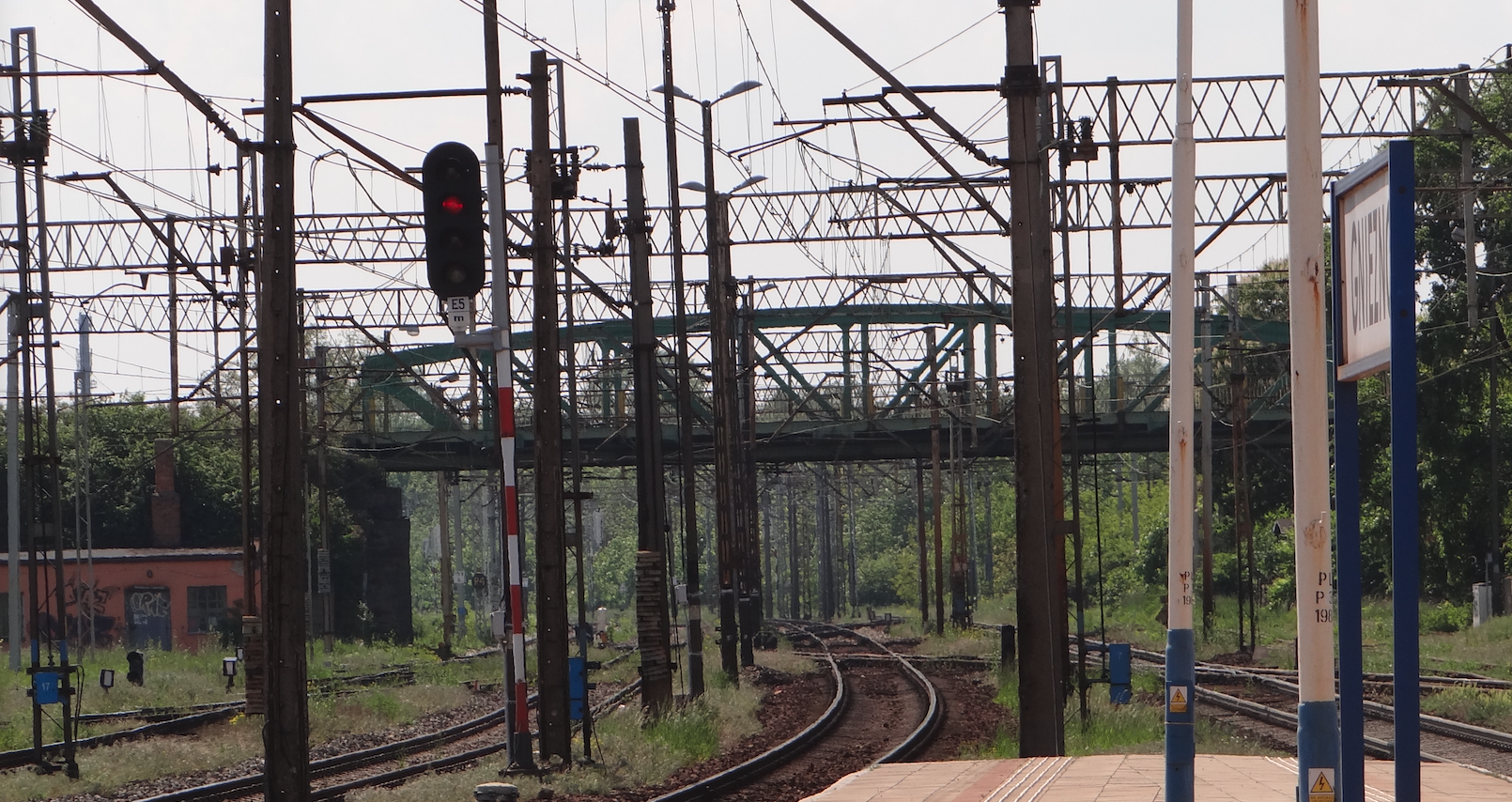
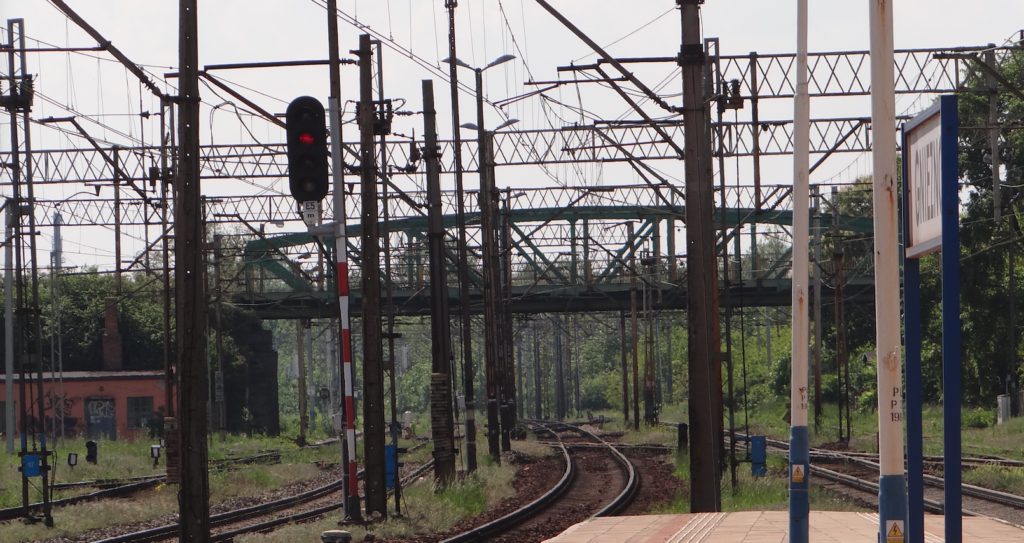
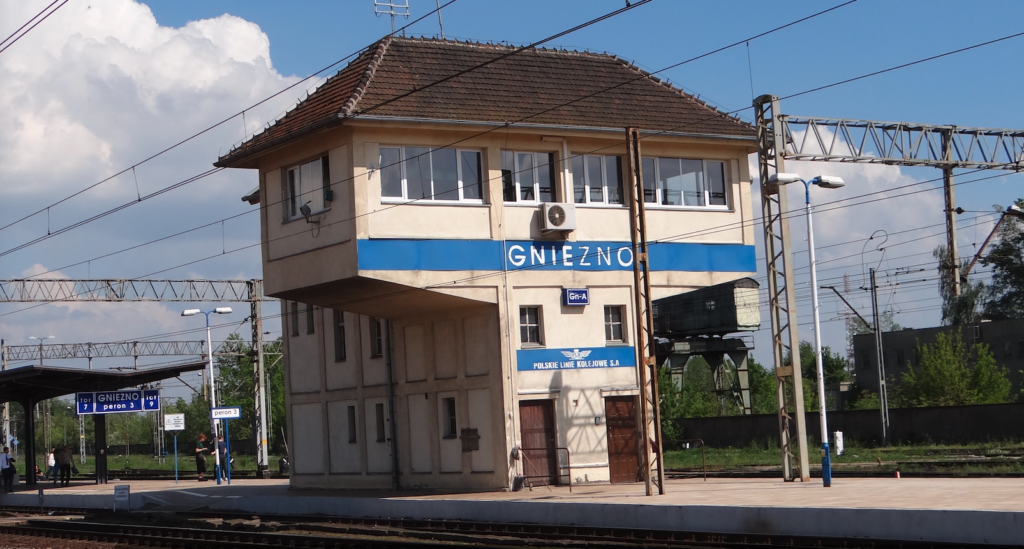
Gniezno station (km 160.05, elevation 122 m). National road no. 353, 7022.
Written by Karol Placha Hetman