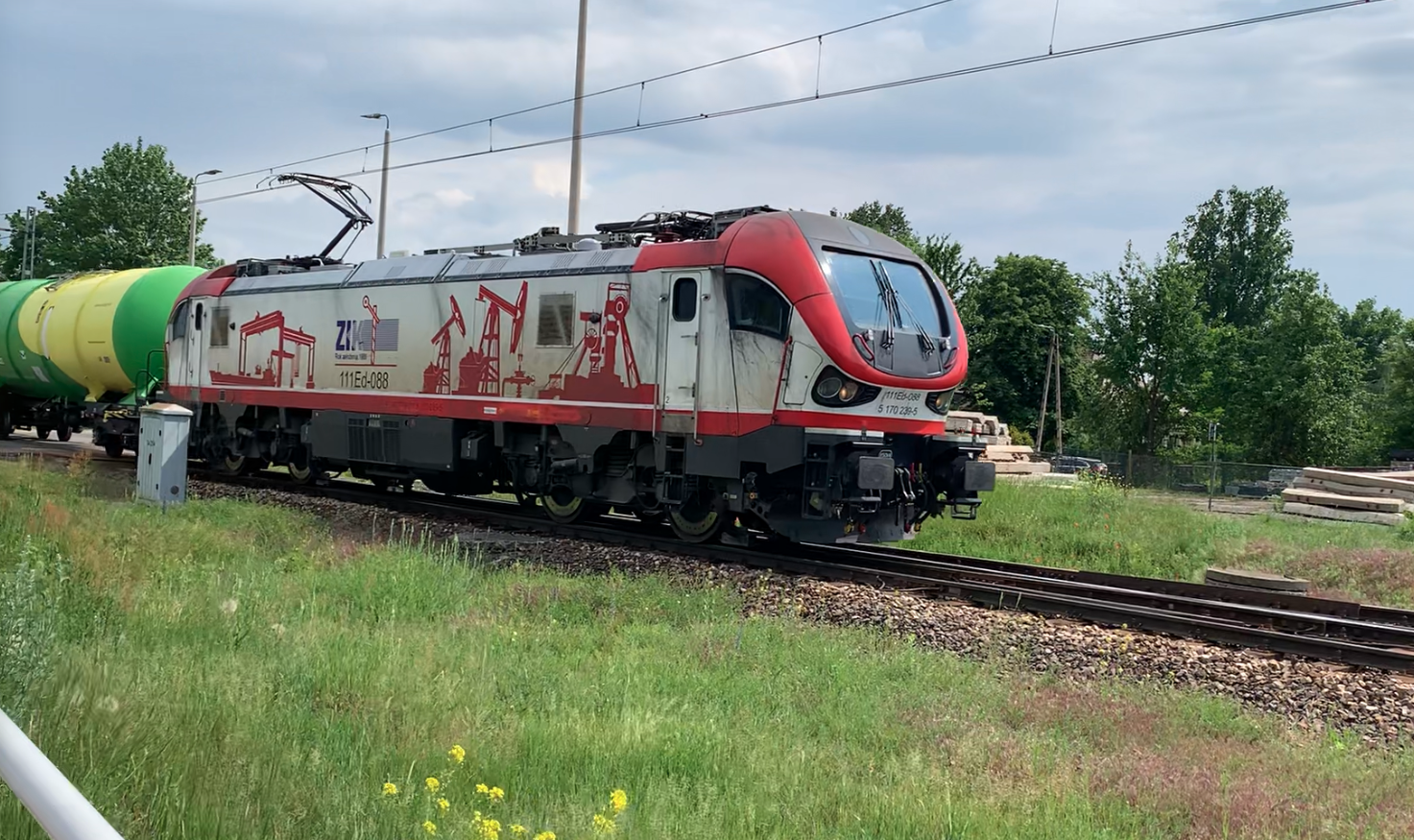
Dęblin 2026-11-08
PESA Gama 111Ed-088 Electric Locomotive.
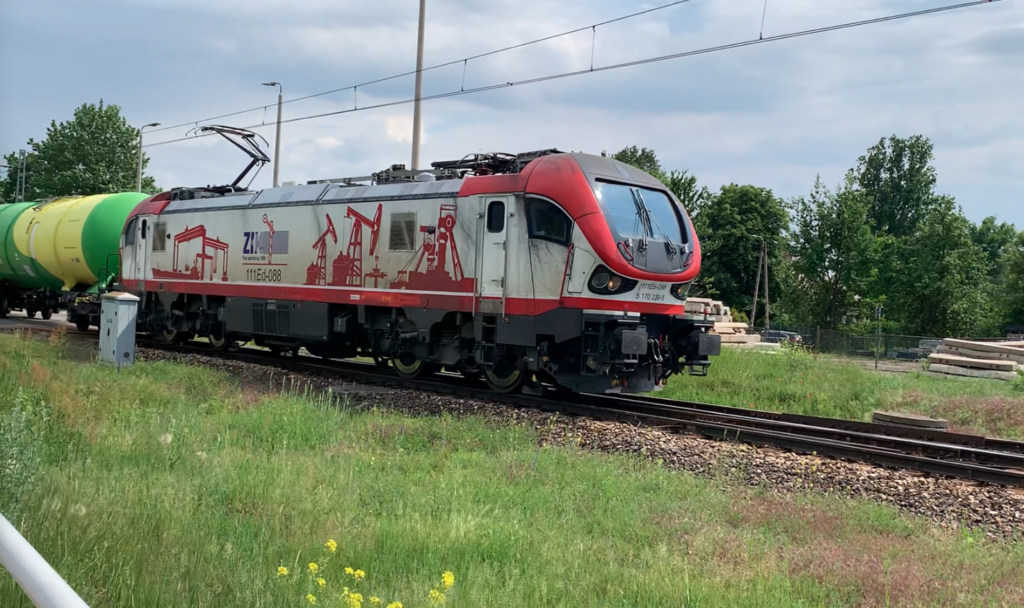
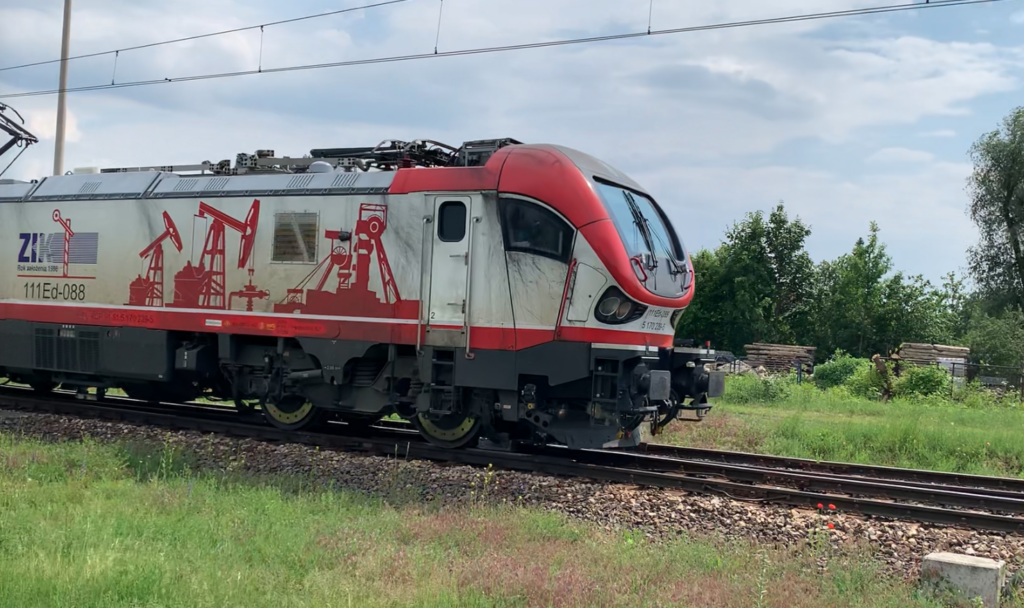
The PESA Gama electric locomotive is a good return of Polish manufacturers to building locomotives in Poland, which were designed by Polish engineers. After the difficult 1990s and the political transformation (without lustration and decommunization), two large producers of railway rolling stock appeared on the Polish market; NEWAG Nowy Sącz and PESA Bydgoszcz. In 2009, the first Polish new locomotive was the electric Dragon locomotive, which was developed by ZNTK Gliwice together with the plant in Nowy Sącz; later NEWAG. In 2012, locomotives appeared; NEWAG Griffin and PESA Gama.
The PESA Gama family of locomotives was developed in Bydgoszcz; electric, electric with an additional power generator, combustion and hybrid. PESA Gama locomotives are operated, among others, by PKP InterCity, Koleje Mazowieckie, Pol-Miedź Trans, RCP Orlen–Koltrans, Koltrans, Lotos, Ecco Rail, Kolprem, RCP, RCP 2. Most of the locomotives belong to the Rail Capital Partners rolling stock pool. The basic model of the PESA Gama locomotive is an electric locomotive that operates under 3 kV DC traction.
Pool is a loose agreement between companies concluded in order to implement specific projects, such as conducting a common pricing policy, defining sales markets or creating common funds. This agreement is ad hoc and temporary.
PESA Gama Technical Specifications:
Production began in 2012. Axle arrangement: Bo’Bo’. Length: 19.80 m. Width: 3.00 m. Power supply systems: 3 kV DC, 15 kV AC, or 25 kV AC. Electric locomotives capable of speeds up to 200 km/h in passenger service and 160 km/h in freight service. Diesel-electric locomotives capable of speeds up to 160 km/h in passenger service. Maximum tractive effort is 300 kN, including when operating in diesel mode. Starting tractive effort: 320 kN. Maximum axle load: 206 kN. Equipped with a 420 kVA auxiliary power unit (generator set).
Available PESA Gama locomotive versions:
Type 111DE – hybrid, 3 kV DC power supply, universal, speed 160 km/h.
Type 111DEa – diesel-electric, 3 kV DC power supply, universal, speed 140 km/h.
Type 111DEb – diesel-electric, 3 kV DC power supply, universal, speed 160 km/h.
Type 111Ea – electric, 3 kV DC power supply, freight, speed 140 km/h.
Type 111Eb – electric, 3 kV DC power supply, universal, speed 160 km/h.
Type 111Ec – electric, 3 kV DC power supply, freight, speed 140 km/h. Type 111Ed – electric, 3 kV DC power supply, universal, speed 160 km/h.
Type 111Ee – electric, 3 kV DC and 15 kV AC power supply, freight, speed 140 km/h.
Type 111Ef – electric, 3 kV DC and 15 kV AC power supply, universal, speed 160 km/h.
Type 111Eg – electric, 6,000 kW power, 3 kV DC power supply, passenger, speed 189 km/h.
Type 111Eh – electric, 6,000 kW power, 3 kV DC and 15 kV AC power supply, passenger, speed 189 km/h.
Type 111MS – electric, 6,400 kW power, 3 kV DC, 15 kV AC, and 25 kV AC power supply, passenger, speed 200 km/h.
Type 111MS – electric, 6,400 kW power, 3 kV DC, 15 kV AC, and 25 kV AC power supply, freight, speed 140 km/h.
History of the PESA Gama design.
The first version of the PESA Gama locomotive was a model named “Maraton,” designated as the 111Ed Marathon. The locomotive was developed with funding from the National Centre for Research and Development—a Polish executive agency as defined by the Act of August 27, 2009, on Public Finance (Journal of Laws of 2022, item 1634)—established to carry out tasks related to the state’s scientific, scientific-technical, and innovation policy. The Centre is headquartered at ul. Chmielna 69 in Warsaw. The funding supported the design of a modular electric locomotive capable of speeds exceeding 200 km/h and compatible with various power supply systems. Construction of the first unit, type 111Ed-001, began in early 2012. The PESA Gama locomotive was unveiled on September 18, 2012, at the InnoTrans 2012 trade fair in Berlin.
Initial test runs were conducted in the vicinity of Bydgoszcz, followed by trips to Inowrocław, Poznań, and Zduńska Wola. The locomotive was also tested on the railway test track in Żmigród, where it reached a speed of 173 km/h. The locomotive received its initial certification for speeds of 160 km/h for passenger trains and 140 km/h for freight trains. On January 11, 2013, commercial operations began under the supervision of Lotos Kolej. The locomotive hauled trains to Gdańsk, Zduńska Wola, and other locations. Starting in March 2013, the locomotives underwent testing with PKP InterCity, covering 26 train services. These included routes between Warsaw and Kraków, Poznań, Gdynia, and Wrocław. No malfunctions occurred, though a list of necessary adjustments was compiled.
During one of the runs, the locomotive struck a person. It was subsequently sent for an inspection. Following repairs, the locomotive was returned to Lotos Kolej in May 2013, where unit 111Ed-001 remained in service until March 2014.
PESA Gama locomotives were tested by carriers including Pol-Miedź Trans and Orlen KolTrans. Certificates for various versions of PESA Gama locomotives were issued in July 2014. On April 15, 2014, the first contract was signed for the supply of two 111Eb-type locomotives to Koleje Mazowieckie. On July 8, 2015, the first 111Ed-type locomotive was sold to the company Lokomotiv, with an option included for two additional units. On July 7, 2020, a contract was signed for the delivery of one 111Ed-type locomotive to Pol-Miedź Trans. In July 2021, a contract was signed for the supply of three locomotives to PCC Intermodal. On October 26, 2022, PKP InterCity signed a contract for the delivery of 16 111Ed-type locomotives. By January 2021, 33 PESA Gama locomotives had been produced: 22 electric units and 11 diesel units. PESA Gama locomotives are operated by the following companies: PKP InterCity, Koleje Mazowieckie, Pol-Miedź Trans, Orlen KolTrans, Lotos, Ecco Rail, Kolprem, and RCP.
The 111Eb-type locomotive is not equipped with an auxiliary power unit (diesel generator). These locomotives are used, for example, by Koleje Mazowieckie.
The PESA Gama Maraton is a dual-mode (electric-diesel) locomotive. Specifically, it is an electric locomotive equipped with an additional power unit, allowing it to function as a shunting locomotive on sidings—that is, on tracks without overhead wires.
PESA Gama diesel locomotive.
In July 2014, the first PESA Gama diesel locomotive—type 111Db (SU160)—was unveiled. It was built according to specifications provided by PKP InterCity. In September 2014, the locomotive was showcased at the InnoTrans trade fair. Testing was conducted on non-electrified lines, including the route between Krzyż and Piła Główna. The diesel locomotive was used to haul both passenger and freight trains. On July 17, 2014, a contract was signed for the delivery of 10 type 111Db (SU160) diesel locomotives to PKP InterCity. These locomotives were ordered to serve the following routes: Ełk – Korsze, Ełk – Suwałki, Rzeszów – Zamość, Rzeszów – Zagórz, Krzyż – Gorzów Wielkopolski, Piła – Krzyż, and Rzeszów – Lublin.
In May 2015, PKP InterCity began test runs of the first delivered locomotive, hauling passenger carriages without passengers on board. Regular service commenced on June 16, 2015. The acquisition of the SU160 locomotives allowed the operator to stop leasing SU46 locomotives from PKP Cargo. However, the operation of the SU160 units faced challenges due to severe frost, as well as accidents at railway crossings and collisions with wild animals. These incidents resulted in some of the locomotives being taken out of service. PKP InterCity acquired a prototype SU160 (111Db-001) locomotive and also leased five diesel locomotives—each with a 1,000 hp engine—from the Czech railway operator České Dráhy. There was more to the situation than met the eye, however, as a pro-German lobby emerged, pushing for the introduction of Siemens diesel locomotives. Furthermore, the manufacturer even proposed converting old Siemens electric locomotives into diesel-powered units—allegedly in as little as 10 hours.
PESA Gama Hybrid.
The Gama Hybrid is a locomotive capable of hauling trains under a 3 kV overhead contact line at speeds of up to 160 km/h, as well as operating on non-electrified lines at speeds of up to 120 km/h.
In September 2017, the involved parties signed an agreement regarding research and development cooperation for this project. The first locomotive unit was completed in January 2022, and test runs began in February 2022. On October 26, 2022, a contract was signed for the supply and maintenance of 16 electro-diesel (hybrid) locomotives.
PESA Gama Design.
The 111E bogie was specifically designed for the Gama locomotive. The standard version is intended for operation at speeds of up to 160 km/h and in ambient temperatures ranging from -30°C to +60°C. The version designed for 200 km/h speeds has been modified to accommodate a different gearbox and different traction motors. The single-stage gearboxes are manufactured by Henschel Antriebstechnik Kassel.
The locomotive utilizes VEM traction motors, available in 1,400 kW, 1,500 kW, or 1,600 kW power ratings. It is equipped with four inverters—one for each motor—along with two converters. Current collectors (pantographs) from Stemmann are used. The power of the auxiliary engine allows for the servicing of all sidings, as well as hauling a 3,200-tonne train up an incline—with a gradient of up to 7 per mille—and moving the trainset across sections lacking overhead catenary power, with a minimum range of 42 km (supported by a 900-litre fuel tank).
The locomotive features a two-stage suspension system: the first stage consists of coil springs, while the second stage utilizes Flexicoil springs. Additionally, vertical, horizontal, and diagonal dampers are employed to reduce vibrations between the bogie and the locomotive body.
Locomotives equipped with an auxiliary internal combustion engine feature a 403 kW unit (Caterpillar C15 ACERT) coupled to a 420 kW AC generator manufactured by EMIT. When operating in diesel mode, the maximum service speed is 40 km/h; when running without carriages, this increases to 76 km/h. The diesel fuel tank has a capacity of 900 liters. Switching from electric to diesel propulsion takes 5 minutes, a process that includes starting the engine and performing other necessary procedures. In the units supplied to Rail Capital Partners, the Caterpillar engine has been replaced by a Volvo engine.
The PESA Gama locomotive is equipped with electrodynamic brakes capable of either feeding energy back into the overhead contact line or dissipating it through resistors. Standard pneumatic and electropneumatic braking systems are also provided. Each bogie is fitted with two spring-applied parking brakes, positioned diagonally. The brake discs are engaged by Knorr-Bremse brake cylinders, which are mounted to the bogie frame.
The locomotive body is constructed from steel, combined with profiles and sheets made of aluminum alloys. The structural integrity of the locomotive body meets the requirements of the EN 12663 standard. The headstocks are equipped with buffers, screw couplers, and the end fittings for brake and supply lines. The locomotive is divided into three sections: two cabs at either end and a central machinery compartment. The cabs feature integrated crash zones. In the event of a collision, the coupler initially absorbs the impact force, while energy absorbers play a critical role—not only by dissipating energy but also by preventing vehicles from overriding one another. In the second phase, impact energy is absorbed by a “honeycomb” structure—a block composed of specially shaped aluminum elements.
The cabs are equipped with a Konvekta air-conditioning and heating system. Train drivers also have access to a closed-circuit toilet system supplied by TM Technischer Gerätebau—a feature not commonly found in vehicles of this type. Furthermore, the cabs are furnished with an electric kettle, a refrigerator, and a microwave oven. The design of the cab interior was developed in consultation with railway trade unions. The cab also received praise from train drivers from Italy and the Czech Republic during the InnoTrans 2012 trade fair. The vehicle incorporates an external camera system, including a camera focused on the screw coupler. The locomotive’s control system features cruise control, and LED lighting is used throughout.
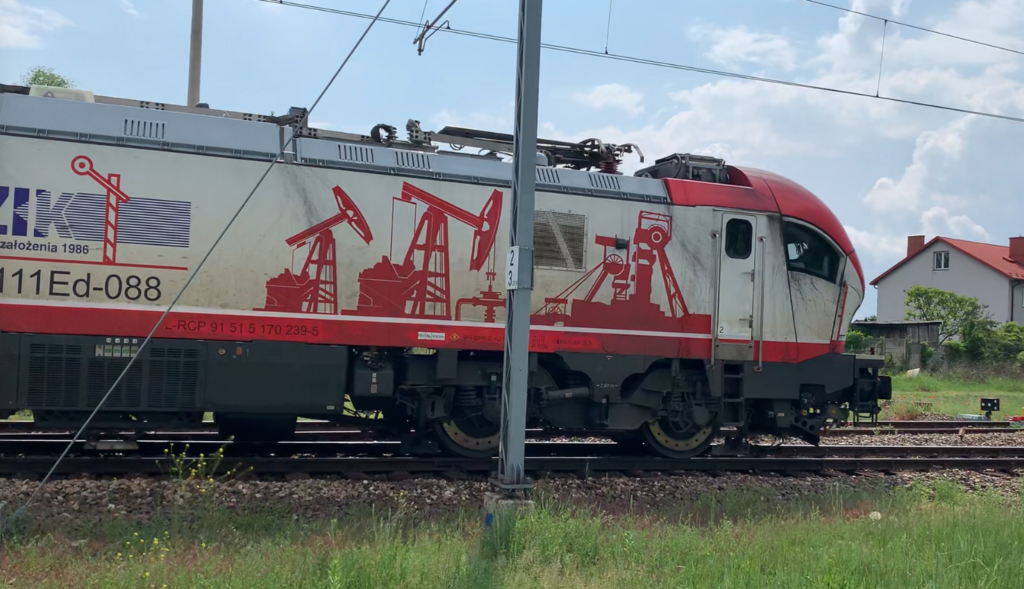
PESA Gama locomotive, type 111Ed-088.
EVN number: 91 51 5 170 239-5 (PL-RCP). Serial number: L390BNA088. Year of manufacture: 2024. The locomotive was delivered to the user in June 2024. Operators: 2024 – Rail Capital Partners Sp. z o.o., Rail STM sp. z o.o., and Zakład Inżynierii Kolejowej w Sandomierzu; 2025 – Rail Capital Partners Sp. z o.o. and Zakład Inżynierii Kolejowej w Sandomierzu. The locomotive has been wrapped in the company’s livery: white and red.
Written by Karol Placha Hetman