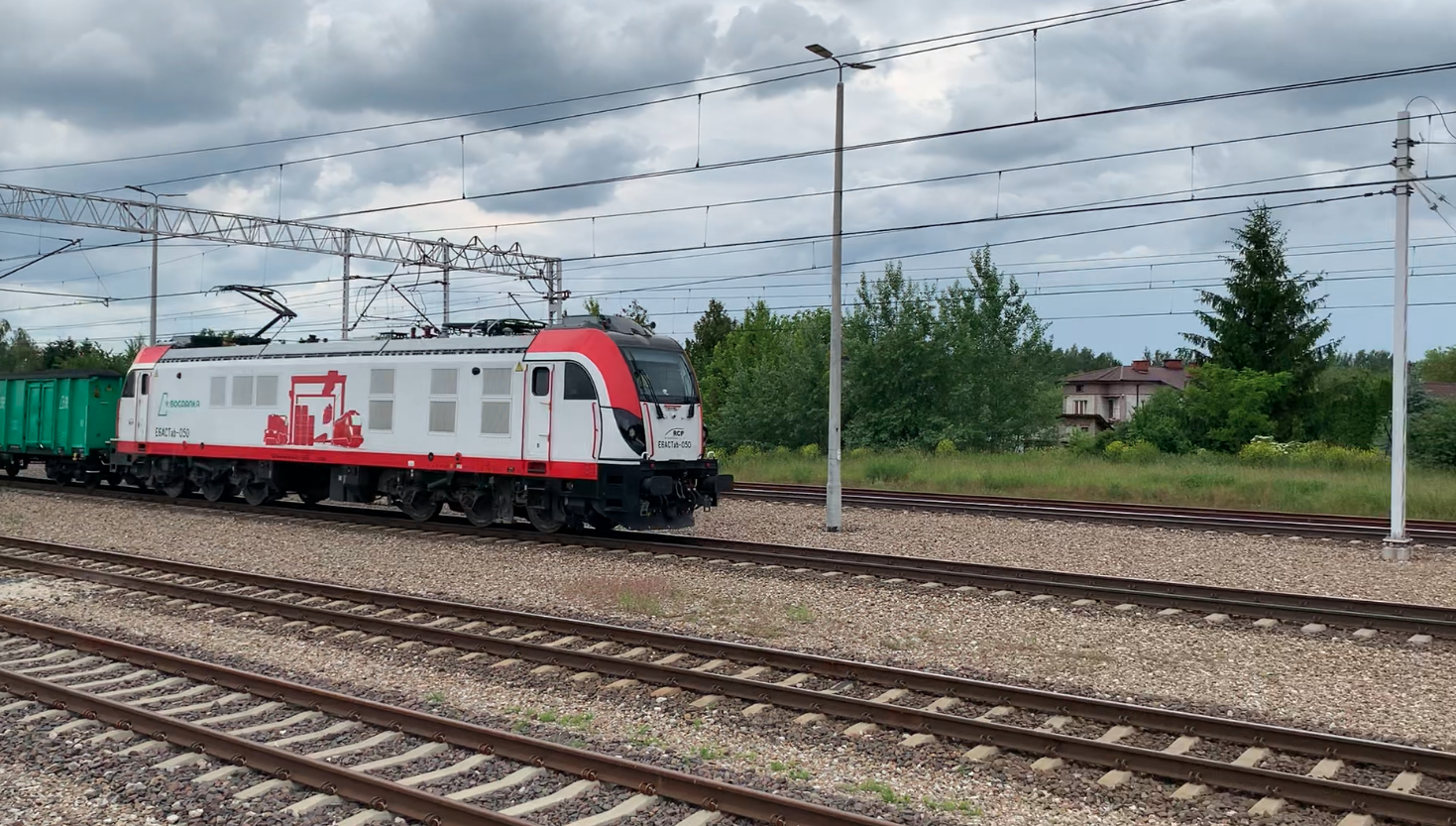
Puławy 2025-08-24
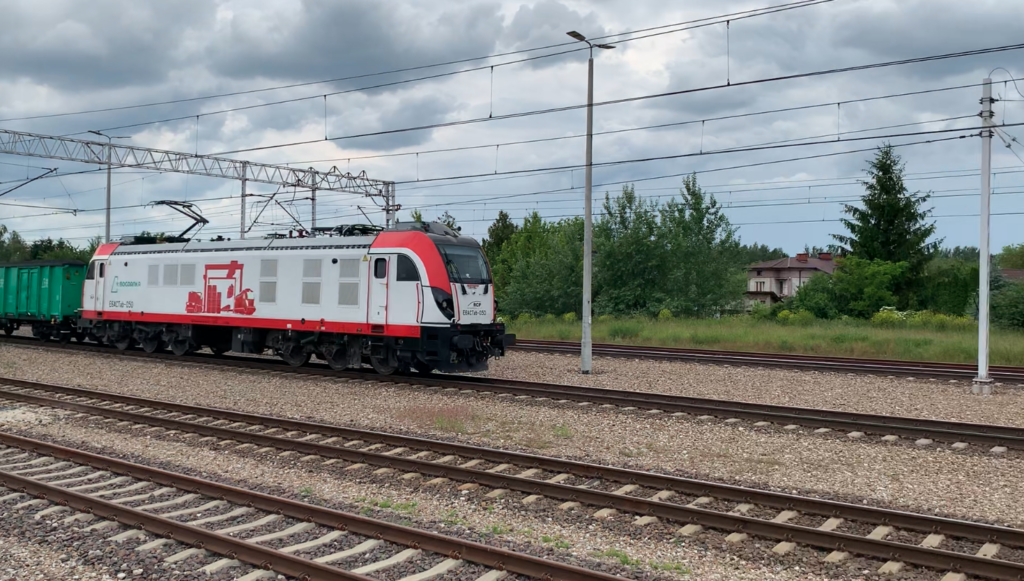
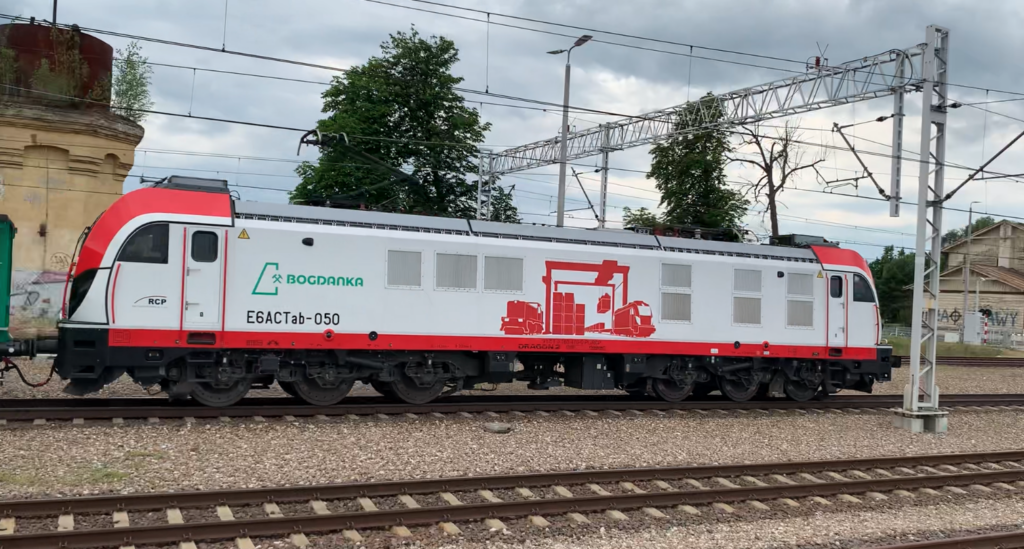
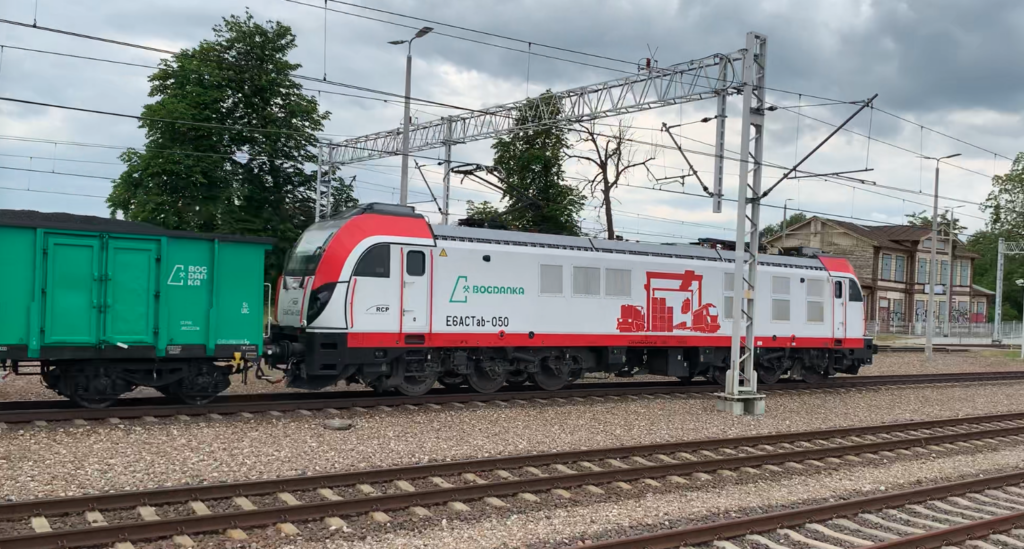
Dragon E6ACTab-050 Electric Locomotive.
Newag Dragon is a family of six-axle electric locomotives designed to pull heavy freight trains weighing up to 4,500 tons. Dragon, or “Smok,” is the popular trade name for this locomotive. Dragon represents a new quality among freight locomotives, particularly adapted to Polish conditions. The E6ACT Dragon locomotive is also designated ET25 by PKP and ET43 by PKP Cargo, and is the first new Polish freight locomotive after the ET22, whose production ended in 1989. The Dragon is characterized by high tractive effort (up to 374 kN), safe operation, attractive pricing, economical operation, extensive equipment, and reliability.
The first Dragon locomotive was built in 2009 at ZNLE Gliwice. The Electric Locomotive Repair Plant operated in collaboration with NEWAG, based in Nowy Sącz. From 2009 to 2016, the Newag Dragon locomotive was manufactured by NEWAG Gliwice, and since 2017, it has been manufactured by Newag Nowy Sącz. By 2021, a total of over 50 locomotives in various versions had been produced and are in service with Polish freight carriers. By March 2025, 94 Newag Dragon locomotives had been built.
Development of the Dragon design
The basic locomotive in Poland was the ET22, of which 1,207 were built by 1989 at the PaFaWag factory in Wrocław. Then, until 1997, EP09 passenger electric locomotives were built there. Polish-Italian universal dual-mode EU43 and single-mode EU11 electric locomotives were also produced. Production continued until 2002, when the PaFaWag plant was closed and the Adtranz company took over. However, these electric locomotives never saw service in Poland because they were too expensive. In 2002, the Adtranz-PaFaWag factory was taken over by Bombardier, which decided against producing complete electric locomotives at the Wrocław plant. As a result, since 2002, there has been no electric locomotive manufacturer in Poland.
This situation was unacceptable to Poland. In 2006, the Ministry of Science and several research and development institutions decided to develop a new Polish electric locomotive for heavy freight trains. At the same time, it was intended to be capable of operating on more worn tracks, so the locomotive was designed with a Co-Co-axle configuration. New traction motors were also designed. The first locomotive is powered by six STX500-4A electric motors (manufactured by EMIT) with a power output of 834 kW each. Subsequent units use ABB AMXL450 motors with a power output of 837 kW.
In 2009, the E6ACT-001 Dragon prototype was presented at the Trako railway fair in Gdańsk. It was the first Polish locomotive since 1990, when the EM10 (HCP 405E) locomotive premiered. In 2010, tests of the Dragon locomotive began on a test track near Żmigród in Lower Silesia. In 2010, the locomotive was presented at the InnoTrans trade fair in Berlin. The locomotive received approval for rail traffic in Poland. By 2011, transport companies such as STK, PKP Cargo, Pol-Miedź Trans, Lotos Kolej, and Freightliner were already interested in the locomotive.
The success of the Dragon locomotive, coupled with changes in regulations, led to the development of the Dragon 2 version in 2018. The first locomotive of this version was designated E6ACTa-001. The locomotive successfully passed tests and received a certificate. Dragon 2 is the first Polish locomotive equipped with SiC (silicon carbide) power electronics, meaning it is equipped with an auxiliary power converter called PSM-175 SiC, developed and manufactured by Medcom. The reason for designing the new Dragon 2 version was the change in TSI regulations.
The Dragon locomotive’s modular design allows for a build that best meets the user’s needs and reduces repair and maintenance time. The locomotive’s standard tractive effort is 374 kN, but modern technologies can increase this to 450 kN (MAX LOAD option).
The locomotive can be built for a customer using electric traction powered by 25 kV/15 kV AC. The locomotive can be retrofitted with an additional diesel drive (DUAL POWER option), which allows the locomotive to be operated on non-electrified sidings. The locomotive’s design focuses on driver safety and comfort. The driver’s cabs feature a crumple zone and a closed cage design. The cage-type driver’s cab is equipped with a touchscreen panel. Instead of rearview mirrors, four cameras are used, and their images are displayed on a monitor. Two additional cameras provide a view of the locomotive’s couplers. The locomotive offers the option of installing a closed toilet. The locomotive incorporates an extensive electronic diagnostic system. The engine compartment is modular, simplifying repairs and reducing maintenance time. In its basic version, the locomotive weighs 119,000 kg. The locomotive features a modern anti-slip system. Thanks to its six axles, the axle load does not exceed 20,000 kg. The locomotive has a wheel flange lubrication system, which increases the service life of the wheelsets and rails, especially in tight curves, and performs very well in Polish conditions.
The Dragon electric locomotive is powered by asynchronous motors powered by IGBT converters. The wheel diameter is 1.25 m. Initially, STX500-4A motors with a power output of 834 kW each were used, followed by ABB AMXL450 motors. Disc brakes are installed. Each axle is mounted in tapered roller bearings. Each axle is equipped with a temperature and speed sensor.
Currently (2021), Dragon locomotives are offered in the following versions:
Dragon DC: DC supply voltage 3 kV. Continuous power 5 MW. Maximum speed 120 – 140 km/h. With a train weighing 3,200 tons, the speed is 115 km/h. Starting tractive effort is 374 kN, 450 kN with the MaxLoad option. Locomotive length over buffers is 20.33 m, width is 3.00 m, and height is 4.32 m.
Dragon AC: Supply voltage: AC 15 kV 16 2/3 Hz, AC 25 kV 50 Hz. Continuous power: 5 MW. Maximum speed: 120 km/h. Starting tractive effort is 374 kN, 450 kN with the MaxLoad option. Locomotive length over buffers is 20.33 m, width is 3.00 m, and height is 4.32 m.
Dragon MS: DC 3 kV, AC 15 kV 16 2/3 Hz, AC 25 kV 50 Hz. Continuous power 5 MW. Maximum speed 120 km/h. Starting tractive effort 374 kN, 450 kN with the MaxLoad option. Locomotive length over buffers 20.33 m, width 3.00 m, and height 4.32 m.
Dragon DIESEL: Diesel engine. Continuous power 2.3 MW. Maximum speed 120 km/h. Starting tractive effort 370 kN. Locomotive length over buffers 20.33 m, width 3.00 m, and height 4.32 m.
Two generations of Newag Dragon locomotives have been produced. The first generation was the Dragon A6ACT. The second generation was the Dragon 2, which includes several versions. Single-system 3 kV DC. Multi-system 3 kV DC, 15 kV AC, 25 kV AC. Versions with a diesel Last Mile approach module.
Dragon locomotives are operated by, among others, PKP Cargo, Cargounit, Rail Capital Partners, Freightliner PL, LOTOS Kolej (now ORLEN Kolej), CEMET, Industrial Division, and other freight carriers.
Dragon E6ACTab-050 Electric Locomotive:
The type designation E6ACTab / E6ACTAd denotes: E – electric locomotive, 6 – six-axle, AC – with alternating current motors, T – for freight use, a – second generation, TSI-compliant, d – with a diesel approach module, b – ETCS system based on baseline 3.4.0.
The Dragon E6ACTab-050 locomotive was built in 2024. EVN number: 91 51 3 160 476-0 (PL-RCP). Accepted on 23 March 2024, by Rail Capital Partners Sp. z o.o. Then it was leased by Jaxan sp. z o.o., which belongs to Rail Capital Partners Sp. z o.o. On 3 April 2026, it is leased by Lubelski Węgiel “Bogdanka” S.A.
Co’Co’ axle arrangement (six traction axles in two bogies). Supply voltage 3 kV DC. Continuous electric power approx. 5 MW (approx. 5,004 kW). Maximum speed 120 km/h (operationally limited to 140 km/h). Locomotive weight 120,000 kg. Wheel diameter 1.250 m. Length 20.25 m. Tractive effort 375-450 kN. ABB AMXL450 traction motors, with a power of 6 x 837 kW.
Written by Karol Placha Hetman