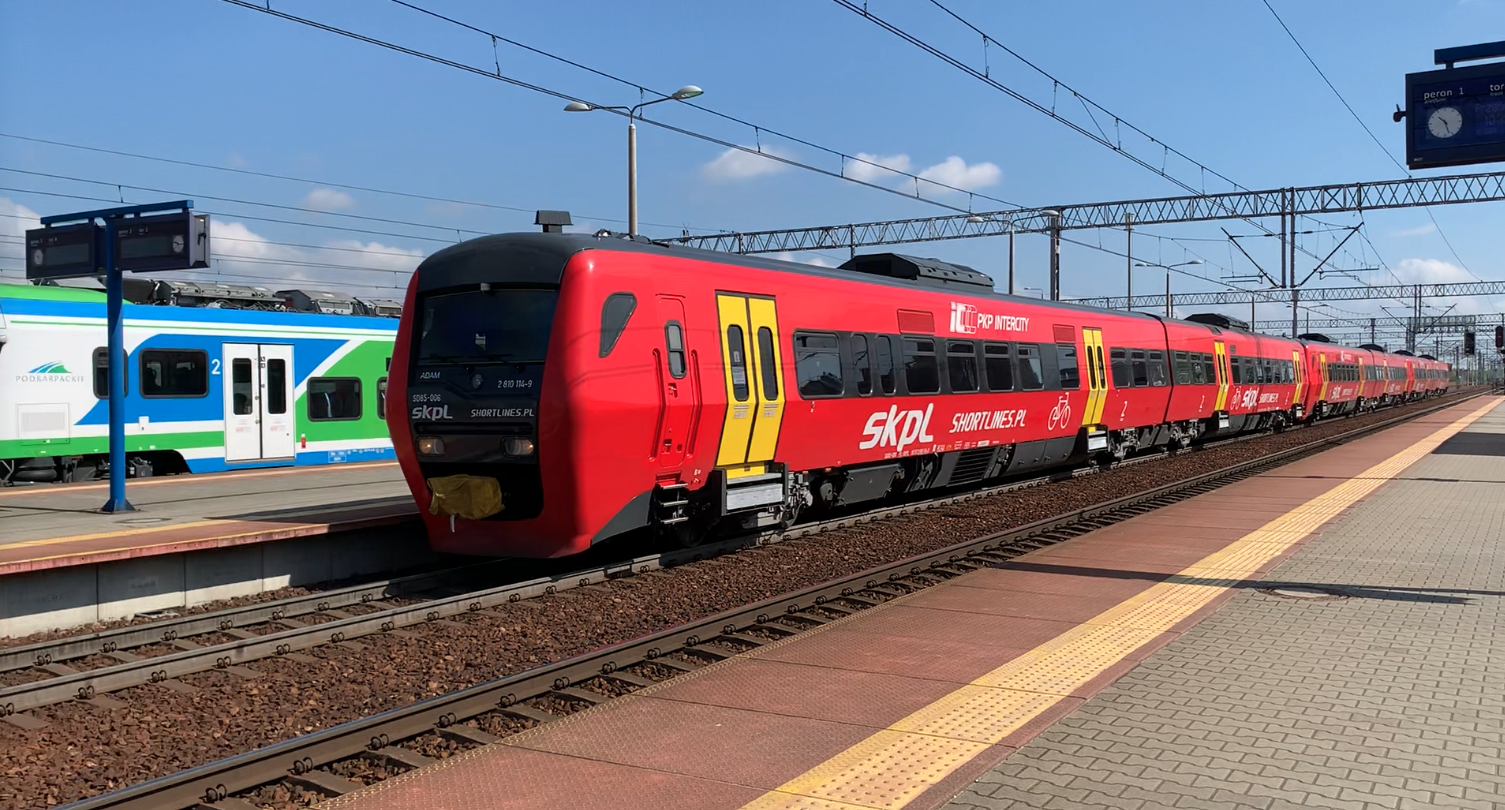
Dębica 2026-05-09
SD85 Diesel Multiple Unit, formerly DM90.
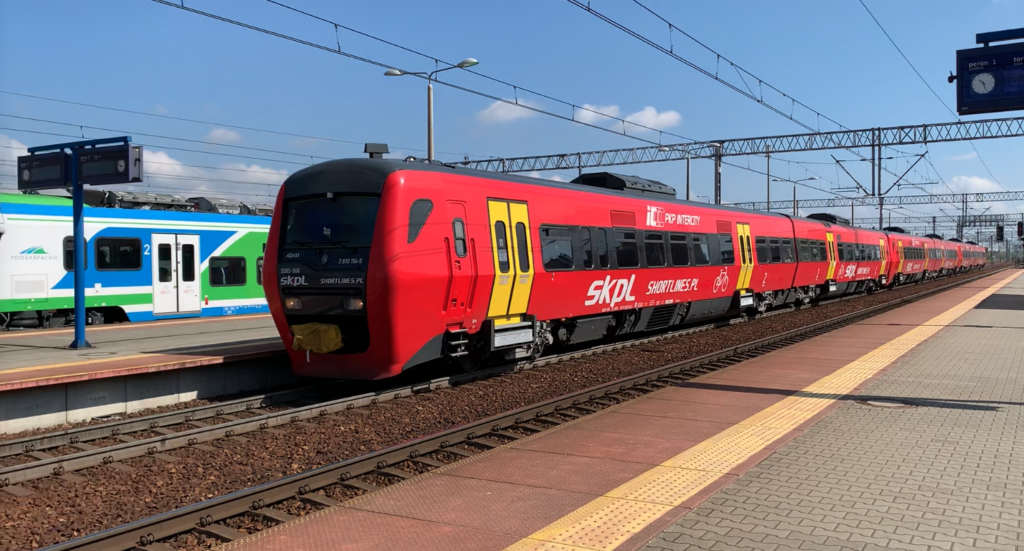
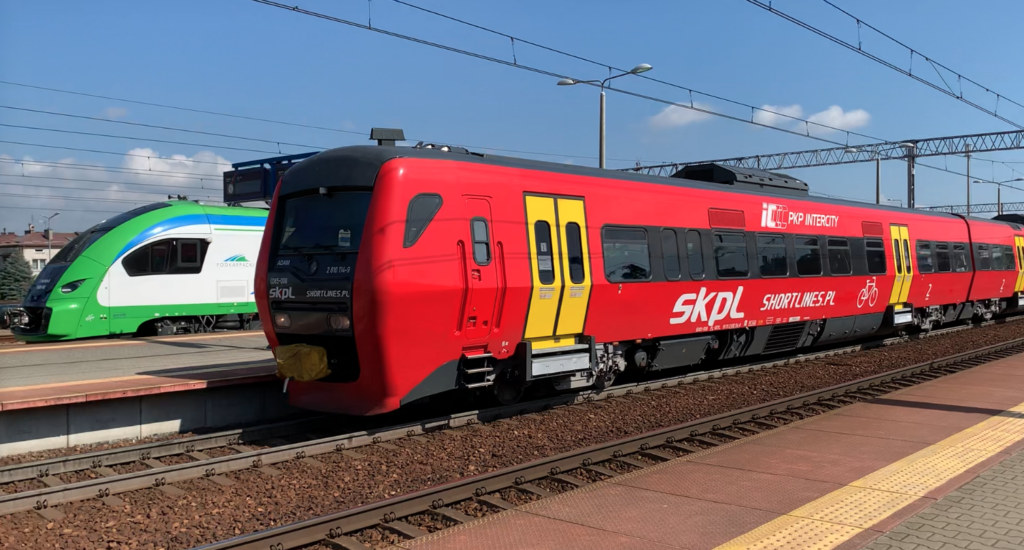
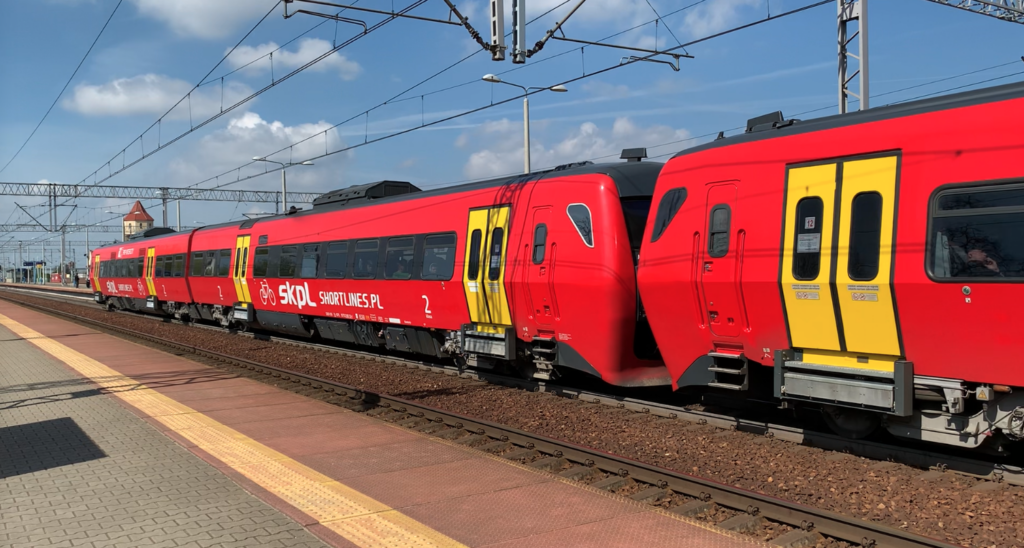
In November 2020, the Polish railway operator SKPL confirmed that it would purchase 32 DM90 DMUs from the Dutch operator. Negotiations had been ongoing since December 2019. Until now, SKPL had primarily operated SN84 DMUs.
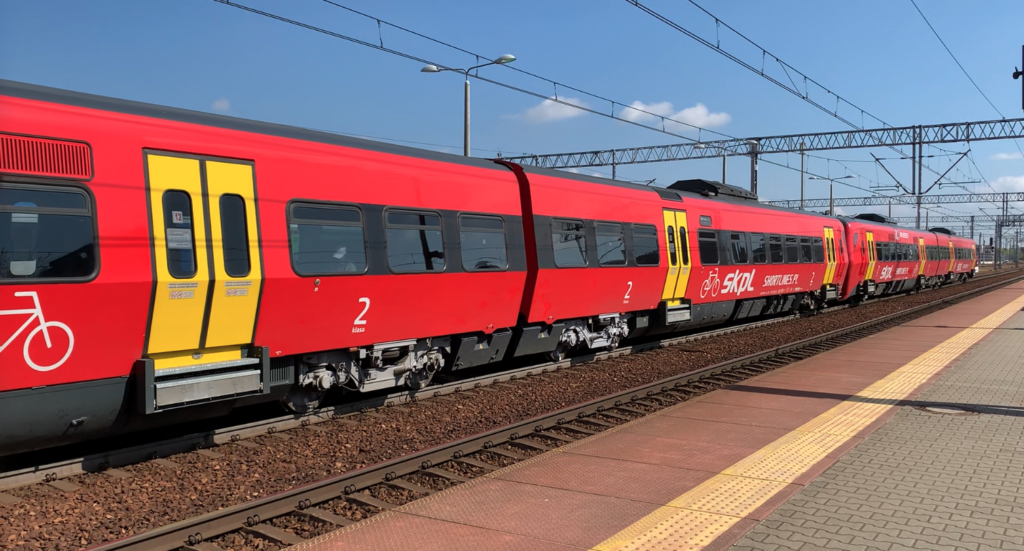
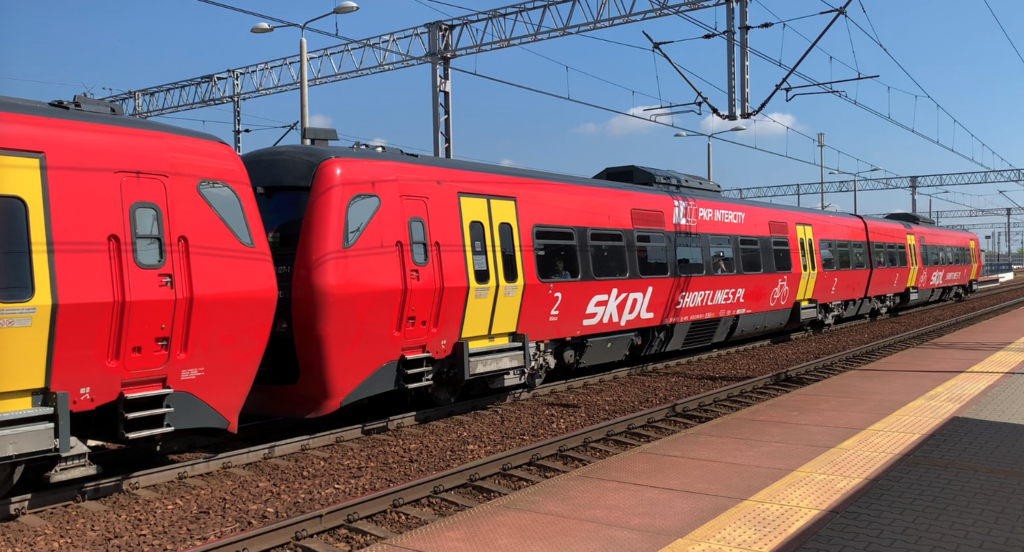
In Poland, DM90 trains were designated SD85 and approved for operation on Polish tracks. SKPL Polonized the trains. One of the most important elements was the addition of additional boarding steps. This was necessary because SD85 trains in Poland primarily operate on routes with low platforms. Originally, all DM90 DMU trains were painted yellow. In Poland, they were repainted in the SKPL carrier’s colors, red, and the doors were painted yellow. SKPL already has experience in Polonizing trains from the Netherlands, such as the DH1 and DH2.
Concerns have arisen regarding the gauge of the DM90 trains, which is reportedly 3.20 m at their widest point. According to assurances from the SKPL carrier and the Rail Vehicles Institute, the trains fit within platforms and on tracks. The actual width of the train bodies is 2.883 m. This incident likely stemmed from a failed sale of DM90 DMUs to Romania. In 2017, Nederlandse Spoorwegen sold 48 DM90s to the Romanian carrier Ferotrans. However, Romania defaulted on the agreement and, by April 2018, had not paid or collected the trains. The case went to court. The Romanians claimed that NS had failed to provide the appropriate documentation and that the trains were too wide for Romanian tracks. Consequently, the court annulled the transaction, and the trains were put up for sale again.
The trains were transported from the Netherlands to Poland in sets of four DM90 (SD85) trains. The trains are approximately 25 years old, having been built for the Dutch Railways (NS). They operated in the Netherlands until 2018. The Dutch operator retired the DM90 trains because most railway lines in the Netherlands were already electrified. The second reason was the limited capacity of the trains in the Netherlands. A partial solution was the conversion of two NS trains, 3446 and 3447, into three-carriage trains. However, at that time, train traffic dynamics were declining. The DM90 DMUs were manufactured in the late 1990s.
The contract price is a trade secret. It is known that the SKPL carrier partially took out a bank loan. Furthermore, purchasing new DMUs from NEWAG or PESA would have been significantly more expensive. It’s also important to remember that new trains are not currently in production, and the DM90 trains were available immediately. The trains were transported to Poland, to Zagórze and Koźmin Wielkopolski. The purchased vehicles are NS; 3402, 3404, 3406, 3407, 3411, 3413, 3415, 3421, 3425, 3427, 3428, 3429, 3430, 3431, 3432, 3433, 3434, 3435, 3436, 3437, 3438, 3439, 3440, 3443, 3444, 3445, 3446, 3447, 3448, 3449, 3450, and 3453.
In 2023, it was not known which routes the SD85 trains would operate on. Everything will depend on market needs. It’s not hard to guess that these will primarily be non-electrified routes with low passenger flows, targeting areas where the former government (communists, Volksdeutsche, and Masons) closed rail connections, stations, and passenger stops until 2015. SKPL also announced that the trains might appear on tracks in other Central European countries. This meant that the company wanted to benefit from “open access to rail infrastructure” in other countries.
On December 30, 2022, testing began on the first SD85-001 DMU (former NS 3429). The train traveled from Zagórz via Sanok to Jasło. SKPL intended to use the SD85 trains on the following routes: Kraków – Zagórz – Łupków, Kraków – Nysa – Jelenia Góra – Kłodzko Miasto, Kraków – Nysa – Jelenia Góra – Kudowa-Zdrój. The SD85 is a diesel multiple unit consisting of two carriages. The vehicles are equipped with air conditioning. All seats in the trains have been replaced with new, single-seat ones. The trains began regular service in June 2023. One of the first routes was the Zagórz – Kraków – Kłodzko Miasto route. This route was already operated by SKPL, commissioned by PKP InterCity. In October 2022, PKP InterCity announced a tender for diesel train operation on selected railway routes. The offer was for four years, with the possibility of a one-year extension. PKP InterCity’s offer required air conditioning in the trains. During negotiations, two- to four-car trains were mentioned.
In April 2023, news of a new connection between Poland and Ukraine emerged. The railway route runs: Warsaw – Dęblin – Lublin – Zwierzyniec – Lubycza Królewska – Rawa Ruska. The first run, provided by SKPL, has already been completed. It appears that after 20 years, the Hrebenne – Rawa Ruska border crossing will be reopened. It’s worth noting that PLK never closed this crossing; carriers were simply not interested. The Ukrainian side renovated the 1435 mm track, which allows trains from Poland to reach Rawa Ruska station. Here, passengers will transfer to Ukrainian trains (broad gauge) and travel to Lviv. Regular Warsaw – Rawa Ruska trains will likely begin operating in June 2023.
Operation in the Netherlands. Carrier: Nederlandse Spoorwegen. The trains have been designated NS3400. There were 53 trains. They were ordered in 1993 and operated from 1996 to 2017. The Polish company SKPL purchased 46 used trains. On November 28, 2020, the first four trains departed the Amsterdam Houtrakpolder staging area for Poland. From that day on, subsequent trains were sent at several-day intervals. On July 23, 2021, the overhaul of train No. 3429 was completed and it was given the Polish designation SD85-001. A test run was performed on LK No. 108.
Unexpectedly, due to the war between Moscow and Ukraine, the train was diverted to the Uherce-Sanok route for the evacuation of refugees. At the end of February 2024, the carrier received the operating permit for the first SD85-001 train. In September 2024, the first two SD85 trains, numbers 003 and 004, entered service for PKP InterCity. SD85 trains began operating on the Kraków-Zagórz and Kraków-Jelenia Góra (Podsudecka Line) routes. The trains run primarily on untracked routes in the Lower Silesian, Opole, and Subcarpathian Voivodeships.
In the following months, SD85 trains began operating on the TLK “Wetlina” and TLK “Bieszczady” trains. The longest routes served by SD85 trains were Kraków-Nysa-Jelenia Góra-Kłodzko Miasto, and occasionally Kudowa-Zdrój. There was also a Warsaw-Lublin-Rawa Ruska route. There was also a Hrebenne-Rawa Ruska route. The newest route is the Poznań Główny-Gorzów Wielkopolski connection. The newest route is the Kraków-Hrubieszów route.
Sample SD85 train routes. 2026.
InterCity 32110 “Kasztelan” Kraków Główny – Hrubieszów Miasto, departs Kraków at 7:56 AM. The route takes 5 hours 52 minutes. Kraków – Tarnów – Dębica – Rzeszów Główny – Leżajsk – Nowa Szarzyna – Rudnik nad Sanem – Nisko – Stalowa Wola Centrum – Stalowa Wola Rozwadów – Biłgoraj – Tereszpol Biłgorajski – Zwierzyniec – Szczebrzeszyn – Zawada – Zamość – Zamość Old Town – Zamość East – Werbkowice – Hrubieszów Miasto (1:48 PM). The train operates in a three-car SD85 configuration.
InterCity 30112 “Bieszczady” Kraków Główny – Zagórz. The train departs Kraków Główny station for Zagórz at 9:27 AM. The route takes: 4 hours 14 minutes. Tarnów – Tuchów – Bogoniowice Ciężkowice – Gorlice – Biecz – Jasło – Jedlicze – Krosno – Zarszyn – Sanok – Zagórz (1:41 p.m.). The train operates in two SD85 trains.
InterCity 32112 “Hetman” Kraków Główny – Hrubieszów Miasto. The train departs Kraków Główny station for Hrubieszów Miasto at 4:23 p.m. The route takes: 5 hours 58 minutes. Kraków – Tarnów – Dębica – Rzeszów Główny – Leżajsk – Nowa Szarzyna – Rudnik nad Sanem – Nisko – Stalowa Wola Centrum – Stalowa Wola Rozwadów – Biłgoraj – Tereszpol Biłgorajski – Zwierzyniec – Szczebrzeszyn – Zawada – Zamość – Zamość Old Town – Zamość East – Werbkowice – Hrubieszów Miasto (10:21 p.m.). The train operates in a three-car SD85 configuration.
InterCity 30110 “Wetlina” Kraków Główny – Zagórz. The train departs Kraków Główny station for Zagórz at 6:19 p.m. The journey takes 4 hours 39 minutes. Tarnów – Tuchów – Bogoniowice Ciężkowice – Gorlice – Biecz – Jasło – Jedlicze – Krosno – Zarszyn – Sanok – Zagórz (10:58 p.m.). The train operates in two SD85 trains.
InterCity 78105 Poznań Główny – Gorzów Wielkopolski. The train departs at 5:55 a.m. The route runs via Krzyż Wielkopolski. Arrival is 7:27 a.m. The train operates in a single SD85 train.
InterCity 78115 Poznań Główny – Gorzów Wielkopolski. The train departs at 8:43 AM. The route runs through Krzyż Wielkopolski. The train operates in a single SD85 train.
InterCity 78107 Poznań Główny – Gorzów Wielkopolski. The train departs at 12:29 PM. The route runs through Krzyż Wielkopolski. The train operates in a single SD85 train.
InterCity 78117 Poznań Główny – Gorzów Wielkopolski. The train departs at 3:39 PM. The route runs through Krzyż Wielkopolski. The train operates in a single SD85 train.
InterCity 78109 Poznań Główny – Gorzów Wielkopolski. The train departs at 5:59 PM. The route runs through Krzyż Wielkopolski. The train operates in a single SD85 train.
InterCity 87116 is a daily service on the Gorzów Wielkopolski – Poznań Główny – Jarocin route. Departing at 6:24 PM from Gorzów, the journey to Poznań typically takes approximately 1 hour 33 minutes, and the entire route to Jarocin takes approximately 2 hours 24 minutes. The train operates in a single SD85 train.
InterCity 87104 is a daily service on the Gorzów Wielkopolski – Poznań Główny – Jarocin route. Departing at 9:31 PM from Gorzów, the journey to Poznań typically takes approximately 1 hour 33 minutes, and the entire route to Jarocin takes approximately 2 hours 24 minutes. The train operates in a single SD85 train.
SD85 trains can be found on the Kraków – Jelenia Góra route, on InterCity TLK 63102/3 “Sudety” and InterCity TLK 63106/7 “Strzelinie” trains. Although SN84 trains run here more frequently.
SD85 (formerly DM90).
The SD85 is a diesel multiple unit consisting of two cars. The vehicles were manufactured by the German factory, Waggonfabrik Talbot, from 1996 to 1998. The vehicles were designated DM90, and in the Netherlands NS-3400. A total of 53 units were built. The DM90s were used on local routes in the Netherlands: Leeuwarden – Wolvega and Groningen – Zwolle. The axle configuration is 2’B’ + 2’B’. Service weight: 74,620 kg. Overall length: 44,800 kg. Width: 2.883 m. Height: 3.89 m. Wheel diameter: 0.76 m. Each car is powered by a single 12-cylinder KHD F12L413F diesel engine. The engine is located under the car floor. Its power output is 478 kW. The engine drives the wheels via a Voith T320 hydraulic transmission. The engine exhaust system extends above the car roof. The train’s acceleration is 0.76 m/s². The operating speed is 140 km/h. The train is equipped with pneumatic and magnetic brakes.
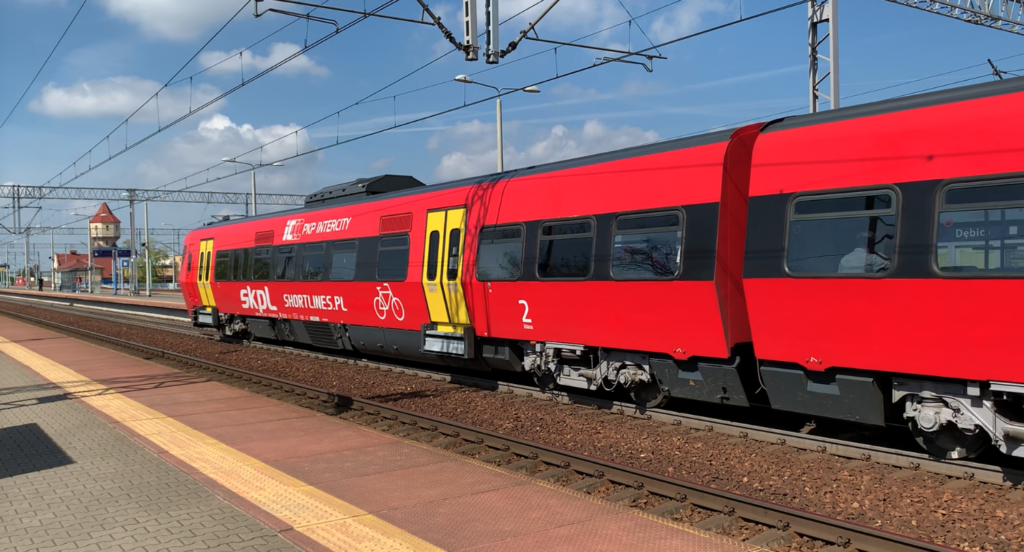
The car bodies are placed on two bogies: one driving and one rolling. The bogies have double suspension, one of which is pneumatic. The vehicles are equipped with air conditioning. All seats have been replaced. The train has 131 seats. The train can accommodate a total of 273 passengers, with a occupancy of 5 persons/m². The passenger doors are double, with a sliding door system. They are equipped with additional folding steps. Each car has two entrance doors. The entrance doors to the driver’s cab are on both sides and open inwards. Ten windows are located in the sides of the cars on each side. There are additional small windows in the driver’s cabs. There are no rear-view mirrors or external cameras. The trains are equipped with Scharfenberg couplers at the front, enabling multiple trains. The windshield is a single piece, with two windshield wipers. The front of the train features six lights: two red (at the rear of the train) and three white. The trains are equipped with air conditioning, audio information, lighting, and new individual seats. The main air conditioning unit is centrally located on the roof. Most of the train’s equipment is located under the car frame: the engine, transmission, electrical system, fuel tanks, and cooling system. Closed-circuit toilets have been installed. The cars can accommodate bicycles. There are two classes: Class 1 and Class 2. The signs SKPL SHORTLINES.PL and PKP INTERCITY are displayed on the sides. Admittedly, the train standing at the platform reeks of grease and exhaust fumes. But what can you expect from trains that are over 30 years old?
It seems that some of the SD85 vehicles have been given their own names, as SKPL Cargo has a habit of doing so with its rolling stock. For example, SD 85-006 has the proper name Adam. However, there is currently no publicly available complete list of names specifically given to all SD85 trains.
Written by Karol Placha Hetman