Łódź 2026-02-18
The Łódź Cross-City Tunnel.
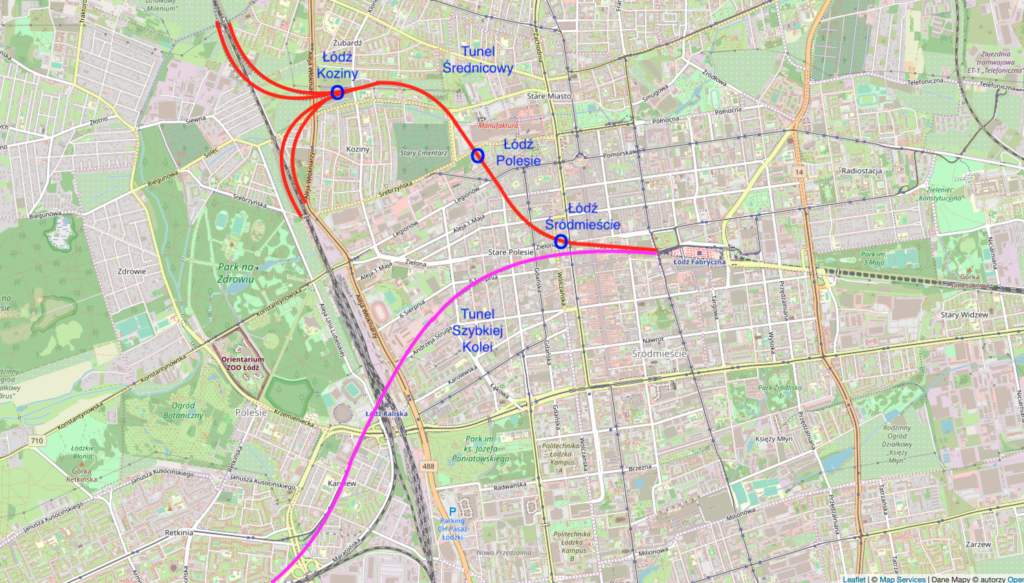
Construction of the Łódź Cross-City Tunnel has been underway since 2019. The tunnel, or rather a set of tunnels, will connect the Łódź Fabryczna terminus station, located on Line No. 17, with the Łódź Kaliska and Łódź Żabiniec stations, located on Line No. 15. The new investment is intended to facilitate passenger access to the center of Łódź. As part of the investment, three additional railway stops are being built, which will enable the future expansion of the Łódź Agglomeration Railway’s transport offerings. This is why residents refer to the tunnel as the Łódź Metro. This project is the largest railway investment in the history of Łódź, but it is not without its dangers.
The investment is a response to the railway problems in Łódź, which has been grappling with the lack of a westward exit from the Fabryczny Railway Station since the 19th century. It’s worth remembering that in the mid-19th century, most stations were terminus stations. In Warsaw, this problem was solved by the construction of a cross-city line. In Łódź, the problem remained unresolved for decades. In the past, both elevated and underground railway routes were analyzed. Implementation never materialized. The city’s chaotic growth, lacking a long-term development plan, hindered this. In 2002, the Institute for Railway Development and Promotion presented the concept of the “Łódź Metro.” It was more of a concept than a direction.
In 2011, Professor Jacek Wesołowski published a concise article on railway development in Łódź. The author pointed out numerous missed opportunities for a cross-city tunnel, and the project’s demise into a caricature. This was due to the hostile attitude of the Polish State Railways (PKP), the neglect of the city authorities, and the ignorance of the marshal’s authorities, who promoted the creation of a metropolitan railway. The author pointed out that certain projects, particularly the construction of a single tunnel for high-speed rail, would not meet the intended objectives, would not solve transport problems, and would create a bottleneck. If all, or at least most, trains were to reach Łódź Fabryczna Station, the cross-city tunnel would have to be four-track. Ultimately, there were to be two pairs of tracks: one for high-speed trains, the other for regional and metropolitan trains. Furthermore, the high-speed rail tracks should be routed from Łódź Fabryczna Station east to Łódź Widzew. Proper planning in Łódź is undoubtedly a weakness, especially in the long term. Careful planning is essential, as this will be a railway system for at least 100 years. It’s worth noting that analyses at the time indicated only 15-25 pairs of trains on the cross-town line, which, after 2020, proved to be an underestimate.
On September 26, 2009, an agreement was signed between the City of Łódź, PKP PLK, EC1 Łódź City of Culture, and the Łódź Voivodeship Government regarding the financing and implementation of a feasibility study for the cross-town tunnel. On December 23, 2009, a tender for the tunnel’s feasibility study was announced. On March 11, 2010, a contract was signed with Sener for this project. However, progress on the project was very slow. It wasn’t until 2016 that a tender for the tunnel’s design and construction was planned. On November 28, 2016, PKP PLK announced a design-and-build tender for the construction of a cross-town tunnel. The project cost was estimated at PLN 2.17 billion. The deadline for submitting bids was January 11, 2017. The winning bid was awarded to a consortium of Energopol Szczecin and Przedsiębiorstwo Budowy Dróg i Mostów from Mińsk Mazowiecki. The contract was signed on December 28, 2017.
It was only during the United Right government that a tunnel construction plan was developed and its implementation began. The tunnel will serve both regional and long-distance rail. The starting point was Łódź Fabryczna station. A tunnel had already been built to Łódź Fabryczna station. The new tunnel was to run northwest. The tunnel was intended to accommodate two trains. After Polesie station, the line was to branch into two tunnels, and then each into two, each with a single track. Two tunnels led to Łódź Żabiniec station in the north, and two tunnels to Łódź Kaliska station in the south. Some tunnels were cut-and-cover, followed by the construction of the ceilings. The decision was made to construct the main tunnels by tunnel boring using a TBM. The larger Katarzyna tunnel and the smaller Faustyna tunnel were planned. In August 2019, work began on the first launch chamber in the area of Odolanowska and Stolarska streets.
The Łódź Śródmieście passenger stop was to be constructed in conjunction with the new tunnel. Its location is near the intersections of Zielona, Wólczańska, and Kościuszki Avenues. Three underground levels are planned, connected by escalators, fixed stairs, and elevators. Level -3 will house two single-edge platforms, each 155 meters long. The remaining levels will be used for public transportation. Level -1 will also house space for services and retail outlets.
The second passenger stop and branch station, Łódź Polesie, is located near Ogrodowa, Drewnowska, and Karskiego Streets. Three underground levels are also planned here, connected by escalators, fixed stairs, and elevators.
The third passenger stop, Łódź Koziny, is located on the border of the Żubardź and Koziny housing estates, near Drewnowska and Kasprzaka Streets and Włókniarzy Avenue. The stop will consist of three levels, two of which (-2 and -3) will house two single-edge platforms, each 155 meters long. This stop is planned as the last one.
In the fall of 2017, contracts for the development of design documentation and construction work were signed. The investment was initially valued at PLN 1.59 billion. Construction was planned to begin in June 2019, with completion in 2022. Work began in August 2019. The project’s completion date was later extended to December 31, 2024. This was due to the Chinese coronavirus pandemic and the associated restrictions. Furthermore, the environment in which the tunnels are being drilled turned out to be more challenging than initially estimated. Therefore, cost increases were anticipated. The work required better coordination. The city authorities displayed ignorance and repeatedly claimed that this was a PiS investment.
But further problems arose. In July 2019, Energopol Szczecin, the tunnel’s main contractor, filed for bankruptcy, which significantly hampered the project’s implementation. The new main contractor was Przedsiębiorstwo Budowy Dróg i Mostów Sp. z o.o. from Mińsk Mazowiecki, which received approval for the construction of the launch chamber. Initially, this company supported the main contractor.
On September 7, 2024, the Katarzyna TBM tunnel boring machine, which was boring a tunnel under the city, was halted due to the collapse of a tenement house at 23 Aleja 1 Maja Street. Due to the prolonged problem, the tunnel boring machine became stuck in the mud. This created another problem, which was assigned to specialists from Polish universities and foreign experts. The launch date for the tunnel boring machine is currently unknown (2026). The report stated that the collapse was caused by tunnel boring work. It did not state that the stone was not properly constructed. The walls and ceiling collapsed, but no information was provided about the foundations, as they were missing.
It is worth mentioning that a second high-speed rail tunnel, known as the “Y,” was to be built on railway line No. 85, from Poznań and Wrocław to Warsaw by 2027. In 2023, work on this project was already advanced. The launch chambers were completed.
In 2016, the modernized section connecting Łódź Widzew with Łódź Fabryczna was opened. The launch of the Łódź Agglomeration Railway is beginning to improve passenger transport and, consequently, reduce the number of cars on city streets. This, in turn, translates into improved safety for car and tram traffic in the city.
The tunnel is to be approximately 7,500 m long. A double-track tunnel with a length of approximately 3,000 m from Łódź Fabryczna station, through the Łódź Śródmieście and Łódź Polesie stops to the area of Odolanowska Street. Four single-track tunnels, with a total length of approximately 4,500 m, from the turnout chamber at Włókniarzy Street to railway line No. 15 towards Łódź Żabieniec and Łódź Kaliska. The total track length is approximately 17,000 m. New platforms will be constructed at 155 m long stops. Additional road investments are necessary. Reconstruction of the road system and infrastructure in connection with the construction of the tunnel. There will be a new SRK system; centrally controlled with LCS and a computer control system. Devices for detecting emergency states of rolling stock (DSAT) will be installed on the line. The tunnel will have systems; Wired emergency communications, a public address and train information system for passengers, a signaling and fire extinguishing system. A new power substation for traction power. A new electrical substation for power supply to passenger stops. Passenger tunnels, ramps, bridges, emergency exits, retaining walls, a ventilation system, and water, storm, and sewage systems will be constructed. The Faustyn TBM is excavating four single-track tunnels, with a total length of approximately 4,000 m. The Katarzyna large TBM is excavating double-track tunnels, approximately 3,000 m long. The large TBM has a diameter of 12.7 m, and the small TBM has a diameter of 8.5 m.
Tunnel excavation and support installation are mechanized. This method minimizes interference with underground utilities. The contractor is taking extreme care to avoid collisions with urban infrastructure. The city’s underground utilities are poorly inventoried, and the plans contain numerous errors. There was no complete documentation of the buildings along the tunnel route. As it turned out, some buildings were missing parts of their foundations, resting on neighboring buildings.
The passenger stops, starting chambers, and the junction chamber were constructed using the diaphragm wall method. This technology involves constructing diaphragm walls for underground structures, then constructing the upper ceiling or struts, and then, successively, constructing the lower-lying elements of the structure. At their deepest point, the tracks will be at a depth of 26 meters, equivalent to a nine-story residential building. The stops will have three levels. The lowest level will consist of platforms and technical rooms. The second level will be similar. The first level will house commercial premises and shops. Access between the floors will be via stairs (both standard and escalators) and elevators. In 2019, the investment value was estimated at PLN 2,014,947,025.48. The European Union was to provide some minor support through the Cohesion Fund under the Infrastructure and Environment Operational Programme. At that time, the project’s completion date was 2026.
In May 2025, single-track tunnels were excavated for the Łódź Fabryczna – Łódź Kaliska and Łódź Żabieniec connections. Installation and finishing work has begun. The largest of the three passenger stops on this route, Łódź Koziny, will have train traffic on two levels. Platforms have already been installed here. Level -1 will house the hall and communication routes. The Łódź Koziny passenger stop will be 260 m long and approximately 75 m wide. This surface requires appropriate technical solutions. The ceilings of level -3 are supported by 75 pillars, while level -2 has 40 pillars. The depth of the stop is 29 m below ground level, with the tracks at 26 m. 50,000 cubic meters of concrete were used to construct the stop. The tracks will be laid on concrete slabs and a subgrade. The speed in the tunnels is limited to 80 km/h.
On February 4, 2026, PLK SA terminated its contract with the contractor for the construction of the Łódź cross-city tunnel. Officially, this decision was dictated by the safety of residents, concern for properties along the tunnel construction route, and the need to ensure the stable and professional implementation of this key infrastructure project for Łódź and the national railway system. Prior to this date, PLK SA had been conducting a mediation process with the contractor, the aim of which was to resume work and ensure the continuation of the tunnel construction. Apparently, an in-depth analysis of the contract, technical documentation, the Contract Engineer’s findings, and the opinions of independent experts indicated that PBDiM was unable to continue the project as agreed. The main contractor was entirely blamed. Interestingly, the city did not participate in the mediation, although it was responsible for the above-ground portion of the project. It should be noted that, since the end of 2023, the December 13 coalition of Volksdeutsche, Communists, and Freemasons has taken power in Poland. Ministerial positions were entrusted to individuals unprepared for this type of work, even those lacking higher education. Their unwritten ideology is to subject the Republic of Poland to Berlin’s dictatorship. This was a repeat of the 17th century, when we gradually lost sovereignty. The decision to withdraw from the agreement covers three contracts: the construction of the main cross-city tunnel, the construction of the Łódź Koziny stop, and the construction of the Włókniarzy traction substation.
The contractor was blamed for everything that was incorrect; numerous construction errors were noted during the tunneling process. The main technical irregularities included: improper pressure maintenance in the TBM chamber, lack of excavation balance control, inadequate soil conditioning, stopping the shield in unprepared locations, and numerous equipment failures. Warning signs were not properly analyzed by the contractor. This led to a series of geotechnical incidents, culminating in a construction disaster on September 6-7, 2024, when part of the outbuilding at 23 1 Maja Street collapsed. Design errors, insufficient geological surveys, and a lack of adequate structural safeguards were cited. This resulted in the extended relocation of 227 residents from 130 apartments at 19, 21, and 23 Aleja 1 Maja Streets and 44 Próchnika Street. The tunneling process was conducted with extremely low efficiency. The TBM, which, according to the contract, was supposed to complete the excavation of a large tunnel section within 14 months. However, after 4.5 years of work, it had completed only 1,496 meters of tunnel and was operational for only 17.5% of that time. As of November 10, 2024, the tunnel has remained idle.
During the contract implementation, the contractor lost financial liquidity, leading to a mass submission of direct payment applications by subcontractors. It should be noted that the contractor received approximately PLN 119 million under the indexation, representing only 5% of the contract value. PKP PLK paid PLN 450 million to subcontractors. PLK SA has now initiated procedures related to taking over the construction site and preparing the next stages of activities, including securing the investment and selecting a new contractor.
Let’s also remember that the contractor was the one who bent over backward to help residents who were forced to vacate their apartments. The city authorities saw no problem, blaming the contractor for everything. The mayor of Łódź, a member of the Civic Platform party, has been in power in Łódź since 2010. Following the recent elections, the Łódź City Council has a majority of councilors affiliated with the Civic Coalition and the committees and alliances supporting the mayor, meaning that the city is politically under the complete control of communists, freemasons, and Volksdeutsche. There is no evidence of deliberate sabotage of the investment. The Łódź authorities publicly declared their support for the project, but at the same time demanded: increased safety for residents, damage repairs, and a clear timeline. These demands are nothing but a lack of competence and support for the contractor. The current opposition, representatives of the Law and Justice party (PiS), criticize the city authorities for linking all problems to the contractor and accusing the previous central government (United Right) of poorly preparing the investment. The Łódź authorities have always emphasized the need to continue the investment and cooperate with PKP PLK. But independent sources emphasize that this is hypocrisy.
Written by Karol Placha Hetman